Supreme Court decides to hear Trump travel ban arguments

CBS News –

WASHINGTON — The Supreme Court has decided to hear arguments on President Trump’s travel ban affecting six countries, mostly Muslim, that are deemed by the federal government to present a higher risk of terrorism to the U.S. The case will be argued in October.

The high court also lifted most of the injunction blocking President Trump’s travel ban, allowing it to take effect in most instances.

Here are a few of the highlights from the Supreme Court’s decision to take the case:

  • The Supreme Court will hear the case in October;
  • It mostly overturned the two lower court orders preventing the travel ban from going into effect;
  • The Trump administration will in most cases be able to enforce its 90-day ban on travelers from Iran, Yemen, Sudan, Syria, Somalia and Syria;
  • Mr. Trump said last week that the ban would go into effect 72 hours after being cleared by courts.
  • One category of foreigners remains protected, those with “a credible claim of a bona fide relationship with a person or entity” in the U.S., according to the Supreme Court opinion;
  • The action by the court is a victory for President Trump in the biggest legal controversy of his presidency so far.

The opinion in the case was unsigned, meaning that it’s not known what the breakdown was on the justices’ vote. However, there were also no dissents, and that suggests that the decision to take the case is likely to have been unanimous.

The justices allowed the ban to be blocked, in accordance with the lower court rulings, as it applies to travellers with “a credible claim” of a “bona fide relationship with a person or entity” in the U.S.

Justices Clarence Thomas, Samuel Alito and Neil Gorsuch felt the partial reinforcement of the travel ban did not go far enough, according to a separate opinion written by Thomas and joined by Alito and Gorsuch. The three think the ban should have been reinstated in its entirety for the six countries in the ban.

The country had been waiting for the court to make its decision public about the biggest legal controversy in the first five months of Mr. Trump’s presidency. The Supreme Court usually saves its most important decisions for the final day of the term. The issue has been tied up in the courts since his original order in January sparked confusion and widespread protests just days after he took office.

The justices met Thursday morning for their last regularly scheduled private conference in June and probably took a vote then about whether to let the Trump administration immediately enforce the ban and hear the administration’s appeal of lower court rulings blocking the ban.

The court had to decide before late this week, after which the justices will scatter for the summer for speeches, teaching gigs and vacations.

It would have taken five votes to reinstate the ban, but it only took four to set the case for argument. Justice Neil Gorsuch, Mr. Trump’s nominee who was confirmed in April, is taking part in the highest-profile issue yet in his three months on the court.

The case is at the Supreme Court because two federal appellate courts have ruled against the Trump travel policy, which would impose a 90-day pause in travel from citizens of Iran, Libya, Somalia, Sudan, Syria and Yemen.

The 4th U.S. Circuit Court of Appeals in Richmond, Virginia, said the ban was “rooted in religious animus” toward Muslims and pointed to Mr. Trump’s campaign promise to impose a ban on Muslims entering the country as well as tweets and remarks he has made since becoming president. The ban “stands to cause irreparable harm to individuals across this nation,” the chief judge of the circuit, Roger L. Gregory wrote.

The San Francisco-based 9th U.S. Circuit Court of Appeals said the travel policy does not comply with federal immigration law, including a prohibition on nationality-based discrimination. That court also put a hold on separate aspects of the policy that would keep all refugees out of the United States for 120 days and cut by more than half, from 110,000 to 50,000, the cap on refugees in the current government spending year that ends Sept. 30.

The White House had asked the Supreme Court to allow it to start enforcing this policy and hear arguments about in the fall. The administration believes the Supreme Court is its best hope of having this policy upheld after the two appeals courts blocked it.

President Trump’s first executive order on travel applied to travelers from the six countries as well as Iraq, and took effect immediately, causing chaos and panic at airports over the last weekend in January as the Homeland Security Department scrambled to figure out who the order covered and how it was to be implemented.

A federal judge blocked it eight days later, an order that was upheld by a 9th circuit panel. Rather than pursue an appeal, the administration said it would revise the policy.

In March, the president issued a narrower order, but it, too, had been blocked.

The government has argued that the ban was needed to allow for an internal review of the screening procedures for visa applicants from the six countries.

This is a developing story and will be updated.

Source: US Government Class

Supreme Court to wrap session Monday, will there be a ruling on the travel ban?

CBS News – WASHINGTON — The Supreme Court will wrap its 2017 session on Monday, which could include a decision on President Trump’s controversial travel ban.

The Supreme Court usually saves their most important decisions for their final day, and CBS News’ Paula Reid says it’s very likely they have come to a decision and they make that decision public on Monday. The justices met Thursday for their last scheduled private conference of the session.

The White House has asked the Supreme Court to allow it to go ahead and actually start enforcing this policy and hear arguments about in the fall. The Trump administration believes the Supreme Court is its best hope of having this policy upheld after two lower courts blocked, it saying it’s likely unconstitutional.

It will take five votes from the court to reinstate the ban, but only four votes to set the case for argument. The biggest question mark is Neil Gorsuch, Mr. Trump’s nominee who will rule on this high-profile case just three months after joining the bench.

The case is at the Supreme Court because two federal appellate courts have ruled against the Trump travel policy, which would impose a 90-day pause in travel from citizens of Iran, Libya, Somalia, Sudan, Syria and Yemen.

The 4th U.S. Circuit Court of Appeals in Richmond, Virginia, said the ban was “rooted in religious animus” toward Muslims and pointed to Trump’s campaign promise to impose a ban on Muslims entering the country as well as tweets and remarks he has made since becoming president.

The San Francisco-based 9th U.S. Circuit Court of Appeals said the travel policy does not comply with federal immigration law, including a prohibition on nationality-based discrimination. That court also put a hold on separate aspects of the policy that would keep all refugees out of the United States for 120 days and cut by more than half, from 110,000 to 50,000, the cap on refugees in the current government spending year that ends Sept. 30.

Trump’s first executive order on travel applied to travelers from the six countries as well as Iraq, and took effect immediately, causing chaos and panic at airports over the last weekend in January as the Homeland Security Department scrambled to figure out who the order covered and how it was to be implemented.

A federal judge blocked it eight days later, an order that was upheld by a 9th circuit panel. Rather than pursue an appeal, the administration said it would revise the policy.

In March, Trump issued a narrower order, but it too has been blocked.

The justices have a range of options. They could immediately allow the administration to stop travel from the six countries and hear arguments on the administration’s broader appeal in October. That’s the path the administration has urged.

But those who oppose the travel ban say it was only supposed to be temporary, about 90 days, and by the time it actually gets to the court it would have been long past it’s actual purpose, Reid says.

Meanwhile, there are rumors swirling that Justice Anthony Kennedy, age 80, could announce his retirement. Kennedy is often the “swing vote” on the court, and if he retires, Mr. Trump could push the court toward a conservative direction for decades to come.

But it’s far from certain that any announcement is coming. Sources tell CBS News the White House and the other justices are in the dark about Kennedy’s plans.

Retirement announcements do tend to come last day of the term, Reid says, but with Kennedy, you never know what he is going to do.

Source: US Government Class

Santa Fe Public Schools considers eliminating grade D

Santa Fe New Mexican – One day in 2010, Larrie Reynolds, superintendent of the struggling Mount Olive School District in New Jersey, asked some 100 students sitting on gym bleachers to raise their hands if they believed they had done their best to succeed in their classes.

No one raised a hand.

With more than 11 percent of the district’s students getting at least one F on a report card, Reynolds and the school board decided to do something to change that attitude. They got rid of the D grade on report cards for middle- and high-schoolers, meaning students had to achieve at least a 70 percent — a C — or fail a class.

Now Santa Fe Public Schools is considering the same practice based on what Reynolds and administrators in other school districts say has been a sea change in student achievement. Santa Fe’s five school board members last week reviewed a brief presentation on what impact eliminating D grades had on other school districts, including Mount Olive, and then asked Superintendent Veronica García to hold a study session to investigate the issue.

Such a change could have enormous implications in Santa Fe because students now can graduate from high school by doing no better than all D’s, with an average score of 65 percent, a district spokesman said. If the D grade were eliminated, the bar for graduation would rise to at least a C average.

As Reynolds tells it, when kids in Mount Olive started falling below a C grade, their parents immediately got involved, and “butts all over town got kicked. The kids realized, ‘The jig is up.’ ”

The decision has paid off in terms of increased proficiency rates. Mount Olive middle and high school students far outpaced their peers in New Jersey on the most recent PARCC exams, a standardized testing system also used in New Mexico’s public schools. Mount Olive students reached proficiency rates in the range of 73 percent to 83 percent in English language arts. Their scores on the PARCC math exams fell well below that level — with 26 percent to 58 percent of students achieving proficiency — but overall, still above the state average.

“It has raised the bar for what we expect of students,” Reynolds said. The rate of students getting an F on a report card has been about 1.5 percent since 2010, he added.

In Santa Fe, school board member Maureen Cashmon said a change in the system seems warranted.

“A D is not really helping our kids,” she said. “It’s not showing that they know the material. Especially in high school. … We are not doing our kids any favor by letting them have D’s on their transcripts.”

Board member Steven Carrillo, who introduced the idea, said he expects the measure, if adopted, to “raise the bar and expectations of our young people, particularly at the high school level.”

With 58 percent of the district’s high-schoolers receiving at least one D on a report card in the past year, a lot is at stake. The measure could lead to greater academic achievement rates or a higher rate of students failing classes in a school district with dismal proficiency rates and a graduation rate that rose above a D level for the first time last year.

One might expect the district’s students, who will be most affected by this decision, to stand firmly against the idea. But interviews with nearly 20 high school students attending summer school in Santa Fe suggest otherwise — even among those who often get D’s.

Capital High School student Terence Benavidez, toiling away in a summer school class at Ortiz Middle School because he has received “C’s and D’s all my life,” said he thinks it’s a great idea for one reason: “You can’t go through life with an F.”

Junior Angel Martinez, a summer-schooler trying to make up for a D in one class, agreed. “It would make me work harder,” she said. She is not the only teen to admit that D’s are the bottom rung of a ladder to graduation, a low bar to reach if you don’t want to push too hard. “As long as I get a D, I’m passing,” she said.

Many students said they were sure they would earn C’s if they were given the choice between that and an F, but they also said their friends wouldn’t pull it off. “You’re gonna see a lot more F’s,” said Capital High senior Anton Ruiz.

Other students say the potential change may not take into account the efforts of students who really are doing their best but can’t manage to pull their grade higher than, say, 68 percent.

“It’s a good idea, but more complicated than just the grade,” said Santa Fe High freshman Tatianna Encinas. “If you struggle to get that D and suddenly can’t get it, you would get an F.”

Daniel Ortiz, a Santa Fe High sophomore, said this is not a black-and-white, C-or-F issue. “I feel like if you get rid of the D, you get rid of an opportunity to raise your grade,” he said, explaining that though he got a D in biology, that was enough to earn him half a credit toward his overall graduation requirements.

If the district drops the D grade, he said, “An equal amount of people will fail and an equal amount of people will try harder and get a C. But there will be a lot of anxiety along the way.”

Teachers interviewed about the idea expressed mixed feelings on the subject. Capital High School teacher Alexandra Robertson said students will come through for one reason: “It’s human nature — ‘We’ll do the bare minimum to get by’ — so I think we’ll see them get C’s.”

Santa Fe High School teacher Blase Bickett said other factors, including figuring the impact on a district working to raise its graduation rate — which was 71 percent in 2015-16, a nearly 4 percent increase over the previous year — need to be considered. “To lose kids to the F — that’s the decision,” he said. “For the district to take that tough stand is going to be very difficult to do.”

A D grade, he said, does serve a purpose: “It says, ‘You did the bare minimum to pass the class.’ But when somebody looks at a D, what does that say?”

Some board members said last week that they think a D might hurt a student’s chance of getting into college, but in New Mexico, that’s probably not the case. Admissions personnel at Santa Fe Community College, The University of New Mexico and New Mexico State University all said they do not look at a student’s individual report card but rather at their cumulative grade-point average.

Dacia Sedillo, an associate vice president at New Mexico State University, said, “Where this could hurt a kid’s chance is a D could have given them just one more point in their GPA. If they are talking about getting rid of D’s and giving students C’s instead, that will help their GPA. But if they are talking about getting rid of D’s and giving students F’s instead, that will make it harder for those students to get into a college — at least in New Mexico.”

And perhaps elsewhere, too. The Los Angeles Unified School District didn’t use a D grade for 10 years, from 2005-15. But the district realized in 2015 that more than 20,000 high school students might not graduate because they were basically D students who would be getting F’s. So the Los Angeles school board voted in 2015 to restore the D grade.

Some college officials there since have said those D’s will not help kids get into college. Critics counter that not all students choose to pursue college after high school and that a high school diploma, D’s and all, still give graduates a shot at a job.

Reynolds said intervention programs must be in place to help students adjust to the new no-D grading system, including tutoring and instant parental notification.

In fact, in the Eminence, Ky., school district, a similar policy failed almost immediately because the district did not offer any programs to help struggling students who found themselves in the F pool. As a result, the district’s rate of students failing classes jumped from 5 percent to 18 percent in the first year of the initiative.

Since then, that district has made adjustments to support students, and has seen gains of 13 percent on standardized test scores at the middle school level and 10 percent at the high school level.

Carrillo said such support systems will be needed in Santa Fe, as well. “That’s where I see us failing: if we don’t put those measures in place to help students and teachers.”

Santa Fe Superintendent García said she will schedule a study session on the topic because a lot of questions remain to be answered.

“What is the intent of not having the D grade?” she asked. “Does it really raise standards? Do we pilot it first? Do we start the concept in middle school so by the time those students get to high school they know it is the new standard? It has merit in investigating it, but I need more data.”

Her fear — one echoed by school board President Lorraine Price during last week’s meeting — is that “if you eliminate the D, teachers may be less inclined to give an F. … the C could become the new D.”

Contact Robert Nott at 505-986-3021 or rnott@sfnewmexican.com.

Source: US Government Class

Jeh Johnson says FBI delayed notification of DNC cyberattack

CBS News – Former Homeland Security Secretary Jeh Johnson testified before the House Intelligence Committee Wednesday that to his knowledge, Russia did not alter vote tallies or ballots in the 2016 U.S. presidential election.

Johnson did admit that there was a delay between the time it took for the FBI to learn about the cyberattack at the Democratic National Committee (DNC) and the time it took for him to learn about the discovery as DHS secretary.

He led DHS amid Russian cyberattacks against the Democratic National Committee (DNC) and Hillary Clinton’s campaign chairman John Podesta, as well as attacks against state election databases last year. He advised states on how to protect themselves ahead of the election on Nov. 8.

During the last open hearing held by the House Intelligence panel, former CIA Director John Brennan told lawmakers that Russia may have successfully tried to recruit U.S. persons to influence the election. Brennan also said he was aware of intelligence and information that revealed contacts between Russian officials and U.S. persons involved in the Trump campaign. He couldn’t say, however, whether or not the activities amounted to collusion.

Live Updates:


Johnson is asked why Trump can’t admit that Russia interfered in the election

The former DHS secretary said you’d have to ask the president, but added that he’s seen various statements from him on that topic. Asked if that concerns him, Johnson said that a president and Cabinet members “depends on the intelligence community” and “otherwise, if you don’t, you can’t effectively do your job.”

“You’re flying blind,” he said.

Johnson is asked how he can be confident no votes were altered

Rep. Jackie Speier, D-California, asked the question and also asked how the government can ensure Russia won’t attempt to alter votes in subsequent elections. Johnson said he made the claim about votes not being altered based upon what he knows, but made clear he has not had access to classified information in five months.

Johnson said that he’s “not sure” he had authority at DHS to investigate whether votes were altered. He said DHS does not engage in vote recounts and there are others who have that responsibility.

Schiff asks again why Obama didn’t speak out against the cyberattacks more forcefully before the election

Johnson reiterated that he and Clapper did make a statement and adds, “We were very concerned that we not be perceived as taking sides in the election, injecting ourself into a very heated campaign or taking steps to themselves delegitimize the election process.”

Meanwhile, at Senate Intel…an election official says 21 state election systems targeted by Russians

CBS News’ Emily Tillett reports that Dr. Sam Liles, acting director of the Cyber Division of DHS, told the Senate Intelligence Committee Wednesday that prior to the election, DHS had no indication that any adversaries, including the Russian government, were planning activities that would change the outcome of the election. However, DHS did detect activities throughout the spring and summer 2016 and later received reports of cyber probing of election infrastructures.

He said election systems in 21 states were targeted in Russian cyber attacks in the 2016 presidential election.

Johnson says U.S. needs a “national leader” to take charge of the cyber issue

Johnson was asked what more the government should do in the future and he said to raise awareness about the “evils and hazards of spear-phishing.” He said at the national level, someone should take the mantle of cybersecurity on “full time” to highlight the cyber issue. He said he would prefer that that person be from DHS.

“We really need a national leader to take charge of this issue,” Johnson said.

Scale and scope of Russia’s cyber efforts were “unprecedented,” Johnson says

The former DHS secretary was asked by Rep. Trey Gowdy, R-South Carolina, what more the administration could have done before the election. Johnson said “hindsight is brilliant” and he said, “I think it was unprecedented the scale and scope of what we saw them doing.”

Schiff asks why it took the Obama administration so long to call out Russia for cyberattacks

Johnson explained that one of the candidates, President Trump, was claiming that the election would be “rigged” and that by accusing Russia of being responsible for the cyber intrusions would undermine the integrity of the process. That comment, therefore, prevented the administration from going public about Russia sooner, he suggested. Johnson released a joint statement with former Director of National Intelligence James Clapper on Oct. 7 accusing Russia of being behind the attacks.

Designating U.S. election infrastructure as “critical infrastructure” was a “no-brainer,” Johnson says

Johnson says that in his view, designating the election systems as critical infrastructure was a “no-brainer” and “should have been done years before.”

He said that it’s only confined to the election infrastructure and not the politicians and not and political parties. Johnson noted that 16 sectors were already considered critical infrastructure.

Johnson acknowledges there was a delay between DNC hack and him learning about it

He said his recollection is that the FBI first discovered the intrusion into the DNC and he said “I recall very clearly that there was a delay between that initial contact” with the DNC and when the report got to him as DHS secretary.

When it came to the initial scanning and probing of voter registration systems, it was discovered in late August, he said, and once it was found, he said that information came to him and other senior people at DHS “pretty quickly.”

2016 election should be wake-up call to Congress and president, Johnson says

The former DHS secretary says the key question for the president and Congress is what will be done to protect the U.S. democracy from the threat of cyberattacks in the future. Johnson said that last year’s “very troubling experience” highlights “cyber vulnerabilities in our political process and our election infrastructure.”

Schiff says he hopes Johnson will describe the sense of debate at DHS amid cyberattacks

The top Democrat on the panel, Rep. Adam Schiff, D-California, said he’d like to hear from Johnson how the U.S. government responded to the Russian cyberattacks last year, the threat Russia posed and what steps the Obama administration took to protect election institutions.

Johnson will say in opening statement that Russia “did not alter ballots”

He released a 6-page prepared statement on the eve of the hearing that praises the Committee’s investigation and calls out Russian President Vladimir Putin for orchestrating cyberattacks with the direct purpose of influencing the 2016 election.

Source: US Government Class

US shoots down Iranian drone in Syria

FoxNews – A U.S. aircraft shot down an armed Iranian drone advancing on coalition forces in southern Syria on Tuesday, Fox News confirmed.

The armed pro-regime Shaheed-129 UAV was shot down by a U.S. F-15E Strike Eagle about 12:30 a.m. after it displayed hostile intent and advanced on Coalition forces. This is the second the U.S. shot down an Iranian drone in less than a month.

The coalition forces were manning an established combat outpost to the northeast of At Tanf where they are training and advising partner ground forces in the fight against ISIS. This is the same location where another pro-regime UAV dropped munitions near Coalition forces before it was shot down on June 8.

The F-15E intercepted the armed UAV after it was observed advancing on the coalition position. The armed UAV was shot down when it continued to advance on the coalition’s position without diverting its course.

The coalition has made it clear to all parties publicly and through the deconfliction line with Russian forces that the demonstrated hostile intent and actions of pro-regime forces toward coalition and partner forces in Syria conducting legitimate counter-ISIS operations will not be tolerated.

There is a deconfliction mechanism in place with Russian forces to reduce uncertainty in this highly contested space and mitigate the chances of strategic miscalculation. Given recent events, the coalition will not allow pro-regime aircraft to threaten or approach in close proximity to Coalition and partnered forces.

The coalition presence in Syria addresses the imminent threat ISIS in Syria poses globally. It does not seek to fight Syrian regime, Russian, or pro-regime forces partnered with them, but will not hesitate to defend Coalition or partner forces from any threat. The coalition calls on all parties to focus their efforts on the defeat of ISIS, which is our common enemy and the greatest threat to regional and worldwide peace and security.

Tuesday’s incident also marks the fifth time since late May that the U.S. military has bombed pro-Syrian forces in southern Syria.

On Sunday, a U.S. F-18 Super Hornet shot down a Syrian Air Force fighter jet near the town Tabqa for the first time, U.S.-led coalition headquarters in Iraq said in a statement. The Syrian government SU-22 dropped bombs near the Syrian Democratic Forces.

Lucas Tomlinson is the Pentagon and State Department producer for Fox News Channel. You can follow him on Twitter: @LucasFoxNews

Source: US Government Class

What anonymous sources cost journalism

CNN – OPINION –Deputy Attorney General Rod Rosenstein put out a very odd statement late Thursday night. He attacked anonymous sources and insisted that any story using them is rightly viewed extremely skeptically. I reached out to Jay Rosen, a professor of journalism at New York University and the author of Press Think, a blog about media and politics, for some perspective on the history of anonymous sourcing and what it means for the future of journalism. Our conversation, conducted via email and lightly edited for flow, is below.

Cillizza: Rod Rosenstein urged “caution” for people reading stories about the Trump White House that contain anonymous sourcing. Is that caution warranted? Why or why not?
Rosen: Caution is always advisable toward stories based on anonymous sources. Yes. Even the people who produce these stories would probably agree with that. But if Rod Rosenstein wanted to warn us away from a report he knew to be misleading, his statement fails. It suffers from the same vagueness of origin that casts doubt on the statements of confidential sources.
Which revelations is Rosenstein talking about? What is the predicate for his actions in releasing this statement? What is that phrase, “when they do not identify the country…” doing in there? He seems to want to say more, but something prevents him. Or maybe he wanted to say less, but someone forced him. Either way, his statement is opaque. Which is the whole problem with confidential sources. They are opaque.
Cillizza: Let’s take a step back. What is the history of anonymous sources? Where did this all start?
Rosen: I don’t think we know for sure. One of the oldest dynamics in politics — reaching back to the 18th century Parliaments — is when the loser in an internal conflict decides to “change the game” by going public with a dispute that had previously been kept in house. Since they still have to live in that house, these people tend to be anonymous. This method in political combat first became possible when there were printed journals reporting on Parliament, and coffee houses where public questions were being debated— assisted, of course, by the newspapers of the day, on sale in those establishments.
Roughly speaking, then, the origins of anonymous sourcing, the birth of public opinion as a live factor in politics, and the invention of political reporting all occur together, in the mid 1700s. And that dynamic I identified — loser in an internal dispute goes public, hoping that the reaction will change the outcome — continues unchanged to this day.
Cillizza: Is anonymous sourcing on the rise?
Rosen: I would be cautious about any statement like that. That would take a massive content study to determine with any reliability. Such studies are done, but they tend to lag 5-7 years behind the fact.
One thing we can point to is the rise of publications — Politico, Business Insider, Axios would be three — that in my view simply don’t care how often they have to rely on blind sources. They have made the call that getting the inside dope is more important to their readers than any fussy concerns about transparency. They have decided not to worry about it. In fact, Henry Blodget, founder of Business Insider, has said, “We will grant anonymity to any source at any time for any reason.” Pretty clear statement. The existence of such competitors obviously has an effect on the climate as a whole.
Cillizza: President Obama’s White House was notoriously hard on leakers. Trump seems to have taken that to a new level. Accurate reading?
Rosen: It’s well established that Obama was more aggressive against leakers than any previous president. Judging by his public statements, Trump is even more willing to go to war, but I don’t think we know what is going on behind the scenes. The first criminal case against a leaker began this month. It’s plausible to suspect that a lot is happening on this front, but we simply don’t know enough to say for sure.
Cillizza: Finish this sentence: “Anonymous sources are _________ in modern journalism.”
Rosen: “Anonymous sources are withdrawals against the bank balance built up by more transparent practices in modern journalism.”
News accounts that rely on confidential sources do not contain within themselves the information required for us to trust them. By definition we cannot “go to the source” because the source is hidden. If we extend our trust to such reports, we do so because of reputation: the reporter’s reputation, or more often the news brand’s.
Some acts of journalism are easier to trust than others. If I tell you what the data shows about test scores in different schools around your district, and I also link to the data so you can check for yourself, that is a fundamentally different act from… “The special counsel overseeing the investigation into Russia’s role in the 2016 election is interviewing senior intelligence officials as part of a widening probe that now includes an examination of whether President Trump attempted to obstruct justice, officials said.” (My italics.)
That term, “officials said” is relatively hard to trust. We can’t go to those people and ask: did you really say that? We can’t decide how credible they are, and act accordingly. Instead we have to trust the Washington Post, which gave us this report, and its reporters. It might be rational to do so, but it’s also subtractive. We are drawing on reserves of trust built up by previous acts of journalism that told us the Post could be trusted. Some acts of reporting add to the bank account, others draw upon reserves of trust. To put it another way, when trust is the currency, stories that depend on anonymous sources are expensive.

Source: US Government Class

Shaken Lawmakers Soften Partisan Tone While Uniting in Concern

New York Times – WASHINGTON — Representative Chuck Fleischmann stood just outside the House chamber in the Capitol on Wednesday morning recounting his harrowing survival of a shooting rampage aimed at a group of lawmakers practicing for an annual charity baseball game. He was still wearing his cleats and red jersey with “Republicans” emblazoned across the front.

But for once, such party labels were not the defining trait. Badly shaken members of Congress — both Democratic and Republican — were united in concern for those wounded and in shock at the events as they assessed where the nation’s increasingly harsh political climate had led them: an early-morning playing field sprayed with gunshots that could have killed dozens of their colleagues, aides, security personnel and volunteers involved with the game.

“I never thought anything like that could happen on a ball field,” said Mr. Fleischmann, a Tennessee Republican who conceded that he was still rattled after bloodying himself diving into a dugout to huddle with his colleagues to flee what appears to be a politically motivated assault.

The sense that national political conflict had escalated out of control was underscored by the fact that the gunman had taken out his deranged political rage on preparations for a rare congressional event that actually brings lawmakers together. Though the annual congressional baseball game pits Republicans against Democrats, it is more a moment for bipartisan camaraderie, fun and bragging rights for frustrated jocks who get to suit up for a good cause.

But such gatherings cannot mask the acrid partisan atmosphere in Congress as well as back home, where lawmakers say they are increasingly worried about hostile audiences and constituents filled with vitriol who are unrestrained in venting at their member of Congress.

“That title can sometimes trigger a lot of things in people,” said Representative Ryan A. Costello, Republican of Pennsylvania. “You get a lot of angry people. That doesn’t mean they are bad people. That doesn’t mean they are out to do any harm.”

“It is the one person out of 10,000 or 50,000 or 100,000 who once they know your whereabouts and when you are going to be there and who you are going to be with who can plan something like this,” he said.

The security of lawmakers has been a continuing concern since the grave wounding of Gabrielle Giffords, then a Democratic representative from Arizona, and the killing of six others at a horrific event in Tucson in 2011. During a closed-door briefing with House security officials on Wednesday, members of both parties recounted recent death threats, and the stunning attack had justifiably heightened their fears.

“I’m shaken up,” said Representative Jeff Duncan, Republican of South Carolina, who said he may have spoken with the gunman as he left practice early. “My colleagues were targeted today by somebody that wanted to kill them. Trent Kelly from Mississippi played third base. He’s one of my best friends, and he was the closet person to the shooter so he was targeted first. And by the grace of God he was missed.”

Congressional leaders promised to explore ways to increase protection and find ways to pay for it. But lawmakers were also adamant that they could not let risks to their safety drive them away from the public contact essential to doing their jobs properly.

“We are not going to run and hide,” said Representative Martha McSally, Republican of Arizona.

Representative Nancy Pelosi of California, the Democratic leader, expressed a similar sentiment in calling for the game to go forward Thursday despite the unsettling assault.

“We cannot let that be a victory for the assailant or anyone who would think that way,” she said.

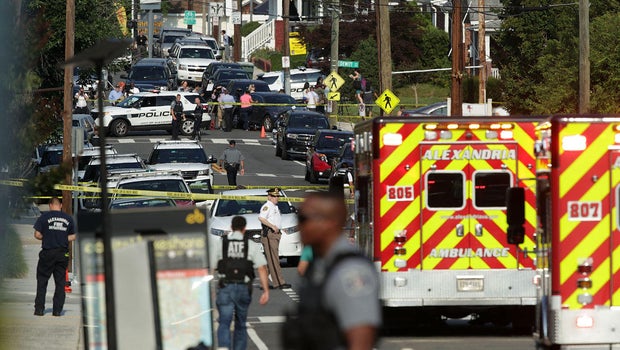
There was widespread relief on Capitol Hill that the toll was not higher given the unexpected nature of the attack on an early morning baseball practice and the many lawmakers who were vulnerable. Lawmakers praised as heroes the Capitol and Alexandria, Va., police officers who took on the gunman and limited what all agreed could have been catastrophic.

The day’s sense of togetherness was evident as some House members crossed the center aisle of the chamber to sit among colleagues in the other party.

Ms. Pelosi made a subtle reference to the usual partisan sentiment in the House after Speaker Paul D. Ryan brought members to their feet with his emotional declaration that “an attack on one of us is an attack on all of us.”

“To my colleagues,” Ms. Pelosi said, “you’re going to hear me say something you’ve never heard me say before. I identify myself with the remarks of the speaker.”

Calls for civility and less-charged language were widespread, a recognition that both parties have been too eager to fan the political flames.

“We, as Republicans and Democrats, have to come together and say, as a team, and as members of Congress in the greatest country in the history of the world, that this hate and this rhetoric has got to be toned down,” said Rodney Davis, an Illinois Republican who was at the practice.

“I have no illusion as to how politically divided we are,” Gwen Moore, Democrat of Wisconsin, said while she expressed confidence that “together, we will be able to heal, support one another and weather this storm.”

Members of Congress and political leaders have called for partisan de-escalation after previous traumatizing events only to see the toxic tone roar back. Given the yawning political divide and the sharp disagreement on the direction of the nation, it will remain a challenge to hold the more divisive political instincts at bay for long.

Source: US Government Class

Capitol Police played key role in saving people’s lives, officials say

CBS News – Rep. Steve Scalise’s presence at the congressional baseball practice in Alexandria, Virginia, where a shooting unfolded Wednesday morning may have saved a number of lives, Sen. Rand Paul said Wednesday.

As a member of House leadership, Scalise, the House majority whip, had members of dignitary protection traveling with him at the practice. That’s the only reason why Capitol Police were at the scene when shots were fired, Paul said.

“The only reason they were there was because we had a member of leadership on our team,” Paul said in an interview on MSNBC’s “Morning Joe.” “If Scalise wouldn’t have been on the team…him being there, he probably saved everybody else’s life because if you don’t have a member of leadership there, there probably would have been no security there.”

He added that if they had not been there, “It would have been a massacre.”

Scalise was among at least five people shot and he was transferred to MedStar Washington Hospital Center to undergo surgery. He had been shot in the hip. His office said he was in “stable condition” and that he was in “good spirits” before entering surgery.

Tim Slater, special agent in charge of the FBI’s Washington, D.C. field office, confirmed that Scalise was traveling with a protection team.

“I’m sure it made a significant difference,” Slater said of the officer’s’ presence as the shooting transpired.

Capitol Police Chief Matthew Verderosa confirmed that two Capitol Police officers engaged fire with the gunman, who has now been identified as James T. Hodgkinson. He would not reveal how many Capitol Police officers were on the scene initially.

Plain-clothes Capitol Police officers protect senior members of Congress, including Scalise. They are part of a separate division within Capitol Police — the department of protective services. They look and act like Secret Service but are separate entities. They also protect Speaker Paul Ryan, Senate Majority Leader Mitch McConnell, Senate Minority Leader Chuck Schumer, House Minority Whip Steny Hoyer, Senate Majority Whip John Cornyn, Senate Minority Whip Dick Durbin, and others. They also investigate threats against members of Congress. Scalise, as House Majority Whip, generally travels in an armored SUV with two plain clothes Capitol Police officers with him.

Paul said he was in the batting cage at the time that he heard the first shot and then a “rapid succession of shots.” He said there was a ten-foot fence between him and the field and he saw Scalise had been shot, but was moving and dragging himself through the dirt. He saw two staffers laying down, one of whom then climbed a 15 to 20-foot fence who then hid behind a tree with Paul. He said he heard at least 50 to 60 gunshots and then he finally heard Capitol Police responding.

“We’re actually very lucky they were there,” he said.

CBS News’ Walt Cronkite and Jillian Hughes contributed to this report.

Source: US Government Class

France’s Emmanuel Macron faces test in parliamentary elections

CBS News – PARIS — French voters are choosing lawmakers in the lower house of parliament on Sunday in a vote that is crucial for newly-elected president Emmanuel Macron.

A total of 7,882 candidates are running for 577 seats in the National Assembly in Sunday’s first round of the two-stage legislative elections. Top vote-getters advance to the decisive second round June 18.

Polls suggest the elections will strongly favor Macron’s party and dramatically shake up French politics, punishing the traditional left and right parties and leaving no single strong opposition force.

Macron’s year-old centrist movement, Republic on the Move, is seeking an absolute majority to be able to implement his campaign promises, which include simplifying labor rules and making it easier to lay off workers in hopes of boosting hiring.

The government outlined the main themes of a major labor reform that has already angered French unions and is likely to prompt tensions over the summer.

Macron also plans to quickly pass a law to strengthen security measures — effectively making the state of emergency permanent, after multiple Islamic extremist attacks in France — and another one that he says will put more ethics into French politics.

The government needs a new Assembly in place to vote on the bills.

Macron called on French voters to give him a “majority to make changes” on the night of his victory May 7. “That’s what the country wants and that’s what it deserves,” he said.

A minimum of 289 seats is required to secure an absolute majority.

According to the latest polls, Macron’s movement appears in a position to win potentially as many as 400 seats.

The candidates of Republic on the Move include many newcomers in politics, like a retired bullfighter, a fighter pilot and a mathematical genius. Half of them are women.

Candidates from the conservative Republicans party are expected to arrive in second position, and other parties with possibly more than 100 seats. The Socialists, who dominated the last Assembly, are expected to suffer a stinging defeat and win just a few dozen seats.

In the wake of far-right Marine Le Pen‘s qualification for the presidential runoff, the National Front party is expected to get its highest-ever score — but does not appear able to become the major opposition force Le Pen had hoped for. Polls project it could win about a dozen seats, in part because of a voting system that favors the biggest parties.

Le Pen herself is running for a seat in Henin-Beaumont in northern France.

Far-left leader Jean-Luc Melenchon, who came in a strong fourth place in the presidential vote with nearly 20 percent support, is running for a parliamentary seat in the southern city of Marseille. His movement could obtain between 10 and 20 seats.

Parisian voter Thibault Gouache says he’s keen to see fresh faces in the parliament.

“The most important thing is changing the people that do politics,” he told The Associated Press. Many candidates have already served multiple terms and “are disconnected to the reality of what we live on a day by day basis.”

The turnout rate is expected to be low for France, with possibly only half of the voters going to the polls.

To win in the first round, candidates need an absolute majority and support from at least a quarter of the district’s registered voters.

Otherwise, all contenders who get at least 12.5 percent of the votes of registered voters advance to the second round.

The French Parliament is made up of two houses, the National Assembly and the Senate. The legislative elections don’t concern the Senate, which is currently run by a conservative majority.

The National Assembly always has the final say in the voting process of a law.

Source: US Government Class

Comey testimony: Trump team denies accusations, tries to turn tables on ex-FBI boss

FoxNews – President Trump’s legal team shot back Thursday at James Comey’s Senate testimony, defending the president in a brawny statement against the fired FBI director’s more damaging claims and asserting Comey himself could now be in legal jeopardy for his admission he’d leaked details of “privileged” conversations.

Trump’s personal lawyer, Marc Kasowitz, also said Comey’s testimony backed up Trump on key points — affirming that the president “never sought to impede” the Russia probe, and that while he was FBI director, Comey told Trump several times he wasn’t the subject of an investigation.

The president’s lawyer issued the rebuttal in a written statement that he read to reporters during a brief post-hearing appearance.

The statement sought to shield Trump and shift scrutiny onto Comey, who on Thursday delivered dramatic testimony that stopped short of accusing Trump of obstruction of justice but made numerous other allegations.

Kasowitz tried to rebut them one by one.

Despite Comey’s claims to the contrary, he emphasized Trump “never, in form or substance, directed or suggested” that Comey drop an investigation into ex-National Security Adviser Michael Flynn.

Kasowitz also denied Trump asked Comey for a pledge of loyalty, contradicting Comey’s story and setting up a “he said-he said” between the former FBI boss and the president.

Kasowitz also cast doubt on Comey’s explanation as to why he decided to leak a memo describing the Flynn conversation after Trump had fired him as FBI director.

“Although Mr. Comey testified he only leaked the memos in response to a tweet, the public record reveals that the New York Times was quoting from these memos the day before the referenced tweet, which belies Mr. Comey’s excuse for this unauthorized disclosure of privileged information and appears to be entirely retaliatory,” the statement said.

The New York Times wrote its first story about private conversations between Comey and Trump on May 11, though the Times made no mention of a memo existing to allegedly substantiate the encounter. The following day Trump sent an infamous tweet implying he had recorded the discussion himself: “James Comey better hope that there are no ‘tapes’ of our conversations before he starts leaking to the press!”

Comey suggested that tweet prompted him to leak his notes. Four days later the first story appeared in the press citing an alleged Comey memo.

Kasowitz, meanwhile, pointedly raised the question Thursday of whether Comey’s leak amounts to a legal problem for him: “We will leave it to the appropriate authorities to determine whether this leak should be investigated along with all those others being investigated.”

Though Trump did not tweet or make a direct statement about Comey’s testimony, he did reference fighting back during a speech he gave to religious conservatives as Comey’s testimony was wrapping up.

“They will lie, they will obstruct, they will spread their hatred and their prejudice, but we will not back down from doing what is right,” Trump said. “We will fight and win, and we will have an unbelievable future. An unbelievable future. And it’s going to be together.”

Though Trump, a well-established prolific tweeter, has not sent a message from his account since Wednesday morning, he was certainly represented on the social media network. The Republican National Committee tweeted from its @GOP account, often hashtagging posts “#bigleaguetruth.”

“So according to Comey, @POTUS never asked to stop the investigation and Russia didn’t change a single vote. Good to know. #BigLeagueTruth,” one message read.

One of Trump’s children, Donald Trump Jr., was also tweeting a rapid-response defense of his dad.

Writing about Comey’s assertion that Trump intimated Comey should drop the Flynn investigation, Trump Jr. wrote: “Knowing my father for 39 years when he ‘orders or tells’ you to do something there is no ambiguity, you will know exactly what he means.”

Source: US Government Class