Perspectives: The Impact of the Israel-UAE Agreement

(These three articles are form AllSides.com. This website is a good source to read articles on the same topic from different view points. Read the different articles and see if you can identify any differences.)

Click on the image to read the articles.

Source: US Government Class

New Jobless Claims Fall Below 1 Million

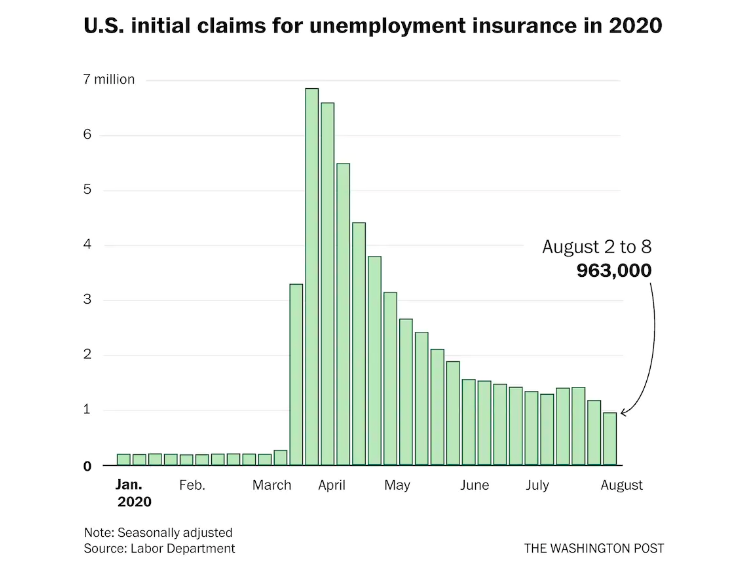
Washington Post –  About 960,000 workers filed for unemployment insurance last week, which marks the first time that initial claims dipped below 1 million since mid-March, when the coronavirus pandemic first took hold and workers were told to stay home.

The weekly claims figure for the week that ended Aug. 8 fell below the 1.18 million claims from last week but remained well above historic highs. The pre-pandemic record for initial weekly claims was 695,000, from 1982, another recession.

Another 488,000 new claims were filed for Pandemic Unemployment Assistance, which is offered to gig and self-employed workers.

All told, more than 28 million people are receiving some form of unemployment benefits as of the week of July 25, down more than 3 million from the previous week.

Economist said the longer the pandemic drags down the economy, the more job losses will become permanent — and the more likely people filing weekly claims are not going to bounce back and be rehired, as many were earlier in the pandemic.

“We’re finally below 1 million, so that’s something to celebrate,” said Beth Ann Bovino, the chief economist at S&P Global Ratings Services. “But it stops there. The worry I have is that the times of quick recalls are in the past. I suspect that these jobs being lost are permanent, and that’s a real problem for the economy and for these households.”

The numbers come as economic issues take increased prominence in the presidential election. President Trump has been touting the numbers of jobs that have been regained in the past three months, despite the unemployment rate and weekly claims remaining around historic highs.

Congress continues to be deadlocked in negotiations over extending the extra federal unemployment benefits that expired at the end of July. Economists have warned about the damage to the economy if those enhanced benefits, which many workers credit with helping them keep up to date on basic payments of rent and groceries, are not renewed.

Trump on Saturday issued an executive order that he claimed would enhance unemployment benefits by circumventing Congress, but the order raises questions about legality and how it would be implemented by the states. It’s unclear whether it will affect unemployment insurance in the near future.


Source: US Government Class

Payroll Tax Delay To Boost Take-Home Pay, But Don’t Spend It Yet

NPR –  President Trump wants to give a $100 billion boost to the U.S. economy by hitting the “pause” button on workers’ payroll taxes.

That would leave more money in people’s paychecks. But the move — which Trump ordered over the weekend — is only temporary. And that could produce headaches down the road for workers, employers and the Social Security system.

Trump announced the payroll tax suspension on Saturday as part of a series of moves designed to sidestep Congress after talks on a more comprehensive bill to provide coronavirus relief broke down. He directed the Treasury Department to stop collecting the 6.2% payroll tax from workers making up to $104,000 a year. The move is supposed to take effect next month.

“This will mean bigger paychecks for working families as we race to produce a vaccine,” Trump told reporters assembled at his golf club in Bedminster, N.J.

Critics say this particular relief measure is misguided since it benefits only people who are lucky enough to have a job still. What’s more, because the tax relief is only temporary, workers are expected to repay the taxes next year.

“What good does that do people if they just get a temporary payroll tax cut and have to put that somewhere to save it to repay the money in a balloon payment a couple of months from now?” asked Maya MacGuineas, president of the Committee for a Responsible Federal Budget. “That’s really done very little to improve the economy.”

Trump insists his goal, if he’s reelected, is to cut the payroll tax for good.

“If I’m victorious on Nov. 3, I plan to forgive these taxes and make permanent cuts to the payroll tax,” Trump said. “I’m going to make them all permanent.”

But while the president can delay the collection of taxes, only Congress can eliminate them altogether. There’s no guarantee lawmakers would do so. And if they did, that would be a severe blow to Social Security, which the delayed payroll taxes pay for.

“Social Security is already facing immense pressures in terms of the finances,” MacGuineas said. “Getting rid of the revenue source that funds the program would make the finances of it much, much worse.”

White House economic adviser Larry Kudlow argued that the administration would simply borrow money if necessary to make up for any shortfall in Social Security.

Still, the payroll tax suspension seemed to have little support outside the White House and a small circle of presidential advisers. It never gained much traction in Congress. And the U.S. Chamber of Commerce made clear it’s not something its members were asking for.

“The people who love the payroll tax cut are the American people,” said conservative pundit Stephen Moore — an adviser to Trump’s campaign who was briefly floated as a nominee for the Federal Reserve.

Moore, who co-founded the anti-tax Club for Growth, has been one of the most dogged advocates for payroll tax relief.

“Virtually all Americans who are working are going to see a nice boost in their paychecks,” he said of the deferred tax collection. “That puts money in the economy and incentivizes people to work. I think that’s a very positive effect.”

Employers are supposed to stop withholding the payroll tax on Sept. 1, but for many it won’t be that easy. Companies need guidance from the IRS on exactly who is eligible to have their taxes suspended and how to keep track so those taxes can eventually be repaid.

“It’s going to be a mixed bag of employers,” said Pete Isberg, vice president of government relations for ADP, which handles payroll for hundreds of thousands of employers. He said while some companies will be able to adjust their computers quickly to stop withholding payroll taxes, “some will be able to do it in October or November. And some may just never do it.”

Isberg said companies also want some reassurance that they won’t be on the hook for their workers’ taxes, if Congress doesn’t forgive the bill. They’ll also have to try to explain to employees why take-home pay is or is not going up in September, and how that could be reversed early next year.

Source: US Government Class

Kanye West polling at 2% nationwide against Trump and Biden more than a month since announcing bid

Washington Times –  Kanye West continues to poll at 2% among U.S. voters, a new survey revealed Wednesday, more than a month since the billionaire rapper and mogul announced his presidential campaign.

Conducted this past Sunday and Monday, the nationwide poll asked 1,983 registered voters about how they would vote if the presidential election was held now instead of November.

Only 2% of respondents — 33 people in all — told pollsters they would rather cast their ballot for Mr. West than President Trump or presumptive Democratic nominee Joseph R. Biden.

Forty-nine percent of respondents said they would vote for Mr. Biden, 40% said they would vote for Mr. Trump, and 9% said they did not know who they would pick or had no opinion.

The national tracking poll was conducted by Morning Consult for Politico and has a margin of error of plus or minus 2 percentage points, according to the pollster.

Mr. West, 43, announced he was running for president on July 4, effectively missing the deadline for him to appear on the ballot as an independent in many states this fall.

A nationwide poll of 2,000 registered voters conducted days later by Redfield & Wilton Strategies found that only 2% of respondents said they would consider voting for Mr. West, who has previously expressed his support for Mr. Trump.

It has since emerged that Republican operatives have assisted with trying to get Mr. West on the ballot in several states. Mr. Trump has denied involvement.

Arkansas Secretary of State John Thurston said Tuesday that Mr. West will appear on the ballot there this fall after submitting more than the 1,000 signatures needed to qualify.

More recently, The New York Times reported Wednesday morning that Mr. West met privately last weekend in Colorado with Jared Kushner, Mr. Trump’s senior adviser and son-in-law.

The White House offered no immediate reaction to The Times report.

Mr. West has previously qualified to appear on the ballots in Oklahoma and Colorado, and he is currently fighting to appear in Wisconsin, The Associated Press reported this week.

Forty-nine percent of people said they heard about Republicans helping the West campaign, Morning Consult reported Wednesday. Fifty-one said they heard not much or nothing at all.

Mr. West is married to reality TV star Kim Kardashian West.

Source: US Government Class

Biden picks Kamala Harris as running mate

Santa Fe New Mexican – WILMINGTON, Del. — Joe Biden named California Sen. Kamala Harris as his running mate Tuesday, making history by selecting the first Black woman to compete on a major party’s presidential ticket and acknowledging the vital role Black voters will play in his bid to defeat President Donald Trump.

In choosing Harris, Biden is embracing a former rival from the Democratic primary who is familiar with the unique rigor of a national campaign.

The 55-year-old first-term senator, who is also of South Asian descent, is one of the party’s most prominent figures. She quickly became a top contender for the No. 2 spot after her own White House campaign ended.

She will appear with Biden for the first time as his running mate at an event Wednesday near his home in Wilmington, Del.

In announcing the pick, Biden called Harris a “fearless fighter for the little guy, and one of the country’s finest public servants.” She said Biden would “unify the American people” and “build an America that lives up to our ideals.”

Harris joins Biden at a moment of unprecedented national crisis. The coronavirus pandemic has claimed the lives of more than 160,000 people in the U.S., far more than the toll experienced in other countries. Business closures and disruptions resulting from the pandemic have caused severe economic problems. Unrest, meanwhile, has emerged across the country as Americans protest racism and police brutality.

Trump’s uneven handling of the crises has given Biden an opening, and he enters the fall campaign in strong position against the president. In adding Harris to the ticket, he can point to her relatively centrist record on issues such as health care and her background in law enforcement in the nation’s largest state.

The president told reporters Tuesday he was “a little surprised” that Biden picked Harris, pointing to their debate stage disputes during the primary. Trump, who has donated to her previous campaigns, argued she was “about the most liberal person in the U.S. Senate.”

“I would have thought that Biden would have tried to stay away from that a little bit,” he said.

Harris’ record as California attorney general and district attorney in San Francisco was heavily scrutinized during the Democratic primary and turned away some liberals and younger Black voters who saw her as out of step on issues of racism in the legal system and police brutality. She declared herself a “progressive prosecutor” who backs law enforcement reforms.

Biden, who spent eight years as President Barack Obama’s vice president, has spent months weighing who would fill that same role in his White House. He pledged in March to select a woman as his vice president, easing frustration among Democrats that the presidential race would center on two white men in their 70s.

Biden’s search was expansive, including Massachusetts Sen. Elizabeth Warren, a leading progressive; Florida Rep. Val Demings, whose impeachment criticism of Trump won party plaudits; California Rep. Karen Bass, who leads the Congressional Black Caucus; former Obama national security adviser Susan Rice; Atlanta Mayor Keisha Lance Bottoms, whose passionate response to unrest in her city garnered national attention, and reportedly New Mexico Gov. Michelle Lujan Grisham.

A woman has never served as president or vice president in the United States. Hillary Clinton was the Democratic presidential nominee in 2016. Two women have been nominated as running mates on major party tickets: Democrat Geraldine Ferraro in 1984 and Republican Sarah Palin in 2008. Their parties lost in the general election.

The vice presidential pick carries increased significance this year. If elected, Biden would be 78 when inaugurated in January, the oldest man to ever assume the presidency. He’s spoken of himself as a transitional figure and hasn’t fully committed to seeking a second term in 2024.

Harris, born in 1964 to a Jamaican father and Indian mother, spent much of her formative years in Berkeley, Calif. She has often spoken of the deep bond she shared with her mother, whom she has called her single biggest influence.

Harris won her first election in 2003 when she became San Francisco’s district attorney. In that post, she created a reentry program for low-level drug offenders and cracked down on student truancy.

She was elected California’s attorney general in 2010, the first woman and Black person to hold the job, and focused on issues including the foreclosure crisis. She declined to defend the state’s Proposition 8, which banned same-sex marriage and was later overturned by the U.S. Supreme Court.

After being elected to the Senate in 2016, she quickly gained attention for her assertive questioning of Trump administration officials during congressional hearings.

Harris launched her presidential campaign in early 2019 with the slogan “Kamala Harris For the People,” a reference to her courtroom work. She was one of the highest-profile contenders in a crowded Democratic primary and attracted 20,000 people to her first campaign rally in Oakland.

But the early promise of her campaign eventually faded. Her law enforcement background prompted skepticism from some progressives, and she struggled to land on a consistent message that resonated with voters. Facing fundraising problems, she abruptly withdrew from the race in December 2019, two months before the first votes of the primary were cast.

One standout moment of her presidential campaign came at the expense of Biden. During a debate, she said Biden made “very hurtful” comments about his past work with segregationist senators and slammed his opposition to busing as schools began to integrate in the 1970s.

“There was a little girl in California who was a part of the second class to integrate her public schools, and she was bused to school every day,” she said. “And that little girl was me.”

Shaken by the attack, Biden called her comments “a mischaracterization of my position.”

The exchange resurfaced recently with a report that one of Biden’s closest friends and a co-chair of his vice presidential vetting committee, former Connecticut Sen. Chris Dodd, still harbors concerns about the debate and that Harris hadn’t expressed regret.

The comments attributed to Dodd and first reported by Politico drew condemnation, especially from influential Democratic women who said Harris was being held to a standard that wouldn’t apply to a man running for president.

Some Biden confidants said Harris’ debate attack did irritate the former vice president, who had a friendly relationship with her. Harris was also close with Biden’s late son, Beau, who served as Delaware attorney general while she held the same post in California.

But Biden and Harris have since returned to a warm relationship.

“Joe has empathy, he has a proven track record of leadership and more than ever before we need a president of the United States who understands who the people are, sees them where they are, and has a genuine desire to help and knows how to fight to get us where we need to be,” Harris said at an event for Biden earlier this summer.

At the same event, she bluntly assailed Trump, labeling him a “drug pusher” for his promotion of the unproven and much-questioned malaria drug hydroxychloroquine as a treatment for the coronavirus. After Trump tweeted “when the looting starts, the shooting starts” in response to protests about the death of George Floyd, a Black man in police custody, Harris said his remarks “yet again show what racism looks like.”

Harris has taken a tougher stand on policing since Floyd’s killing. She co-sponsored legislation in June that would ban police from using chokeholds and no-knock warrants, set a national use-of-force standard and create a national police misconduct registry, among other things. It would also reform the qualified immunity system that shields officers from liability.

The list in the legislation included practices Harris did not vocally fight to reform while leading California’s Department of Justice. And while she now wants independent investigations of police shootings, she didn’t support a 2015 California bill that would have required her office to take on such cases.

“We made progress, but clearly we are not at the place yet as a country where we need to be and California is no exception,” she told the Associated Press recently. The national focus on racial injustice now, she said, shows “there’s no reason that we have to continue to wait.”

Source: US Government Class

Democrats hold firm in demands for coronavirus relief bill as impasse continues

CBS News – Washington — Democratic congressional leaders are holding firm on their priorities in negotiations with White House officials and Senate Republicans over the next coronavirus relief bill, refusing to budge on a long-term extension of enhanced unemployment benefits of $600 per week to unemployed Americans that expired at the end of July.

Speaker Nancy Pelosi discussed the ongoing negotiations in a press conference with Senate Minority Leader Chuck Schumer on Thursday. In recent weeks, Pelosi and Schumer have met almost daily with Treasury Secretary Steven Mnuchin and White House Chief of Staff Mark Meadows.

“We have to move more quickly because the light at the end of the tunnel may be the freight train of the virus coming at us if we do not act to contain it,” Pelosi told reporters. She and Schumer argued that Republicans do not comprehend the gravity of the economic fallout from the coronavirus pandemic.

“Republicans want to apply just a Band-Aid,” Schumer said, referring to the White House offer for a short-term extension of the unemployment benefits. “We won’t let them just pass the Band-Aid, go home and leave America bleeding.”

Schumer also slammed Meadows and Mnuchin for appearing to set a Friday deadline for negotiations. Mnuchin told reporters Wednesday that “our objective is to try to reach an understanding of the major issues by Friday.”

“We’re not quitting, we are ready to work, we will keep working,” Schumer countered.

Senate Majority Leader Mitch McConnell announced Thursday that the Senate would not adjourn for its August recess until a deal was reached. Senators “will have 24-hour notice before a vote, but the Senate will be convening on Monday, and I will be right here in Washington,” McConnell said. House Majority Leader Steny Hoyer announced last week that the House would be canceling its August recess.

Meadows said after meeting with Pelosi and Schumer Wednesday that they continue to be “trillions of dollars apart” in terms of their priorities. Democrats are seeking to reach a deal similar to legislation passed by the House in May, which would cost approximately $3 trillion. Republicans have criticized the price tag as excessive, and questioned why provisions like election assistance for states were included.

“Our Republican counterparts refuse to acknowledge running a pandemic in the middle of an election is difficult,” Schumer told reporters on Thursday, saying that White House officials did not understand the “depth” and “breadth” of the crisis.

Schumer and Pelosi signaled again that they were unwilling to budge on the $600 per week figure. Some Republicans have argued that this would incentivize Americans to remain unemployed if they were making more on unemployment insurance than they were at their old jobs. Pelosi said this thinking demonstrated “condescension to American working families.”

Pelosi scoffed at the Republican proposal introduced last week which would have provided an additional $200 per week in unemployment benefits.

“When they showed up last week it was already too late, and they came to the table with $200. It was already too late,” Pelosi said, arguing that Republicans should have come to the negotiating table earlier since the benefits expired at the end of July.

She also shot down the idea that they could consider a short-term extension of the benefit if a deal could not be reached, saying “we’re not having a short-term extension.”

Schumer, Pelosi, Mnuchin and Meadows are expected to meet again on Thursday afternoon.

Senate Republicans on Thursday expressed skepticism that a deal between the two parties could be reached. Senator Lisa Murkowski said it “doesn’t look like” White House officials and Democrats would have successful negotiations, and Senator Mike Rounds simply said “nope” when asked by reporters if he thought they would reach a deal this week.

“I believe there will be a deal, yes, but I don’t know that I could characterize the probability of it being successful,” Senator Mitt Romney said, offering slightly more hope than his colleagues.

Source: US Government Class

Foreign threats loom ahead of U.S. presidential election

Santa Fe New Mexican – NEW YORK — As the Nov. 3 presidential vote nears, there are fresh signs that the nation’s electoral system is again under attack from foreign adversaries.

Intelligence officials confirmed in recent days that foreign actors are actively seeking to compromise the private communications of “U.S. political campaigns, candidates and other political targets” while working to compromise the nation’s election infrastructure. Foreign entities are also aggressively spreading disinformation intended to sow voter confusion heading into the fall.

There is no evidence that America’s enemies have yet succeeded in penetrating campaigns or state election systems, but Democrat Joe Biden’s presidential campaign confirmed last week that it has faced multiple related threats.

The former vice president’s team was reluctant to reveal specifics for fear of giving adversaries useful intelligence.

Because of such secrecy, at least in part, foreign interference largely remains an afterthought in the 2020 contest, even as Republicans and Democrats alike concede it poses a serious threat that could fundamentally reshape the election at any moment.

Biden’s campaign is increasingly concerned that pro-Russian sources have already shared disinformation about Biden’s family with President Donald Trump’s campaign and his Republican allies on Capitol Hill designed to hurt the Democratic candidate in the days leading up to the election.

When asked directly, the Trump campaign refused to say whether it had accepted materials related to Biden from any foreign nationals. Trump was impeached last year after being caught pressuring Ukrainian leaders to produce damaging information about work Biden’s son did in the country, even though repeated allegations of corruption against the Bidens have been widely discredited.

A Biden spokesman said “absolutely not” when asked if the campaign had received any materials from foreign actors.

“Joe Biden has been demonstrating international leadership to protect the sovereignty of our democracy for years, whereas Donald Trump has actively encouraged attacks on our elections,” said Biden spokesman Andrew Bates.

Meanwhile, Wisconsin Sen. Ron Johnson, a key Trump ally and chairman of the Senate Homeland Security Committee, denied having accepted any damaging materials on Biden from foreign nationals after at least one Ukrainian national, Oleksandr Onyshchenko, told the Washington Post he had shared tapes and transcripts with Johnson’s committee and Trump ally Rudy Giuliani. House Democrats announced Friday they have subpoenaed Secretary of State Mike Pompeo for documents he turned over to Johnson’s panel.

“It does a disservice to our election security efforts when Democrats use the threat of Russian disinformation as a weapon to cast doubt on investigations they don’t like,” Johnson spokesperson Austin Altenburg said.

The 2020 campaigns and party committees have been receiving regular briefings from the National Counterintelligence and Security Center, whose director, Bill Evanina, released a rare public statement last week confirming Russia’s continued work to meddle in the U.S. election.

Evanina said that Russia, as part of an effort to weaken the U.S. and its global standing, has been spreading disinformation to undermine confidence in American democracy and “to denigrate what it sees as an anti-Russia ‘establishment’ in America.”

Source: US Government Class

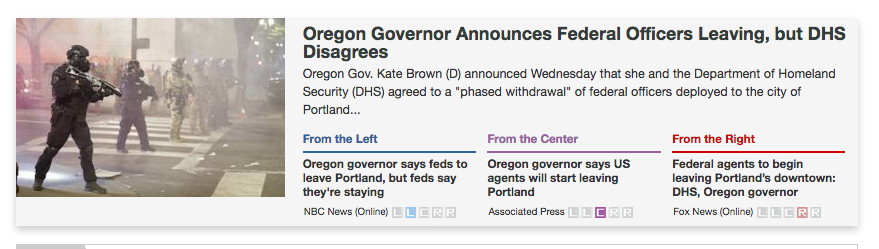
Oregon Governor Announces Federal Officers Leaving, but DHS Disagrees

(These three articles are form AllSides.com. This website is a good source to read articles on the same topic from different view points. Read the different articles and see if you can identify any differences.)

Source: US Government Class

John Lewis’ death sparks surge in support to rename Edmund Pettus Bridge, the site of Bloody Sunday, in his honor

CBS News – Following the death of Representative John Lewis on Friday, millions have paid tribute to the Georgia Congressman’s decades of activism, fighting for social justice and voting rights. Many pointed to Lewis’ iconic leadership in the 1965 march that came to be known as Bloody Sunday, leading to a surge of support to rename the Edmund Pettus Bridge, where the peaceful marchers were attacked by police, in Lewis’ honor.

Edmund Pettus was a brigadier general in the Confederate Army during the Civil War. He later joined the Alabama Ku Klux Klan and ascended to the level of Grand Dragon, according to the Smithsonian. Pettus also served in the U.S. Senate from 1897 until his death on July 27, 1907.

A Change.org petition supporting the name change amassed thousands of signatures within a day after Lewis’ death. The petition was launched about a month ago, and had garnered around 250,000 signatures prior to Lewis’ death. By Saturday evening, the petitioned had received more than 437,000 signatures.

“It’s far past time to rename the Edmund Pettus Bridge after Representative John Lewis, a civil rights icon that nearly gave his life on that bridge,” Michael Starr Hopkins, who created the petition, wrote. “Edmund Pettus was a bitter racist, undeserving of the honor bestowed upon him. As we wipe away this country’s long stain of bigotry, we must also wipe away the names of men like Edmund Pettus.”

On March 7, 1965, Lewis led 600 people across the Edmund Pettus Bridge in Selma, Alabama, in a peaceful demonstration demanding the right to vote for Black people. At the foot of the bridge, the protesters were attacked by state troopers, who launched tear gas into the crowd and beat marchers with night sticks. Lewis, who was 25 at the time, suffered a fractured skull after he was beaten by a police officer.

The violence by police was widely publicized, and months later, President Lyndon B. Johnson signed the voting rights act of 1965.

Lewis reflected on the 55th anniversary of the march this year, saying in a tweet, “we were beaten, tear gassed, and trampled by horses. I thought I saw death. I thought I was going to die.”

Paul McCartney tweeted support for renaming the bridge in Lewis’ honor, saying the Georgia congressman was “a great leader who fought with honesty and bravery for civil rights in America.”

Musician Stevie Van Zandt echoed McCartney’s statement, saying, “It should have happened while he was alive. Why we would have anything named after the grand dragon of the ku klux klan is way beyond me.”

Ava DuVernay, who directed the 2014 film “Selma” about the 1965 voting rights marches, tweeted out her support of the petition last month.

She said the bridge should be “named for a hero” and “not for a murderer,” and said that the change is “past due.”

Alabama Senator Doug Jones and Representative Terri Sewell have expressed their support for the name change as well. Alabama Governor Kay Ivey, who the petition is aimed at, has not commented on the petition.


Source: US Government Class

Lujan Grisham, legislators wrestle for control in pandemic spending debate

Santa Fe New Mexican – First, there was a tug of war over who could control funds sent from Washington.

Now, the Legislature is questioning whether the governor overstepped her legal authority.

In the midst of all the other tumult the pandemic has brought to New Mexico, the coronavirus also is sparking tension within state government — in the form of a quarrel over control between legislators and Gov. Michelle Lujan Grisham.

The source of friction?

Clearly, there’s some disagreement regarding public health orders, such as a recent one reinstating business closures. Similar debates are raging nationwide.

Yet so far, a more tangible division may center on how the governor has spent money to fight the virus.

“There’s a real tension building up between the executive and the legislative members,” said Sen. John Arthur Smith, chairman of the Senate Finance Committee.

Prior to last month’s special session, the two branches of government argued over which one had the power to spend federal stimulus dollars approved for novel coronavirus efforts, a dispute the governor ultimately won when she vetoed — and then replaced — certain parts of legislators’ budget bill.

Then on Thursday, House and Senate leadership called on Lujan Grisham to explain the legality of her decision to unilaterally authorize emergency funding to deal with the outbreak “in excess of the statutory limits.”

Republicans, who are a minority in the Legislature, had been arguing since early in the pandemic that the governor violated state law through that spending, and they urged a key legislative panel to look into the matter.

The issue took on greater significance when that committee, the Legislative Council, voted unanimously to ask attorneys to look into the spending earlier this month. The panel includes top Democrats, who took the uncommon step of questioning the legality of decisions made by an executive from their own party.

Asked about the emergency purchases, the acting secretary of the state Department of Finance and Administration said they were imperative, particularly as many of them came in the frantic early stages of an unprecedented outbreak.

“This was kind of a no-brainer,” Debbie Romero said. “We needed to get testing up, we needed to get [personal protective equipment] purchased, we needed to get food distributions out. I mean, we were closing schools and we wanted to make sure kids had meals.”

The Governor’s Office maintains it fully complied with state law, saying the state’s All Hazards Emergency Management Act allowed the governor to authorize the spending.

“Not only does the governor have the ability to do so, she has the duty to do so,” spokeswoman Nora Meyers Sackett said.

‘A line in the sand’

Shortly after the coronavirus outbreak began, Lujan Grisham issued an executive order March 27 to make available $20 million in emergency funds, and another order April 8 allocated $10 million more.

In those first couple of months of the pandemic, the state’s finance department — in conjunction with health, homeland security and other agencies navigating the outbreak — approved numerous emergency purchases amounting to millions of dollars each to buy personal protective equipment and other coronavirus-related goods and services.

A May purchase order, for instance, shows the state government spent $2.9 million to give Cochiti Pueblo broadband connectivity so residents and K-12 students could use the internet without having to go to the library and violate social-distancing measures.

Another set of orders, authorized in April and May, allocated $2.46 million to buy respirators and gloves.

Almost immediately, Republican legislators began crying foul, saying state law limits governors to emergency appropriations of only $750,000 each and arguing the governor should have obtained approval from the Legislature first.

“She was out of line when she did that,” House Minority Leader Jim Townsend said Friday. “I think she knew she was out of line, and she did it anyway.”

Some fiscally conservative Democrats soon joined the chorus.

Legislators “have to draw a line in the sand if they’re going to protect their appropriation authority and say, ‘Hey you’ve overstepped, governor, when you’ve done this,’ ” said Smith, D-Deming.

Last week, Senate President Pro Tem Mary Kay Papen and House Speaker Brian Egolf sent a letter to the governor on behalf of the Legislative Council asking her to justify the spending so legislators “may further analyze the separation of powers concerns that have been raised.”

Some in the legislative branch also have taken issue with a policy exemption approved in March by the state’s finance department that allowed agencies to pay for emergency goods and services before they received them.

Source: US Government Class