New Mexico nets record revenues from oil and gas boom

Santa Fe New Mexican – ALBUQUERQUE — A surge in oil production has resulted in record revenues for state government coffers and public education. But industry officials cautioned Tuesday that regulatory certainty will have to be maintained if New Mexico wants to hold on to its spot as one of the United States’ top producers.

New figures released by the New Mexico Oil and Gas Association show revenues, taxes and other fees related to the fossil fuel-producing sector reached a high of $2.2 billion for the 2018 fiscal year.

That represents an increase of $465 million over the previous fiscal year and an additional $128 million specifically for education. Overall, the industry provided more than $1 billion for public schools and the state’s universities during the period.

The boom has been driven by production in the Permian Basin, which straddles southeastern New Mexico and West Texas. Competition remains fierce as both states and the federal government look to capitalize on the financial windfall that has come from the latest boom.

The U.S. Bureau of Land Management recently touted the $1.1 billion that resulted last year from oil and gas lease sales on federally managed public land, and most of that came from New Mexico.

The state surpassed both California and Oklahoma to become the third-largest producer in the country while still trailing Texas.

Government forecasters also announced Tuesday that the United States — already the world’s biggest oil producer — will pump progressively more barrels of oil per day in 2019 and 2020 to become a net exporter of crude and petroleum products. Most of the increase is expected to come from Texas and New Mexico.

“The future is very bright for New Mexico, and we can expect these trends to hold for the foreseeable future if New Mexico remains a favorable place for oil and natural gas producers to do business,” said Ryan Flynn, the association’s executive director.

The positive outlook for the industry comes as New Mexico lawmakers consider a host of measures that Flynn and others fear could end up pushing development into Texas’ share of the basin or to other countries with less stringent regulations.

One initiative calls for increasing the royalty rate for the most productive oil and natural gas wells on state trust land, while another would impose a four-year moratorium on state-issued oil and gas permits that involve hydraulic fracturing. Since every well involves fracking to squeeze more oil and gas from shale formations, industry experts have said that could have devastating effects on development in New Mexico.

Democratic lawmakers are floating proposed increases for potential penalties against developers who flout oil well maintenance and cleanup regulations from $1,000 a day to $15,000 a day.

Many of the bills are the result of a policy shift promised by Democrats as they swept top leadership posts across state government and expanded their majority in the Legislature during the midterm elections.

If it weren’t for the revenue boost provided by the oil and gas industry, Flynn said New Mexico lawmakers would not have as much flexibility as they chart out their spending priorities for the upcoming year. The extra revenue makes tax credits or rebates for other industries such as film or renewable energy possible while still balancing the budget, he said.

According to the association, the oil and gas money represented nearly one-third of total recurring state general fund revenues last year. It trickled down to Albuquerque Public Schools and other districts around the state, while the University of New Mexico and New Mexico State University shared in more than $100 million.

“You can’t just ignore our industry when it comes to diversifying the economy or trying to go out and grow our state’s economy,” Flynn said. “We’re the foundation. I feel like the better our industry is doing, the more opportunities policymakers have.”

Source: US Government Class

Two Views on Socialism

OPINION Editorials

Why Trump’s War on Socialism Will Fail

The Democrats will commit political suicide by embracing socialism

Washington Post –  NEW YORK — “We socialists are trying to save capitalism, and the damned capitalists won’t let us.”

Political scientist Mason Williams cited this cheeky but accurate comment by New Deal lawyer Jerome Frank to make a point easily lost in the new war on socialism President Trump has launched: Socialism goes back a long way in the United States, and it has taken doses of it to keep the market system alive.

Going back to the late 19th century, Americans and Europeans, socialists and liberal reformers, worked together to find creative ways to solve problems capitalism alone couldn’t, and to humanize the system’s workings. This has been well documented in separate books written by historians Daniel Rodgers and James Kloppenberg. “The New Deal,” Rodgers wrote, “was a great, explosive release of the pent-up agenda of the progressive past.”

Think about this when pondering the Green New Deal put forward last week by Sen. Edward Markey, D-Mass., and Rep. Alexandria Ocasio-Cortez, D-N.Y. It’s sweeping and adventurous. There is virtually no way it will become law as long as Republicans control the Senate and Trump is president. And if something like it eventually does get enacted, there will be many compromises and rewrites.

But there would be no social reform, ever, if those seeking change were too timid to go big and allowed cries of “socialism” to intimidate them.

In his State of the Union address last week, Trump cast himself as Horatius at the bridge standing against the Red Menace: “We renew our resolve that America will never be a socialist country.”

Yet in referring to “new calls to adopt socialism in our country,” he had a point. Open advocacy of socialism is now a normal part of our political discourse. Ocasio-Cortez is a member of the Democratic Socialists of America, and Sen. Bernie Sanders, I-Vt., won over 12 million votes in the 2016 Democratic presidential primaries running explicitly as a democratic socialist. Some recent polls even have Sanders running ahead of Trump in hypothetical 2020 matchups.

We should be clear that Trump’s words are entirely about re-election politics. He wants to tar all Democrats as “socialists” and then define socialism as antithetical to American values. “America was founded on liberty and independence, and not government coercion, domination and control,” he declared. “We are born free, and we will stay free.” Cue Lee Greenwood.

But attacking socialism isn’t the cakewalk it used to be. During the Cold War, it was easy to frighten Americans with the S-word because the Union of Soviet Socialist Republics offered a powerful example of the oppression that state control of all of the means of production could unleash.

The Soviet Union, however, has been dead for nearly three decades. China is communist on paper but a wildly unequal crony capitalist dictatorship in practice. Young Americans especially are far more likely to associate “socialism” with generous social insurance states than with jackboots and gulags. Sweden, Norway and Denmark are anything but frightening places.

The 2018 PRRI American Values Survey offered respondents two definitions of socialism. One described it as “a system in which government provides citizens with health insurance, retirement support and access to free higher education,” essentially a description of social democracy. The other was the full Soviet dose: “a system where the government controls key parts of the economy such as utilities, transportation and communications industries.”

You might say that socialism is winning the branding war: 54 percent said socialism was about those public benefits while just 43 percent picked the version that stressed government domination. Americans aged 18 to 29, for whom Cold War memories are dim to nonexistent, were even more inclined to define socialism as social democracy: 58 percent of them picked the soft option, 38 percent the hard one.

Oh, yes, and on those tax increases that conservatives love to hate — and associate with socialism of the creeping kind — a Fox News poll last week found that 70 percent of Americans favored raising taxes on those with incomes of over $10 million.

Trump will still probably get some traction with his attacks on socialism. And progressives should remember that social democratic ideas associated with fairness and expanding individual freedoms — to get health care or go to college, for example — are more popular than those restricting choice.

Nonetheless, Jerome Frank was right: those slurred as socialists really do have a good track record of making capitalism work better and more justly. The S-word is not now, and, in its democratic forms, never should have been an obscenity.

(c) 2019, Washington Post Writers Group

Globe and Mail – Last week I began to understand how the Democrats will lose the 2020 presidential election. The reality is that they are not one party, but two: a liberal and a socialist. The former can beat Donald Trump – but not if it is associated with the latter.

Socialism is a term for so long regarded as anathema in the United States that it used to be avoided altogether: Instead of socialism, one said either progressive or the s-word. These days, however, the s-word is no longer taboo. In their eagerness to recruit a new generation of young voters, the Democrats have – not for the first time in their history – admitted a faction of radical ideologues into their midst.

Exhibit A is the “Green New Deal” unveiled on Thursday by the Bronx’s very own La Pasionaria, Alexandria Ocasio-Cortez (AOC), and the rather less glamorous 72-year-old Massachusetts senator Ed Markey.

Now don’t get me wrong: I’m not in denial about climate change. But the measures proposed in the Green New Deal to “achieve net-zero greenhouse-gas emissions” are breathtaking. Comrades, we’re talking about a “10-year national mobilization” on the scale of the Great Patriotic War … sorry, I meant the Second World War. By the end of the Green Leap Forward, 100 per cent of U.S. power demand will be met from “clean, renewable, and zero-emission energy sources,” which means geothermal, hydro, solar and wind – nukes are out, according to the FAQ sheet on the “10-Year Plan” released by AOC’s office.

“All existing buildings in the United States” are going to be upgraded “to achieve maximum energy efficiency.” And, there is going to be investment in high-speed rail “at a scale where air travel stops becoming necessary.” The people’s commissars are also going to “guarantee a job with a family-sustaining wage, adequate family and medical leave, paid vacations, and retirement to all people of the United States.” The highlight of AOC’s FAQ sheet was the pledge of “economic security” for people “unable or unwilling to work.”

This is what you get when you recruit your legislators more or less directly from college. For this is the language of countless student union resolutions, freighted with the pious verbiage of today’s “intersectionality,” oblivious to the echoes of the totalitarian regimes of the past. And yet, this document has been endorsed by (thus far) five of the leading candidates for the Democratic nomination in 2020.

Meanwhile, in the real Democratic Party, all hell is breaking loose. Just more than a year ago, they were celebrating the swearing-in of a new governor in Virginia, the former army-medic Ralph Northam, who during the election campaign had accused his Republican rival of “fear-mongering, hatred, bigotry, racial divisiveness.” Symbolizing the new, progressive South was the election of the African-American lawyer Justin Fairfax as Lieutenant Governor – not forgetting the bravery of the Attorney-General Mark Herring in refusing to defend the ban on same-sex marriage in the Virginia state constitution.

Last week, all three men were battling for political survival after a) the publication of a photograph from Mr. Northam’s medical-school yearbook showing two students, one in blackface and the other in a Ku Klux Klan hood (it’s not clear which is the young Northam); b) the allegation, strongly denied by Mr. Fairfax, that he had sexually assaulted a woman in 2004; and c) the admission by Mr. Herring that he, too, wore blackface in college.

The point is that it is political suicide for the Democrats to embrace the campus socialism of AOC.

Mr. Trump’s State of the Union address was not only delivered with a panache that took his opponents by surprise. It was also subtly crafted to expose the fatal contradictions between the Democrats and their socialist succubi. Sure, there was red meat for the Republican base on the economy, immigration, and abortion. But the blue potatoes of bipartisanship were more plentiful – infrastructure investment, criminal justice reform, China-bashing – as appealing to the aging Democratic leadership as they were repugnant to the youthful lefties. I lost count of how many times he forced Nancy Pelosi to applaud. AOC’s face was a rictus throughout.

“We are born free and will stay free,” Mr. Trump declared early on. “America will never be a socialist country.” But he saved the best for last: a devastating broadside against the crumbling Chavista regime in Venezuela, “whose socialist policies have turned [it] from the richest country in South America to the poorest on earth.”

There are a great many reasons why Mr. Trump ought to be a one-term president. Yet the further the Democratic Party lurches to the left under the influence of AOC and her fellow social-justice warriors, the higher the probability of his re-election. In U.S. politics, unlike in Europe, those who live by the s-word, die by the s-word.


Source: US Government Class

In the age of social media, is etiquette asking too much?

Santa Fe New Mexican – You’re rushing from class to class at school, pushing open one door after another to get to your destination. But have you paused to consider whether there’s anyone behind you who might benefit from you holding that door open for a few extra seconds?

You pull your car into the driveway of the girl you are taking out on a first date. Do you go to the door and introduce yourself to her parents, or just honk the horn and expect her to come running out?

Traditionally, manners have been front and center for social situations and standards, but today’s teens are changing the protocol, experts say.

And with Valentine’s Day just around the corner, it might be a good time for teens to consider how important manners are when it comes to connecting with — and impressing — others.

“In civilized society, manners are important for a host of reasons,” said Psyche Williams-Forson, associate professor and chairwoman of the Department of American Studies at the University of Maryland, College Park. “One, they emphasize humanity and graciousness. Two, they have a way of ordering our behaviors. Three, among others ways, they serve as a guide to traditions and practices that are reflective in all cultures,”

But, she said, social media has caused manners to change for teens, and not necessarily for the better.

“As children are introduced to social media at a younger and younger age, various cultural norms and practices related to politeness and manners are giving way as they are introduced to what they see other children, teens and adults doing online,” she said. “Children begin to imitate adults who don’t always exercise the best judgment.

“This means that unless particular customs and ways of being are reinforced at home, which is where most people are first introduced to manners, we will see more behavior that reflects a lack of manners.”

Zach Quintana, a student at Tierra Encantada Charter School, agrees that all forms of etiquette are completely lost through social media. “There are no manners,” he said. “People can do what they want.”

On the other hand, Capital High School student Jacqueline Samanigo believes manners still apply in social media platforms, even if they are not always followed. But, she said, “A lot of people are putting others down by adding rude comments, and that’s not necessary at all.”

To see how Santa Fe teens practice manners at school, Generation Next staff members performed an experiment in their schools. In each school, a Generation Next reporter would either hold the door open for five minutes, counting the number of thank-you responses by students walking through, or count the number of thank-you’s students gave while they worked their way through the lunch line over a five-minute period.

How did students fare?

At Santa Fe High School, just eight people said “thank you” out of about 60 students. At Santa Fe Prep, two experiments were performed. In the first, four out of 13 students said “thank you,” and during the second trial, two out of nine students said “thank you.” At Mandela International Magnet School, seven out of 10 said “thank you,” and at St. Michael’s High School, it was eight out of 10.

Manners can also come in handy when teens are dating. “We are in a hypersexual society, so for many teens, dating equals sex. It’s what they hear in the music, see in movies and online,” Williams-Forson said. “With the explosion of television programs and social media sites, dating is out of control.”

Quintana disagrees, claiming there is at least some traditional social etiquette still involved with dating. “Make sure you have a lot of politeness, talk in a good manner, be respectful,” he said. He also believes that the man should pay for dinner on a first date.

Similarly, Samanigo expects her date to be somewhat mannerly, but not necessarily for herself. “For my parents, it would be better if they got out of the car and knocked and presented themselves. … I would kind of of expect that,” she said.

“But, if they just honked at me, I wouldn’t mind that at all.”

Nevertheless, there are many teens who work on their manners by taking classes. Dina Schmid, an etiquette consultant and owner of Queen City Etiquette in Cincinnati, believes manners are important in everyday life, and her classes aim to cover such issues at dress, posture and even sportsmanship. “Having good etiquette determines how people will perceive you,” she said.

And, she said, learning and displaying good manners can give a teen “a boost of self-confidence.”

Source: US Government Class

Empowered Dems flex muscle with host of new tax proposals

Fox News – Newly empowered Democrats in Washington and statehouses across the country are flexing their legislative muscle with a host of tax proposals that would affect billionaires and blue collar alike.

From D.C. to Sacramento, the controversial levies include everything from a “wealth tax” to new charges on ammunition and groceries. Some of these are meant as a deterrent against certain kinds of purchases — like guns and ammo — while others are intended to help pay for ambitious new programs.

WEALTH TAX FACES CONSTITUTIONAL QUESTIONS

Here are just some of the proposals being considered since the start of the New Year:

Wealth Tax

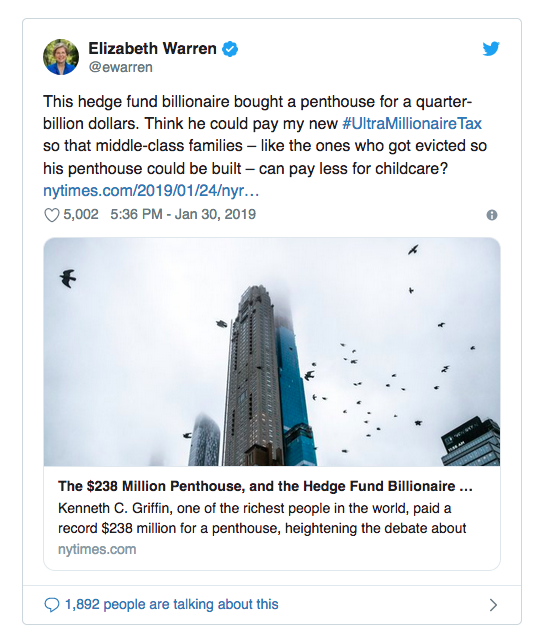
Massachusetts Sen. Elizabeth Warren, who is about to formally launch her Democratic presidential campaign, has proposed a 2 percent tax on net worth above $50 million and a 3 percent tax on net worth above $1 billion. The proposal is unique in that it targets assets and not income, and has already faced some constitutional questions.

While critics also note it would be difficult to enforce since it would require the government to value assets, the proposal would be estimated to affect about 75,000 households.

The senator has pitched it as targeting those at the tippy-top of the wealth scale, in order to pay for programs like government-backed child care and more.

While Warren targets wealth, other lawmakers have floated the possibility of simply raising the income tax rate for those at the very top. Rep. Alexandria Ocasio-Cortez has pitched, albeit not formally, a 70 percent marginal tax on incomes over $10 million. The democratic socialist lawmaker’s plan is not unprecedented – from 1957 through the 1970s, the tax rate was at 70 percent or higher – but the idea has drawn sharp criticism from Republicans and some moderate Democrats.

OCASIO-CORTEZ DEFENDS CALL FOR 70 PERCENT TAX ON RICH 

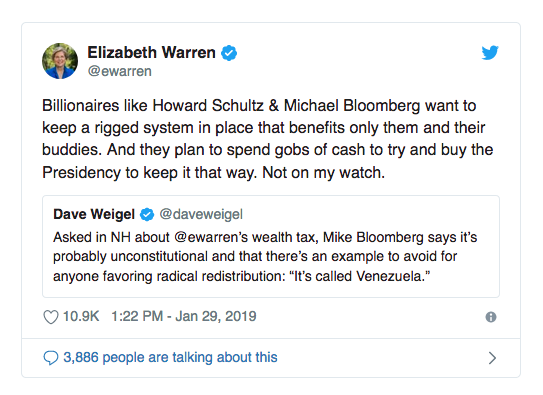
And billionaires like ex-Starbucks CEO Howard Schultz and former New York City Mayor Michael Bloomberg, both of whom are weighing a presidential run, have hit back. Schultz has called a number of the ideas from Democrats “ridiculous,” while Bloomberg last weekend compared Warren’s plan to the type of policy that destroyed Venezuela’s economy.

“We need a healthy economy, and we shouldn’t be embarrassed about our system,” he told reporters during an event in New Hampshire.

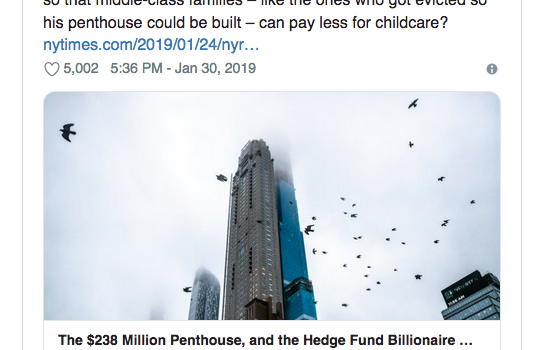
“Billionaires like Howard Schultz & Michael Bloomberg want to keep a rigged system in place that benefits only them and their buddies. And they plan to spend gobs of cash to try and buy the Presidency to keep it that way. Not on my watch,” Warren tweeted.

California Gun Tax

With a supermajority in both houses of the state legislature and a new governor who wants to take a firm stance on gun control, California lawmakers are hoping to quickly pass Assembly Bill 18, which among other things looks to tax the sale of handguns and semiautomatic weapons in order to generate funding for gun control programs.

The bill, which was sponsored by Democratic Assemblyman Marc Levine, would implement “an excise tax on the sales of handguns and semiautomatic rifles” and then hand over the resulting revenue to the California Violence Intervention and Prevention Grant Program (CalVIP).

“California needs to bolster violence prevention initiatives so that they are commensurate with our state’s tough gun laws and as effective as violence prevention programs of other states,” Levine said in a statement earlier this month.

CALIFORNIA VS. TRUMP: NEW STATE LAWS TAKE  ON CLIMATE CHANGE AND WHITE HOUSE ENERGY AGENDA 

The gun-tax legislation has, unsurprisingly, drawn heavy criticism from gun-rights and hunting groups.

“While the legislation lacks details of how the actual proposal will look, it expresses the intent to place an additional tax on handguns and semi-automatic firearms for distribution to various community-based intervention and prevention programs,” the National Rifle Association’s Institute for Legislative Action said in a statement. “Once again, lawmakers are saddling lawful gun owners with additional taxes and fees for the misdeeds of criminals.”

Connecticut Ammo Tax

California is not the only state looking at gun-related taxes.

A Democratic Connecticut state legislator introduced a bill on Monday that would raise the tax on ammunition in the state by 50 percent.

“Currently, ammunition is taxed at the same rate as other products, but we want to increase it by 50 percent, because we see it as a prevention measure,” Rep. Jillian Gilchrest said in a video posted on Twitter. “For example, if someone were to buy a 50 cartridge box of ammunition, which goes for about $10, it would increase the price to $15.”

Gilchrest goes on to explain that military and law enforcement members would be exempted from the tax, though those exemptions do not appear in an initial draft of the bill posted to the Connecticut state legislature’s website.

In a statement Tuesday, the NRA condemned Gilchrest’s effort.

“This dreadful legislation punishes law-abiding citizens and makes it harder to learn how to safely use firearms,” the NRA said in a statement posted to Twitter.

Connecticut Grocery Tax

Along with a tax on ammunition, Connecticut is also looking into a possible tax on groceries and prescription drugs.

Connecticut Gov. Ned Lamont is mulling including the tax as part of his administration’s first budget proposal due later this month.

While the details of the possible sales tax are unclear, a local report stated that the tax, if implemented, could be set at the current 6.35 percent sales tax, or limited to 2 percent as recommended by a “fiscal stability commission.”

Even the consideration of such a tax, however, is sparking a backlash against the Democratic governor in the state with a history of high taxes.

“People throughout Connecticut are bracing themselves and their financial plans so they can manage the brunt of Governor Lamont and Connecticut Democrat lawmakers and their new taxes and proposals,” House Republican Leader Themis Klarides told Fox News. “Targeting groceries and medication to generate revenue is a terrible strategy.”

New Jersey ‘Rain Tax’

New Jersey residents could be hit with what Republicans are calling a “rain tax,” if Democratic Gov. Phil Murphy signs newly passed legislation.

The bill, approved by the New Jersey Assembly and the Senate, would allow municipalities to create utilities that can collect fees from homeowners and business owners that have large paved surfaces, like driveways and parking lots. During storms, rainwater mixes with pollutants on those surfaces before running into sewers and drains. The funding from the fees could be used for upgrades to reduce the impact on the environment.

“With all the salt that we’ve had on roads recently, that’s all running into the sewer systems, so you can’t ignore the problems because they don’t go away,” New Jersey Senate President Steve Sweeney told CBS New York.

New Jersey residents face possible rain tax

The bill would establish a “Clean Stormwater and Floor Reduction Fund,” which would be used for stormwater utilities in the state, as well as water quality monitoring, pollution reduction projects and outreach programs, according to the legislation.

But Republicans have blasted the plan, dubbing it a “rain tax” and complaining the state already has implemented too many costs on residents.

“We all want to protect our environment. We all want to preserve it for future generations, but this is a weighted tax,” Sen. Tom Kean Jr. told CBS New York. “The citizens of New Jersey…really [have] no way to defend themselves against tax increases at local levels.”

Nebraska Beer Tax

It’s not just Democrats who have introduced recent tax proposals.

Two Republican state senators in Nebraska, Tom Briese and Curt Friesen, have introduced two bills that, if enacted, would amount to a 345 percent increase in the tax on beer, wine and liquor.

While the lawmakers contend that the tax would only amount to a 10 cent increase in the price of a mug of beer and is part of the solution to lowering property taxes on the state’s farmers, brewers in the Cornhusker State are not happy.

“We’re really scared that if this passes, it will stop the growth of this industry,” Gabby Ayala, the executive director of the Nebraska Craft Brewers Guild, told the Omaha World-Herald. “Other states that have high taxes don’t have as many breweries — it stops people from wanting to invest and expand.”

CLICK HERE TO GET THE FOX NEWS APP

Craft brewers in Nebraska argue that their businesses are reviving small communities and are an economic success story in a state heavily reliant on farming.

“These breweries are the only real bright spot in a lot of little towns,” said Caleb Pollard of Scratchtown Brewing Co. in Ord, a town of 2,100 people.

While the bill has faced some opposition, lawmakers looking into property tax relief proposals say that so-called “sin taxes” – those on alcohol, tobacco and gambling – make sense.

“We do have a property tax crisis in Nebraska,” Briese told the newspaper. “The responsible approach to provide immediate and substantial relief is to access other taxes.”

Source: US Government Class

Lujan Grisham releases donor details of $700,000 spent on inauguration

Santa Fe New Mexican – Organizers of Gov. Michelle Lujan Grisham’s inauguration spent more than $700,000 on last month’s festivities, according to financial disclosures published Thursday.

The newly elected governor’s inaugural committee reported raising nearly $873,000 to ring in the Democrat’s ascendance to New Mexico’s highest office, with many of the single biggest donors coming from the insurance, gambling and energy industries.

Unlike campaigns and political action committees, the committees that organize inaugural events for New Mexico’s governors are not required to disclose details of spending or fundraising. But Lujan Grisham said shortly after her election in November that she would make the finances of her inaugural committee public. Thursday’s reports offered insight into the money behind the biggest party of the season in New Mexico politics.

Lujan Grisham’s inaugural committee elected to cap donations at $11,000, and more than three dozen donors gave the maximum.

Several of the biggest donations came from the insurance industry, including Presbyterian Health Plan, Torchmark Corp., Health Care Services Corp., Molina Healthcare, Poms and Associates, and Delta Dental Plans.

Others contributions came from in energy and mining, such as Exxon Mobil, ConocoPhillips, Devon Energy, Select Energy Services and Intrepid Potash.

The gambling industry gave big, too, with companies including Sunray Gaming of New Mexico as well as All American Ruidoso Downs.

Additionally, several people with ties to groups that are either seeking the state’s approval to build a new horse-racing track and slot machine casino — or actively opposing it — gave tens of thousands of dollars to Lujan Grisham’s inaugural committee.

The funds paid for a public swearing-in ceremony and $100-a-ticket ball at the Santa Fe Community Convention Center on New Year’s Day as well as another ball at the Eldorado Hotel and Spa later that evening with tickets starting at $500.

The committee reported spending nearly $112,000 at the Eldorado Hotel and Spa as well as $88,000 on Walter Burke Catering and nearly $86,000 on Occasion Services, an event-planning firm. The committee spent hundreds of thousands of dollars on expenses such as audio and video, rental fees for the convention center, staff, entertainment and advertising.

Remaining funds will be donated to charity, the committee said.

The committee published these details on its website, providing a name, home state, amount and date of contribution for each donor.

Inaugural committees for past governors have disclosed some financial information, too.

The committee that organized the 2011 inauguration of Lujan Grisham’s predecessor, Susana Martinez, reported raising about $966,400, for example. It did not, however, initially disclose its spending.

Donations to Gov. Michelle Lujan Grisham’s inaugural committee

View the inaugural committee’s list of contributions and expenses.

Source: US Government Class

lexandria Ocasio-Cortez introduces 2020 policy test with Green New Deal

CBS News – Alexandria Ocasio-Cortez isn’t old enough to run for president. But the freshman congresswoman from New York introduced a Green New Deal resolution on Thursday that is already emerging as a key policy test for 2020 Democratic candidates.

“Our first step is to define the problem and define the scope of the solution,” Ocasio-Cortez told reporters during a Thursday afternoon press conference for her newly-introduced proposal, which was quickly backed by Democratic presidential hopefuls Senators Kirsten Gillibrand, Kamala Harris, Elizabeth Warren and Cory Booker. “Small, incremental policy solutions are not enough.”

Several contenders vying for the Democatic nomination have expressed support for the underlying principles of the sweeping resolution to combat climate change, and activist groups energized by the November midterm election wins have been pressuring candidates to sign on as co-sponsors.

“We are going to be pressuring all the 2020 contenders, especially the senators, to co-sponsor the bill,” Stephen O’Hanlon, a spokesperson for the Sunrise Movement, a climate change group that staged a high-profile sit-in in House Speaker Nancy Pelosi’s office in November which Ocasio-Cortez attended, told CBS News. “It will make clear who is just using it as a buzzword and who is taking it seriously.”

Progressive activists are “extremely supportive of the Green New Deal and think of it as the gold standard plan on climate, and expect their presidential candidates to be treating it as such,” said Chad Bolt, associate policy director of Indivisible, a grassroots resistance group. Bolt says the environment ranks among the top three issues for its members.

The resolution introduced by Ocasio-Cortez and Massachusetts Sen. Ed Markey, a Democrat, is broad and light on specifics, and seen more as a roadmap for overhauling the economy than a concrete piece of legislation. The resolution includes plans to decarbonize the economy, reduce greenhouse gases, make sure low-income and minority communities benefit, create a federal jobs guarantee, provide universal health care and make investments in infrastructure.

The Green New Deal proposal is named after President Franklin Roosevelt’s sweeping “New Deal” economic and labor reforms during the Great Depression. It’s aimed a transforming the American economy by ending its dependence on fossil fuels, investing heavily in renewable energy like solar and wind and sparking large-scale job-creation. Some proposals have set the goal to converting the entire U.S. economy to renewable energy within 12 years and eliminating the carbon footprint by 2030.

The lack of specifics could present opportunities and liabilities for presidential candidates. On one hand, it becomes a kind of “catch-all” way to talk about the environment, jobs and economic fairness, issues at the forefront of the party’s primary. But on the other, it could put candidates in a difficult position when pressed on the costs and impact on certain jobs and industries. The debate over Medicare-for-All has already shown the kinds of risks and rewards candidates face.

Republicans have branded the proposal as a costly fringe policy goal, and many centrist Democrats have not backed the initiative. Pelosi referred to it Thursday morning as a “suggestion” and the “green dream.”

“It will be one of several or maybe many suggestions that we receive,” Pelosi told Politico in an interview. “The green dream or whatever they call it, nobody knows what it is, but they’re for it right?”

Later in the morning, Pelosi said she had not seen the proposal. “I do know its enthusiastic and I welcome all the enthusiasm that is out there,” she told reporters during her weekly press conference. Pelosi also named the nine Democratic members of the new Select Committee on the Climate Crisis — and notably left Ocasio-Cortez off the list. The New York Democrat said Pelosi offered her a spot, but she declined it because she wanted to focus on the “legislative” side of climate policy.

Despite some hesitation within the party, the Democratic base sees the proposal as a way for its leaders to capitalize on their new power in Washington.

Read the resolution here:  

In a statement to CBS News on Tuesday, Congressman Raúl Grijalva, Democrat of Arizona, confirmed that he will be supporting the resolution, after initially being reluctant to back it. “The Green New Deal will put the health and well-being of our communities first,” Grijalva said. Its aspirational goals will help our country combat climate change through clean and renewable energy, create millions of new jobs in the process, and safeguard our environment for generations to come.”

Most of the Democratic presidential candidates have also broadly endorsed the idea behind the Green New Deal.

Oregon Democratic Sen. Jeff Merkley, who’s mulling a presidential bid, said the issue should be an integral part of his party’s agenda going forward. On CBSN’s “Red and Blue,” Merkley outlined what he believes should be the key components of a comprehensive Green New Deal.

“The core objectives are some things such as let’s drive a fast transition from fossil fuel, carbon transmission creating energy sources to renewable energy so that we save our planet. Second principle is, let’s create tens of millions of jobs as we renovate our energy economy,” he said Tuesday.  “A third principle — a just transition for fossil fuel workers so that no one is left behind and so we show respect and gratitude for all the work they’ve done to power economy is the decades past.”

Source: US Government Class

Most viewers approved of Trump’s second State of the Union address

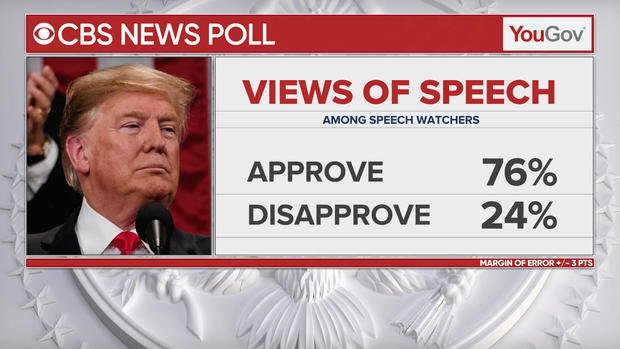
CBS News – Seventy-six percent of Americans who tuned in to President Trump’s State of the Union address Tuesday night approved of the speech he gave. Just 24 percent disapproved.

1-poll-speech-view.jpg
More than three-quarters of Americans who watched the State of the Union approved of the address. CBS News

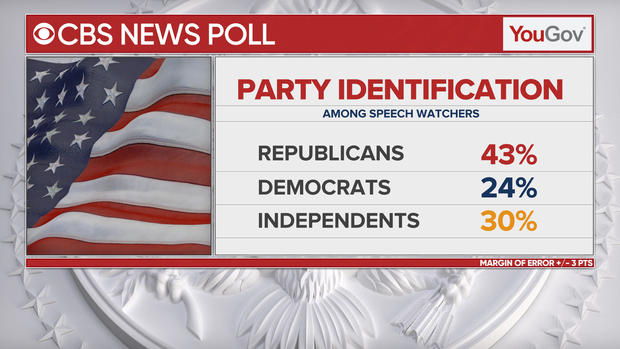
As is often the case in State of the Union addresses, the people who watched tonight’s speech leaned more towards the president’s own party, at least compared to Americans overall. In the latest CBS national poll released last month, 25 percent of Americans identified themselves as Republicans. Among those who watched Tuesday night’s address, that figure was 43 percent, and Republicans helped bolster the overall approval of the address.

2-poll-party-identification.jpg
Those who watched the speech were more likely to be Republicans than the population overall. CBS News

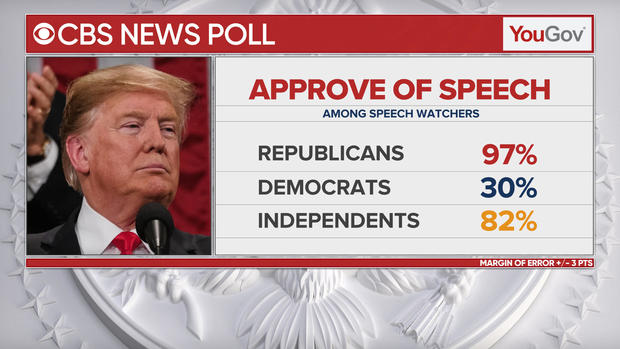
And while 97 percent of Republicans approved of the speech, far fewer Democrats who tuned in did (30 percent). Most independents did approve.

3-poll-approve-of-speech.jpg
Independents largely approved of President Trump’s State of the Union address. CBS News

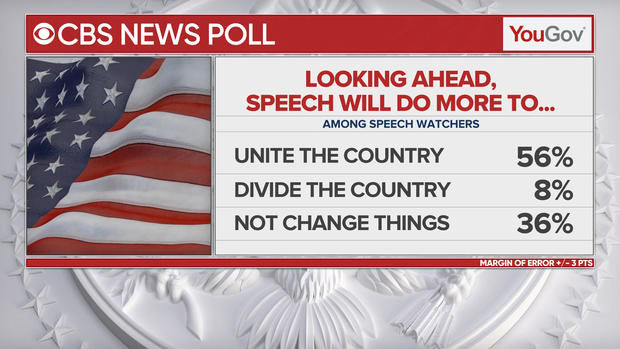
Fifty-six of Americans who watched tonight feel the president’s speech will do more to unite the country, rather than divide it, although 36 percent don’t think it will change things much.

Democrats who watched the speech see things differently, however. Just 15 percent of Democrats think the president’s speech will unite the country.

5-poll-unite-divide.jpg
Most viewers thought the State of the Union would do more to unite the country. CBS News

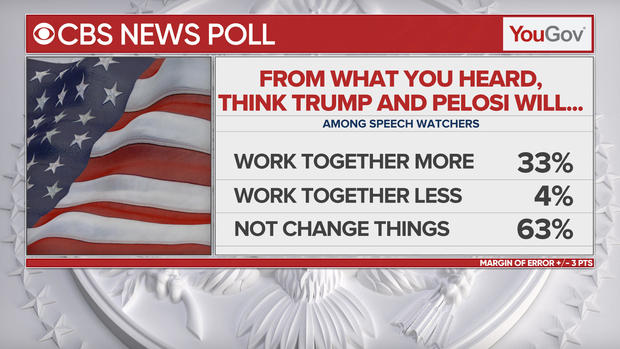
On bipartisanship, just a third said what they heard in the speech made them think Mr. Trump and House Speaker Nancy Pelosi will work together more going forward. Sixty-three percent said there wouldn’t be much change.

4-poll-bipartisan.jpg
But most didn’t think the speech would make the president and Pelosi work together more. CBS News

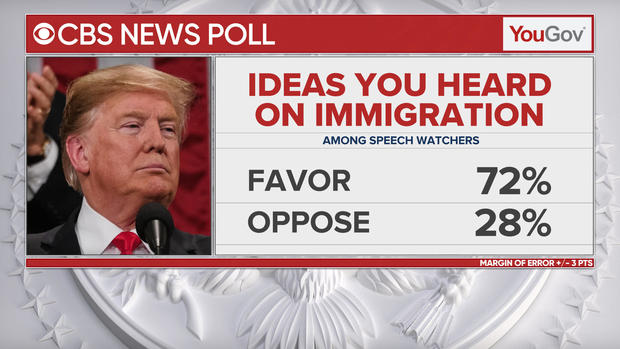
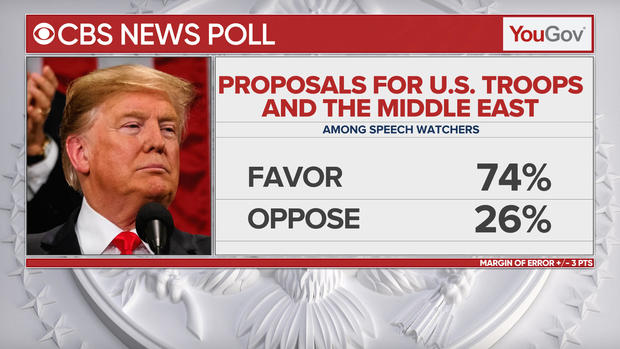
On some of the specific issues the president touched upon, most viewers had a favorable opinion of what Mr. Trump had to say about immigration and what to do about U.S. troops in the Middle East.

6-poll-immigration.jpg
Seventy-two percent of viewers approved of what the president said on immigration. CBS News
11-poll-foreign-proposals.jpg
Most viewers approved of Mr. Trump’s comments on the Middle East. CBS News

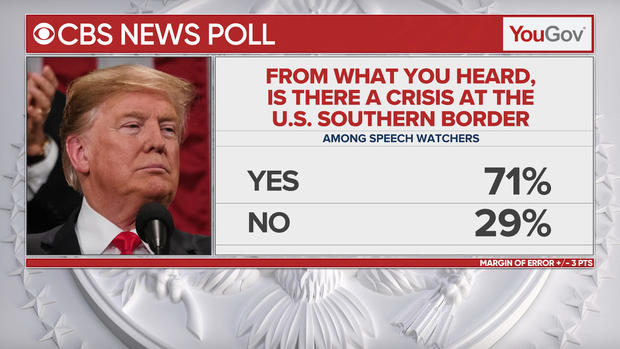
From what they heard tonight, 71 percent of speech-watchers think there is a crisis at the southern border. Democrats who watched do not.

8-poll-border-crisis.jpg
Seventy-one percent of speech-watchers think there is a crisis at the southern border. CBS News

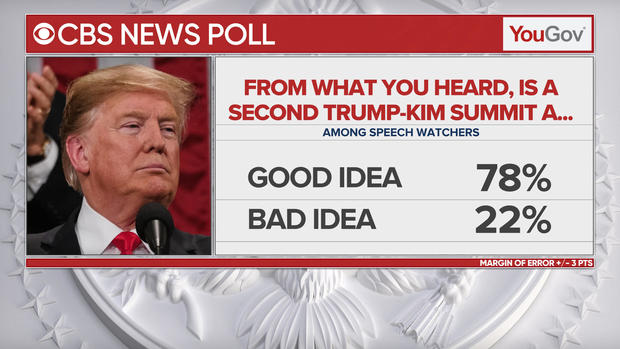
On North Korea, 78 percent of speech-watchers think a second meeting between Mr. Trump and North Korean leader Kim Jong Un is a good idea. Republicans are particularly likely to think it’s a good idea. Most Democrats (57 percent) don’t think it is, but 43 percent do.

10-poll-summit.jpg
Most of those who watched the State of the Union think a second summit with Kim is a good idea. CBS News

This CBS News survey is based on 1,472 interviews of U.S. adults who watched the State of the Union address on Tuesday night. The survey was conducted by YouGov using a representative sample of 9,322 U.S. adults who were initially interviewed online between Feb. 1 to 4, 2019, to indicate whether they planned to watch the address, and if they were willing to be re-interviewed after the address. Only those who watched the address were included in the analysis.

The initial sample of U.S. adults was weighted according to gender, age, race, and education based on the American Community Survey, conducted by the U.S. Bureau of the Census, as well as the 2016 presidential vote. The final sample of post-address re-interviews was weighted to be representative of those who said they would watch the State of the Union address according to gender, age, race, education, and party identification. The margin of error is +/- 3 percent.

Source: US Government Class

State of the Union Fact Check

FactChecking the State of the Union

State of the Union Fact Check: What Trump Got Right and Wrong

FactCheck.org

Summary

President Donald Trump’s State of the Union address included many claims that were familiar to fact-checkers. He has repeated most of these assertions before:

  • Trump wrongly claimed El Paso transformed from one of the most dangerous cities in the nation to one of the safest “immediately” after construction of a border barrier. El Paso was a relatively safe city before construction of a 57-mile-long fence started in mid-2008. And violent crime did not drop in the immediate years after its completion.
  • The president twice referred to human trafficking to make the case for ending illegal immigration. However, experts told us legal ports are the typical mode of entry in the bulk of the cases they deal with concerning foreign nationals.
  • Trump falsely said a “strong security wall” along San Diego’s border with Mexico “almost completely ended illegal crossings.” A government report said the fence “by itself, did not have a discernible impact.”
  • The president urged Congress to pass a border security plan, which includes $5.7 billion for a border wall, by citing the flow of illicit drugs from Mexico. But drugs mainly enter the U.S. in cars and trucks traveling through legal ports of entry.
  • Trump boasted that “more people are working now than at any time in our history –- 157 million.” That’s roughly accurate, but due to population growth, the country has almost continually hit historical employment highs. Since recovery from the Great Recession, the U.S. been setting new records virtually every month since mid-2014.
  • He exaggerated the number of jobs created under his presidency by starting the clock at his election, and he inflated the manufacturing job gain even more.
  • The president said, “African American, Hispanic American and Asian American unemployment have all reached their lowest levels ever recorded.” It’s true the rates have reached the lowest levels ever recorded during the last year, but the gap between white unemployment and the rate for black and Hispanic Americans has remained the same.
  • Trump inflated the reduction in food stamp recipients on his watch by including the last few months under President Barack Obama.
  • Trump mischaracterized New York’s newly passed abortion law and did not accurately represent Virginia Gov. Ralph Northam’s comments about an abortion bill in that state.
  • Trump boasted about the U.S. being the top oil and natural gas producer in the world. Those achievements, however, occurred years ago or have been expected for a long time.
  • He also incorrectly claimed that the U.S. was a net energy exporter. America isn’t yet, but is expected to be in 2020.
  • Trump said that he signed legislation “so that we can finally terminate those who mistreat our wonderful veterans.” But it was already possible to fire VA employees before the Veterans Affairs Accountability and Whistleblower Protection Act became law in June 2017.
Analysis

The president’s address on Feb. 5 had been delayed by a week in the aftermath of a partial government shutdown. His remarks, and the false and misleading claims we noted, mainly concerned the issues of immigration and the economy.

Texas-Size Tale on El Paso

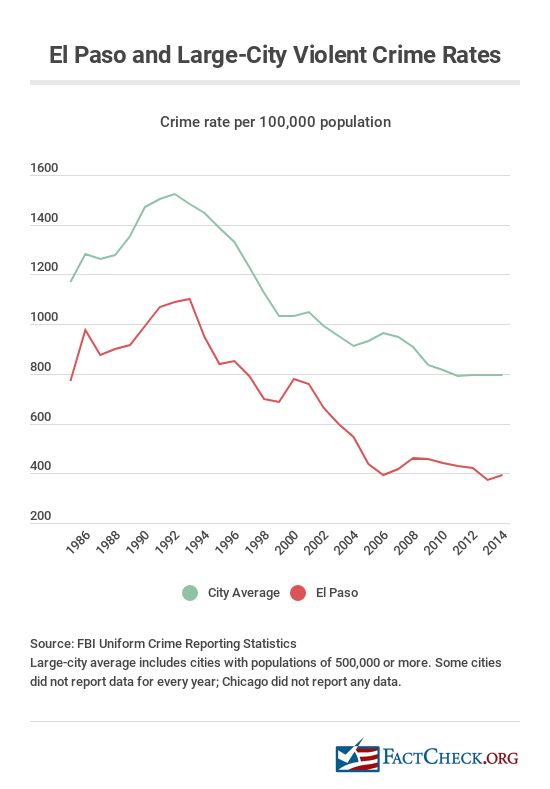
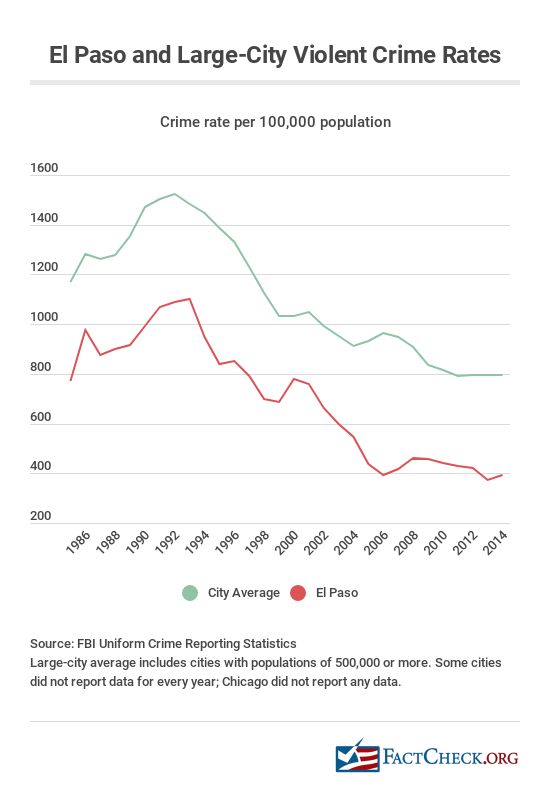
Trump wrongly claimed that El Paso transformed from a city with one of the highest violent crime rates to “one of the safest cities in our country” immediately after a border barrier was erected. Actually, El Paso was a relatively safe city before construction of a 57-mile-long fence started in mid-2008. And violent crime did not drop “immediately” after a fence was completed.

Trump: The border city of El Paso, Texas, used to have extremely high rates of violent crime — one of the highest in the entire country, and considered one of our nation’s most dangerous cities. Now, immediately upon its building, with a powerful barrier in place, El Paso is one of the safest cities in our country.

As we wrote when Trump made a similar claim on Jan. 14, El Paso has never been “one of our nation’s most dangerous cities.” The city had the third lowest violent crime rate among 35 U.S. cities with a population over 500,000 in 2005, 2006 and 2007 – before construction of a 57-mile-long fence started in mid-2008.

Nor did violent crime drop “immediately” after the fence went up. In fact, the city’s violent crime rate increased 5.5 percent from 2007 to 2010 — the years before and after construction of the fence, which was completed in mid-2009. Those years were not anomalies. Violent crime increased about 9.6 percent between 2006 and 2011 — two years before the fence construction began and two years after it was finished.

Along with the rest of the country, El Paso’s violent crime rate spiked in the early 1990s and has been trending downward ever since. The city’s violent crime rate dropped 62 percent from its peak in 1993 to 2007, a year before construction on the fence began.
 

Human Trafficking

Trump referred twice to human trafficking when making the case for ending illegal immigration. However, experts say typically the cases they deal with concerning foreign nationals are people brought through legal ports of entry.

The president said it was time “for the Congress to show the world that America is committed to ending illegal immigration and putting the ruthless coyotes, cartels, drug dealers, and human traffickers out of business.” But ending illegal immigration wouldn’t end human trafficking.

He later said the traffickers “take advantage of the wide open areas between our ports of entry to smuggle thousands of young girls and women into the United States and to sell them into prostitution and modern-day slavery.” There’s no data on how many are smuggled illegally across the border with Mexico for human trafficking, experts say.

“Yes, in some cases it does happen,” Brandon Bouchard, director of media relations for Polaris, which operates the National Human Trafficking Hotline, said of people being smuggled across the border. Based on the group’s experience, however, “we believe the vast majority of people are coming through legal ports of entry.” And the statistics the group has, which come from the calls it receives through the hotline, show that labor trafficking is the largest trafficking issue for foreign nationals.

“When it’s labor trafficking, people are recruited in their home country under false pretenses,” Bouchard told us. “They think they’re coming into the U.S. for a job.”

The available data suggest most come through ports of entry. The United Nations’ International Organization on Migration has found that “nearly 80% of international human trafficking journeys cross through official border points, such as airports and land border control points,” based on 10 years’ worth of cases on which the IOM has assisted.

“Children are less likely to be trafficked through official border points: out of all the children in our sample, official border points are used in 56% of cases,” the Counter-Trafficking Data Collaborative, an IOM initiative, says.

Polaris’ data for the U.S. come from those who call its hotline. From January 2015 through the end of June 2018, calls to the hotline reported more than 35,000 potential victims of trafficking. And of those victims whose immigration status was known (nearly 14,000), half were U.S. citizens or legal permanent residents and half were foreign nationals, according to Bouchard.

Martina Vandenberg, founder and president of the Human Trafficking Legal Center, told us the center searched its database of 1,435 trafficking cases since 2009 for those involving kidnapping or smuggling charges. It found 26 and 29 cases, respectively, that also included those charges. “The data refute the claims Trump is making about the efficacy of a wall,” she said.

Evangeline M. Chan, director of the Immigration Law Project at Safe Horizon, a group that assists trafficking survivors in New York City, said that trafficking “is a much more complex and nuanced problem than most people realize.” The type of coercion used is “a lot more subtle” than a kidnapping-type scenario.

Typically what Chan sees are victims who are “lured into the country with promises of a better life.” They’re “very often brought to the country legally through ports of entry and using visas and legal documents.”

A large portion of the survivors Safe Horizon assists are from Southeast Asia, but the next area of origin is Mexico and Central America, she said.

San Diego Wall Falsehood

Trump also said a “strong security wall” along San Diego’s border with Mexico “almost completely ended illegal crossings.” That’s not accurate.

According to a 2009 report by the nonpartisan Congressional Research Service, the U.S. Border Patrol began in 1990 to build a 14-mile fence along San Diego’s border with Mexico. The fence was completed in 1993, but it could not alone stop the flow of people crossing the border illegally, CRS said.

“The primary fence, by itself, did not have a discernible impact on the influx of unauthorized aliens coming across the border in San Diego,” CRS said.

In response, Border Patrol on Oct. 1, 1994, launched “Operation Gatekeeper,” which provided significant manpower and other resources along the border.

CRS, March 16, 2009: Operation Gatekeeper resulted in significant increases in the manpower and other resources deployed to San Diego sector. Agents received additional night vision goggles, portable radios, and four-wheel drive vehicles, and light towers and seismic sensors were deployed. According to the former INS, between October 1994 and June of 1998, San Diego sector saw the following increases in resources:

  • USBP agent manpower increased by 150%;
  • Seismic sensors deployed increased by 171%;
  • Vehicle fleet increased by 152%
  • Infrared night-vision goggles increased from 12 to 49;
  • Permanent lighting increased from 1 mile to 6 miles, and 100 portable lighting platforms were deployed;
  • Helicopter fleet increased from 6 to 10.

In fiscal year 1992, border patrol apprehended 565,581 immigrants attempting to cross into the U.S. illegally in the 60-mile San Diego sector. Apprehensions fluctuated in the following few fiscal years (531,689 in 1993, 450,152 in 1994, 524,231 in 1995 and 483,815 in 1996) before significantly dropping beginning in fiscal year 1997 (283,889) and the years thereafter, according to USBP statistics.

By fiscal year 2010, apprehensions had dropped to 68,565 and declined further to 26,290 by fiscal 2015.

In a video, CBP credits the decline to a strategy that included “[i]ncreased manpower, utilized intelligence, focused prosecutions, technology was advanced and tactical infrastructure was improved by adding fencing, all-weather roads and stadium lighting.”

The Wall and Drugs

In calling on Congress to approve his border security plan, which includes spending $5.7 billion on a border wall, Trump said it is needed to stop the flow of illegal drugs into the United States from Mexico.

Trump, Feb. 5: Tens of thousands of innocent Americans are killed by lethal drugs that cross our border and flood into our cities — including meth, heroin, cocaine and fentanyl.

However, as we have written, experts — including those within his administration — say that the majority of illicit drugs from Mexico enter the U.S. in cars and trucks traveling through legal ports of entry.

That’s particularly true of deadly opioids — heroin and fentanyl — that the president singled out in his speech.

The 2018 National Drug Threat Assessment says the Southwest border “remains the primary entry point for heroin into the United States.”

“The majority of the [illegal heroin] flow is through [privately owned vehicles] entering the United States at legal ports of entry, followed by tractor-trailers, where the heroin is co-mingled with legal goods,” the report said.

“A small percentage of all heroin seized by CBP along the land border was between Ports of Entry,” the report added.

The DEA report also said Mexican cartels “most commonly smuggle the multi-kilogram loads of fentanyl concealed in” privately owned vehicles through the legal ports of entry.

Last month, U.S. Customs and Border Protection made the largest fentanyl bust in its history when a Mexican national “attempted to enter the United States through the Port of Nogales.” Border agents discovered nearly 254 pounds of fentanyl worth about $3.5 million “concealed within a special floor compartment of a trailer that was laden with cucumbers.”

For an earlier story we wrote in August 2017, Peter Reuter, a University of Maryland criminal justice professor who founded and directed RAND’s Drug Policy Research Center from 1989 to 1993, told us he was skeptical of Trump’s repeated claims that a wall — or more accurately, building additional physical barriers — would stop drugs from coming into the United States from Mexico.

In addition to the fact that most drugs come through legal ports of entry, Reuter said that smugglers have a history of adapting to law enforcement’s attempts to stop the flow of illegal drugs.

A Hollow Employment Boast

Trump said that “more people are working now than at any time in our history –- 157 million.” That’s roughly accurate, but it’s not such a remarkable feat when taking into account steady population growth.

Although Trump is fond of citing this statistic, the number of people working in the U.S. has increased fairly steadily for as long as such figures have been tracked by the Bureau of Labor Statistics.

There have been exceptions, notably during recessions, when the number of people employed has declined even as the population increased. That’s what happened during the Great Recession. But after the Great Recession ended in 2009, the number of people employed in the U.S. began rising steadily (again) in early 2010, and has set historical “records” every month since mid-2014. So President Barack Obama could have correctly claimed that there were more people employed in the U.S. than at any time in the country’s history for 32 straight months at the end of his presidency (though we could find no evidence that he ever did).

A more meaningful way to take the population increase into account is to look at the labor force participation rate, which BLS defines as a measure of the number of people in the labor force as a percentage of the population. The labor force participation rate for people ages 25 to 54 in January was 82.6 percent, according to BLS. That’s a little more than 1 percentage point higher than when Trump took office, but it is not the highest in history. It was higher from the late 1980s to the late 2000s, and peaked at 84.6 percent in January 1999.

Another good measure is the employment-population ratio, which is the percentage of the population that is working. Looking again at that statistic just for those ages 25 to 54, the ratio has been steadily climbing since 2011, and was at 79.9 percent in January. But that’s not a record high either. It peaked at 81.9 percent in April 2000.

Later in his speech, Trump boasted, “All Americans can be proud that we have more women in the workforce than ever before.” That’s also not so extraordinary, given population growth. The number of women in the workforce has set records fairly consistently for as far back as the Bureau of Labor Statistics‘ online tool goes, to 1964. As with overall employment, there was a dip in the number of working women during the Great Recession, but the number has been climbing steadily since late 2010, and has again been setting new historical highs every month since July 2013.

Job Creation Exaggeration

Trump exaggerated the number of job gains on his watch.

Trump: We have created 5.3 million new jobs and importantly added 600,000 new manufacturing jobs — something which almost everyone said was impossible to do.

Actually, Bureau of Labor Statistics figures show the economy has added just under 4.9 million jobs since January 2017, when he took office — not 5.3 million. And the economy added 454,000 manufacturing jobs during Trump’s tenure — not 600,000.

Trump prefaced his remark by saying he was speaking of the time “since the election,” thus claiming credit for jobs created during that last months of Barack Obama’s time in office.

But even so, he’s way off on the manufacturing jobs. Only 481,000 have been added since November 2016. To get a gain of 600,000 you must go back to September 2014. Trump is claiming credit for jobs created months before he even announced he was running for the White House.

Employment Context

The president boasted that “African American, Hispanic American and Asian American unemployment have all reached their lowest levels ever recorded.”

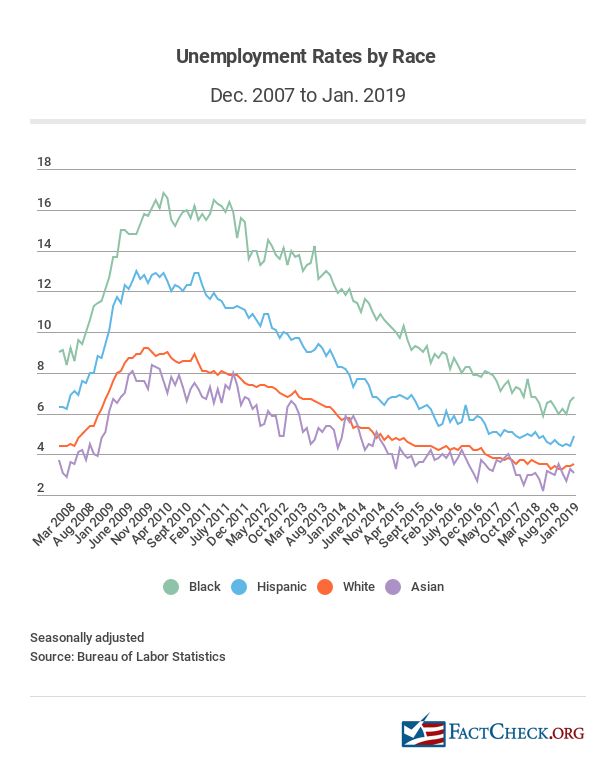
It’s true that the unemployment rates for all three groups reached the lowest ever recorded in at least one month during the last year, but the percentage point gap between white unemployment and the rate for black and Hispanic Americans has remained about the same. Also, the unemployment rates for all Americans, including for African Americans, Hispanics and Asians, has been steadily dropping since late 2010 and early 2011.

The black unemployment rate dropped to its lowest level, 5.9 percent, in May 2018, since the BLS began measuring it in 1972. It has since inched back up, and was at 6.8 percent in January. The white unemployment rate in January was 3.5 percent, or 3.3 percentage points lower than the black unemployment rate. When Trump took office in January 2017, the black unemployment rate was 7.7 percent, 3.4 percentage points higher than the rate for whites.

The percentage point gap between white and Hispanic unemployment rates has also remained about the same. In January 2017, the Hispanic rate, at 5.8 percent, was 1.5 percentage points higher than the rate for whites, and in January, the Hispanic rate was 4.9 percent, 1.4 percentage points higher than for whites.

“The declines in [black] unemployment are tracking those of the overall economy but remain double those of white workers,” Marcus Casey, a fellow in economic studies at the Brookings Institution, told us via email. “This has been the case for a long time. While certainly this looks a lot better than the Great Recession, it’s notable that over this period blacks became more educated and skilled, yet are still unable to break this long historical trend.”

Last year, when Trump similarly took credit for the lowest black unemployment rate in U.S. history, Casey and Bradley Hardy, another Brookings fellow, wrote a paper arguing that “the unemployment rate alone presents a revealing but incomplete picture of economic well-being within any community.”

We also have noted that unemployment rates in general, as well as those for black and Hispanic Americans, have been steadily declining since late 2010 and early 2011. (See chart below.)

The black unemployment rate fell 8.8 percentage points in the seven years before Trump took office, and it has continued to drop in the two years under Trump. The rate was 7.7 percent in January 2017, when Trump took office. So it dropped a little less than 1 percentage point in the two years under Trump.
Food Stamp Inflation

Trump also inflated the reduction in food-stamp recipients.

Trump: Nearly 5 million Americans have been lifted off food stamps.

Actually, since Trump took office, the number has gone down 4.1 million  — not 5 million. That’s as of September, the most recent month for which figures are available.

Once again, Trump is padding his numbers by claiming credit for things that occurred during Obama’s final months as president, after Trump was elected but before he took office.

Abortion

The president’s comments on two state abortion bills require context.

Trump: Lawmakers in New York cheered with delight upon the passage of legislation that would allow a baby to be ripped from the mother’s womb moments from birth. These are living, feeling, beautiful babies who will never get the chance to share their love and their dreams with the world. And then, we had the case of the governor of Virginia where he stated he would execute a baby after birth.

The New York law the president referenced is the Reproductive Health Act, which Democratic Gov. Andrew Cuomo signed on Jan. 22, the anniversary of Roe v. Wade. As we’ve written in more detail, the law modifies the state’s existing abortion law to expand the circumstances under which abortions after 24 weeks are allowed.

Previously, pregnancies after 24 weeks could be terminated only if they were life-threatening. The new law provides for two more instances in which abortions would be allowed: the “absence of fetal viability” or to protect the patient’s health.

Trump also alluded to statements Gov. Ralph Northam made in a radio interview following the controversial introduction of a similar abortion bill in Virginia. In the interview, Northam, who is a physician, said third-trimester abortion is “done in cases where there may be severe deformities. There may be a fetus that’s nonviable. So in this particular example, if a mother’s in labor, I can tell you exactly what would happen. The infant would be delivered, the infant would be kept comfortable, the infant would be resuscitated if that’s what the mother and the family desired. And then a discussion would ensue between the physicians and the mother.”

Northam’s words were interpreted by some to mean that he was suggesting infanticide. As multiple news outlets reported, Northam later clarified that he was not talking about infanticide. A spokesperson for Northam said his comments were “focused on the tragic and extremely rare case in which a woman with a nonviable pregnancy or severe fetal abnormalities went into labor.”

Energy

Trump claimed credit for the country’s energy resources, saying, “We have unleashed a revolution in American energy — the United States is now the number one producer of oil and natural gas anywhere in the world.”

It’s true that America is the top producer of both oil and natural gas. But, according to the Energy Information Administration, the United States became the top natural gas producer in 2009 after surpassing Russia, and also has been number one in petroleum production since 2013.

Over the summer, the EIA announced that America’s crude oil production exceeded Russia’s for the first time since 1999, making it the leading producer in the world. But the boom has been in the works for a decade, and has long been expected. As we’ve written before, the International Energy Agency predicted in its 2012 World Energy Outlook that the U.S. would take the top crude oil spot by 2020, driven by hydraulic fracturing, or fracking.

Trump also said that “for the first time in 65 years, we are a net exporter of energy.” The United States is not yet a net exporter of energy. As of Jan. 29, the EIA predicted that the nation would export more energy than it imports in 2020. That’s soon, but it’s not a milestone that the president can accurately claim.

The EIA explains that America has imported more energy than it exports since 1953. The anticipated switch to net exporter is due to increases in crude oil, natural gas and natural gas plant liquids production that outstrip domestic consumption.

VA Firings Possible Before

Trump said that “after four decades of rejection, we passed VA Accountability so that we can finally terminate those who mistreat our wonderful veterans.” But it’s not true that nothing could previously be done to fire VA employees.

As we’ve written before, the bipartisan Veterans Affairs Accountability and Whistleblower Protection Act aims to make it easier for the VA secretary to remove employees by, among other things, shortening the firing process and expediting the appeals process for senior executives. However, employees could still be fired before that legislation became law.

The Office of Personnel Management keeps data on federal employment, including terminations for discipline or performance going back to fiscal year 2005. The data show that, on average, the VA fired about 2,300 employees each fiscal year before Trump’s presidency. The average is nearly the same when calculated by calendar year, which lines up more closely to when presidents take office in late January. (The VA had more than 388,000 total employees, as of June 2018, according to OPM.)

For example, the VA terminated 3,321 people for performance and disciplinary reasons in 2017, and 1,181, or 35.6 percent, of all those firings occurred in the five full months before Trump signed the legislation into law in late June 2017.

New York Times

President Trump appeared in front of a joint session of Congress for the annual address. Here is how his remarks stacked up against the facts.

President Trump during the State of the Union address on Tuesday.CreditSarah Silbiger/The New York Times

President Trump leaned hard on the strength of the American economy during his second State of the Union address on Tuesday, but with a blend of precise statistics and gauzy superlatives that are much more difficult to measure.

He also returned to a theme that dominated the second year of his presidency — a quest for a border wall with Mexico to cope with what he said is a crisis of crime and drugs in the United States caused by illegal immigration.

The two issues dominated his address, which in tone was more measured than his biting Twitter feed, but in substance contained numerous claims that were false or misleading.

Here is what Mr. Trump said and how it stacked up against the facts.

“The U.S. economy is growing almost twice as fast today as when I took office, and we are considered far and away the hottest economy anywhere in the world.”

The American economy expanded at an annual rate of 3.5 percent in the third quarter of 2018. Growth in Latvia and Poland was almost twice as fast. Same for China and India. Even the troubled Greek economy posted stronger growth. And a wide range of economic analysts estimate that the growth of the American economy slowed in the fourth quarter, and slowed even further in the first month of 2019.

“We recently imposed tariffs on $250 billion of Chinese goods — and now our Treasury is receiving billions and billions of dollars.”

Since Mr. Trump imposed tariffs on certain imports from China — and imported steel and aluminum from around the world — federal tariff revenues have increased. Revenues from customs duties, which include tariffs, rose by $13 billion in the third quarter of 2018 compared with a year earlier, the Commerce Department reported. Technically, that money is paid by Americans who bring the goods across the border, and it is often passed on to American consumers in the form of higher prices.

“My administration has cut more regulations in a short period of time than any other administration during its entire tenure.”

The Trump administration has slowed the pace of adopting new rules, and it has moved to roll back some existing or proposed federal regulations, particularly in the area of environmental protection. The White House claimed that as of October, a total of $33 billion worth of future regulator costs had been eliminated. But experts say the scale of the rollbacks in the Trump era still does not exceed extensive cuts in federal rules during the Carter and Reagan administrations, when rules governing airline, truck and rail transportation were wiped off the books, among other changes.

“We have created 5.3 million new jobs and importantly added 600,000 new manufacturing jobs — something which almost everyone said was impossible to do, but the fact is, we are just getting started.”

The Bureau of Labor Statistics reports that since January 2017, when Mr. Trump took office, the economy has added 4.9 million jobs, including 454,000 jobs manufacturing jobs. Far from being “impossible,” that is closely comparable to the pace of job creation during some two-year periods during the Obama administration, and significantly slower than the pace of job creation in manufacturing in the 1990s.

Wages were “growing for blue-collar workers, who I promised to fight for. They are growing faster than anyone thought possible.”

Wages are rising faster for construction and manufacturing workers than workers in service occupations, according to the Labor Department.

“More people are working now than at any time in our history.”

While the total number of people working in the United States is higher than ever, it is not because of the president’s policies. It is because more people than ever live in the United States.


“The border city of El Paso, Tex., used to have extremely high rates of violent crime — one of the highest in the entire country, and considered one of our nation’s most dangerous cities. Now, immediately upon its building, with a powerful barrier in place, El Paso is one of the safest cities in our country.”

El Paso was never one of the most dangerous cities in the United States, and crime has been declining in cities across the country — not just El Paso — for reasons that have nothing to do with border fencing. In 2008, before border barriers had been completed in El Paso, the city had the second-lowest violent crime rate among more than 20 similarly sized cities. In 2010, after the fencing went up, it held that place.

“San Diego used to have the most illegal border crossings in our country. In response, a strong security wall was put in place. This powerful barrier almost completely ended illegal crossings.”

Border apprehensions decreased by 91 percent in the San Diego sector between the 1994 fiscal year, right after the original border fencing was completed, to the 2018 fiscal year. But, according to the Congressional Research Service, that fence alone “did not have a discernible impact” on the number of immigrants crossing the border into the United States illegally.

“As we speak, large, organized caravans are on the march to the United States.”

At the end of January, a new caravan of thousands of migrants from Central America was headed north, and some of the travelers said they intended to try to cross into the United States. But many in the caravan have said they plan to remain in Mexico, thanks in part to policies put in place by the new Mexican government. President Andrés Manuel López Obrador has made it easier for Central Americans to get visas and work in Mexico. President Trump’s warnings of an imminent invasion from new caravans is overstated.

“I hope you can pass the U.S.M.C.A. into law, so we can bring back our manufacturing jobs in even greater numbers, expanding American agriculture, protecting intellectual property, and ensuring that more cars are proudly stamped with the four beautiful words: Made in the U.S.A.”

The revised trade deal with Canada and Mexico, known as the United States-Mexico-Canada Agreement, does include provisions that are intended to bring manufacturing jobs back to the United States — like minimum wage provisions for some auto manufacturing. But some economists have said those provisions could ultimately push more manufacturing — and jobs — outside North America. The deal does allow American farmers to sell more dairy products to Canada. But the trade pact has yet to be approved by Congress, and both Democrats and Republicans say that is unlikely to happen without significant changes.


“When I took office, ISIS controlled more than 20,000 square miles in Iraq and Syria. Just two years ago. Today, we have liberated virtually all of the territory from the grip of these bloodthirsty monsters.”

The Defense Department reports that the Islamic State now controls only around 20 square miles of territory in Syria, down from 34,000 in 2014. But many of the gains against the Sunni extremist caliphate began under President Barack Obama, with the Trump administration continuing Obama administration policy. And the top American military commander in the Middle East told a Senate hearing on Tuesday that the Islamic State could return if the United States and its allies abandoned the fight. In December, Mr. Trump announced he was withdrawing American troops from Syria.

“We condemn the brutality of the Maduro regime, whose socialist policies have turned that nation from being the wealthiest in South America into a state of abject poverty and despair.”

This has become a popular talking point among American conservatives. It is true that the rule of President Nicolás Maduro of Venezuela has brought that country to economic ruin. Inflation is at astronomical rates, and ordinary people are struggling to get basic food and health supplies. Three million citizens have fled. Some of the collapse can be traced to Mr. Maduro’s economic policies, which do fall under the broad label of socialism. But analysts say that corruption, the lack of rule of law and the absence of democracy — all the hallmarks of a dictatorship — have played just as big or larger roles.

“If I had not been elected president of the United States, we would right now, in my opinion, be in a major war with North Korea.”

In 2016, at the end of the Obama administration, there was no sign that the United States and North Korea were about to go to war, though Pyongyang had been conducting nuclear tests and Mr. Obama had continued economic sanctions. In Mr. Trump’s first year in office, he increased tensions with North Korea by attacking its leader, Kim Jong-un, in a series of Twitter posts, which prompted hostile statements from Pyongyang. Mr. Trump wrote that North Korea’s actions would be met with “fire and fury” and called Mr. Kim “Little Rocket Man.” Analysts said at the time that the chances of war between the two nations had grown because of these exchanges.


“Lawmakers in New York cheered with delight upon the passage of legislation that would allow a baby to be ripped from the mother’s womb moments from birth.”

On Jan. 22, the 46th anniversary of the Supreme Court’s landmark decision Roe v. Wade, Gov. Andrew M. Cuomo, Democrat of New York, signed the Reproductive Health Act. The new law ensures a woman’s right to an abortion in New York if Roe v. Wade were to be overturned. It does not broadly allow abortions until shortly before birth, as Mr. Trump suggested. Instead, it will allow for an abortion after 24 weeks to protect the mother’s health or if the fetus is not viable. Under the prior law, abortions were allowed after 24 weeks only if the woman’s life was in jeopardy.

“We had the case of the governor of Virginia where he stated he would execute a baby after birth.”

In an interview last month, Gov. Ralph Northam said that he supported a late-term abortion bill that would loosen restrictions on the procedure, and allow women to consult with a doctor on an abortion up to, but not including, the time of birth.

The governor, a pediatric neurologist, also talked about some of the dangerous medical emergencies that pregnant women could face, such as carrying a nonviable fetus. He said that in such a case, the mother would deliver the infant and then, “the infant would be resuscitated if that’s what the mother and the family desired, and then a discussion would ensue between the physicians and the mother.” While Mr. Northam was talking about an end-of-life care discussion in the case of a child that would not live, Republicans seized on his remarks as evidence that Mr. Northam supported killing babies after their birth.

Reporting was contributed by Eileen Sullivan, Michael Tackett, Linda Qiu, Edward Wong, Eric Lipton, Eric Schmitt, Adam Liptak, Binyamin Appelbaum, Caitlin Dickerson, Charlie Savage, Coral Davenport, Glenn Thrush, Helene Cooper, Jim Tankersley, Julian E. Barnes, Katie Benner, Matt Phillips, Robert Pear and Thomas Gibbons-Neff.


Source: US Government Class

U.S. job gains show employers shrugged off government shutdown

New York Times – Add the recent government shutdown to the list of things that didn’t slow the American job market.

Over the past eight years, the U.S. economy has endured trade tensions, debt-limit standoffs, foreign-policy crises and all manner of natural disasters. Through it all, companies kept on hiring.

The resilience continued in January as employers shrugged off both the month long shutdown and fears of an economic slowdown to add 304,000 jobs, far more than forecasters had anticipated. The report from the Labor Department marked the 100th consecutive month of job gains, more than double the previous record.

“This jobs report is showing no evidence of an economy slowing, certainly not falling into recession,” said Michelle Meyer, chief U.S. economist for Bank of America Merrill Lynch. “It’s still a tight labor market. Employers are still actively looking for jobs, and with wages ticking up, it looks like workers are getting some more bargaining power.”

Friday’s report does not mean the economy escaped the shutdown unscathed. The Congressional Budget Office this week estimated that the funding lapse shaved $11 billion off total output, $3 billion of which will never be recovered. Those totals don’t include indirect costs from permits not issued, loans not processed and flights not taken because of delays at airports.

The effects on spending, investment and output should show up in other government reports, some of which were themselves delayed by the shutdown.

Those disruptions didn’t deter employers, however. The unemployment rate rose slightly, to 4 percent, at least partly because of the idling of hundreds of thousands of federal workers. But hiring in the private sector was strong and broad-based, with manufacturers, retailers and construction companies all adding jobs. Wage growth, which has picked up in recent months after years of sluggish gains, remained solid, and the strong labor market continued to pull in workers from the sidelines.

The Labor Department did revise downward its estimate of December hiring by 90,000 jobs, an unusually large adjustment. But the strong growth in January, combined with upward revisions to earlier months, meant that the pace of hiring, averaged over six months, actually rose.

That combination of strong hiring and modest wage gains has put the economy on a strong, sustainable footing. More jobs means more income for consumers, which leads to more spending, and in turn more hiring.

“The virtuous cycle continues,” said Michael Gapen, chief U.S. economist for Barclays. “What’s kept this recovery going, what’s kept the U.S. economy so resilient to all the things that have clouded the outlook, is a virtuous cycle of a continuously growing U.S. labor market.”

None of the threats to the economy over the past several years have disrupted that central pattern. The shutdown, for example, caused ripple effects throughout the private sector, but companies and businesses also found ways to cope. Ben Herzon, an economist for Macroeconomic Advisers, a forecasting firm, said that as a result, the shutdown’s economic impact might be more muted than simple economic models might suggest.

“The economy is resilient,” Herzon said. “People and businesses find a way to work around these disruptions. People want to buy stuff, and businesses want to find a way to make that happen.”

James Diana and his wife started JD’s Canine Cruiser, a dog-walking and pet-sitting business in the Virginia suburbs of Washington, in 2012. The area’s strong economy has allowed them to expand the business and bring on more contract employees, many of whom are at-home parents and others who might not find work in a less robust economy.

Many of Diana’s customers are federal employees or contractors, and the shutdown hit his business hard. He said cancellations in January were roughly double their normal level, costing him thousands of dollars in lost business. Government workers, he noted, will get back pay, but that won’t help him.

“That actually is lost income for us,” he said. “They’re going to get their money back. I’m not going to get my money back.”

Diana said he pared his own spending, but he also tried to fill in the gap in his business. He doubled down on efforts to find new customers, including on Thumbtack, an online marketplace for hiring people to complete tasks.

“It forced me to go out there and get more clients,” he said — to “really get out there and start cranking.”

A hidden shutdown?

The relative invisibility of the shutdown in Friday’s data wasn’t a total surprise. Because federal workers will receive back pay, the figures counted all of them as having been on payrolls in January, even if they weren’t actually on the job.

Government contractors generally won’t receive back pay, so if they didn’t work, they weren’t counted. Ditto for other private-sector workers who were laid off (or weren’t hired) because of the shutdown. But most economists expected those effects to be small in an economy that employs more than 150 million people. Sure enough, private employers added nearly 300,000 jobs last month.

The shutdown does help explain why the unemployment rate ticked up in January. Unlike the monthly hiring figures, which come from a survey of employers and are based on their payrolls, the unemployment rate is based on a survey of households. In that survey, 175,000 more people than in December reported themselves as being unemployed because of a “temporary layoff” — a total that included government workers.

“Where’s your shutdown impact? There it is,” said Brett Ryan, an economist for Deutsche Bank in New York. “It just showed up in the unemployment rate.”

Cautious, but still hiring

Economists have become increasingly concerned in recent months about a range of possible threats to the United States economy. Growth has slowed in Europe and China; trade tensions are threatening the American manufacturing sector; stock market jitters could make consumers less likely to spend; and the shutdown, of course, could erode confidence among consumers and businesses.

None of that, however, has yet affected the job market.

“There’s a caution or concern in people’s voices, but it hasn’t turned into action,” said Teresa Carroll, executive vice president for Kelly Services, a staffing firm. “Anybody in a hiring situation in a company is probably waiting for that next shoe to drop, but it doesn’t mean they’re stopping.”

It isn’t just Friday’s data that looked strong. Claims for unemployment insurance recently hit a nearly 50-year low. Paychecks are growing — data released Thursday showed that wages and salaries rose 3.1 percent in the final three months of 2018 compared to a year earlier, the fastest growth since the recession ended a decade ago. And employers report in private surveys that they plan to keep on adding workers, at least if they can find them.

“The underlying foundation hasn’t changed,” said Becky Frankiewicz, president of ManpowerGroup North America, a staffing firm. She said what she was hearing from clients was “nice, robust optimism continuing around hiring.”

As the unemployment rate has fallen, companies have had to work harder to find workers. Frankiewicz said companies are increasingly offering training, rethinking job requirements and letting employees work remotely. They are also raising pay — a factor that may be attracting people who had previously stopped looking for work. The labor force grew by nearly half a million people in January, suggesting that more Americans are willing and able to work than the low unemployment rate might indicate.

“If wages are rising, that gives a greater incentive for folks to come back into the labor force and look for jobs,” Meyer of Bank of America Merrill Lynch said.

More complications for policymakers

Earlier this week, the Federal Reserve signaled that it was pressing “pause” on plans to continue raising interest rates this year. Jerome H. Powell, the Fed’s chairman, said “the case for raising rates has weakened somewhat” because of low inflation and slowing global growth.

Friday’s report seemed to offer a sharp counterpoint to those comments. The economy, at least in the United States, still seems strong, and wage growth has been picking up.

Still, economists said the report was unlikely to lead the Fed to reverse course yet again.

“This is just one piece of news,” Ryan of Deutsche Bank said. “They’re going to have to see several more of these before they’re comfortable hiking again.”

For President Trump, whose approval ratings have been battered by the shutdown, the Russia investigation and other factors, Friday’s data was welcome news. Both Trump’s re-election campaign and the White House issued news releases highlighting the jobs figures, and the president hailed the report on Twitter.

Source: US Government Class

Bill lets parties choose: Open primaries or pay for them

One lawmaker wants to give political parties a choice of whether to let independent voters participate in primary elections.

The option is: Let independents vote or pay for the election yourselves.

Backers hope Senate Bill 418 will win over legislators wary of letting just any voter help pick their party’s nominees.

If it does, the bill could also end for now a long-running debate over the role of independent voters, who are a growing segment of the electorate in New Mexico. It is one of 14 states where a voter must be affiliated with a party to cast a ballot in a primary.

The bill has an unlikely champion in its sponsor, Sen. Mark Moores, R-Albuquerque. He has voted against open primaries in the past.

Moores has been sympathetic to the argument that requiring political parties to let independents vote in primaries would violate the rights of free association.

“The government should not be able to tell the Republican Party or the Democrat Party how to do it,” he said.

But, Moores said, taxpayers should not have to cover the costs of a party’s primary if independents do not have the right to participate.

In fact, a group of independent voters represented by former state Attorney General Paul Bardacke is making the case that the New Mexico’s closed primary system is unconstitutional.

“If the taxpayers are going to pay for those primaries, they should be open,” Moores said.

His bill would require that major parties allow independents and voters registered with minor parties to participate in the primaries.

Voters would simply request a party’s ballot at the polls. Voters registered with major parties would not be able to vote in the primaries of other parties. A registered Democrat, for example, could not vote in a Republican primary.

If a party chose not to open primaries to independent voters and covered the election costs, it could largely make its own rules and choose how to run the election. That could open the way to experimentation in voting.

Advocates for open primaries have argued for a range of bills in recent years — none successful.

But groups such as New Mexico Open Primaries say opening the primaries would only be fair and would increase voter turnout.

Twenty years ago, only 10 percent of the state’s voters were not affiliated with a political party. Now, 22 percent of New Mexico’s registered voters are independents.

In communities such as Santa Fe County, a dominant party often runs candidates unopposed in general elections. For example, the only candidates for sheriff in Santa Fe County last year were Democrats. So Republicans and independents did not get to vote for a sheriff unless they switched to the Democratic Party to cast a ballot in the decisive primary.

The House of Representatives is weighing legislation that also would require major parties to open primaries to independent and minor-party voters. But under that measure, House Bill 93, parties would not have a choice of complying.

Other Democrats argue that opening up the primaries would weaken political parties.

“What they’re getting at is they want to make the parties irrelevant,” said Sen. Jerry Ortiz y Pino, D-Albuquerque. “What we ought to be doing is strengthening the parties and allowing more minor parties.”

Moores’ bill will get its first hearing in front of the Senate Rules Committee.

Source: US Government Class