Trump says he’s considering cut in payroll taxes, calls on Fed to cut rates

Washington Times – President Trump confirmed Tuesday that he is considering cuts in payroll taxes and capital gains taxes to spur more economic growth, but said such action wouldn’t be necessary if the Federal Reserve would “do its job” by cutting interest rates further.

While insisting that the U.S. is “very far from a recession” as he prepares for his reelection bid, the president said the government must take extra steps to guard against an economic slowdown and remain competitive.

“You have to be proactive,” the president told reporters at the White House. “So we really need a Fed rate cut.”

While Mr. Trump blames the central bank for holding back the economy, his tariff war with China is also weighing on businesses, especially in the agricultural sector. The president gave one of his most strenuous defenses yet on his protracted trade war by saying he has no choice but to stop China from “ripping off” the U.S. with unfair practices.

“Whether it’s good or bad [for the U.S.] short term is irrelevant,” Mr. Trump said. “We have to solve the problem with China.”


Economic growth in the second quarter slowed to an annual rate of 2.1%, down from 3.1% in the first three months of the year. But consumer spending remained strong in July, and the unemployment rate is near historic lows.

Some economists and Wall Street analysts, pointing to trade tensions and a global economic slowdown, are predicting a recession by sometime in 2021. U.S. stock markets suffered their biggest one-day loss of the year last week, highlighting investors’ concerns.

Although the president and his advisers say the economic outlook remains strong, some White House officials floated the idea Monday of a temporary payroll tax cut to boost the economy. White House economic adviser Larry Kudlow said Sunday that a payroll tax cut wasn’t “on the table,” but the president told reporters at the White House on Tuesday that he has been considering it.

“We’re always looking at the capital gains tax [and] payroll tax,” Mr. Trump said. “Payroll tax is something that we think about, and a lot of people would like to see that.”

Workers pay a 6.2% payroll tax on the first $132,900 of their income, a fee employers must match, to fund Social Security programs.

A proposal to index capital gains for inflation, long considered by the White House, also is picking up momentum. The move would lower taxes primarily for wealthier individuals, and Mr. Trump said one of the attractive features is that he could take the action unilaterally.

“We’ve been talking about indexing for a long time,” he said. “It can be done directly by me. Indexing is something that would be very easy to do. It’s something that I’m certainly thinking about.”

But the president said neither of those moves is imminent, and he made clear that he views more rate cuts by the Fed as the quickest way to provide the broadest, most significant help for the economy.

“I’m not talking about doing anything at this moment,” Mr. Trump said. “I’ve been thinking about payroll taxes for a long time. Whether or not we do it now or not — it’s not being done because of recession. Because legitimately, if we had a cut in interest rates by the Fed … you would see growth like you’ve never seen in this country.”

The Fed cut a key lending rate by one-quarter of a percentage point last month, its first rate reduction since 2008. The president has criticized the central bank and Chairman Jerome Powell repeatedly for raising rates four times last year. He said the rate hikes prevented the economy from growing faster.

Mr. Trump said Tuesday that the central bank should cut rates by at least 1 percentage point “over a period of time.”

“If the Fed would do its job, we’d have a tremendous spurt of growth,” the president said. “We’re looking for a rate cut.”

The Fed’s next meeting is scheduled for mid-September.

Cutting payroll taxes that fund Social Security programs “should not be cut except in extreme situations,” said Steve Wamhoff, director of federal tax policy at the Institute on Taxation and Economic Policy.

In 2011 and 2012, Congress and President Obama reduced the part of the payroll tax paid directly by employees from 6.2% to 4.2%.

“The last Social Security payroll tax cuts were enacted during cataclysmic economic conditions inherited by President Obama and were opposed by many congressional Republicans,” Mr. Wamhoff wrote in a blog post Tuesday.

The Committee for a Responsible Federal Budget estimated that a temporary cut in employees’ share of the Social Security payroll tax would reduce revenue by $70 billion to $75 billion annually for each percentage point.

The group said indexing capital gains would reduce revenue by $100 billion over 10 years.

“There is absolutely no argument for adding another $100 billion to the national credit card — certainly not through administrative fiat,” said President Maya MacGuineas, president of the Committee for a Responsible Federal Budget.

Conservative economist Stephen Moore, who has served as an informal adviser to the White House, told The Washington Times on Monday that officials were discussing the use of revenue from tariffs on China — $30 billion to $40 billion per year — to partially offset a payroll tax cut.

As the administration seeks ways to jolt the economy ahead of the presidential election, Mr. Trump and his advisers are criticizing Democrats and the media for rooting for a recession.

“I think the word ‘recession’ is a word that’s inappropriate because it’s just a word that … certain people in the media are trying to build up, because they’d love to see a recession,” the president said. “We’re very far from a recession.”

Trump campaign manager Brad Parscale slammed MSNBC hosts for having “giddily talked about a recession … and even said a recession would be OK!”

“The liberal media is so deranged by President @RealDonaldTrump that they’re now cheering for the economy to tank,” Mr. Parscale tweeted. “Sorry to disappoint Democrats, but the economy has never been stronger!”

The president acknowledged the political risk he is taking by persisting in his trade war with China. But he said China has lost 2 million jobs in the trade war and will lose “a lot more jobs” if Beijing doesn’t reach a deal with the U.S.

“Somebody had to do something with China,” he said. “Obama should have done it, Bush should have done it, Clinton should have done it. They all should have done it. Nobody did it. I’m doing it. My trade deals aren’t causing a problem. This is something that had to be done.”

He added, “I could be sitting here right now with a stock market that would be up 10,000 points higher, but I didn’t want to do it. I think we have no choice to [confront China], and a lot of people that really know, people that love our country, they’re saying, ‘Thank you very much.’ … And we’re winning because they’re having the worst year they’ve had in decades, and it’s only going to get worse.”

Secretary of State Mike Pompeo said Tuesday on CNBC that Beijing and Washington will continue to communicate, at least by phone, in the next week or 10 days about trade issues.

Source: US Government Class
Trump Wants ‘Intelligent Background Checks’ and Says McConnell Is ‘On Board

New York Times – WASHINGTON — The time is now for lawmakers to come together and pass new laws for “meaningful” background checks on gun purchasers, Mr. Trump said Friday as he left the White House for a political fund-raiser in Southampton, N.Y., followed by a vacation at his golf club in New Jersey.

Less than a week after mass shootings in El Paso and Dayton, Ohio, left 31 people dead, Mr. Trump said there was “tremendous” support for “really common-sense sensible, important background checks.”

The Senate majority leader, Mitch McConnell of Kentucky, was “on board,” Mr. Trump said. And the gun lobby, which in the past has been effective in resisting such measures, would “get there.”

While Mr. Trump suggested there was a greater will now for new gun measures than after previous mass shootings, there were no new major signals on Friday from the National Rifle Association, the White House or Capitol Hill that action on the politically fraught issue was closer to compromise or resolution. And there was no rush for lawmakers, who are on recess, to reconvene early to take up the proposals.

The National Rifle Association’s position on new gun safety measures had not changed. The association’s chief executive, Wayne LaPierre, said Thursday that additional background check measures being discussed in Washington “would not have prevented the horrific tragedies in El Paso and Dayton.”

The organization has succeeded in the past in convincing Mr. Trump to abandon certain gun control efforts. Both Mr. Trump and Mr. McConnell have opposed legislation to expand background checks, including a bill the House passed earlier this year.

So, why now?

“Time goes by,” Mr. Trump said. “I think I have a greater influence now over the Senate and over the House.”

The president directed the White House to see what he might be able to do through executive action if Congress does not act. Former President Barack Obama also considered executive actions, with little success, after Congress did not act after a 2012 mass shooting in a Connecticut elementary school that killed 20 children and six adults.

Some Democratic lawmakers who have pushed for gun legislation in the past were hopeful that the president was right, and that this time was different. But they acknowledged the challenge of upsetting a core group of Mr. Trump’s supporters while he campaigns for a second term in the Oval Office.

“He is at a different point now than he was before, but I’ll believe it when I see it,” Senator Richard Blumenthal, Democrat of Connecticut, said Friday.

Mr. Blumenthal is sponsoring legislation in the Senate that would make it easier for the authorities to take firearms from people considered potentially dangerous. He and other Democrats say the so-called red flag laws and improved background checks go hand-in-hand.

Mr. Trump has not defined what “meaningful” background checks entail. “We’re not talking about anything specific — I can tell you this,” Mr. Trump said.

On Friday, he suggested that a minor’s record, which is typically expunged when he or she turns 18, should be visible to those reviewing a prospective gun buyer’s background, but he did not suggest there was specific proposal to address it.

Mr. McConnell has signaled that he would at least be open to considering new legislation, including red flag laws, though he did not call the Senate back from its August recess to address the issue immediately. Mr. Trump, on Friday, said that an early return to Washington was not necessary, and that lawmakers could expect to start debating proposals when they reconvene next month.

The key to success, Mr. Blumenthal said, would depend on whether Mr. Trump and Mr. McConnell were willing to stand up to the National Rifle Association.

“They have both raised false hopes in the past,” Mr. Blumenthal said.

This time is different, Mr. Trump said. He added that members of the N.R.A. are “great patriots” who love their country and reaffirmed his support for the Second Amendment.

“I really think they’re going to get there,” he said of the association.

And to those who question whether a substantive change in gun laws was realistic, Mr. Trump said, “There’s never been a president like President Trump.”

Source: US Government Class

California sued over new law targeting Trump’s tax returns ahead of 2020 election

The Sacramento Bee – A conservative group is suing California over a new law Gov. Gavin Newsom signed last week that would force President Donald Trump to release the last five years of his tax returns in order to get his name on the state’s 2020 primary ballot.

Trump has yet to weigh in on the issue, though his personal attorney Jay Sekulow told the New York Times that “the state of California’s attempt to circumvent the Constitution will be answered in court.”

Judicial Watch filed a 13-page complaint on Thursday in the Eastern District of California in Sacramento. On Monday, it announced it is seeking an injunction on behalf of four California voters — two registered Republicans, one Independent and one Democrat — to stop the new law.

“We have a general concern that is broader than the concern of a particular candidate,” said Tom Fitton, president of Judicial Watch. “This is part of a pattern of government officials abusing their powers to harass President Trump.”

Fitton said Judicial Watch has not coordinated its legal efforts with Trump or his campaign. He’s not sure if the president will file a separate lawsuit but said Trump has standing to do so because, as a candidate, “he has certain claims that the voters don’t have.”

Judicial Watch argues in its lawsuit that the U.S. Constitution establishes a firm set of eligibility requirements related to age and citizenship and that California’s law violates voters’ “First Amendment right to associate with candidates who choose to preserve their privacy by declining to release their tax returns.”

In a signing statement, Newsom said the Constitution “grants states the authority to determine how their electors are chosen, and California is well within its constitutional right to include this requirement.”

Secretary of State Alex Padilla endorsed the bill and must now defend it in court. His office is charged with administering Senate Bill 27 and posting candidates’ tax returns online. He told The Sacramento Bee in March that “candidates who are serious about holding the highest office in the nation should be transparent about their personal financial interests. … I support SB 27 which will write this vital norm of our democracy into state law.”

Legal experts say Judicial Watch has a compelling case.

Jessica Levinson, a professor Loyola Law School, said the outcome will largely depend on which court hears the case first.

“This is a strong challenge,” Levinson said of the group’s chances of securing an injunction to stop the new law from taking immediate effect. “This is a gray area. Nobody has ever said that this is permissible, and nobody’s ever said it’s not OK. I think it’s a close call because it does in some ways look like more of a requirement (for office) than a ballot access rule. This is really close to the line and potentially over it.”

Newsom’s Democratic predecessor, Gov. Jerry Brown, vetoed a similar proposal in 2017, warning it “may not be constitutional” and could establish a “slippery slope” precedent.

“Today we require tax returns, but what would be next?” Brown wrote in his veto message. “Five years of health records? A certified birth certificate? High school report cards? And will these requirements vary depending on which political party is in power?”

Tim Murtaugh, director of communications for the president’s 2020 campaign, cited Brown’s decision as evidence the state’s new law will not hold up in court.

“There are very good reasons why the very liberal Gov. Jerry Brown vetoed this bill two years ago — it’s unconstitutional and it opens up the possibility for states to load up more requirements on candidates in future elections,” Murtaugh said in a statement.

State Sen. Mike McGuire, D-Heraldsburg, authored Senate Bill 27, dubbed the “Presidential Tax Transparency and Accountability Act.” He called Trump a “catalyst” for the legislation but said the president is not the only person who will be affected. The law also applies to future gubernatorial candidates and 2020 Democratic presidential candidates, three of whom would not presently qualify for the state ballot under the new law.

“This is a fight worth having in the courts, and we look forward to taking the Trump administration head on because we believe it’s a clear case,” McGuire said. “We’re following through with the will of the American people.”

Despite Democrats’ efforts to promote the bill as a measure of transparency, Levinson said it’s clear their intent was to go after Trump.

“It looks like exactly what it is, which is a political ploy to make this look bipartisan when we all know what this is about,” she said. “This is about the fact that President Trump ran for office, broke norms by not releasing his tax returns and California doesn’t like that.”

The bill passed on a party-line vote in both chambers of the Legislature.

“Democrat leadership in this state continues to put partisan politics first — a fact made obvious by Gov. Newsom’s insistence here to waste time and taxpayer money to fight a losing legal battle,” said a statement from Jessica Patterson, chairwoman of the California Republican Party.

Records from the National Conference of State Legislatures’ Election Legislation Database show 10 other states have bills still alive this year that would require presidential candidates to disclose their tax information in order to get their name on the state’s ballot. Bills from five states — Hawaii, Illinois, New Jersey, Rhode Island and Washington — have already cleared one chamber this year.


Source: US Government Class

U.S. preparing to withdraw thousands of troops from Afghanistan in initial deal with Taliban

New York Times – The Trump administration is preparing to withdraw thousands of troops from Afghanistan in exchange for concessions from the Taliban, including a cease-fire and a renunciation of al-Qaeda, as part of an initial deal to end the nearly 18-year-old war, U.S. officials say.

The agreement, which would require the Taliban to begin negotiating a larger peace deal directly with the Afghan government, could cut the number of American troops in the country from roughly 14,000 to between 8,000 and 9,000, the officials said. That number would be nearly the same as when President Trump took office.

The plan has taken shape after months of negotiations between the Taliban and Zalmay Khalilzad, an Afghan-born American diplomat who was appointed by the Trump administration last year to jump-start talks. Officials said an agreement could be finalized ahead of the Afghan presidential election in September, though they cautioned that Taliban leaders could delay and that significant challenges remain.

The proposal is likely to be viewed skeptically by some U.S. and Afghan officials who question the Taliban’s honesty and wonder how the United States can verify whether Taliban leaders are following through. But if approved, it would be one of the most significant steps toward ending the war, a goal that increasingly has bipartisan support.

“I would say that they are 80 or 90 percent of the way there,” said one official, who like others spoke on the condition of anonymity to discuss details of the emerging deal. “But there is still a long way to go on that last 10 or 20 percent.”

A Taliban spokesman, Zabiullah Mujahid, declined to comment about the likelihood of an initial agreement. In a brief telephone interview Thursday, he said he did not know when talks would resume.

“We are hopeful,” he said. “Things look promising that there will be a breakthrough. We hope there won’t be any obstacle, but it also depends on the seriousness of the Americans.”

Khalilzad said in a tweet Wednesday that he plans to resume his next round of talks with the Taliban in Qatar soon and that if the group does its part, an agreement will be finalized.

Additional cuts to U.S. forces would be negotiated as part of discussions involving the Taliban and the Afghan government, U.S. officials said.

Army Gen. Austin “Scott” Miller, the top U.S. commander in Afghanistan, is open to the proposal, two defense officials said, because he believes it would protect U.S. interests by maintaining a counterterrorism force that can strike the Islamic State and al-Qaeda. Miller, who took command in Kabul last September, previously has said that political negotiations are “absolutely” a key to ending the war.

“Neither side will win it militarily, and if neither side will win it militarily you have to move . . . towards a political settlement here,” he said in an interview with ABC News in February.

A spokesman for Miller, Army Col. Sonny Leggett, declined to comment.

U.S. officials acknowledged there are legitimate concerns that the Taliban might not break with al-Qaeda, as Washington has demanded, or stand up to the Islamic State. Still, officials may be content with a partial troop withdrawal that opens the door to additional negotiations and keeps the counterterrorism mission alive as the status quo becomes politically untenable.

The Taliban has refused to talk with the Afghan government, which it calls a puppet regime, until it reaches a deal with the United States on its troops.

A Pentagon spokesman, Cmdr. Sean Robertson, said the Defense Department has not been ordered to withdraw forces from Afghanistan — a point that other officials describing the potential deal also stressed. Robertson declined to discuss what a partial troop withdrawal could include, saying the department does not comment on military planning.

“Our strategy in Afghanistan is conditions-based,” Robertson said. “Our troops will remain in Afghanistan at appropriate levels so long as their presence is required to safeguard U.S. interests.”

Afghan government officials, speaking on the condition of anonymity because of the sensitivity of the discussions, said they expected that an initial U.S. deal with the Taliban would include some U.S. troop reductions but did not know what numbers or timetable might be proposed.

The officials said they were pleased to hear that a U.S. proposal would require the Taliban to meet with them. But some expressed concerns that a partial pullout would embolden the Taliban.

“The Americans call this a peace negotiation, but the Taliban definitely perceive it as a withdrawal negotiation,” one Afghan official said.

A State Department official rejected that view, saying the United States is pursuing “peace” not “withdrawal.”

In recent weeks, U.S. visitors to Afghanistan have included Marine Gen. Joseph F. Dunford Jr., the chairman of the Joint Chiefs of Staff; Marine Gen. Kenneth F. ­McKenzie, the chief of U.S. Central Command; and Secretary of State Mike Pompeo.

The task of explaining the negotiations in Afghanistan to the American public has fallen to Pompeo. On Monday, when asked whether he expected a reduction in U.S. forces before the 2020 election, he said, “That’s my directive.” The following day, he clarified his remarks, saying that “there is no deadline” for the mission there and accusing the news media of misinterpreting his words.

The president wants to draw down forces “just as quickly as we can get there, consistent with his other mission set, which is to ensure that we have an adequate risk reduction plan for making sure that there is not terror that’s ­conducted from Afghanistan,” Pompeo told reporters aboard his plane en route to Thailand.

Trump said this week that he did not know whether all troops will come home from the war before the U.S. election. “We hope in the coming days that we will be able to urge the Taliban to talk,” he said.

Cutting the troop level to 9,000 would require commanders in the field to make some tough decisions on which bases to close and which missions to curtail, and on whether to scale back advising Afghan troops.

One person with familiarity with Miller’s thinking said the general is sure to want to keep open Bagram air base, from which the United States launches counterterrorism strikes in Afghanistan’s eastern mountains. The military also is likely to maintain a significant presence in Kabul, where there are numerous bases, and some troops at Kandahar Airfield, the largest U.S. base in the south.

Meanwhile, U.S. officials say that German troops are likely to keep a presence in northern Afghanistan and that Italian troops will remain in the west.

But some Afghan officials fear that a preliminary deal outlining a U.S. withdrawal could weaken their negotiating position during intra-Afghan talks and eventually leave them alone to fight the ­battle-hardened Taliban.

One of the concerns is that gains made since the fall of the Taliban could be erased if the group, which seeks to reestablish an Islamic emirate, becomes part of a power-sharing government. Women’s rights groups are especially concerned, given the Taliban’s restrictions on women and opposition to educating girls. But the State Department says it has secured agreement with the Afghan government on “next steps on the Afghan peace process.”

In the absence of formal talks between the Afghan government and the Taliban, the militant Islamist group has been willing to meet with a delegation of Afghan leaders in Qatar in recent weeks, with the understanding that the Afghans are not acting in an official government capacity. Though the Taliban officials were reportedly welcoming, progress was not made on preserving fundamental freedoms, according to media reports citing people who attended the meetings.

The State Department declined to comment on the details of the drawdown agreement, but an official said that “any future reductions or withdrawal of forces will be conditions-based.”

State Department officials say a breakthrough hinges on an agreement on four issues: counterterrorism assurances, troop withdrawal, intra-Afghan dialogue and a comprehensive cease-fire. In March, Khalilzad said that he reached agreement on a draft containing the first two points but that a final deal would not conclude “until everything is agreed.”

Khalilzad spent the past 10 days in Kabul for consultations with Afghans in what he described to one reporter as his “most productive visit” there since becoming special envoy. Next he will travel to Pakistan and then Qatar to continue talks with the Taliban, a State Department official said.

In another indication that a force-reduction deal may soon be reached, the Afghan government named a 15-member team Wednesday to negotiate directly with the Taliban. Meetings with the Taliban and the Afghan government would proceed after the U.S. and Taliban officials reach their preliminary deal.

The discussions continue even as violence across the country remains pervasive, with the Taliban controlling more territory than at any point since 2001.

On Sunday, Afghan vice-presidential candidate Amrullah Saleh was targeted in an attack in Kabul that left at least 20 people dead. He has long been an adversary of the Taliban.

On Monday, two U.S. soldiers — Spec. Michael Nance, 24, and Pfc. Brandon Kreischer, 20 — were killed in Uruzgan province in what officials have described as an “insider” attack by an Afghan soldier. Fourteen U.S. troops have died this year from injuries sustained in the conflict.

Last year was the deadliest year for civilians during the entirety of the Afghan conflict, with 3,804 civilian deaths and 7,000 wounded, according to the United Nations.

Nearly 2,400 American troops have died in the country since the war began in 2001 and more than 20,000 have been wounded, according to the Pentagon.

Constable reported from Kabul. Sayed Salahuddin in Kabul and Missy Ryan in Washington contributed to this report.

Source: US Government Class

Democrats pull no punches on second night of primary debate

Washington Post – Former vice president Joe Biden, attempting to regain his footing by adopting a more aggressive and combative posture during a Democratic presidential debate here Wednesday night, faced relentless attacks on his decades-long Senate record on race and criminal justice, immigration and health care, and his commitment to women’s rights.

The exchange showcased many of the deep divides within the party that are taking on greater urgency as the candidates strive to make gains before the field narrows.

Standing between Sens. Kamala D. Harris (Calif.) and Cory Booker (N.J.), Biden swiveled back and forth as his record on and commitment to issues of race were questioned in increasingly pointed ways. Later, Harris and Sen. Kirsten Gillibrand (N.Y.) teamed up to criticize his positions on working women and abortion.

“Everybody’s talking about how terrible I am on all these issues,” Biden said at one point. “Barack Obama knew exactly who I was. He chose me and he said it was the best decision he made.”

But the former president’s legacy also faced frequent scrutiny, as candidates sought to a remarkable degree to distance themselves from his administration’s trade policies and record of deporting millions of undocumented immigrants, and to promote proposals that could dismantle his signature health-care law.

Biden was eager to remind voters of the stature he built over nearly five decades of public service — and to shed the image of him as the halting and lackluster candidate he was in the first debate, in June — by vigorously challenging his opponents’ records. But they were just as sharp with him, drawing attention to his age — 76 — and to positions he still defends.

“There’s a saying in my community,” Booker told Biden amid a discussion about criminal justice. “You’re dipping into the Kool-Aid and you don’t even know the flavor.”

Wednesday’s exchange concluded the second round of 12 scheduled Democratic debates, with some campaigns hoping that they did enough to shake up a race that has largely been guided by four candidates: Biden, Harris, and Sens. Bernie Sanders (I-Vt.) and Elizabeth Warren (Mass.).

If the first night was a showcase of the liberal-vs.-moderate split within the party, the second night put on display other divides and a thirst to have a nominee who represents the party’s growing diversity. Half of the 10 candidates onstage Wednesday at the Fox Theatre were minorities, making it a historically diverse lineup.

“Mr. President, this is America,” Biden said, addressing President Trump, pointing to the diversity in race and experience onstage. “And we are stronger together because of this diversity. Not in spite of it, Mr. President. We love it, we are not leaving it. We are here to stay. And we’re certainly not going to leave it to you.”

Much like the night before, the debate began with a prolonged — and at times intense — discussion about health care, with candidates sparring over whether to eliminate private insurance as part of a push to provide universal coverage.

Harris, who formerly supported Sanders’s Medicare-for-all plan — which would abolish private health insurance and put a government-run plan in its place — released a new proposal Monday that would allow private insurance as long as it followed Medicare’s coverage rules. Biden accused her of being inconsistent in her positions, and of not being forthcoming about the costs for middle-class taxpayers.

“This idea is a bunch of malarkey, what we’re talking about here,” he said. “I don’t know what math you do in New York, I don’t know what math you do in California.”

“Yeah, let’s talk about math,” Harris responded, calling Biden part of the “status quo” and citing the billions of dollars in profits going to the pharmaceutical and insurance industries. “You do nothing to hold insurance companies to task for what they’ve been doing to American families.”

But the verbal crossfire was perhaps most frenetic during a prolonged exchange about the criminal justice system.

Booker had spent the week before the debate forecasting his lines of attack, with an emphasis on Biden’s criminal justice record as a senator, which resulted in harsh penalties for offenders. Referring to Biden’s signature 1994 crime bill, and the increase in African Americans put in prison as a result, Booker called him “an architect of mass incarceration.”

In the weeks leading up to the debate, Biden released a criminal justice policy that would eliminate the death penalty and reduce punishments for some drug offenses, rolling back aspects of the laws he helped put in place.

“This is one of those instances where the house was set on fire and you claimed responsibility for those laws,” Booker said. “And you can’t just now come out with a plan to put out that fire.”

Biden defended his record while challenging Booker over his handling of the Newark Police Department while he was mayor. Biden said Booker stood by idly while the department engaged in stop-and-frisk policies that disproportionately targeted black men.

“If you want to compare records — and, frankly, I’m shocked that you do — I’m happy to do that,” Booker said.

Harris faced criticism for her record as a prosecutor, particularly from Rep. Tulsi Gabbard (Hawaii), who said Harris did not adequately use her power as an insider to protect people victimized by the criminal justice system.

“The people who suffered under your reign as prosecutor, you owe them an apology,” Gabbard said.

New York Mayor Bill de Blasio was implicitly challenged for not firing a New York police officer who killed Eric Garner, an unarmed black man, using an unauthorized chokehold in 2014. Julián Castro, who was housing secretary under Obama, and Gillibrand said the officer, Daniel Pantaleo, should have been fired even though prosecutors had not charged him. Some in the audience jumped in with chants of “Fire Pantaleo” early in the debate.

Although Democrats have uniformly criticized Trump’s immigration policies — which include family separations and mass deportation raids — they have been deeply divided over the appropriate legislative response to a surge of migration at the U.S.-Mexico border.

During the June debate, most Democratic candidates raised their hands when asked whether they would decriminalize unauthorized border crossings, an issue that has since caused a rift in the party.

Castro targeted Biden, who does not favor decriminalizing the crossings.

The former vice president also said he and Castro had sat together in many Cabinet meetings.

“I never hear him talk about any of this when he was [housing and urban development] secretary,” Biden said. “The fact of the matter is, if you cross the border illegally, you should be able to be sent back. It’s a crime. It’s a crime.”

Castro replied: “It looks like one of us has learned the lessons of the past, and one of us hasn’t.” Pointing to various border-control measures, he added: “What we need is politicians that actually have some guts on this issue.”

Biden responded: “I have guts enough to say his plan doesn’t make sense.”

Several candidates pressed Biden to explain whether he opposed the Obama administration’s deportation policies, and he dodged repeatedly.

“I was vice president. I am not the president,” he said. “I keep my recommendations private.”

Booker, who has struggled to wrest away some of Biden’s support among black voters, quickly jumped in with a sharp retort.

“First of all, Mr. Vice President, you can’t have it both ways,” he said. “You invoke President Obama more than anybody in this campaign. You can’t do it when it’s convenient then dodge it when it’s not.”

Obama remains highly popular in the Democratic Party, making any internal critiques of his record politically perilous for candidates vying to become president.

“Am I the only one that misses Barack Obama in this room?” Tom Perez, the chairman of the Democratic National Committee, asked the debate audience in the lead-up to the exchange, as the crowd erupted in cheers.

But as several Democrats onstage Wednesday rushed to criticize Biden, they grew increasingly comfortable with criticizing Obama’s legacy by proxy. The Obama administration’s record on deportations, criminal justice, trade and health care was challenged implicitly and explicitly by several candidates.

Even Biden stepped away from the former president on one issue, saying he no longer supports the Trans-Pacific Partnership, a trade deal Obama backed.

The debate marked a rematch between Biden and Harris. She directly attacked him in the June forum over his willingness to work with segregationist senators, particularly on measures to restrict court-mandated busing as a way to further integrate schools. Biden was caught off guard, with advisers offering various explanations, including that he had endorsed her in her 2016 Senate race and that she had been friends with his late son, Beau Biden.

Before Wednesday’s debate, Biden’s campaign aides insisted that he was ready for the onslaught of attacks, and that he had learned from the first debate in Miami that his record would come under deeper and more personal scrutiny than he had anticipated.

“Go easy on me, kid,” Biden told Harris as she came onstage and shook his hand. She smiled and said, “You good?”

Biden faced a barrage of direct challenges for his record on gender equality and abortion rights, with Gillibrand and Harris leading the charge.

Gillibrand questioned Biden repeatedly about past comments in which he suggested that outsourcing child care was not good for families. She characterized his quotes as being opposed to women working outside the home.

Biden pushed back on the senator from New York, saying that she had previously praised his record on women’s issues and indicating that her attack was politically motivated.

“You came to Syracuse University with me and said it was wonderful I’m passionate about . . . making sure women are treated equally,” he said. “I don’t know what’s happened except that you’re now running for president. So I understand.”

The discussion ended when Biden said he has never thought that women who work outside the home were shirking their responsibilities or hurting their families.

But there was no letup, as Harris immediately jumped in and trained her fire on Biden for his support of the Hyde Amendment, which restricts federal funding for abortion. Last month on the campaign trail, Biden reaffirmed his support for the measure before saying the next day that he would abolish it.

“Why did it take you so long to change your position on the Hyde Amendment?” Harris asked.

More than half of the candidates in the field are at risk of not meeting the polling and donor thresholds to qualify for the next round of debates in September. The first night of the second debate attracted only about half the television audience as the first night of the June debate.

Trump weighed in before Wednesday’s exchange with his views about the first night of the debate, tweeting: “Very low ratings for the Democratic Debate last night — they’re desperate for Trump.”

The contentious and rowdy tone of the debate at times forced Democrats to concede that the president and Republicans might ultimately benefit from their internal squabbles.

“The person that’s enjoying this debate most right now is Donald Trump, as we pit Democrats against each other, while he is working right now to take away Americans’ health care,” Booker said.

Tim Murtaugh, the Trump campaign’s communications director, clipped part of Booker’s quote and endorsed the idea that Trump was enjoying the Democrats’ dust-up.

“Fact Check: TRUE,” he tweeted.

Trump was referenced several times during the debate, with Gillibrand saying the first thing she would do as president is “Clorox the Oval Office” and Andrew Yang, an entrepreneur, saying he was building a coalition of “disaffected Trump voters.”

“For the last three years, we’ve been consumed by a president who, frankly, doesn’t give a damn about your kids or mine,” said Sen. Michael F. Bennet (Colo.). “Mr. President, kids belong in classrooms, not cages. And they deserve something better than a bully in a White House. Let’s end this three-ring circus in Washington.”

Source: US Government Class

The Practical Reasons Candidates Talk About Improbable Policies

NPR – Elizabeth Warren made sure to specially thank South Carolina Rep. James Clyburn when they introduced their student debt forgiveness plan this week.

The reason: he might actually get a vote on it.

“I am deeply grateful to the congressman for taking this first piece on student debt cancellation so that we have a chance to work it through the House. Right now, we’re not likely to get a vote in the Senate,” she said, to chuckles in the audience.

“But [we] have a chance to work it through the House so we can iron out any kinks and get it ready to go so that soon, I hope, we have people in the House and the Senate who are interested in passing this and we have someone in the White House who will sign it into law,” Warren added.

She’s not wrong to hope, but then, this scenario represents an uphill climb for her party. Even if Democrats win the White House and hold onto the House next year, winning the Senate already looks tough.

And even then, to pass some of their most ambitious proposals, Democrats would either need a filibuster-proof majority (60 senators) or to blow up the filibuster altogether, which it’s not clear that all Democratic senators would want to do.

All of which raises a tough, basic question: If a policy just doesn’t seem viable even if a candidate wins, what does the debate accomplish?

“Priming” the issues

It’s not just student debt cancellation; Democrats have discussed a wide variety of potential policies that would be hard to pass, even with a majority in the Senate: reparations for slavery, the Green New Deal, expanding the Supreme Court and “Medicare for All” are dramatic proposals that appear to have very difficult paths to passage. Even a less-drastic proposal, like a public option for health insurance, could be a stretch.

Medicare for All, as presented by lawmakers like Vermont Sen. Bernie Sanders, is maybe the highest-profile example in this primary of a hyper-ambitious plan — not only would it be an overhaul of the U.S. healthcare system, but it would go further than even many existing single-payer systems around the world, as Sarah Kliff has reported at Vox.

And it would have a tough time of passing. Sanders has said he’d try to pass it via reconciliation, which only requires a simple majority of 51 senators. But even if he could, and even if Democrats had 51 senators after 2020, getting those votes would be a stretch considering that an array of current Democratic senators oppose Medicare for All to some degree.

It is still true, however, that debating it now doesn’t do nothing. Politicians like Sanders and Warren may recognize that even if their policies don’t pass in their respective (hypothetical) presidencies, talking about the policy now could lay the groundwork for Medicare for All in the future.

“The campaign does serve the purpose of priming people or helping them to understand the contours of the debate so that when you get to the time that you’re actually trying to pass legislation, people have already had exposure to the issues at play,” said Lanhee Chen, who was policy director on the 2012 Mitt Romney campaign.

It also could open the Overton Window wider, in the process making it more likely that a smaller — but still major — change could happen in the nearer term.

“I think that a very legitimate reason for why a candidate would propose a bold health care plan like Medicare for All, even if they’re not going to be president or if they can’t get it passed is, over the long term, it moves public opinion and political will in your favor and it may be easier to have something like public option,” said Jennifer Palmieri, director of communications on Hillary Clinton’s 2016 presidential campaign.

All of this debate comes at a price, however, says Robert Blendon, professor at Harvard’s T.H. Chan School of Public Health. He believes that talking this much about Medicare for All takes oxygen away from other related issues that voters care about more — and that might have more of a shot at seeing bipartisan changes.

“You give them a list and you discover that they’re actually not talking about Medicare for All or a redo of the Affordable Care Act,” he said. “They’re focused on their own pocketbook issues: high drug costs, charges by hospitals and insurance premiums. And they’re not concerned about overall spending.”

It’s true that Medicare for All proponents argue that their plan would tackle all of these problems. One of their challenges, then, is convincing voters that a wholesale overhaul of the system is the right fix.

Never say never

It’s not that pushing bold ideas is an entirely calculated, cynical move — candidates have ideas they believe in, even if those ideas don’t seem to have much of a path to reality.

On that note, there’s one important caveat: programs are impossible to pass until they’re not. That shift can happen relatively quickly.

“John F. Kennedy ran in 1960 and Medicare for retirees was one of his lead issues,” Blendon says. “He wins and the leaders from the House and Senate meet with him and tell him that’s in no way possible.”

But then, after Kennedy was assassinated and President Lyndon Johnson took office, a couple short years passed, and Congress swung hard toward more liberal Democrats.

“Lyndon Johnson meets with the same leaders and they say, ‘Lyndon, we can pass the Medicare bill,’” Blendon said. “For a big change to occur, you would have to have a change in the president and their leanings and the Congress. But that happens every now and then.”

What candidates get out of it

But from a calculated political point of view, there’s also a lot to gain from talking about these sorts of big, ambitious policies — for one thing, even if ideas like Medicare for All aren’t popular with the total electorate, they are often much more popular with Democratic primary voters.

In addition, putting bold ideas out there can help a candidate tell a particular story about themselves.

“It tells voters that you think you get the depth of the problem,” Palmieri said. “And it tells voters that your inclination is to have a very bold solution, and well beyond the policy, that tells voters something about the kind of person you are.”

For example: talking about Medicare for All helps Sanders reinforce that he wants to remake government — as he put it at the start of a recent speech on the policy: “While we’re at it, let’s make a political revolution.”

Elizabeth Warren, similarly, has rolled out plan after plan — which has helped her craft an identity as the detailed policy thinker of the pack.

On the flip side, Joe Biden is also using Medicare for All to distinguish himself, as he appears to be readying himself to weaponize Kamala Harris’ support for the policy against her in next week’s debates.

Having a list of bold ideas can also be necessary for candidates who are Congress members in a time of gridlock.

“If you’re a senator or a member of Congress and you were running for president, you’re probably not going to have much of a legislative accomplishment record to run on because Congress has been so dysfunctional,” Palmieri says. “So the manner by which you distinguish yourself is a very bold policy idea.”


Source: US Government Class

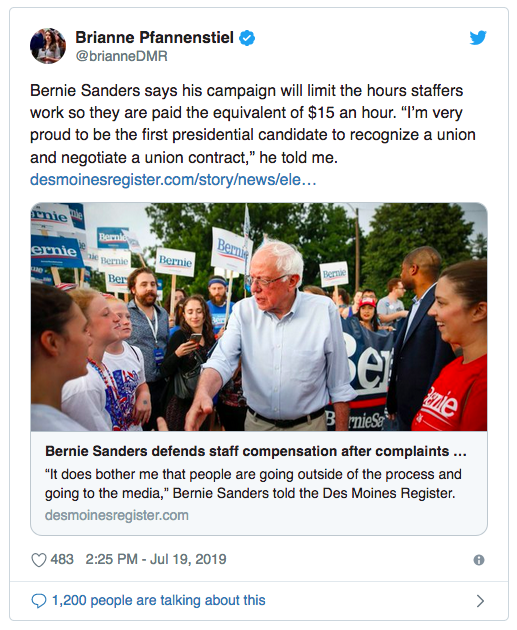
Bernie Sanders campaign announces it will cut hours to pay staffers $15 minimum wage, prompting mockery

FoxNews – Democrat presidential candidate Bernie Sanders announced this weekend he will cut staffers’ hours so that they can effectively be paid a $15-an-hour minimum wage, prompting mockery from critics who say the move is more evidence that Sanders’ plan to raise the national minimum wage is hypocritical and would only lead to less work and more unemployment.

The Washington Post first reported last Thursday that Sanders’ field staffers were upset that Sanders championed a $15 minimum wage on the campaign trail, and made headlines for railing against major corporations who pay “starvation wages” — even as his own employees made “poverty wages.”

In response, Sanders told The Des Moines Register he was “very proud” to lead the first major presidential campaign with unionized workers, but also “bothered” that news of the internal strife had spilled into the media.

The self-described socialist candidate said junior field organizers earn roughly $36,000 per year in salary, with employer-paid health care and sick leave. But he acknowledged that their salary can effectively dip below $15 per hour if staffers work much more than 40 hours per week, which is common on presidential campaigns.

The solution is to “limit the number of hours staffers work to 42 or 43 each week to ensure they’re making the equivalent of $15 an hour,” he told the Register’s Brianne Pfannenstiel.

“It does bother me that people are going outside of the process and going to the media,” Sanders added. “That is really not acceptable. It is really not what labor negotiations are about, and it’s improper.”

He went on to say that the union contract “not only provides pay of at least $15 an hour, it also provides, I think, the best health care benefits that any employer can provide for our field organizers.”

Reaction from commentators and lawmakers was unsparing.

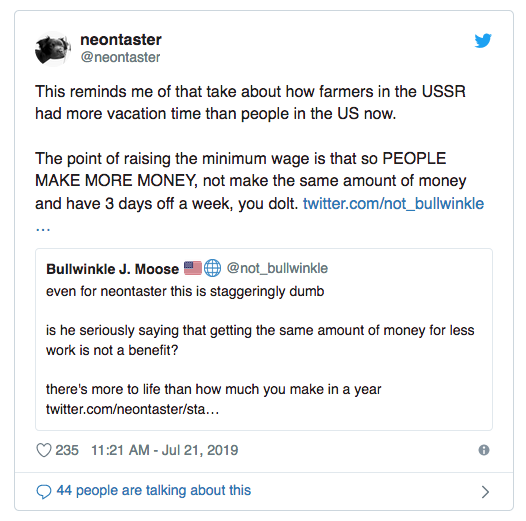
“For the first time in his life, socialist Bernie Sanders practices economics and, buddy, the results are hilarious,” wrote columnist and humorist Stephen Miller. He added: “Why won’t millionaire Bernie Sanders, who owns 3 homes, instead of cutting hours, pay his staff a living wage? People are starving.”

“So does this fall under the category of hypocrisy, irony, or poetic justice?” Crenshaw asked. “All three? Can’t make this stuff up.”

“This situation is an instructive example of the downside of more than doubling the minimum wage,” wrote The Blaze’s Aaron Colen. “Companies don’t just suddenly get more money to pay employees. They have to make tough decisions; usually either cutting hours, or worse, cutting staff.”

Added The Daily Wire’s Ashe Shcow: “This is just *chef’s kiss*.” Ben Shaprio wrote, “In which Bernie Sanders learns about economics.”

The development comes days after the nonpartisan Congressional Budget Office (CBO) concluded that a proposed $15 federal minimum wage could result in 3.7 million people becoming unemployed — far higher than House Democrats’ estimates — as employers struggle to make payroll and respond by slashing jobs and hours.

The CBO noted the “considerable uncertainty” in calculating the impact of the minimum wage from state to state, and indicated that up to 17 million Americans could see pay increases.

Republican leaders have said a minimum wage hike would be “devastating” for middle-class families, citing CBO research finding that the minimum wage hike would also reduce business income, raise consumer prices and reduce the nation’s output. Overall, the CBO said the move would reduce real family income by about $9 billion in 2025 — or 0.1 percent.

Nevertheless, the Democrat-controlled House last week voted in favor of a bill to gradually raise the federal minimum wage to $15 per hour. The current federal minimum wage is $7.25 per hour, unchanged since 2009. The bill is unlikely to see much traction in the Republican-controlled Senate.

The episode underscored a key vulnerability that has dogged Sanders’ campaign for months, and which intensified after Sanders released ten years of his tax returns earlier this year. The documents showed Sanders and his wife paid a 26 percent effective tax rate on $561,293 in income, and made more than $1 million in both 2016 and 2017.

Despite advocating for socialism on the world stage, Sanders donated only $10,600 to charity in 2016 and $36,300 in 2017, the records showed, followed by nearly $19,000 in 2018.

Meanwhile, according to a letter from campaign staffers to Sanders campaign manager Faiz Shakir, workers were being “expected to build the largest grassroots organizing program in American history while making poverty wages.”

“Given our campaign’s commitment to fighting for a living wage of at least $15.00 an hour,” the letter continued, “we believe it is only fair that the campaign would carry through this commitment to its own field team.”

Sanders admitted in a combative Fox News town hall in April that “you’re going to pay more in taxes” if he becomes president.

Source: US Government Class

Chinese Money in the U.S. Dries Up as Trade War Drags On

New York Times – WASHINGTON — Growing distrust between the United States and China has slowed the once steady flow of Chinese cash into America, with Chinese investment plummeting by nearly 90 percent since President Trump took office.

The falloff, which is being felt broadly across the economy, stems from tougher regulatory scrutiny in the United States and a less hospitable climate toward Chinese investment, as well Beijing’s tightened limits on foreign spending. It is affecting a range of industries including Silicon Valley start-ups, the Manhattan real estate market and state governments that spent years wooing Chinese investment, underscoring how the world’s two largest economies are beginning to decouple after years of increasing integration.

“The fact that the foreign direct investment has fallen so sharply is symbolic of how badly the economic relationship between the United States and China has deteriorated,” said Eswar Prasad, former head of the International Monetary Fund’s China division. “The U.S. doesn’t trust the Chinese, and China doesn’t trust the U.S.”

For years, Chinese investment into the United States had been accelerating, with money pouring into autos, tech, energy and agriculture and fueling new jobs in Michigan, South Carolina, Missouri, Texas and other states. As China’s economy boomed, state and local governments along with American companies looked to snap up some of those Chinese funds.

But Mr. Trump’s economic Cold War has helped reverse that trend.

Chinese foreign direct investment in the United States fell to $5.4 billion in 2018 from a peak of $46.5 billion in 2016, a drop of 88 percent, according to data from Rhodium Group, an economic research firm. Preliminary figures through April of this year, which account for investments by mainland Chinese companies, suggested only a modest uptick from last year, with transactions valued at $2.8 billion.

“I certainly hear in conversations with investors a lot of concern about whether the U.S. market is still open,” said Rod Hunter, a lawyer at Baker McKenzie who specializes in foreign investment reviews. “You have a potentially chilling effect for Chinese investors.”

A confluence of forces appear to be at play. A slowing economy and stricter capital controls in China have made it more difficult for Chinese investors to buy American, according to trade and mergers and acquisitions advisers. Mr. Trump’s penchant for imposing punishing tariffs on Chinese goods and an increasingly powerful regulatory group that is heavily scrutinizing foreign investment, particularly involving Chinese investors, have also spooked businesses in both countries.

China, which has retaliated against American goods with its own tariffs, may also be turning off the investment spigot as punishment for Mr. Trump’s economic crackdown.

Concerns about America’s receptiveness to Chinese investment have been aggravated by a flurry of transactions that collapsed under heavy scrutiny from the Committee on Foreign Investment in the United States. The group, which is headed by the Treasury Department, gained expanded powers in 2018 that allow it to block a broader array of transactions, including minority stakes and investments in sensitive technologies like telecommunications and computing.

Shortly after the New Year, China’s HNA Group took a $41 million loss on a glass and aluminum Manhattan high-rise after American regulators forced it to sell the property because of security concerns about its proximity to Trump Tower, only a few blocks away.

In March, the Chinese owners of a gay dating app known as Grindr were told by regulators to find a buyer for the company. The Trump administration feared Beijing could use personal information as leverage over American officials.

Those interventions followed prominent cases earlier in Mr. Trump’s term, such as Broadcom’s quashed bid for Qualcomm and the sale of MoneyGram to a unit of the Chinese e-commerce giant Alibaba last year. An agreement involving Lattice Semiconductor and an investment firm with reported ties to the Chinese government was also rejected.

In some cases, the chill has benefited American companies. In June, UnitedHealth swooped in to buy PatientsLikeMe, a health care technology start-up, after the committee said it was a security risk to allow the company’s Chinese owner to have access to health data. The purchase amount was not disclosed.

But the increased scrutiny is also complicating efforts by American industries to team up with Chinese investors and leading to a retrenchment in certain sectors. The real estate sector, which has been buttressed by investors from China in the last decade, has had a steep falloff as relations sour and as Chinese officials clamp down on foreign real estate investment.

A May report from Cushman & Wakefield noted a “frenzy of disposal activity” among Chinese commercial real estate investors in the United States. In 2018, there were 37 property acquisitions by Chinese buyers worth $2.3 billion, but $3.1 billion of commercial real estate was sold off. The report said that the treatment of HNA and tough trade talk made Chinese investors feel unwelcome.

Chinese investors are also showing less appetite for residential real estate in the United States. Research released recently by the National Association of Realtors found that purchases of homes in America by Chinese buyers declined by 56 percent to $13.4 billion in the year to March.

“The magnitude of the decline is quite striking, implying less confidence in owning a property in the U.S.,” said Lawrence Yun, chief economist at the realtor’s group.

Despite the decline, China was still the top foreign buyer of American properties from April 2018 to March 2019.

The financial sector, including banks and private equity, is also feeling the effects. A fund that Goldman Sachs started with the China Investment Corporation in 2017 is being looked at closely by the Treasury Department, according to two Treasury officials. The fund, the China-US Industrial Cooperation Partnership, was set up to invest in American manufacturing and health care companies and then forge business ties in China.

A Goldman Sachs spokeswoman said that the bank was in compliance with all government regulations.

John Kabealo, a Washington-based lawyer who specializes in cross-border transactions, said that American private equity funds are now less likely to team up with foreign funds when making acquisitions because doing so could raise red flags.

“I think there’s a whole lot of concern in the fund world right now,” Mr. Kabealo said. “Funds still want to take Chinese money, but they’re being much more cautious in the way that they do it.”

The Committee on Foreign Investment in the United States, which previously only had the authority to review transactions in which a foreign investor took a controlling stake of an American business, is now reviewing a broader range of transactions, including joint ventures and smaller investments by foreigners in American businesses that make critical technology.

“There’s certainly a degree of hesitation in China in investing in the U.S.,” said Aimen Mir, the former assistant secretary for investment security at the Treasury Department who recently joined the law firm Freshfields Bruckhaus Deringer. “It’s hard to argue against the fact that these rules have clearly had some impact on Chinese investment.”

Weaker Chinese investment is unlikely to derail the United States economy, as it is a small fraction of that from Britain, Canada, Japan and Germany. China also continues to be largest buyer of United States Treasuries; however, its holdings have fallen in recent years to $1.1 trillion, according to the latest Treasury Department data.

But the decline in investment could hurt areas that are already economically disadvantaged and that have become dependent on Chinese cash. States like Michigan have increasingly wooed Chinese investment, resulting in new factories and jobs in a part of the country that has struggled to recover from the Great Recession.

Craig Allen, the president of the U.S.-China Business Council, said the loss of Chinese investment would be felt predominately in rural states where Chinese investors have bought factories and revived struggling businesses.

“The not-so-welcome mat is out, and it is having a deleterious effect on relatively poorer areas in the United States that need jobs,” he said.

“The Chinese hear from our state and local officials that they’re welcome,” Mr. Allen said. “What they’re hearing from federal officials is quite different.”

In Kentucky’s Ballard County, local officials are grateful that China’s Shanying International Holdings acquired a shuttered paper mill last year. In May, the mill reopened and filled many of the 300 jobs that had been lost.

Mayor Brandi Harless of Paducah, Ky., who traveled to China to meet executives of the company this year, said that it would be a shame if trade tensions hampered manufacturing investments in towns such as hers.

“Given our national conversation, I expected there to be some hesitancy,” Ms. Harless said. “But I haven’t heard anyone in our community be negative about this opportunity.”

Source: US Government Class

Congress Delays Robert Mueller Hearings One Week Amid Dispute Over Questions

CBS News – Former special counsel Robert Mueller’s highly anticipated congressional testimony about his investigation into Russian interference in the 2016 election has been delayed by one week, according to a press release issued Friday evening.

Mueller will now appear before the House Judiciary Committee and House Intelligence Committee on July 24 for two separate hearings.

The testimony before the committees was originally scheduled for July 17, but when the Judiciary Committee asked for more time to question Mueller, he asked for more time to prepare. The two sides agreed to allow the additional time and move the hearing back.

“We are pleased to announce that Special Counsel Mueller will provide additional public testimony when he appears before our committees,” Congressmen Jerrold Nadler, D-N.Y., and Adam Schiff, D-Calif., said in a statement Friday. Nadler heads the House Judiciary Committee and Schiff heads the House Permanent Select Committee on Intelligence.

“At his request, we have agreed to postpone the hearing for one week, until July 24, at which time Mr. Mueller will appear in public before the House Judiciary Committee followed by the House Permanent Select Committee on Intelligence,” the statement read.

“The House Judiciary Committee will convene on July 24 at 8:30 a.m. with Special Counsel Mueller testifying in public for three hours,” the statement continues. “After a brief break, the House Intelligence Committee will convene for additional public testimony beginning at 12:00 p.m.”

“All members — Democrats and Republicans — of both committees will have a meaningful opportunity to question the Special Counsel in public, and the American people will finally have an opportunity to hear directly from Mr. Mueller about what his investigation uncovered.”

The Judiciary Committee made its request for more time after some members expressed frustration that only roughly half of its members would be allowed time to ask questions in a two-hour period, sources told ABC News.

Committee Democrats also wanted the extra time after learning the Justice Department would attempt to block their additional request for closed door questioning with two of Mueller’s top deputies: James Quarles and Aaron Zebley. The deputies will not be testifying behind closed doors when Mueller appears.

Judiciary Committee member Steve Cohen, D-Tenn., conceded to ABC News on Friday that the panel would not get to question Zebley and Quarles.

The ranking Republican on the House Judiciary Committee released a statement after Democrats announced the format for the Mueller hearing.

“I appreciate news the chairman has taken seriously the concerns Judiciary Republicans raised this week. The new format will allow all Judiciary Republicans to question the special counsel on July 24,” Congressman Doug Collins, R-Ga., said in his statement.

Mueller broke a nearly two-year silence when he made a brief public statement at the Department of Justice in late May.

During his comments, Mueller said he had no further plans to speak publicly on matters that were addressed in his more than 400-page report.

“The report is my testimony,” Mueller said.

Source: US Government Class

S&P 500 Touches 3,000 as Investors See Rate Cuts in Future

New York Times – Few analysts expected the S&P to reach the 3,000 mark so soon, but many see reasons for the gains to continue.

The stock market hit a new high in its decade-long rally on Wednesday, as the benchmark S&P 500 stock index traded above 3,000 for the first time.

Investors cheered the potential for an interest-rate cut, which would make stocks more appealing. In testimony before Congress on Wednesday, Jerome H. Powell, the Federal Reserve chair, raised concerns about a global slowdown hurting the United States, laying the groundwork for a cut later this month.

The weak outlook for growth is partly a result of the trade war, which the central bank recently said could discourage business spending and may be contributing to a manufacturing slowdown. That weakening also has the potential to hurt the stock market, especially if the Fed’s policy moves aren’t enough to offset a slump.

But right now, stocks appear to be in a sweet spot, as the economy and corporate profits continue to grow and borrowing costs seem likely to come down.

“You’ve got some modest growth, you’ve got moderate inflation, you’ve got a decent labor market, and you’ve got valuations in the market that aren’t stretched,” said Scott Wren, senior global equity strategist at the Wells Fargo Investment Institute.

Despite the prospect of weaker growth, falling interest rates lift stocks in two ways. They lower the returns on new investments in bonds, the main alternative to stocks for many investors. That makes stocks look more attractive to investors. A rate cut also makes it cheaper for consumers and companies to borrow, and that can buck up economic activity and help corporate profits.

Expectations that the Fed would begin to lower interest rates, in what would be a change of course for the central bank, has become the defining feature of this year’s stock market rally, and a stronger than expected jobs report had raised the prospect that the Fed might not act so quickly to cut borrowing costs.

Some analysts question whether lower rates alone will be enough to push stocks higher, and several pointed to the start of the second-quarter earnings reporting season next week as a key test for the market.

“So much of this interest news is already built in,” said Bruce Bittles, chief investment strategist at the asset management and brokerage firm Baird. “Now it’s got to prove itself in terms of earnings going forward.”

After jumping out of the gates by more than 0.7 percent, the S&P 500’s gains on Wednesday became more muted throughout trading day.

Shortly before 12 p.m., the benchmark index was up roughly 0.5 percent. Technology and semiconductor sectors outperformed, rising more by about 1 percent. Financials were the worst performing sector, declining by roughly 0.3 percent, as investors factored in the growing certainty that lower interest rates could hurt lending revenues.

Still, large, round numbers can occupy an outsize role in the minds of investors and analysts, if only because they make it easier to keep track of the often random meanderings of markets. The S&P 500’s ability to touch 3,000 is a timely reminder that, despite all the worry about the effect of a trade war and possible economic slowdown and the lost tailwind of the 2018 corporate tax cut, the stock market is having a remarkably good year.

The S&P 500 is up about 19 percent in 2019, after already enjoying one of the longest bull markets on record. Since the climb began in March 2009, the index has more than quadrupled.

Stocks have also benefited from the strong performance of giant tech companies. Microsoft is up about 34 percent this year, Apple almost 28 percent and Facebook about 52 percent, as of the close of trading on Tuesday.

Tech companies have some of the highest capitalizations in the stock market. (Microsoft is worth more than $1 trillion.) Such large valuations give these tech giants significant influence over the S&P 500.

That’s not to say the rally this year has not had some rough spots.

In May, the S&P 500 tumbled 6.6 percent after trade talks between China and the United States suddenly fell apart amid public accusations and new tariffs.

Technology firms are linked to China on multiple points, from networks of Chinese factories they rely on to churn out smartphones and buy their microchips, to the large and growing base of customers in the country, which is one of the world’s largest groups of consumers of technology products.

The information technology sector of the S&P 500 — which includes Apple and Microsoft — tumbled nearly 9 percent in May as the White House shifted its focus to the transfer of technology from the United States to China, and announced measures to block American companies from doing business with Huawei, the giant Chinese telecommunications equipment maker.

That decline ended only after members of the Fed began to talk about their willingness to cut rates. More recently, the easing of tensions after President Trump and his Chinese counterpart, Xi Jinping, met at the Group of 20 summit in Japan has also helped.

Still, few think that stocks would be impervious to negative developments in the high-stakes negotiations between Beijing and Washington.

“Global growth is the issue here,” said Mr. Wren of Wells Fargo. “More trade negativity, that’s a headwind for the global story.”


Source: US Government Class