
US election 2020: Democrats respond to Obama’s warning

BBC – Democratic presidential candidates have given their reaction to a warning by former President Barack Obama against moving too far left in politics.

Mr Obama’s rare intervention into the Democratic race was a talking point at campaign events on Saturday.

Some Democrats called for unity, while others defended their policy agenda.

Nearly 20 candidates remain in the running and there is much debate over the best approach to taking on President Trump next year.

Speaking at a fundraising forum in Washington, the former president – considered a moderate – cautioned candidates against pursuing polices that were not “rooted in reality”.

Mr Obama, who was in office from 2009 to 2017, said “ordinary Americans” didn’t want to “completely tear down the system”.

“This is still a country that is less revolutionary than it is interested in improvement,” Mr Obama said to an audience of wealthy donors on Friday.

The remarks represented Mr Obama’s most pointed intervention yet in a crowded race featuring 18 candidates.

Former vice-president Joe Biden and senators Elizabeth Warren and Bernie Sanders are leading the pack, but Mr Obama is yet to publicly back a candidate.

How did candidates respond to Mr Obama?

Although none of the Democratic candidates explicitly rebuked Mr Obama’s comments, Mr Sanders mounted the strongest defence of his policy platform.

Answering questions on a forum aired by Univision, a Spanish-language TV network, he was asked whether Mr Obama was “right” to say voters didn’t want systemic change.

Mr Sanders, who describes himself as a democratic socialist and progressive, laughed and said: “Well, it depends on what you mean by tear down the system.”

“The agenda that we have is an agenda supported by the vast majority of working people,” he said. “When I talk about raising the minimum wage to a living wage, I’m not tearing down the system. We’re fighting for justice.”

Elizabeth Warren, another left-leaning frontrunner, struck a more conciliatory tone, choosing to praise Mr Obama’s trademark health care policy, the Affordable Care Act.

“I so admire what President Obama did,” Ms Warren said at a campaign event in Iowa, the New York Times reported.

“He is the one who led the way on health care and got health care coverage for tens of millions of Americans when nobody thought that was possible.”

New Jersey Senator Cory Booker said the party ought to be focusing its energy on defeating Republican President Donald Trump, not internal political squabbles.

“Let’s stop tearing each other down, let’s stop drawing artificial lines,” he said.

Unlike Mr Obama, Julián Castro, a former mayor of San Antonio, Texas, said he was confident any Democratic candidate would beat President Trump, regardless of their political persuasion.

“Their vision for the future of the country is much better and will be more popular than Donald Trump’s,” Mr Castro, former housing secretary in the Obama administration, said.

Obama tips his hand

Obama has studiously avoided weighing in on the large field of Democratic candidates vying for the party’s 2020 presidential nomination. Behind closed doors on Friday, however, he tipped his hand a bit.

Sanders is preaching political revolution. Warren is urging “big systemic change”. The former president clearly had those two frontrunners in mind when he suggested such aggressive talk risks alienating the kind of middle-of-the-road voters necessary to defeat Donald Trump next year.

This shouldn’t come as too much of a surprise. Obama, despite being labelled a radical socialist by his conservative critics, governed as a pragmatic moderate. That created a fair amount of consternation of among progressives in his party, who thought he was one of their own when elected. Some view his presidency as a missed opportunity to enact fundamental structural reforms in the wake of the 2008 economic crisis.

This time around, they’re throwing their support behind Warren and Sanders and won’t appreciate being indirectly lectured by the former president.

The moderate-progressive division within the Democratic Party is very real, and it has the potential for combustion. Obama may not be picking a favourite candidate, but it looks like he’s picking sides.


Others not involved in the race for the nomination were more blunt.

In a tweet, Peter Daou, a former aide to Hillary Clinton, wrote: “Saying ‘Americans are moderate than these wild leftists’ is basically conceding that the far-right propaganda machine has prevailed.”

In a later tweet, Mr Daou included the hashtag #TooFarLeft, which was widely used by other social media users who disagreed with Mr Obama.

The Democratic race is still in flux as the first of the state-by-state votes that will decide which of the contenders challenges Mr Trump for the White House looms in Iowa in February.

Pete Buttigieg, mayor of South Bend, Indiana, topped the latest poll of likely Democratic voters in Iowa.

Some Democrats are concerned that Mr Biden, a moderate who was vice-president to Mr Obama, will struggle to beat Mr Trump, prompting a flurry of latecomers to join the race.

In recent days Deval Patrick, the two-time former governor of Massachusetts, entered the field amid speculation that former New York Mayor Michael Bloomberg may follow suit.

But Democratic hopes of electoral success in 2020 were boosted on Saturday after Democratic Governor John Bel Edwards secured a second term as Louisiana governor.

Source: US Government Class
Gen Z voters in Iowa size up the 2020 presidential candidates

CBS News – With less than three months to go before the Iowa caucuses, you don’t have to look far to see signs of campaign season all over Drake University in Des Moines, Iowa. Student John Altendorf, who has decorated his frat room with political souvenirs, estimates 14 presidential hopefuls have visited the campus so far.

“We get to shake hands with all of these candidates, and one of them could be possibly be president one day,” said Altendorf. “Whether you’re on the left or the right, it’s still a really cool experience as a student.”As part of the Iowa Caucus Project, Altendorf and his fraternity brother, Tanner Halleran, are documenting 2020’s first presidential nominating contest. They were among seven students who spoke to CBS News about the upcoming election season.

Student Emilyn Crabbe supports South Bend, Indiana, Mayor Pete Buttigieg. She lists unity and education as her top issues.

Education is also a top issue for Jackie Sayers, who supports California Senator Kamala Harris.

Darby Holroyd also supports Harris. She lists reproductive rights and gun legislation as her top issues. “I’ve never lived in a world without mass shootings,” said Holroyd.

For Sigournie Brock, health care and climate rank as most important. She’s leaning towards former Vice President Joe Biden, but is not completely decided.

Neither is Tanner Halleran who is leaning towards Buttigieg and is worried about the rural economy.

John Altendorf, a Republican, supports President Trump and considers agricultural policy his top issue.

Ireland Larsen, a volunteer for New Jersey Senator Cory Booker‘s campaign, is most worried about criminal justice reform.

According to a 2019 study by Pew Research, Generation Z (those in their teens and early 20s) and millennials (mid-20s through age 39) make up around 37% of eligible voters and tend to hold more liberal views, compared to older generations. Historically, younger voters turn out at lower rates compared to older Americans. However, youth turnout surged during the 2018 midterms. Democratic candidates hope that enthusiasm carries into 2020.

“I think there’s a lot of passion,” said Crabbe. “I think a lot of people feel like we’re at a crossroads we’ve never been at before.”

“I know people our age — many of us weren’t able to vote that time,” said Holroyd, referring to 2016. “That’s an energizing factor in the event they weren’t pleased with the result in 2016.”

Altendorf, who is  president of the Drake College Republicans, said he believes youth enthusiasm will hinge on who Democrats nominate.

Despite differing political views and candidate preferences, the Drake students are united in their enthusiasm for the primary cycle.

“I think it’s a good thing we have so many candidates running right now, because a lot of students, they have more candidates to identify with,” said Sayers.

Source: US Government Class

New Mexico picks new spring assessments for students

Santa Fe New Mexican – The New Mexico Public Education Department announced Tuesday a five-year contract with testing company Cognia to provide new spring reading and math assessments for students in grades 3-8 that will require fewer hours of test time and offer teachers an opportunity to add local flavor to a writing component.

The state agency also said all high school sophomores will take the PSAT, administered by the nonprofit College Board, as their standardized proficiency exam this spring.

“We plan to ask teacher leadership from across the state to develop the writing prompts for these assessments,” Public Education Deputy Secretary Gwen Perea Warniment said of the new exams for elementary and middle school students. “It was a very strong recommendation we heard while engaging stakeholders during this process: Come up with something that can be culturally relevant and adaptable to our state.”

Cognia, also a nonprofit organization, was formed by the merger of nonprofits Measured Progress and AdvancED in August. The most recent tax forms publicly available for Measured Progress show President Martin Borg received over $434,000 in compensation in 2017.

The Cognia tests will cost the state $38.92 per student, or roughly $6 million per year for the 153,000 third through eighth graders in New Mexico. Previously, the state had been paying $31.25 per student for exams administered through a coalition called the Partnership for Assessment of Readiness for College and Careers.

The Public Education Department said the Cognia exams will take between five and a half and six hours to complete, compared to nine hours for the PARCC exams.

Under the federal Every Student Succeeds Act, states are required to administer proficiency assessments in reading and math for all public school students in grades 3-11. The New Mexico Public Education Department announced in October it would use the College Board’s SAT college entrance exam as the standardized test for high school juniors. It also said it planned to eventually adopt the PSAT, or Preliminary SAT/National Merit Scholarship Qualifying Test — as the official assessment for freshmen and sophomores.

Warniment said a testing contract for the PSAT for ninth graders has not been completed.

It’s not clear how much the state will pay to administer the PSAT to 10th graders. But the department has said the state will pay $1.2 million a year, or $52 per student, to the College Board to administer the SAT to every junior.

Currently, the state allows students to take their reading assessment in Spanish if they have been in the U.S. for fewer than five years. But the state’s Spanish-language test is not yet aligned with Common Core Standards — benchmarks of concepts and skills at the center of each grade level’s curriculum.

Warniment said part of the agreement with Cognia is to develop a reading assessment in Spanish that is aligned with Common Core. The Spanish-language test will be ready for third and fourth graders starting in spring 2021 before expanding to other grades in following years, she said.

“We want to judge if a student has the reading comprehension and other required skills, and not just if he or she speaks English,” Warniment said. “We can leverage the Spanish language as a way to better assess students.”

The announcement of the new spring proficiency tests — which the state will use to evaluate the progress and needs of students, schools and school districts — comes in the middle of the fall semester. But school officials indicated the timing won’t interrupt teaching plans.

Veronica García, superintendent of Santa Fe Public Schools, said educators here will continue teaching Common Core Standards, regardless of the test at the end of the year.

“Our curriculum maps are all tied to those Common Core Standards,” she said. “If the test is aligned to those, then there’s no need to change what we’re doing.

“We don’t yet know the rigor of the test or the number of items in each section,” García added. “It’s something new, but there are a lot of details yet to be seen in terms of how this impacts our district.”

Source: US Government Class

Biden’s electability pitch for 2020 stokes ire of progressive voters: ‘It is sexist. It is ageist.’

Washington Times – Joseph R. Biden is slipping in the polls, and Democratic voters say the key selling point for his presidential bid — that he is the most “electable” candidate — is sexist, ageist or simply flat-out wrong.

It is a startling takedown of the former vice president, who presents himself as the candidate best equipped to save America from such vile traits.

“It is sexist. It is ageist. It is ridiculous,” Zoie Larkins, an 18-year-old college student from Vermont, said of the electability argument.

The perception that Mr. Biden would be a prohibitive favorite took another hit in the past week when former New York Mayor Michael R. Bloomberg signaled he was considering a bid of his own, apparently convinced that Mr. Biden and the other Democratic candidates aren’t capable of ousting Mr. Trump.

Howard Wolfson, a longtime aide to Mr. Bloomberg, said the former mayor is “increasingly concerned” that the current field of candidates isn’t well-positioned to defeat Mr. Trump.

Yet much of the criticism that Mr. Biden is old, white and male could also be aimed at Mr. Bloomberg.

Mr. Biden said he would welcome Mr. Bloomberg to the race and boasted that he has a unique coalition of support that includes women, young people, minorities and working-class people.

“The Democratic Party is a big tent. In order to be able to win, you have to be able to reach out and win parts of all the constituencies,” Mr. Biden told reporters in New Hampshire. “Look at all the polls. I’m ahead across the board, on average.”

Mr. Biden and his allies have argued that his rapport with working-class voters and his comparatively moderate positions will be needed if Democrats want to win back Rust Belt states and save the “soul” of the nation from the racism and xenophobia emanating from the White House.

Long considered a strength, that perceived electability is weakening in recent polls, including in a recent Quinnipiac University poll in Iowa that showed Mr. Biden slipping to fourth place behind Sen. Elizabeth Warren of Massachusetts, Mayor Pete Buttigieg of South Bend, Indiana, and Sen. Bernard Sanders of Vermont.

“For Iowa caucusgoers checking the electability box as their top quality in choosing a candidate, there is no one candidate with a clear edge,” said Quinnipiac University polling analyst Mary Snow. “Biden, Warren and Buttigieg are tied among those ranking a 2020 win uppermost in their decision.”

Other surveys suggest that Democratic voters are starting to see other candidates, even far-left contenders such as Ms. Warren, on equal footing with Mr. Biden in terms of their prospects in a general election.

Mr. Biden tied Ms. Warren at 23% in a recent Monmouth University poll, with Mr. Sanders close behind at 20%.

The former vice president also scored a 7.3 “electability” rating, down from 7.7 in June. Ms. Warren was at 7.1, up from 6.4 in June, and Mr. Sanders was at 7.0, up from 6.5 in June.

Melissa Harris, a Sanders supporter from Catharpin, Virginia, said she doesn’t think Mr. Biden is the most electable candidate in the field.

“I think that’s safe white man bulls– . I do,” Ms. Harris said. “I think it’s completely like ‘last white man standing,’ regardless of how inadequate he is. And I don’t think that he’s the right guy for the job at all.”

Another septuagenarian white man very well could enter the field with Mr. Bloomberg, who is taking steps to launch a presidential run as a Democrat after saying in March that he planned to sit out the race.

Mr. Bloomberg, a Republican turned independent turned Democrat, would seemingly occupy space in the more moderate lane, where Mr. Biden and Mr. Buttigieg are among candidates jockeying for position.

Mr. Trump said Friday that there is no one he would rather have as a challenger than “little Michael.”

“He’s not going to do well, but I think he’s going to hurt [Joe] Biden actually,” the president told reporters.

Still, some Democrats are holding out for something better.

Laura Cowell, a local party leader in Prince William County, Virginia, said she hasn’t settled on a candidate but that the party would do well to look for more diversity in its nominee. She cast doubt on Mr. Biden’s viability.

“I am pretty tired of old white men, and I can speak for a lot of my friends that feel that way, too. We are done with old white men,” Ms. Cowell said. “His electability? I don’t know. I mean, Warren [is giving] him a good run — she really is. And Buttigieg is still out there, so I think it’s pretty early.”

Peggy Chenoweth of Gainesville, Virginia, said she could see the argument that “electability” is code for needing to nominate a white man to take on Mr. Trump.

“There’s a nostalgia with him that goes back to the Obama era,” she said of Mr. Biden. “I’m not sure that that’s necessarily the best way to go, but there’s definitely [a] likability factor.”

The 2020 Democratic field has several black candidates, including Sens. Kamala D. Harris of California and Cory A. Booker of New Jersey, a Hispanic candidate in former Housing and Urban Development Secretary Julian Castro, and an openly gay candidate in Mr. Buttigieg.

Ms. Chenoweth blamed Mr. Trump for helping create a national atmosphere that could make it more difficult for the broader public to embrace those kinds of candidates.

“As much as I would love to say that the country’s ready for a homosexual president or ready for a woman president, I don’t know. I really don’t, because you’ve seen such a wave towards anti-Semitism and racism,” she said.

Ms. Harris, the Sanders supporter, said calls by the senator from Vermont for “radical change,” which might have seemed fringe during his 2016 presidential run, are becoming increasingly mainstream.

“He’s less fringe every four years, right? The things he’s saying now are mainstream,” she said. “I think that Joe Biden is a part of the political machine, and I do think Bernie Sanders will move toward radical change. I get we don’t do radical change well as a nation, but I do think that we need radical change.”

Others said the idea of electability had less to do with sexism or some kind of implicit prejudice than with voters’ comfort with Mr. Biden.

“I think people just know him and are more comfortable with him right now than with all the other candidates to choose from,” said Irene Burns of Catharpin, Virginia. “I don’t think it’s sexist. I know he’s an old white guy, and I keep saying when all the old white guys are gone, maybe they’ll fix health care and gun control.

“But they don’t go away,” she said with a laugh.

Source: US Government Class

Dow hits record as stock market rally extends into 5th week

Washington Post – NEW YORK — The Dow Jones Industrial Average returned to a record on Monday, joining other market gauges at all-time highs, as the stock market’s rally carried into a fifth week.

Oil producers, banks and other stocks that do well when the economy is strengthening again led the way. It’s a notable shift in leadership following months of struggles for what Wall Street calls “cyclical” stocks, which lagged due to worries about trade wars and the slowing global economy.

Behind the resurgence for cyclicals are rising hopes that the United States and China are making progress in negotiations on their trade dispute, or at least that they’re no longer making it worse. Reports last week also showed that the job market is continuing to grow, corporate profits aren’t doing as badly as Wall Street expected and interest rates will likely remain low for a while.

Even in manufacturing, which has been hit particularly hard by President Donald Trump’s trade war, investors saw some hopes that things may be hitting bottom soon.

The Dow climbed 114.75 points, or 0.4%, to 27,462.11 and surpassed its prior all-time high set in July.

The S&P 500 rose 11.36, or 0.4%, to 3,078.27, and the Nasdaq composite added 46.80, or 0.6%, to 8,433.20. Both the S&P 500 and Nasdaq also clinched records.

“Investors are doing what we’re theoretically supposed to be doing: We’re looking out at the next 12 to 18 months and investing on the basis of where it’s going, not on where we’re at today,” said Tom Stringfellow, chief investment officer at Frost Investment Advisors.

“We are investing on expectations that whatever the worst is, we’re there now.”

Of course, all that optimism could wash away quickly if U.S.-China trade talks take yet another turn for the worse, Stringfellow said. But investors likely need to see only incremental improvements, rather than comprehensive deals, to keep the momentum going, he said.

Rising optimism in the market was evident not only in U.S. stock indexes but also in higher yields for Treasurys. When investors feel less need for safety, the crowd thins to buy Treasury bonds. And when prices fall for Treasurys, their yields rise.

The yield on the 10-year Treasury climbed to 1.77% from 1.72% late Friday. Not only that, the gap between the yields of the 10-year and two-year Treasurys widened, which many on Wall Street see as a sign of increased confidence in the economy.

The two-year yield rose to 1.57% from 1.55%, and the gap between it and the 10-year yield is close to its largest since late July.

Such a widening spread helps banks, which make money by borrowing money at short-term rates and lending it out at longer-term rates.

Financial stocks in the S&P 500 climbed 0.9%, aided by a 1.9% jump for Bank of America and a 1.8% gain for Citigroup.

Other cyclical sectors, such as energy and industrials, were also ahead of the pack.

Chevron jumped 4.6%, and Exxon Mobil added 3% as energy stocks overall climbed 3.1% after the price of oil rose.

A stronger global economy would mean more demand for energy, and benchmark U.S. crude rose 34 cents to $56.54 per barrel. Brent crude, the international standard, rose 44 cents to $62.13 a barrel.

Defensive stocks, meanwhile, lagged. Utilities fell 1.3% for the largest loss in the S&P 500, and real-estate stocks were down 1.1%.

It’s a reprieve for cyclicals, which have been becoming a smaller part of the stock market. Investors instead have focused on defensive stocks that can do well even when the economy is turning sour or on companies that can grow almost regardless of the economy, such as Amazon.com, Apple and other big technology companies.

Cyclical companies recently made up about 34% of the S&P 500, down from 41% in early 2018, according to James Paulsen, chief investment strategist at the Leuthold Group.

Part of the reason for the shift into cyclical stocks may simply be the calendar. It’s what typically happens late in the year, said Sam Stovall, chief investment strategist at CFRA.

But the shift doesn’t necessarily mean the all-clear for the economy and the market. Barry Bannister, head of institutional equity strategy at Stifel, sees cyclical stocks doing better than defensive stocks into the middle of 2020, but he sees the S&P 500 falling back to 3,050 by the end of the year and rising modestly to 3,100 in 2020.

Monday’s biggest loss in the S&P 500 came from Under Armour, which said it has been cooperating with federal regulators for two years on an investigation into its accounting practices. Its Class A shares plunged 18.9%.

In overseas stock markets, the French CAC 40 jumped 1.1%, and Germany’s DAX returned 1.4%. The FTSE 100 in London added 0.9%, South Korea’s Kospi rose 1.4% and the Hang Seng in Hong Kong climbed 1.6%.

Wholesale gasoline was unchanged at $1.66 per gallon. Heating oil climbed 1 cent to $1.94 per gallon. Natural gas rose 11 cents to $2.82 per 1,000 cubic feet.

Gold was unchanged $1,508.00 per ounce, silver rose 1 cent to $18.01 per ounce and copper rose 2 cents to $2.67 per pound.

The dollar rose to 108.64 Japanese yen from 108.26 yen on Friday. The euro strengthened to $1.1127 from $1.1163.

Copyright 2019 The Associated Press. All rights reserved. This material may not be published, broadcast, rewritten or redistributed.

Source: US Government Class

Automakers Side With Trump in Legal Fight With California

WASHINGTON (AP) — General Motors, Fiat Chrysler, Toyota and 10 smaller automakers are siding with the Trump administration in a lawsuit over whether California has the right to set its own greenhouse gas emissions and fuel economy standards.

The companies said Monday they will intervene in a lawsuit filed by the Environmental Defense Fund against the administration, which is planning to roll back national pollution and gas mileage standards enacted while Barack Obama was president.

The group calls itself the “Coalition or Sustainable Automotive Regulation” and includes Nissan, Hyundai, Kia, Subaru, Isuzu, Suzuki, Maserati, McLaren, Aston-Martin and Ferrari.

“With our industry facing the possibility of multiple, overlapping and inconsistent standards that drive up costs and penalize consumers, we had an obligation to intervene,” said John Bozzella, CEO of Global Automakers and spokesman for the coalition.

The move puts the automakers at odds with four other companies — BMW, Ford, Volkswagen and Honda — which have decided to back California and endorse stricter emissions and fuel economy standards than Trump has proposed.

But the coalition’s stance is not so straightforward. For instance, although it opposes California’s right to set standards, it still wants President Donald Trump and the state to compromise on one national regulation.

Trump has proposed freezing the Obama-era standards at 2021 levels.

“There’s a middle ground that supports year-over-year increases in fuel economy,” and promotes electric cars and innovation, Bozzella said.

Automakers are taking sides because they want to know what regulations they’ll have to obey as they develop vehicles for future model years, said Alan Baum, a Detroit-area consultant who does work for the auto industry and environmental groups.

But they’re carefully trying not to antagonize customers who are for or against Trump, and they don’t want to alienate Wall Street investors who are against investing in technology that may not generate returns for several years, he said.

“Companies don’t want to take a political position because the color they care about is green, not red or blue,” Baum said.

GM, Fiat Chrysler and Toyota make more money off larger, less-efficient vehicles than most of their competitors, Baum said.

In September, Trump announced his administration would seek to revoke California’s congressionally granted authority to set standards that are stricter than those issued by federal regulators.

The move came after Ford, BMW, Honda and Volkswagen signed a deal with the California Air Resources Board, the state’s air pollution regulator, which had been at odds with the Trump administration for months.

Many automakers have said in the past that they support increasing the standards, but not as much as those affirmed in the waning days of the Obama administration in 2016.

Under the Obama administration requirements, the fleet of new vehicles would have to average 30 mpg in real-world driving by 2021, rising to 36 mpg in 2025. Currently the standard is 26 mpg.

The Trump administration contends that freezing the fuel economy standards will reduce the average sticker price of new vehicles by about $2,700 by 2025, though that predicted savings is disputed by environmental groups and is more than double Environmental Protection Agency estimates from the Obama administration. The Trump administration says the freeze would increase safety by making newer, safer cars more affordable.

Environmental groups say the figures don’t include money consumers would save at the gas pump if cars got better mileage. A study released by Consumer Reports in August found that the owner of a 2026 vehicle will pay over $3,300 more for gasoline during the life of a vehicle if the standards are frozen at 2021 levels.

California’s authority to set its own, tougher emissions standards goes back to a waiver issued by Congress during passage of the Clean Air Act in 1970. In 2007, when Republican Arnold Schwarzenegger was governor, President George W. Bush’s administration denied California’s bid to place first-in-the-nation greenhouse gas limits on cars and trucks. But the state asked the EPA to reconsider its decision, and in 2009 — when Obama took office — the feds granted California’s request.

California has 35 million registered vehicles, the most of any state. A dozen other states and the District of Columbia follow California’s standards.

___

Krisher reported from Detroit.

Source: US Government Class

Despite many colleges dropping SAT, New Mexico paying for it

Santa Fe New Mexican – When the New Mexico Public Education Department announced a plan last month to administer the SAT college entrance exam to all 23,000 high school juniors in the state, it touted the initiative as a boon for students planning to attend college and a way to encourage more to apply.

“Every single kid will have a college assessment exam paid for,” Deputy Secretary Gwen Warniment said.

Fees for the test, which many students take repeatedly in an effort to improve their scores, range from $49.50 to $64.50.

But some critics see the initiative as a windfall for the organization that markets the test — the nearly century-old College Board, whose CEO, David Coleman, earned nearly $1.6 million in 2017, according to the nonprofit’s most recently released tax forms. Records show the organization lobbied the state last year.

And the move to adopt the SAT in spring 2020, a mandate from Gov. Michelle Lujan Grisham, comes as a growing number of public and private colleges and universities nationwide are dumping entrance exams like the SAT and ACT as requirements for admission.

About 40 percent of colleges and universities in the U.S. that award bachelor’s degrees do not require an SAT or ACT score for admission, according to the nonprofit National Center for Fair and Open Testing. In just the last year, the organization says, 47 announced they were removing the SAT.

In New Mexico, the importance of an SAT score varies. At the state’s largest institutions, the University of New Mexico and New Mexico State University, incoming freshmen must submit either ACT or SAT scores. Smaller public schools, however, such as New Mexico Highlands University in Las Vegas and Western New Mexico University in Silver City, are considered “open enrollment” institutions that don’t require entrance exam scores. But they do allow applicants to submit them for use as placement tests and to qualify for scholarships.

Issac Brundage, Western New Mexico’s vice president of student affairs and enrollment management, said in an email, “As an open enrollment institution, we are able to provide meaningful opportunities to students who may face academic, economic or socioeconomic barriers that may hinder their ability to successfully navigate standardized tests such as the SAT.”

St. John’s College, a private liberal arts college with campuses in Santa Fe and Annapolis, Md., does not require SAT or ACT scores.

Santa Fe Community College also accepts the SAT and the ACT to help determine student placement, as well as the Accuplacer, another College Board test designed to assess a student’s preparedness for introductory-level credit courses.

But the community college does not require the entrance exam scores to determine enrollment eligibility.

‘A tremendous marketing opportunity’

For New Mexico’s 11th graders, the SAT will replace the state’s previous standardized reading and math exams known as PARCC, administered to all students in grades 3-11 through a dwindling coalition of states called the Partnership for Assessment of Readiness for College and Careers.

Although the tests aren’t popular among some parents and educators, standardized reading and math assessments are required for all public school students in the nation in grades 3-11 through the federal Every Student Succeeds Act.

In addition to the SAT, New Mexico education officials said they expect to adopt the PSAT — or Preliminary SAT/National Merit Scholarship Qualifying Test — as the official assessment for freshmen and sophomores. Both exams are products of the College Board.

According to the Public Education Department, the state will pay $1.2 million a year, or $52 per student, to the nonprofit College Board to administer the SAT beginning in spring 2020, compared to about $31.25 per student the state was paying for PARCC exams.

Warniment said New Mexico is still finishing the procurement process for reading and math exams for students in grades 3-8. Those tests will incorporate some questions developed by New Mexico teachers, she said.

New Mexico isn’t the only state switching to a college entrance exam as its standardized assessment for high school students. So far, more than a dozen states have begun using the SAT or ACT — or both — as a graduation requirement, and several others offer the SAT at no cost to students.

An effort to make a similar switch in California was nixed last month. Gov. Gavin Newsom vetoed legislation that would have allowed school districts to replace their 11th grade test with the SAT or ACT, saying a student’s performance on these exams “is highly correlated with race and parental income and is not the best predictor for college success.”

Robert Schaeffer, public education director of the National Center for Fair and Open Testing, said the College Board, which also administers Advanced Placement exams to high school students, which can help them earn college credit, has taken advantage of the federal education law by reaching out to states in hopes of persuading them to use its SAT as a standardized exam.

“With the Every Student Succeeds Act, the College Board saw a tremendous marketing opportunity,” Schaeffer said. “Instead of selling the tests one-on-one to kids and parents, they could now sell the test wholesale to state departments of education.”

Records indicate the nonprofit met with New Mexico officials last year. According to lobbyist reporting forms, Michelle Cruz Arnold, executive director of government relations for the College Board, paid $553.92 in December 2018 to take Legislative Education Study Committee Director Rachel Gudgel and a handful of her staffers to dinner at Santacafé, an upscale downtown Santa Fe restaurant. Arnold also gave Lujan Grisham’s campaign $500 in October 2018, records show.

Gudgel said nobody on her staff was part of the Public Education Department’s task force that decided on the SAT. “We had nothing to do with it,” she said.

The Governor’s Office had a similar comment. “The decision to make the SAT the official high school assessment was made by the Public Education Department — the LESC has no bearing or impact in such a decision,” spokeswoman Nora Meyers Sackett said in an email.

Responding to a question about the governor’s campaign donation from Arnold, Meyers Sackett said, “A donation is an expression of an individual’s or group’s support; accepting it does not infer reciprocal support or endorsement or in any way dictate policy or decision-making​.”

‘A score that is useful’

State Sen. Bill Soules, D-Las Cruces, said he expects New Mexico students’ average SAT score to initially take a large dip after the test is administered to all public high school juniors. But in general, he said, the exam will help more students apply to college and will help schools assess their own effectiveness.

“The SAT has general subject areas,” Soules said. “It’s more of a statistical sampling of how students are doing,” said Soules, a former public school teacher and principal. “… Also it gives students a score that is useful. PARCC did nothing for students once they left home.”

Education officials said the state will pay for every student to take the test once. It won’t cover repeat testing for those who hope to boost their scores.

And while every high school junior in the state might have a set of SAT scores to submit to colleges, there’s no guarantee those scores will ensure the student enrollment at an institution with an SAT admission requirement.

At NMSU, for instance, incoming freshmen must have a high school GPA of at least 2.75, an ACT composite score of 21 or an SAT score of 1060, or must graduate in the top 20 percent of their class. There is no minimum SAT score at UNM, but UNM Admissions Director Matt Hulett said the school generally does not consider students with an SAT score of 900 or below to be prepared for a four-year college.

Still, Hulett said the state’s new SAT initiative will help speed up the college admissions process.

“In years past, we have had to wait for kids to take the test sometime during their senior year. Sometimes they never take it, and we can’t accept them even if their high school transcript is good enough,” Hulett said. “Now we will have everything we need for a complete application by the end of junior year. This will help us admit more students faster.”

The state’s switch to the SAT also means faster testing for students. While teachers in the past have had to set aside entire weeks to prepare students for the PARCC exams, and several days for the tests themselves, the SAT takes most students no more than four hours.

Veronica García, superintendent of Santa Fe Public Schools, said she doesn’t expect the new SAT requirement to have much affect on students or high schools in the district. Schools aren’t likely to alter their curriculum or add SAT preparation courses ahead of the SAT rollout, she said, because the Common Core curriculum standards the state follows are already about 85 percent aligned with the exam.

“What our teachers should continue to do is to teach to rigorous standards,” García said. “If we’re meeting those, students will do well on whatever assessment the state gives them.”

Show what you’re thinking about this story

Source: US Government Class

Warren vows no middle class tax hike for $20T health plan

WASHINGTON (AP) — Elizabeth Warren on Friday proposed $20 trillion in federal spending over the next decade to provide health care to every American without raising taxes on the middle class, a politically risky effort that pits the goal of universal coverage against skepticism of government-run health care.

The details of Warren’s “Medicare for All” plan aim to quell criticism that the Massachusetts Democrat and presidential candidate has been vague about how she would pay for her sweeping proposal. Her refusal to say until now whether she would impose new taxes on the middle class, as fellow progressive White House hopeful Bernie Sanders has said he would, had become untenable and made her a target in recent presidential debates.

However, her detailed proposal was quickly attacked by her moderate rivals, including former Vice President Joe Biden, whose campaign said it amounts to “mathematical gymnastics.” Some independent experts also questioned whether her numbers were realistic.

In a 20-page online post, Warren said a cornerstone of her plan would require employers to transfer to the government almost all the $8.8 trillion she estimates they would otherwise spend on private insurance for employees.

“We can generate almost half of what we need to cover Medicare for All just by asking employers to pay slightly less than what they are projected to pay today, and through existing taxes,” she wrote.

Campaigning in Iowa, Warren said Friday her plan was drafted with help from top health care experts and economists. “If Joe Biden doesn’t like that … I’m just not sure where he’s going,” she said.

Companies with fewer than 50 employees that don’t already sponsor coverage would be exempt from the proposal. And in a nod to unions whose support will be key in the Democratic primary, Warren said that employers already offering health benefits under collective bargaining agreements will be allowed to reduce how much they send to federal coffers — provided they pass those savings on to employees.

Democrats have spent decades debating the proper role of government in health care, and the complicated politics surrounding the issue quickly resurfaced after Warren released her proposal. Biden, who favors building on the Affordable Care Act, slammed Warren’s plan as eliminating private insurance coverage and said it still amounts to a tax increase on workers.

President Donald Trump has branded Medicare for All as socialism.

For all the attention being paid to Warren’s proposal, Sanders is the chief architect of Medicare for All. He has previously released several options to pay for it, including a 4% income tax “premium” that kicks in after the first $29,000 for a family of four — very much affecting the middle class.

Politics aside , some independent experts raised doubts about the Warren campaign’s estimates.

“They are making more aggressive assumptions about the same things we already made aggressive assumptions about,” said John Holahan, an economist at the Urban Institute who co-authored a recent cost analysis that the Warren campaign is using as a starting point for its estimates.

And then there’s the task of passing such legislation through Congress. A Republican-controlled Senate is unlikely to approve anything approaching Medicare for All. And if Democrats took the Senate majority, the party almost surely won’t have enough votes to break a filibuster.

“There’s the practical application of getting 60 people in the Senate who are going to vote for this,” said former Iowa Gov. Tom Vilsack, who has consulted Warren on rural policy.

A critical question for Warren is whether her $20 trillion cost estimate is accurate. The Urban Institute think tank recently pegged the cost closer to $34 trillion over 10 years.

If Warren is underestimating the cost by that much, her predictions about needed tax revenue would come up well short.

“This seems like an exercise to low-ball the revenues needed to actually make this enormous transition,” said Emory University economist Ken Thorpe, who has done his own estimates of Medicare for All.

How Warren’s proposed employer contribution would work in the real world will get close scrutiny. It could create winners and losers among companies depending on their health care costs, which can reflect such factors as the age of the workforce and the generosity of benefits.

“It’s going to lock in inequities based on companies that have an older workforce with better benefits,” Thorpe said.

If the transfers from employers to the government don’t raise enough money, Warren said she would make up the difference by imposing a supplemental contribution requirement for big companies “with extremely high executive compensation and stock buyback rates.”

All told, Warren estimates she could generate $20.5 trillion in revenue through a combination of, among other things, higher levies on capital gains and other investments and new taxes on the wealthiest 1% of Americans.

Some of her other revenue estimates also could hit political snags. Many lawmakers may be reluctant to side with Warren’s call to raise $800 billion over 10 years by eliminating a Pentagon contingency fund used for anti-terrorism operations. Another $400 billion represents dividends from an immigration overhaul, a legislative feat that has eluded the past three presidents.

And a whopping $2.3 trillion would come from stronger enforcement of existing tax laws — money that would have to be identified and collected before it could be used.

Over the weekend, Warren and more than a dozen other candidates will be in Iowa, which holds the nation’s leadoff presidential caucuses in three months. Health care remains a dominant issue as the first votes of the Democratic contest near.

___

Associated Press Writer Thomas Beaumont in Des Moines, Iowa, contributed to this report.

Source: US Government Class

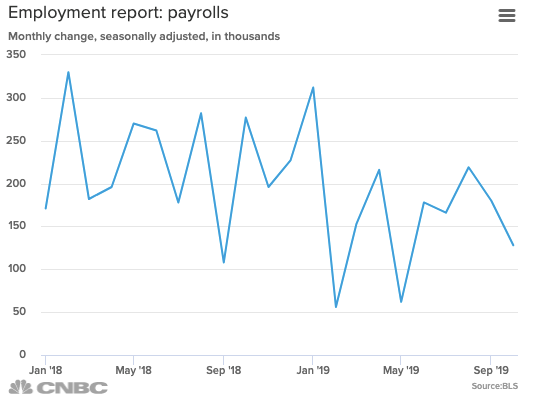
October job creation comes in at 128,000, easily topping estimates even with GM auto strike

CNBC – Nonfarm payrolls rose by 128,000 in October as the U.S. economy overcame the weight of the GM autoworkers’ strike and created jobs at a pace well above expectations.

Even with a decline of 42,000 in the motor vehicles and parts industry, the pace of new jobs well exceeded the estimate of 75,000 from economists surveyed by Dow Jones. The loss of jobs came due to the General Motors strike that has since been settled. That 42,000 job loss itself was less than the 50,000 or more that many economists had been anticipating.

The unemployment rate ticked higher to 3.6%, in line with estimates, but remains around the lowest in 50 years. A more encompassing measure that includes discouraged workers and those holding part-time positions for economic reasons also edged up to 7%.

The unemployment rate for African Americans nudged down to a record low 5.4%. Also, the total employment level as measured in the household survey jumped to 158.5 million, also a new high.

The pace of average hourly earnings picked up a bit, rising 0.1% to a year-over-year 3% gain, also in line with estimates. The average work week was unchanged at 34.4 hours.

“This report is yet another sign that the economy is still strong right now and adds to a list of indicators that are looking optimistic of late,” said Steve Rick, chief economist at CUNA Mutual Group. “The vigor of this labor market, along with a more positive housing market and solid Q3 GDP, should offer some welcome reassurance.”

Big revisions upward

Along with the better-than-expected performance in October, previous months’ counts were revised considerably higher. August’s initial 168,000 estimate came all the way up to 219,000 while September’s jumped from 136,000 to 180,000.

Together, the new estimates added 95,000 positions for the two-month period, bringing the three-month average to 176,000, which is well above the pace needed to keep the unemployment rate around its current level.

For the year, monthly job creation now averages 167,000 compared with 223,000 in 2018.

The report helps further quell worries that the U.S. economy is teetering toward recession and helps affirm the assessment from most Federal Reserve officials.

Central bank leaders have largely praised the state of the U.S. economy, particularly compared with its global peers. The Fed earlier this week lowered its benchmark interest rate a quarter point, the third such move this year, but Chairman Jerome Powell clearly indicated that this likely will be the last cut for some time unless conditions change significantly.

“The October jobs report is unambiguously positive for the US economic outlook,” said Citigroup economist Andrew Hollenhorst. “Above-consensus hiring in October, together with upward revisions to prior months, is consistent with our view that job growth, while clearly slower in 2019 than in 2018, will maintain a pace of 130-150K per month. Wage growth remaining at 3.0% should further support incomes and consumption-led growth.”

Hottest sectors

At the industry level, the biggest job creation came in food services and drinking establishments, which added 48,000. While those positions are generally associated with lower wages, they also can reflect consumer demand and the willingness to spend discretionary money. The industry has seen a surge in job creation as of late, with the past three months averaging 38,000 compared with 16,000 in the first seven months of this year.

Professional and business services added 22,000 and health care rose 15,000, part of a gain of 402,000 for that industry over the past year.

Social assistance increased by 20,000 while financial activities rose by 16,000, bringing to 108,000 the total Wall Street jobs added over the past year.

Job losses came in manufacturing (-36,000) as part of the GM strike, and the federal government, which subtracted 17,000 because 20,000 workers hired for Census duties finished their work.

The total employment level in the household survey reached another record high, swelling by 241,000 to 158.5 million.

The labor force expanded by 325,000 to 164.4 million and the labor force participation rate edged higher to 63.3%. Those counted as not in the labor force declined by 118,000 to nearly 95.5 million.

After previously sitting at a record low, the unemployment rate for Asians jumped 0.4 percentage points to 2.9%.

Source: US Government Class

Twitter bans political ads ahead of 2020 election

AN FRANCISCO (AP) — Twitter, reacting to growing concern about misinformation spread on social media, is banning all political advertising from its service. Its move strikes a sharp contrast with Facebook, which continues to defend running paid political ads, even false ones, as a free speech priority.

“While internet advertising is incredibly powerful and very effective for commercial advertisers, that power brings significant risks to politics, where it can be used to influence votes to affect the lives of millions,” Twitter CEO Jack Dorsey said Wednesday in a series of tweets announcing the new policy.

Facebook has taken fire since it reiterated in September that it will not fact-check ads by politicians or their campaigns, which could allow them to lie freely. CEO Mark Zuckerberg told Congress in October that politicians have the right to free speech on Facebook.

Zuckerberg wasted no time responding to Twitter’s move. During Facebook’s conference call for earnings, which began less than an hour after Dorsey’s tweet, the Facebook chief offered an impassioned monologue about what he called his company’s deep belief “that political speech is important.”

Zuckerberg stood by the company’s decision to run unchecked political ads and denied that the choice is financially motivated, saying such ads make up less than half of a percent of Facebook revenue.

Facebook’s recent $5 billion fine from the Federal Trade Commission for privacy violations was more than 10 times what it makes from political ads, he said.

“This is complex stuff. Anyone who says the answer is simple hasn’t thought about the nuances and downstream challenges,” he said. “I don’t think anyone can say that we are not doing what we believe or we haven’t thought hard about these issues.”

Google did not have an immediate comment on Twitter’s policy change.

Trump’s campaign manager called Twitter’s change a “very dumb decision” in a statement Wednesday.

“This is yet another attempt to silence conservatives, since Twitter knows President Trump has the most sophisticated online program ever,” campaign manager Brad Parscale said.

The presidential campaign for former Vice President Joe Biden said it was “unfortunate” that companies would think the only option was to completely ban political ads.

“When faced with a choice between ad dollars and the integrity of our democracy, it is encouraging that, for once, revenue did not win out,” Bill Russo, the deputy communications director for Biden’s campaign said in a statement.

Political advertising makes up a small sliver of Twitter’s overall revenue. The company does not break out specific figures each quarter, but said political ad spending for the 2018 midterm election was less than $3 million. It reported $824 million in third-quarter revenue.

Candidates spend significantly more purchasing ads on Facebook than on Twitter, company records show.

The issue suddenly arose in September when Twitter, along with Facebook and Google, refused to remove a misleading video ad from President Donald Trump’s campaign that targeted Biden.

In response, Democratic Sen. Elizabeth Warren, another presidential hopeful, ran her own ad on Facebook taking aim at Zuckerberg. The ad falsely claimed that Zuckerberg endorsed President Donald Trump for re-election, acknowledging the deliberate falsehood as necessary to make a point.

Critics have called on Facebook to ban all political ads. These include CNN chief Jeff Zucker, who recently called the company’s policy of allowing lies “absolutely ludicrous” and advised the social media giant to sit out the 2020 election until it can figure out something better.

Misleading political ads on social media played a major role in Russian disinformation efforts during the 2016 presidential election.

Dorsey said the company is recognizing that advertising on social media offers an unfair level of targeting compared to other mediums. It is not about free expression, he asserted.

“This is about paying for reach. And paying to increase the reach of political speech has significant ramifications that today’s democratic infrastructure may not be prepared to handle,” he tweeted. “It’s worth stepping back in order to address.”

Twitter currently only allows certified campaigns and organizations to run political ads for candidates and issues. The latter tend to advocate on broader issues such as climate change, abortion rights and immigration.

The company said it will make some exceptions, such as allowing ads that encourage voter turnout. It will describe those in a detailed policy it plans to release on Nov. 15.

It will also still allow politicians to freely tweet their thoughts and opinions, which can then be shared and spread. Trump’s Twitter feed in particular is known for his often bombastic and controversial tweets that are shared widely.

Matt Shupe, a Republican political strategist whose public relations firm has won awards for its use of ads on Facebook, called Twitter’s decision “incredibly dumb.” He said there’s no reason to eliminate all political advertising just to stop the relatively small number of bogus or misleading ads.

“You can’t abolish television advertising because cigarette makers bought ads once,” he said.

The decision will hurt political challengers the most, Shupe said, as they don’t have the name recognition or wide reach of incumbents and need ads to get their message out.

“If you’re a challenger, advertising allows you to make up that difference,” he said. “It’s very hard to organically grow an audience for a state assemblyman campaign.”

Ethan Porter, a professor of media and public affairs at George Washington University, echoed the concerns and called Twitter’s decision disappointing. He said it will deprive voters of one way to learn about those standing for election.

“That loss of information about candidates in an election — I don’t think that should be taken lightly,” he said. “Voters should know who the candidates in an election are and twitter is an important platform.”

Twitter said in June that political figures and world leaders who tweet abusive or threatening messages might get slapped with a warning label, but the tweets would remain on the site. Twitter has not yet used this warning label.

Federal campaigns are expected to spend the majority of advertising dollars on broadcast and cable channels during the 2020 election, according to advertising research firm Kantar, and about 20% of the total $6 billion in spending on digital ads.

Twitter’s policy will start on Nov. 22.

___

AP reporters David Klepper in Providence, Rhode Island, Amanda Seitz in Chicago, Will Weissert in Washington, Mae Anderson in Atlanta and Tali Arbel in New York contributed to this article.

Source: US Government Class