DNA pilot testing program for felony suspects

You need to answer any of the three of the six questions given to you in class today.

Be sure to identify which questions you are answering by the questions number and be sure to answer ALL parts of the questions.  You also need to use complete sentences for all of your answers.

Example:
2a – The pilot program is ………….
2b – Law enforcement agencies will be able to get ……..

Source: US Government Class

About 100 years ago, a different pandemic loomed

Santa Fe New Mexican – Despite advice in a November 1918 edition of The New Mexican — to “avoid coughs, crowds and cowards, but fear neither germs nor Germans!” — the worldwide Spanish influenza outbreak hit New Mexico hard.

“It was so bad in New Mexico, they ran out of coffins. Carpenters couldn’t make them fast enough. It was just terrible,” said Richard Melzer, a former history professor at the University of New Mexico.

While the world deals with the deadly coronavirus, some 100 years ago, Spanish influenza killed at least 1,500 people in New Mexico. But some estimates put the death toll at more than 5,000, with some dying of pneumonia after contracting the virus. In 1920, the state’s population was 363,000, according to census records.

The flu devastated local communities, said Melzer, who wrote the article “A dark and terrible moment: the Spanish flu epidemic of 1918 in New Mexico,” for the 1982 edition of New Mexico Historical Review. From mining towns to pueblos, most people in the state knew someone who contracted it or died from it.

The virus was one of the deadliest in history, killing an estimated 50 million people worldwide. In World War I, which was fought around the same time, an estimated 21 million people were killed.

Though it was called Spanish flu, historians aren’t sure where it originated. There’s some evidence it started at a military base in Kansas, while other evidence points to Asia.

Nancy Bristow, who is chairwoman of the history department at the University of Puget Sound in Tacoma, Wash., said attitudes today are similar to opinions about the flu during the pandemic.

While the flu killed thousands every season — as it continues to do — it was seen as a “domesticated” illness. Everyone gets it but wouldn’t die from it unless they were old or young, she said.

“At first, the officials said, ‘Don’t worry. It’s only the flu. Don’t be too afraid.’ But it’s clearly not a regular flu. It’s several times more deadly,” Bristow said.

Then people in their 20s and 30s began dying, many just days or even hours after showing symptoms.

Bristow said public health agencies and politicians downplayed the outbreak at first, not wanting to spark a panic.

“They both want to calm the public and keep them from panicking, but they also want people to [understand] that this is a really serious illness,” she said. “Finding that balance is very difficult, and I think they failed in 1918.”

She said those same challenges are facing health officials today.

Shannon Withycombe, a women’s medicine historian at UNM, said it’s important to study how epidemics are used as political and economic tools.

She said there was a nationalist bent in the way the 1918 influenza outbreak was discussed, something she still sees.

“Certainly many epidemics that make the news, sparking potential panic and fear, are focused on the fact they come from parts of the world that we see ourselves as superior to, such as Ebola coming from Africa, COVID-19 coming from China,” she said. “I think there is political value for a variety of people in power for constructing narratives about these epidemics that lead us down a dangerous path.”

To fill some of the gaps in knowledge about the Spanish flu epidemic, Withycombe is requiring one of her classes to participate in a project to uncover what happened during the outbreak in New Mexico.

“They’re going to be doing a project where they don’t just look through the Albuquerque Journal or the Santa Fe New Mexican, but every digitized newspaper in New Mexico to see the stories people were writing during the epidemic,” she said.

The outbreak in New Mexico came later than the rest of the country, hitting hardest in October and November. Parts of the state came to a standstill. There was a two-week closure of schools, which would sometimes serve as makeshift hospitals.

Alex Castillo, who was 18 at the time, told the Albuquerque Journal “the bells constantly tolled” for funerals.

A Nov. 18, 1918, article in The New Mexican headlined “How to fight Spanish influenza” went beyond the common home remedies such as a whiskey, honey and lemon concoction or onions. It recommended a hot mustard foot bath, plenty of hot lemonade and Dr. Pierces Pleasant Pellets.

“It is best to take a vegetable pill every other day made up of May-apple, aloes, jalap and sugar-coated,” the article by Dr. L.W. Bowers said.

There was no vaccine. Doctors mistakenly thought the disease was caused by bacteria.

In the midst of the outbreak, cities and health departments around the country required people to wear face masks. However, New Mexico was one of a handful of states without a public health department, something that would arise in the aftermath of the flu.

Cities took matters into their own hands. There were quarantines in Santa Fe and Albuquerque. Taos would fine or even arrest people without masks.

The masks were often ineffective, having large holes that the virus could slip through. In one account, four women played bridge together in Albuquerque, prudently wearing their six-ply face masks. The next day, three of them were dead.

In summer 1919, much of the flu pandemic came to an end. People either died or developed immunity, and the strain mutated to a less deadly form of the flu.

Poor record keeping has forced some to rely on anecdotal evidence. State Historian Rob Martinez said his great-grandmother contracted the Spanish flu and died, but he has not found a burial record for her.

“We suspect that the deaths were happening so fast that they were just burying them,” Martinez said.

He said despite all the unanswered questions, the search is valuable.

“As a historian, I look back on the Spanish flu, just over 100 years ago, and just see that we’re dealing with the same questions,” Martinez said. “History does repeat itself. It really does.”

Source: US Government Class

Dow rallies 1,294 points, most in its history

CNN Business) – US stocks rebounded sharply on Monday, with the Dow logging its biggest point gain in history.
Stocks are coming off their worst week since the 2008 financial crisis. The Dow (INDU) last week dropped 12.4%, while the S&P 500 (SPX) plunged 11.5%.

The Dow also recorded its worst one-day point drop in history on Thursday.

“If [the market is] priced to perfection and then something indicates that the perfection is a pipe dream, prices will come off,” said Brad Cornell, emeritus professor of finance at UCLA, of last week’s selloff. Prices are much more reasonable now, he added.
But Monday’s rebound was strong. After a sharply higher open and some flipping between gains and losses mid-morning, stocks moved solidly higher.

The Dow finished up 1,294 points, or 5.1%, making it its best one-day point gain on record. On a percentage basis, Monday was its best day since March 2009. The S&P climbed 4.6%, its best performance since December 2018. The rise in both indexes snapped a seven-day losing streak. The Nasdaq Composite (COMP) closed up 4.5%.

All three indexes are now less than 10% from their highs. They entered a correction last week, which is defined as a 10% decline from the most recent highs.

Investors are pushed and pulled into different directions by headlines about the novel coronavirus outbreak. On the one hand, the Organization for Economic Cooperation and Development warned Monday that the outbreak could significantly slow down global growth.

Meanwhile, hopes for stimulus action from the world’s central banks are keeping investors from further selling. The Bank of Japan said it would provide “ample liquidity” to keep financial markets stable and the Bank of England also pledged to do what’s necessary for the British economy’s stability.

The Federal Reserve next meets on March 18 and market expectations for a half-percentage point interest rate cut are at 100%, according to the CME’s FedWatch Tool.

That said, Fed officials have been speaking out against immediate rate cuts and Fed Chairman Jerome Powell said last week that “the fundamentals of the US economy remain strong.”

Although a Fed rate cut could revive investor sentiment — at least in the short-term — market participants are skeptical of how much monetary policy can really do against a global disease outbreak.

“I’d prefer a vaccine over a rate cut,” wrote Seema Shah, chief strategist at Principal Global Investors, in a blog post.
Commodities broadly rebounded from last week’s selloffs. Gold futures settled up 1.8% at $1,592.30 an ounce, while US oil prices ended 4.4% higher at $46.75 per barrel.

US Treasury yields, meanwhile, continue to trend lower. Treasuries are a common safe haven investment that receives a lot of buying interest during times of trouble. Bond prices and yields move opposite to each other. The 10-year yield dropped to a all-time low just above 1%.

America’s battered manufacturing sector grew in February, according to the Institute of Supply Management. It was the second positive month in a row for the sector, which had fallen into a recession in the second half of 2019 on the back of the US-China trade war.

However, the ISM report also highlighted the potential impact the coronavirus outbreak could have on US manufacturing. Imports have contracted and survey respondents voiced their concerns about demand and supply chain issues.

Source: US Government Class

Court says Trump administration can withhold money from NYC, 7 states in ‘sanctuary cities’ fight

(CNN) – The Trump administration can withhold federal money from seven states, as well as New York City, over their cooperation on immigration enforcement, a federal appeals court ruled Wednesday.

The decision by the 2nd US Circuit Court of Appeals reversed a lower court ruling that blocked the Justice Department from withholding a key law enforcement grant the department said was available only to cities that complied with specific immigration enforcement measures.

The federal appeals court ruling comes amid an ongoing feud between the Trump administration and so-called “sanctuary cities,” which limit cooperation between local law enforcement and federal immigration authorities. Over recent weeks, the administration has stepped up its fight against sanctuary jurisdictions and taken measures like barring New York residents from enrolling in certain Trusted Traveler programs, such as Global Entry.

Judge Reena Raggi, writing on behalf of the unanimous 3-judge panel, acknowledged the divisive nature of the issue at hand, writing: “The case implicates several of the most divisive issues confronting our country and, consequently, filling daily news headlines: national immigration policy, the enforcement of immigration laws, the status of illegal aliens in this country, and the ability of States and localities to adopt policies on such matters contrary to, or at odds with, those of the federal government.”

The city of New York is a plaintiff in the lawsuit, along with New York, Connecticut, New Jersey, Washington, Massachusetts, Virginia and Rhode Island.

In July 2017, then-Attorney General Jeff Sessions announced that applicants for Edward Byrne Memorial Justice Assistance Grants would have to comply with federal immigration enforcement. States pushed back and sued over the move.

Lower courts have blocked the Justice Department from adding new requirements for the policing grants. In April 2018, the 7th US Circuit Court of Appeals upheld a ruling in favor of the city of Chicago.

But Raggi noted in Wednesday’s ruling that the conditions on federal grants put forth by the administration in part help the government enforce national immigration laws and rejected the notion that the conditions “intrude on powers reserved to the States.”

The requirements announced in 2017 include allowing federal immigration authorities access to jails and providing the Department of Homeland Security advance notice before local officials release an undocumented immigrant wanted by federal authorities.

In a statement, a Justice Department spokesman heralded the ruling, saying: “Today’s decision rightfully recognizes the lawful authority of the Attorney General to ensure that Department of Justice grant recipients are not at the same time thwarting federal law enforcement priorities.”

“While today’s ruling is a major victory for Americans, its full scope will not be realized until the practices of granting nationwide injunctions and associational injunctions are stopped, as certain cities that are parties to this judgment may nonetheless use rulings from other courts to evade these lawful conditions,” the spokesman added.

Source: US Government Class

In liberal Takoma Park, a bold new climate proposal: Banning fossil fuels

Washington Post – Takoma Park, the liberal enclave just outside Washington known as the “Berkeley of the East,” is debating whether to outlaw gas stoves, leaf blowers and water heaters.

The Maryland city of 17,000 that voted nearly four decades ago to become a “nuclear-free zone” is considering a total ban on fossil fuels, part of a nationwide effort by local governments to address what they see as a lack of federal action on climate change.

The proposal, which was first raised in a new climate resolution, would ban all gas appliances, close fossil fuel pipelines, and move gas stations outside city limits by 2045. The cost to the average homeowner could reach $25,000, officials wrote.

While not binding, the 2020 Climate Emergency Response Act will set the agenda for Takoma Park’s policy-making in coming years. It has sparked robust discussion, drawing lines of residents to council meetings and prompting long back-and-forths on neighborhood listservs.

Cities elsewhere are also paying close attention, said Bruce Nilles, managing director of the Rocky Mountain Institute, a national group headquartered in Colorado.

Like Berkeley, Calif., or Portland, Ore., Takoma Park is seen as a testing ground for the next wave of climate policies — last year, a gas station in the city became the first in the country to completely convert to electric charging.

Some residents think an outright ban on all fossil fuels, which has never been done in the United States, could be too difficult to implement — or too costly. But others say bold measures are needed to reach the city’s goal of net-zero greenhouse gas emissions by 2035.

Given advancements in technology, environmental advocates say, the change could also bring cost savings and might not be as dramatic as some anticipate.

The city’s sustainability office recently revised the resolution to soften language on the proposed ban, disappointing some activists. But Takoma Park Mayor Kate Stewart said the goal of “moving off of fossil fuels” remains. The possibility of a ban, she added, will be discussed in coming months.

Natural gas has been heralded for years as a cost-effective, cleaner alternative to coal. But as the coal industry declines, policymakers are turning their attention to underground gas lines that, according to experts, contribute a sizable percentage of carbon emissions.

In 2019, Berkeley became the first city in the United States to ban the installation of natural gas lines for new buildings. More than two dozen cities and counties have followed suit. In Takoma Park, some officials want to take this ban further, in part because there is relatively little new construction in the city.

The idea, as laid out in the first draft of the city’s climate resolution, is to take advantage of the natural life cycle of gas appliances. Starting from 2030, all water heaters, space heaters and stoves that rely on gas would have to be replaced with alternatives.

Fossil-fuel-based leaf blowers would be phased out with incentive programs and eventually outlawed, while gas stations would be asked to convert to electric charging or relocate. The proposal promotes electric vehicle use but does not include a ban on vehicles that run on fossil fuels.

In the shorter term, the city would mandate that all buildings, including single-family homes, meet specific energy requirements by 2029 and upgrade all lighting to LED by 2022.

These ideas have received strong support from Takoma Park’s resident-led Committee on the Environment and other advocacy groups, including the youth-led Sunrise Movement. But even in left-leaning Takoma Park, the resolution has detractors.

“The number of times the word ‘require’ is used in this is stunning,” said resident Maxine Hillary at a public hearing. She criticized the fossil fuel ban as “insensitive and draconian” and denounced the proposal for mandatory composting, stating: “Don’t tell me what to do with my table scraps.”

John Ackerly, who co-chairs the environmental committee, said he has been “shocked” by friends and neighbors in the city skeptical of the resolution, with some sharing fears of an impending “LED police.” Most opponents, he said, seem to take issue with the proposals for new mandates, which has also emerged as the flash point elsewhere.

In Bellingham, Wash., where officials are debating a ban on all fossil-fuel-based residential heating, natural gas companies have launched a $1 million campaign to promote their product. In Berkeley, a restaurant trade group is suing the city over its ban on new gas pipelines, which went into effect Jan. 1.

“Yes, there are ways that we could soften [these policies] and make them more palatable. . . . But we know that voluntary programs are not going to get us to net zero,” said Takoma Park sustainability manager Gina Mathias.

Officials are looking carefully at the impact of climate requirements on low-income households, Stewart said, and the city is creating a “sustainability assistance fund” to help residents and businesses transition from fossil fuels.

A revised copy of the resolution, released earlier this week, took out the 2045 deadline for elimination of fossil fuels. But it still commits the city to establishing energy-efficiency requirements for every building, banning natural gas in new construction, and “dramatically” reducing the use of fossil-fuel-powered appliances.

Discussions are ongoing. At a city council meeting Wednesday night, slightly more than a dozen residents came to show support for the resolution, urging officials not to make further compromises.

Mike Tidwell, a Takoma Park resident who is founder of the Chesapeake Climate Action Network, said he wants to see the 2045 deadline put back into the resolution. Drew Kodjak, an environmental attorney who also lives in the city, said he thinks 2045 is too long to wait.

“If you believe the Intergovernmental Panel on Climate Change, fossil-fuel free has to become a reality in the next one or two decades — and not just in Takoma,” said Nilles of the Rocky Mountain Institute. “We don’t really have a choice.”

Source: US Government Class

Court sides with ex-felons who challenged Florida voting requirement

The HIll – A federal appeals court on Wednesday upheld an injunction of a Florida law that barred ex-felons from voting if they had not paid fines and other fees related to their sentences.

The U.S. Court of Appeals for the 11th Circuit agreed with a previous district court’s rule halting the law, which was passed by state Republicans in 2019 after a constitutional amendment went through the year prior enfranchising former felons. The three-judge panel ruled that the law violates the Equal Protection Clause because it unconstitutionally bars a class of felons from voting based only on their wealth

“It is undeniable that the [law’s legal financial obligation] requirement punishes those who cannot pay more harshly than those who can,” the appeals court said Wednesday. “We affirm the district court’s preliminary injunction enjoining the defendants … from preventing the plaintiffs from voting based solely on their genuine inability to pay legal financial obligations.”

The amendment to Florida’s constitution was first passed in the 2018 midterms, with nearly 65 percent of voters choosing to allow 1.4 million convicted felons to vote following their release from incarceration.

However, Gov. Ron DeSantis (R) signed a bill in June mandating that the former convicts pay off restitution, court fees and fines before regaining the right to vote, sparking criticism from opponents who said the law amounted to a poll tax.

Florida’s Supreme Court upheld the law, but the federal district court intervened and issued its injunction, ruling in favor of 17 former felons who sued the state. DeSantis followed up by appealing the district court’s decision.

Several groups, including the Florida State Conference of the NAACP, the Orange County branch of the NAACP, and the League of Women Voters of Florida, have slammed DeSantis over the bill, saying it and the past ban disproportionately affected people of color.

The American Civil Liberties Union (ACLU) of Florida, which helped present the case on behalf of the former felons, celebrated the appeals court’s ruling, saying “This is a huge victory for our brave clients!”

“The Voting Restoration Amendment passed with 5.2 million votes and was one of the largest expansions of voting rights in United States history,” added Daniel Tilley, legal director of the ACLU of Florida. “Despite the state’s best efforts to dismantle Amendment 4 through SB7066, today’s ruling affirms what Floridians intended when they passed Amendment 4 — to restore to returning citizens their right to vote.”

Source: US Government Class

Election reforms drowned by filibuster

Santa Fe New Mexican – It was past 1 a.m. Thursday when state Sen. Cliff Pirtle made his move. With less than 11 hours remaining in this year’s legislative session, he knew just how to freeze a government that was already in slow motion.

Pirtle, R-Roswell, announced a “call of the Senate.” This meant all 42 senators were required to be in the chamber. Unless everyone was present, a long-winded debate could not continue on a bill to reform various election laws.

Democrats favored the bill, but Pirtle’s tactical maneuver meant trouble for them.

Sen. Linda Lopez, D-Albuquerque, had gone home. She would have to be located and brought back to Santa Fe or the bill would be left in limbo.

“I think [Senate Majority Leader] Peter Wirth made the right decision. He didn’t send the state police to get Senator Lopez,” said the bill sponsor, Sen. Daniel Ivey-Soto.

Ivey-Soto, D-Albuquerque, never got the chance to revive the election measure, House Bill 229.

After the Senate reassembled at about 9 a.m., Republicans employed a new strategy to stop the bill.

Sen. Bill Sharer, R-Farmington, got the floor and babbled for two hours during debate on an unrelated proposal.

Sharer’s filibuster devoured enough time to kill the reform measure. It was never reconsidered, and the legislative session ended at noon.

Democrats have only themselves to blame.

Lopez’s exit during a key part of the session opened the way for minority Republicans to strangle a bill that would have tightened security on absentee voting and added a felony penalty for fraud.

The Republican floor leader, Sen. Stuart Ingle of Portales, had voted for the election reforms in the Rules Committee. His stand contradicted that of state Republican Party Chairman Steve Pearce.

Pearce had railed against the bill for days. He claimed it deleted identification requirements for absentee voters and would have created opportunities for election fraud.

None of this was true. But, for partisan reasons, Pearce has been outspoken about the bill weakening the republic. Ingle either hadn’t read Pearce’s messages or ignored them in a show of independence.

Pearce’s interest in the bill was personal. His pal, fellow Republican Yvette Herrell, lost the 2018 election in New Mexico’s 2nd Congressional District after the absentee ballots were counted.

Herrell did not contest the election. She knew she’d lost it.

But she’s again running for Congress, and now she has a different story. Her advertising is built around the claim that Democrats stole the election from her.

Pearce kept alive the theme of Democrats condoning election fraud. He claimed Ivey-Soto’s bill would create an absentee voting system that would enable vote thieves to thrive.

Key officials supported the bill Pearce denigrated.

Twenty-two of 26 county clerks who took a position favored the election reforms. Pearce, though, had the louder voice for his misinformation campaign.

With the session droning toward a close, not every Democrat in the Senate was invested in the election bill.

Sen. Clemente Sanchez, D-Grants, told me he wasn’t annoyed by Sharer’s filibuster. The state budget had been crafted. That was the main business of the session. With the critical work done, it was time to go home, Sanchez said.

Sanchez, usually the best-dressed senator in his natty suits and splashy neckwear, donned blue jeans, a sport coat and black cowboy boots for the final hours. His casual fashion statement was a sign that he didn’t intend to debate anyone.

Ivey-Soto was in no such mood. He rose and made procedural arguments to try to cut off Sharer.

Ingle, who’s been in the Senate since 1985, said he had never seen such an attempted power grab as the one Ivey-Soto pursued.

Sen. Mark Moores and other Republicans complained the decorum of the Senate was at stake. They said Democrats trying to silence Sharer were acting like those street fighters who wage combat in the state House of Representatives.

Senate Democrats lost the skirmish. They had no lawful way to end Sharer’s filibuster.

Wirth gave the floor back to Sharer, who proceeded to assault human ears and run down the clock.

That was the end of the bill for election reforms. And it was the end of 30 days at the Capitol. Now it’s election season. All 112 legislative seats are on the ballot this year.

Incumbents who are running again will say it was a successful session with many notable accomplishments. Oh, sure, they might add, it’s not always easy to watch the sausage being made.

The truth is harsher.

A bill to tighten election security had a chance to be approved. Instead, a weaker system will be in place when you vote.

Source: US Government Class

Group petitions to join this state, blaming Oregon’s liberal Democrats

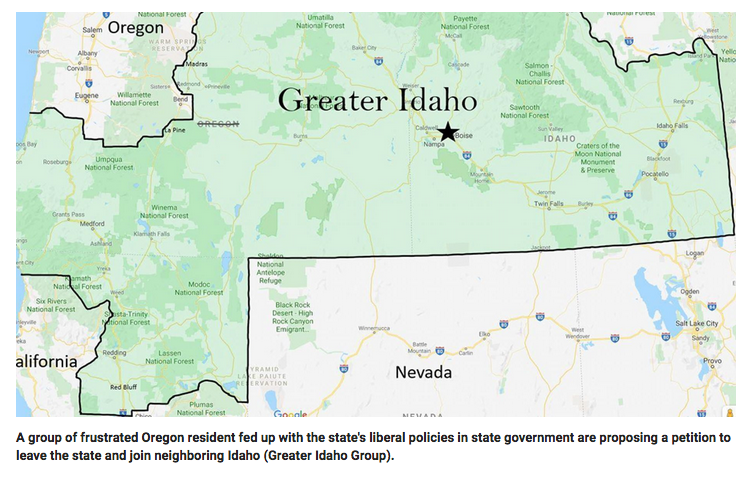
FoxNews – A group of frustrated Oregon conservatives, who have tried everything from voting out Democratic state officials they consider too liberal to recalling the state’s governor and appealing to their Washington representatives, now want to leave the state – by moving the border with neighboring Idaho westward, a published report Monday said.

The group, Move Oregon’s Border for a Greater Idaho, has secured initial approval from two counties and has set a goal of getting enough signatures to put the proposal on local ballots in November, USA Today reported.

Barring a setback, voters in southeastern Oregon could see a question on a redrawn state border with Idaho, the newspaper reported.


Last year, a controversial bill protesting greenhouse gas emissions caused state Republicans to flee Salem, the state capital. Democrats currently control both branches of the state legislature as well as the governor’s mansion.

Proponents were unsuccessful collecting the 280,000 signatures for a recall election, but Greater Idaho said it only needs to collect about 2,400 signatures from Josephine County and about 3,000 from Douglas County to appear on the ballot, USA Today reported.

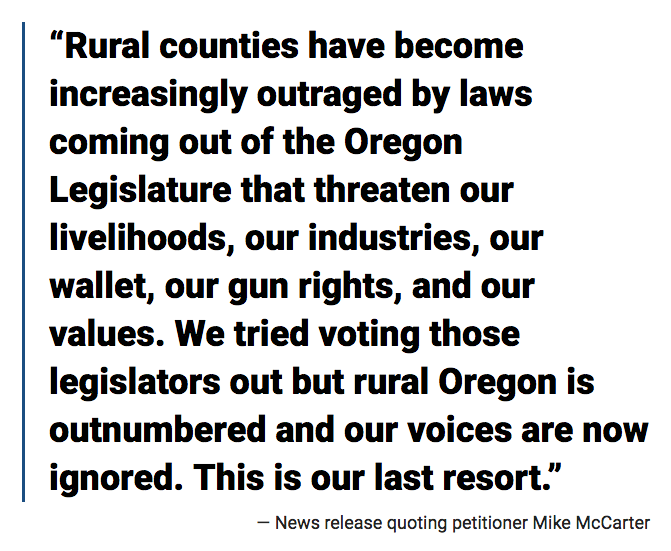
“People here would prefer Idaho’s conservative governance to the progressive/liberal current Oregon governance. Every time I look at the Facebook group Greater Idaho, the group has gotten bigger,” Gottschalk said in a news release.

Of Oregon’s 36 counties, only 14 in the Willamette Valley area would remain if the group succeeds, the newspaper reported. Moving the border would require approval from the U.S. Congress as well as the Idaho and Oregon state legislatures, however.

The proposal to join Idaho isn’t the first effort Oregonians have made to leave the state. In 1941, residents of residents of southwestern Oregon tried to secede by creating a state of Jefferson with northern Californians.

Source: US Government Class

Who’s responsible for what you buy on Amazon? A court is about to decide

New York (CNN Business) – When David Wilk, a lawyer in Williamsport, Pennsylvania, got a call from a woman looking to sue Amazon, little did he know it would become the most high-profile case of his career.
“I will never have another case like this in my life,” Wilk said.

On Wednesday, the case “Oberdorf v. Amazon” will undergo a rare hearing in Philadelphia by all the federal judges on the US Third Circuit Court of Appeals. The closely-watched case hinges on the question of whether Amazon can be held liable for damages caused by goods sold in its third-party marketplace, where outside sellers sell their products alongside Amazon’s own offerings.

The decision, which is subject to appeal, could influence numerous other cases and, ultimately, the way Amazon (AMZN) runs its business.

Five years ago Wilk’s client, Heather Oberdorf, was blinded in one eye when she says a faulty dog collar broke and caused her retractable dog leash to recoil and hit her face and glasses. She had bought that dog collar from a third-party seller on Amazon, called the Furry Gang, which neither she nor Amazon has been able to locate, despite what Wilk described as “extensive efforts.”

According to Amazon’s 2018 annual report, 58% of its sales came from its millions of third-party sellers, many of whom ship directly to consumers. US courts have routinely held that Amazon is not liable for defects or intellectual property issues related to these third-party sales, viewing Amazon as a platform that connects buyers and sellers. Court hav eheld that plaintiffs seeking damages must sue the third-party seller directly.

The original appeals court decision in Oberdorf v. Amazon was a significant departure from previous rulings. In their 2019 opinion, two of the three judges on the panel ruled Amazon was liable under Pennsylvania law as the seller of the dog collar that injured Oberdorf.

The court looked at multiple factors, including whether Amazon was the only party available for Oberdorf to sue, whether holding the company responsible would be an “incentive” to enforce safety protocols, and the legal terms the company signs with its third-party sellers. The judges decided Amazon should be liable under all of these factors.

“Although Amazon does not have direct influence over the design and manufacture of third-party products, Amazon exerts substantial control over third-party vendors,” the opinion said. The Third Circuit granted Amazon’s request to review the decision before the full appeals court, a sign of the court’s awareness that any decision is likely to have have lasting implications.

Amazon declined to comment for this story, but previously has argued that it is not a “seller,” and only provides a marketplace for other sellers. “If you purchase any of the products or services offered by these businesses or individuals, you are purchasing directly from those third parties, not from Amazon,” according to its conditions of use. “Amazon does not assume any responsibility or liability for the actions, product, and content of all these and any other third parties.”
Further, the company claims its listings are protected by the Communications Decency Act, which states that online platforms cannot be treated as the publisher of information provided by a third party on their sites.

If the full appeals court rules against Amazon, “I think it could have a significant effect throughout the country,” said Professor Aaron Twerski, who has written extensively about the Oberdorf case with his Brooklyn Law School colleague Edward Janger.

Though this case is brought under Pennsylvania law, Twerski said it would take only a few states to shift some precedent toward holding Amazon liable. Ultimately the issue could end up before the Supreme Court.

A substantial shift in case law holding Amazon liable for third party sales would change the way the marketplace operates, according to Sucharita Kodali, vice president and principal analyst at Forrester. She believes Amazon would respond by demanding more stringent vetting measures for third-party sellers and their products. Right now, many product categories don’t even require a seller to gain approval from Amazon to set up on the platform.

“They should have done this long ago. Yes, there would be fewer sellers but really, do we need two million in the first place?” she said via email. “And if the shady ones go away, I promise you, no one will shed a tear.”

The overall impact might be fewer third party sellers, but Kodali believes the impact on Amazon’s overall finances would be muted given that the company has multiple revenue streams and its strongest third-party sellers aren’t the problematic ones.

Wilk — the lawyer who will argue the case — thinks at its core the decision is about how e-commerce functions in our everyday lives, and that the courts must catch up to consumers’ perception that Amazon is responsible for the goods it sells.
“Really what it comes down to is is the court going to recognize how people buy things in the modern world?” he said.

Source: US Government Class

Bill creating path for drug imports from Canada sent to governor

Santa Fe New Mexican – A bill that would create a potential pathway for New Mexico to import prescription drugs from Canada is now on its way to Gov. Michelle Lujan Grisham’s desk, where it is expected to be signed into law.

The House unanimously approved Senate Bill 1, which calls for the state to create a plan for Canadian drug imports, late Sunday night in a 68-0 vote after the Senate previously passed the measure. The governor expressed support for the proposal in a statement Sunday night.

“This measure received unanimous support through every step of the legislative process because getting New Mexicans the medicine they need at a cost they can afford is a bipartisan, commonsense issue,” the governor said. “I applaud the Legislature for making sure New Mexico is at the front of the line for this program, and I promise to sign Senate Bill 1 quickly so we can begin the process of significantly reducing drug costs.”

The House vote follows the Trump administration’s announcement in December of proposed federal rules to allow states to import prescription medication from Canada. Supporters in New Mexico say Canadian imports could help lower the cost of prescription drugs by expanding the market outside the U.S., where prescription drugs fetch some of the highest prices in the world.

SB 1 would authorize the state Department of Health to apply for federal approval to import prescription drugs from Canada to New Mexico. It calls for an advisory committee to be formed, made up of Cabinet secretaries and leaders from state agencies to create a drug import plan.

Vermont, Maine, Colorado and Florida have passed similar measures as other states consider them, according to the Governor’s Office.

It’s a measure that is part of a string of bills the governor supports that her office and supporters argue would cut health care costs and boost access to health care. That includes a plan to institute a cost ceiling for insulin copays of $25 per prescription.

Federally controlled substances, including opioid painkillers, would be excluded from the drug import program. Patients would not be allowed to purchase medications online directly from Canadian drugmakers or other sellers.

The plan would require approval from the U.S. Food and Drug Administration and the Health and Human Services Department, lawmakers have said.

Source: US Government Class