

Share:
LG is raising washing machine prices due to new Trump tariff
CNN Money – LG Electronics told retailers on Wednesday that its laundry machines will get more expensive due to a tariff announced by the Trump administration earlier this week.
“As a result of the trade situation, we will be initiating pricing actions, which will be sent under separate cover shortly,” LG executive Thomas Yoon said in a memo obtained by CNNMoney. The note was first reported by the Wall Street Journal.
An LG spokesman declined to comment as to how much more expensive the appliances will get, or on the timing of the price hike.
But consumers should be prepared for prices to go up by 15% to 20%, said Dinesh Kithany, asmart home and appliances analyst with IHS Markit. That could translate to washing machines that are $70 to $100 more expensive, he said.
Because washers and dryers are typically sold as a pair, prices for both appliances could go up.
On Monday, U.S. Trade Representative Robert Lighthizer announced that President Trump approved tariffs on both washing machines and solar panels in order to protect U.S. manufacturing.
The tax starts at 20% for the first 1.2 million washers imported this year. The tariff goes up to 50% after that threshold is met.
“While this is disappointing news, let me assure you that we have planned for this possibility so we can minimize any disruption in supply of LG washers and dryers,” Yoon said in the memo.
LG said a new $250 million washer factory that’s being built in Clarksville, Tennessee should help ease some pressure, since those washers won’t be subject to the tariff.
Samsung, the other top South Korean washing machine manufacturer, did not immediately respond to a request for comment on whether it will raise prices, too.
Source: US Government Class
Share:
UConn accused of bias in handling of conservative speaker
FoxNews – An appearance Wednesday evening by a conservative speaker has sparked a free speech controversy at the University of Connecticut, whose handling of the event has been slammed as both biased and overzealous.
Ben Shapiro, a political commentator and author whose 2013 book “Bullies: How the Left’s Culture of Fear and Intimidation Silences Americans,” was a New York Times bestseller, will be speaking at the invitation of a campus Republican group.
But the university approved the group’s request for Shapiro’s appearance only after holding a so-called pre-event review process that led to the decision to restrict access to the event, and even offer counseling to students who might be offended by it.
And earlier this month, a school official dashed off an email to students alerting them that Shapiro was appearing, adding that “even the thought of an individual coming to campus with the views that Mr. Shapiro expresses can be concerning and even hurtful.”
Republican student groups and Young America’s Foundation, a national group that has handled Shapiro’s talks around the country, charged the university’s action leading up to his appearance were overzealous, and biased against conservatives.
“What we saw with their review process that they subjected this lecturer to was limitations on who could attend — students and professors – where it could take place, an advance guest list,” said Spencer Brown, spokesman for the Young America’s Foundation. “It’s a frivolous level of restrictions.”
Brown said liberal speakers at UConn were not subject to the same level of scrutiny. He said that a recent speech by Anita Hill, the lawyer and scholar who in 1991 testified about sexual harassment before a Senate committee hearing on the nomination of Clarence Thomas to the U.S. Supreme Court, was treated by college officials much differently. In Hill’s case, the university was both supportive, and opened her appearance to the public, said Brown.
It’s a frivolous level of restrictions. College campuses for a long time have gotten away with being indoctrination places for leftists.
“College campuses for a long time have gotten away with being indoctrination places for leftists,” Brown told Fox News. “The diversity officer’s email conditioned people to react negatively to opposing ideas.”
Last year, the University of California, Berkeley came under fire by Republicans and conservatives when its executive vice chancellor, Paul Alivisatos, urged that ahead of a planned lecture by Shapiro, students and faculty members seek counseling.
University of Connecticut officials insist they do not discriminate based on political ideology. They have told reporters they decided to implement a review process after a speech titled “It Is O.K. To Be White” last November by conservative commentator Lucian Wintrich ended in a scuffle, after a member of audience snatched the speaker’s notes from the lectern, and then Wintrich grabbed her to retrieve his papers. The woman, Catherine Gregory, an adviser at a community college, was arrested and charged with larceny and disorderly conduct.
College officials say it is easier to hold members of the audience accountable if they limit crowd sizes and other conditions.
In a statement to Fox News, college spokeswoman Stephanie Reitz said: “UConn recently updated its event planning review procedures to better ensure that the First Amendment rights of all invited speakers, audience members at their events, and others are respected and protected.”
Asked about the controversial email by the college’s diversity officer, Joelle Murchison, alerting students about Shapiro and describing the event as understandably hurtful, Reitz said: “One issue that’s considered in the course of the pre-event reviews is whether there might be protesters on site, or whether students who disagree with a speaker are aware of ways to express themselves peacefully.”
“In this case, we sent an informational email to a small portion of the student body to let them know of the upcoming event,” Reitz said. “It’s not a ‘warning,’ as it’s been described by some. It’s simply a way to make sure that UConn students know of on-campus programs or services if they want to talk with others about their views.”
Asked if the college has taken similar steps with students who might find events featuring liberal speakers troubling, Reitz said it has. “It’s part of the review process and in fact, the university specifically reached out to the College Republicans about Nathan Robinson’s visit for the same reason,” she said.
New Orleans public defender Robinson will be speaking Wednesday evening at a counter-event, at the invitation of UConn’s Democratic students club. His speech is titled, “Ben Shapiro is not as insightful as he thinks he is.”
The procedures are meant to be an objective planning tool to help ensure that events can take place without interruptions or safety issues, and aren’t based on a speaker’s political ideology.
Shapiro, a former Breitbart editor and editor-in-chief of conservative news and commentary site The Daily Wire, challenges the approaches many colleges take to his events. Liberal leanings of colleges is, in fact, one of his themes.
At a college speech, he brought along a diaper and said it was for “self-indulgent pathetic children who can’t handle anyone with an opposing point of view.”
It’s not just conservatives who challenge the tensions that arise at colleges over controversial speakers. Many First Amendment experts have been watching campus battles over speakers such as Shapiro with concern.
Brookings Institution senior fellow John Villasenor conducted a survey on free speech last year of 1,500 college and university students and found an overwhelming intolerance of people who express opposing views.
A majority, or 62 percent, of Democrats, and 39 percent of Republicans, said it was acceptable to shout down the speaker.
A fifth of the respondents said they agreed with using physical force to silence a speaker who makes “offensive and hurtful statements.”
A surprisingly large fraction of students believe it is acceptable to act—including resorting to violence—to shut down expression they consider offensive. And a majority of students appear to want an environment that shields them from being exposed to views they might find offensive.
Source: US Government Class
Share:
Bill aims to register all eligible New Mexico voters
Santa Fe New Mexican -By the time the 2016 presidential election rolled around, New Mexico had one of the lowest rates in the nation of voting-age citizens registered to vote. Only two-thirds of the state’s eligible voters had signed up to cast a ballot, compared to at least 80 percent in Maine and the District of Columbia, according to the U.S. Census Bureau.
Perhaps unsurprisingly, New Mexico also had one of the lowest rates of election turnout among its voting-age population.
One state lawmaker wants to make it easier for people to vote through an amendment to the New Mexico Constitution that would require the state to ensure every citizen who is eligible to vote is registered.
Senate Joint Resolution 5 would ask New Mexicans to put the state among a growing number with what is known as automatic voter registration. Such laws are popular among progressives, who argue that such a system makes it easier for the public to participate in elections. But others warn the laws could lead to voter fraud and might be ill-suited for a state like New Mexico, with closed primary elections. Even some Democrats are likely to oppose the idea.
Sen. Daniel Ivey-Soto, D-Albuquerque, who is sponsoring the joint resolution, said the constitutional amendment comes down to a question: “If we are going to require registration as a condition for voting, who’s responsibility is it for people to be registered?”
The joint resolution would put that responsibility on the state.
Ivey-Soto’s proposal does not lay out specifically how the state would register voters. That would be up to state officials, he said, and he believes there are several places to start. For instance, in a few other states with similar policies, the Motor Vehicle Division automatically registers eligible citizens when they get a driver’s license.
The constitutional amendment would specifically allow voters to opt out, however.
The measure would also require approval from voters. If it passes the Legislature, it would go to the ballot.
This change to the constitution would be a political statement in itself — the proposal comes in the wake of contentious efforts around the country to tighten the rules on voting, such as a requirement to show photo identification at the polls.
“The history of the last century of this country is that voter registration is about excluding voters,” Ivey-Soto said. “What we’re saying with this constitutional amendment is that we agree registration should not be used as an exclusionary tool.”
Nine states and the District of Columbia had adopted some sort of automatic voter registration policy as of December, according to the Brennan Center for Justice, a public policy institute.
Oregon approved a policy to register drivers who are eligible to vote when they get a license, and data suggest the measure has led to a spike in registrations. Colorado adopted a similar policy without legislation last year. Rhode Island passed an automatic voter registration bill with bipartisan support last year, as did Illinois.
Alaska automatically registers voters through its unique system of providing each resident a share of oil and gas revenue.
Legislators in Nevada passed a “motor voter” bill last year, but Republican Gov. Brian Sandoval vetoed the measure, arguing it increases the possibility of improper registration. Nevadans will get to vote on the proposal in the 2018 election.
The idea has backing here from New Mexico’s top election official.
A spokesman for Secretary of State Maggie Toulouse Oliver, a Democrat, said she is “in favor of automatic voter registration and any policy that makes it easier for eligible New Mexico voters to cast a ballot.”
Still, even with Democrats in control of the Legislature here, the proposal is likely to meet with resistance.
Rep. Patricia Roybal Caballero, D-Albuquerque, pushed a bill last year that would automatically register to vote every eligible citizen when they get a driver’s license. A few Democrats initially joined with Republicans to block the bill in a committee, however, and later passed a version that differed little from the current practice of providing drivers the option of registering when they get a license.
Even that measure went on to die in the Senate.
While Republicans raised concerns about the state registering ineligible New Mexicans to vote or making other clerical mistakes that could lead to fraud, some Democrats also were critical of the idea, arguing the state should not be in the business of telling people to vote.
“People should choose for themselves whether they want to participate in the process or not,” Rep. Debbie Rodella, D-Española, told a committee last year.
Critics also have cautioned that automatic voter registration may not work with New Mexico’s closed primary elections. To vote in a Democratic Party primary, for example, a person must register as a Democrat. The fear is that voters could be left without a party.
Meanwhile, a conservative group has charged that some counties in New Mexico have not maintained voter rolls. According to the U.S. Census Bureau, parts of the state have more registered voters than residents.
There is perhaps a more fundamental challenge in the Legislature, too.
Do politicians really want more people voting?
Ivey-Soto is not going that far. But he said changing election laws are a tough sell.
“Anytime you bring a change in election law to the Legislature,” he said, “every single committee you go before, you are proposing to change the rules under which each member was elected.”
Contact Andrew Oxford at 505-986-3093 or aoxford@sfnewmexican.com. Follow him on Twitter @andrewboxford.
Source: US Government Class
Share:
U.S. defends America First agenda ahead of Trump visit to Davos
REUTERS – DAVOS, Switzerland (Reuters) – Senior U.S. officials hit back on Wednesday against suggestions that Donald Trump’s “America First” agenda was hurting globalization and trade, setting an aggressive tone ahead of the U.S. president’s visit to the World Economic Forum.
In keeping with Trump’s combative trade stance, U.S. Treasury Secretary Steven Mnuchin also welcomed a weaker U.S. dollar, helping to send the world’s reserve currency to a three-year low against a basket of major peers.
“Obviously a weaker dollar is good for us as it relates to trade and opportunities,” Mnuchin told a press briefing at the annual summit in the Swiss ski resort of Davos.
World leaders, including Indian Prime Minister Narendra Modi, Canada’s Justin Trudeau and Brazilian President Michel Temer, raised concerns this week at the summit about growing protectionism, in remarks that delegates said seemed aimed at Trump’s policies.
German Chancellor Angela Merkel and French President Emmanuel Macron are also expected to speak later on Wednesday.
Under his America First agenda, Trump has threatened to withdraw from the North American free-trade agreement (NAFTA), disavowed the global climate change accord and criticized global institutions including the United Nations and NATO.
Trump is expected to arrive by Thursday and deliver a keynote address to the forum on Friday, mingling with the same elite “globalists” that he bashed during his 2016 presidential run.
Mnuchin and U.S. Commerce Secretary Wilbur Ross mounted a joint defence of Washington’s aggressive trade actions in Davos on Wednesday and said more were to come.
“This is about an America First agenda. But America First does mean working with the rest of the world,” Mnuchin said. “It just means that President Trump is looking out for American workers and American interests no different than he expects other leaders would look out for their own.”
Ross said U.S. trade actions were provoked by “inappropriate behaviour on the part of our trading counterparties.”
AMERICAN JOBS
On Tuesday, for example, the United States slapped steep import tariffs on washing machines and solar panels, in moves billed as a way to protect American jobs. China and South Korea condemned the tariffs, with Seoul set to complain to the World Trade Organization over the “excessive” move.
“Many countries are very good at the rhetoric of free trade but in fact actually practice extreme protectionism,” Ross said.
The slide in the dollar also helps U.S. exports, but Mnuchin noted: “Longer term the strength of the dollar is a reflection of the strength of the U.S. economy and the fact that it is and it continues to be the primary currency in terms of the reserve currency.”
Many in Davos worry that a brighter world economic outlook could darken if geopolitical threats – from protectionism and climate change to cyber attacks and war – gather pace in 2018.
Trump, the first sitting U.S. president to attend the forum since Bill Clinton in 2000, is a source of much of this anxiety after a volatile first year in office in which he has turned American foreign policy on its head.
The U.S. delegation is the largest ever to come to Davos, with 10 members of the Trump’s cabinet and senior White House staff, Mnuchin said. That includes Jared Kushner, Trump’s son-in-law and adviser.
When asked about a new agreement that is expected among 11 countries to forge an Asia-Pacific trade pact after the United States pulled out of an earlier version, Mnuchin said the Americans’ involvement was “not off the table”.
But he added, “We are fans of bilateral trading agreements.”
Earlier on Tuesday, Canada’s Trudeau called the new trade agreement, expected to be signed in Chile in March, the “right deal”.
Ross said Trudeau’s comments needed to be taken in the context of the latest round of talks on NAFTA. Perhaps there was some inclination to use that to “put pressure on the U.S. in the NAFTA talks,” Ross said.
Source: US Government Class
Share:
NFL rejects veterans group’s Super Bowl ad urging people to stand for the anthem
FoxNews – The National Football League has rejected a Super Bowl advertisement from American Veterans urging people to stand for the national anthem.
The nation’s largest veterans service organization had been invited by the NFL to place an ad in the Super Bowl LII program. AMVET’s advertisement included a two-word message – “#PleaseStand.” Click here to see the ad.
“It’s a simple, polite request that represents the sentiment of our membership, particularly those whose missing or paralyzed limbs preclude standing,” wrote National Commander Marion Polk in a letter to NFL Commissioner Roger Goodell.
American Veterans accused the NFL of outright censorship by rejecting the advertisement.
NFL spokesman Brian McCarthy defended the league’s decision to ban the American Veterans’ advertisement noting that the game day program “is designed for fans to commemorate and celebrate the game, players, teams and the Super Bowl.”
“It’s never been a place for advertising that could be considered by some as a political statement,” McCarthy told Army Times.
So, the NFL believes that politely asking people to stand for the Star-Spangled Banner is akin to making a political statement?
Click here for America’s fastest-growing Conservative podcast – the Todd Starnes Show!
The NFL has been rocked by national anthem protests throughout the season — leading to a massive decline in television viewership and game day attendance. Still, the NFL and most team owners refused to order players to stand for the national anthem.
Instead, the commissioner and many owners shamefully turned a blind eye as football players took a knee and disrespected not only the flag, but the brave men and women defending our freedom.
Perhaps the Goodell was concerned that a “political statement” in the game day program might take away from the “political statements” being made on the football field when players take a knee.
“Freedom of speech works both ways. We respect the rights of those who choose to protest, as these rights are precisely what our members have fought – and in many cases died – for,” Polk wrote. “But imposing corporate censorship to deny that same right to those veterans who have secured it for us all is reprehensible and totally beyond the pale.”
McCarthy told Army Times they gave American Veterans the option of changing their proposed advertisement to read, “Please Stand for our Veterans.” But the NFL said they never heard back from the group.
It’s becoming increasingly clear that the NFL’s disdain for American patriotism is not just isolated to the gridiron. It’s apparently infested the front office.
“Veterans are good for more than just military aircraft flyovers, photo opportunities during halftime, or props to sell camouflage-style NFL apparel; although, the NFL’s stance on not allowing the veterans’ unfiltered voice to be heard says otherwise,” Polk wrote to Goodell.
I wholeheartedly concur and might I suggest that freedom-loving Americans stand up to the National Football League by turning off the Super Bowl.
Source: US Government Class
Share:
Pennsylvania Supreme Court strikes down state’s congressional districts
CBS News – The Pennsylvania Supreme Court has struck down the boundaries of the state’s 18 congressional districts, granting a major victory to plaintiffs who had contended that they were unconstitutionally gerrymandered to benefit Republicans.
The Democratic-controlled court issued the order Monday. It gives the Republican-controlled Legislature until Feb. 9 to pass a replacement and Democratic Gov. Tom Wolf until Feb. 15 to submit it to the court. Otherwise, the justices say they will adopt a plan in an effort to keep the May 15 primary election on track.
- Judges order redo of North Carolina’s partisan congressional districts
- Math experts try to tackle the issue of gerrymandering
The court said the boundaries “clearly, plainly and palpably” violate the state’s constitution, and blocked it from remaining in effect for the 2018 elections. The deadline to file paperwork to run in primaries for the seats is March 6.
Republicans who controlled the Legislature and governor’s office following the 2010 census broke decades of geographical precedent when redrawing the map, producing one of the country’s most gerrymandered districts outside Philadelphia, dubbed “Goofy kicking Donald Duck” for its absurd shape.
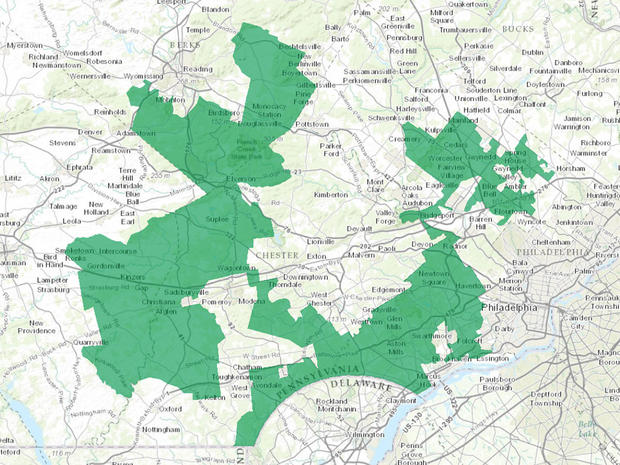
A map of Pennsylvania’s gerrymandered 7th Congressional District, encompassing parts of five counties in the Philadelphia suburbs.
CBS News
They shifted whole counties and cities into different districts in an effort to protect a Republican advantage in the congressional delegation. They succeeded, securing 13 of 18 seats in a state where registered Democratic voters outnumber Republicans 5 to 4.
“We won the whole thing,” said David Gersch of the Arnold & Porter Kaye Scholer law firm in Washington, D.C., which is helping represent the group of registered Democrats who filed the lawsuit last June.
The decision has immediate implications for the 2018 election, meaning that 14 sitting members of Congress and dozens more people are running or considering running in districts they may no longer live in.
The March 13 special election in a vacant southwestern Pennsylvania seat is unaffected by the order, the justices said.
But it’s not just Pennsylvania that deals with the manipulation of voting district lines. The issue of gerrymandering is before the Supreme Court right now, and a decision is expected this spring.
Source: US Government Class
Share:
Government Shutdown Enters Third Day
CBS News – The government shutdown remains in effect Monday, after senators failed to come to an agreement to end it late Sunday night. A vote is scheduled for noon Monday that would end the shutdown with a short-term spending bill that would last three weeks. Majority Leader Sen. Mitch McConnell attempted to schedule a vote Sunday night that would end the shutdown, but Minority Leader Sen. Chuck Schumer objected.
McConnell promised that if by Feb. 8, there is no agreement on immigration, the Senate, assuming that the government remains open, would address DACA and border security, as well as increased defense spending. “Let’s step back from the brink” and stop victimizing the American people and get back to work, McConnell argued.
Schumer told McConnell he was “happy to continue the conversation,” but said that Democrats and the GOP had “yet to reach an agreement on a path forward.”
Senate Majority Whip John Cornyn remained optimistic that the shutdown could be ended with the Monday vote, and he explained to reporters what he thought was behind Schumer’s objection.
“I think the minority leader wants to just give everybody a chance to chew on it and understand it, so that’s why he didn’t want to have the vote tonight,” Cornyn said Sunday night. “And on balance it’s better to have a successful vote tomorrow at noon than a failed vote tonight.”
House and Senate lawmakers met throughout the day Sunday to end the government shutdown as the impasse continued into the second day, with both chambers hoping to strike a deal on spending and immigration that would reopen federal agencies ahead of the work week.
Sunday morning, the fragile outlines of a potential deal seemed to be taking shape. On CBS News’ “Face the Nation,” House Speaker Paul Ryan said the lower chamber has agreed to accept a short-term deal that would fund the government through Feb. 8 if the Senate is able to pass such a bill.
Senate Democrats have so far not agreed to support a bill that makes no concessions on immigration. On Saturday, Republican Sen. Lindsey Graham of South Carolina suggested the bill that would fund the government in exchange for a commitment to move onto immigration after Feb. 8.
Where the shutdown stands on Day 3
- Senate fails to agree to end shutdown Sunday; shutdown continues Monday
- Senate to vote at noon Monday on three-week spending bill that would end shutdown
- McConnell commits to addressing DACA and border security on Feb. 8 if those issues have not been resolved
- Ryan says House would support short-term deal
- Trump calls on Senate to abolish filibuster
“After extensive discussions with Senators, on both sides of the aisle, I believe such a proposal would pass if it was understood that after February 8, the Senate would move to an immigration debate with an open amendment process if no agreement has been reached with the White House and House of Representatives,” Graham said in a statement Saturday afternoon.
On Saturday, Republicans and Democrats failed to reach an agreement as federal agencies began implementing shutdown procedures. McConnell told reporters that lawmakers would be “right back at it” for “as long as it takes.”
“We will keep at this until Democrats end their extraordinary filibuster of government funding and children’s healthcare, and allow a bipartisan majority of Senators to reopen the federal government for all Americans and get Congress back on track,” McConnell said Saturday on the Senate floor. Senate Democrats say they will not support a funding resolution that does not include protections for immigrants brought to the U.S. as children under the DACA program and spending for disaster relief.
Source: US Government Class
Share:
California Democrats want some businesses to fork over half tax-cut savings to state
FoxNews – Calling the Trump administration’s tax reform plan a “middle-class tax increase,” two California lawmakers introduced a bill that would force large companies to fork over half of their expected savings to the state.
Assemblymen Kevin McCarty and Phil Ting, both Democrats, introduced Assembly Constitutional Amendment 22, which calls for a 10 percent surcharge on companies with a net earnings over $1 million. The plan could potentially raise billions for the state’s social services programs.
The paper reported that the two lawmakers face an up-hill battle because Democrats in the state have lost their supermajority in the Legislature.
The Trump administration’s tax bill cut the corporate tax rate from 35 percent to 21 percent. The administration contends that the lessened tax burden will stimulate the economy and help the U.S. stay competitive on a global scale.
Congressional Democrats said the bill was rushed through and benefits the top 1 percent of earners. House Minority Leader Nancy Pelosi has diminished the corporate bonuses as mere “crumbs.”
An editorial last week in The Sacramento Bee called the McCarty-Ting proposal “dumb.”
“California’s tax system should be updated to match a 21st century economy,” the editorial read. “The high sales tax rate, which hits low-income people hardest, ought to be lowered, and certain services used by wealthier people and corporations ought to be subject to taxes. Proposition 13, the property tax cutting measure approved by voters 40 years ago, could be revisited.”
The editorial pointed out that the state will maintain a $13.5 billion reserve this year, but, “Bills that blindly seek to soak big business and the rich at a time of budget surplus solve nothing.”
The Associated Press contributed to this report.
Source: US Government Class
Share:
Hillary Clinton Could Still Become President if Russia Probe Finds Conspiracy Evidence
Newsweek – Nearly a year after President Donald Trump’s inauguration, a Harvard University professor says 2016 presidential candidate Hillary Clinton could still become commander in chief.
Lawrence Lessig, the Roy L. Furman professor of law and leadership at Harvard Law School, penned an essay for Medium in October outlining a series of hypothetical scenarios that could take place should the ongoing probe find that the Trump campaign actually conspired with Russia to influence the results of the election.
If Trump did conspire with Russia, the president “should resign, or, if he doesn’t, he should be impeached,” Lessig wrote in his essay. Vice President Mike Pence would also have to either resign or get impeached, which would make House Speaker Paul Ryan the president of the United States, Lessig wrote at the time.
Given that there is “no mechanism in American law for a new election,” nor “a mechanism for correcting the criminal results of the previous election,” Ryan ought to nominate “the person defeated by the treason of his own party, and then step aside, and let her become President,” Lessig went on to say.
On Wednesday, Lessig told Newsweek this scenario was still a possibility.
“This is one way it could happen,” Lessig said. “But that’s very different from saying I think it will happen, or should happen, or [that] the evidence is there for it to happen.”
Since the essay was published, there hasn’t been “any evidence that’s come out that’s resolved the question, whether there was some conspiracy to steal the election,” the professor said.
“I don’t feel that we’ve seen anything that increases that probability,” he added.
If evidence that Trump and his team conspired to steal the election did emerge in the future, however, the president would have to step down, Lessig maintained.
“Absolutely, he’s got to resign, and if he doesn’t resign, then absolutely Congress needs to impeach him,” he said of the hypothetical situation.
Lessig noted that the hypotheticals he wrote about in his essay would apply to only the specific scenario he described.
“The remedy that I…outline[d] only makes sense if you believe the election was stolen,” he said. “If you don’t believe the election was stolen, there might have been a hundred other things [Trump] did that would lead you to believe he ought to be removed, but none of those justify the remedy I described.”
Source: US Government Class