apgov

Italian election results cast a pall over the European Union

Santa Fe New Mexican – BRUSSELS — Since the European Union’s founding treaty was signed in Rome more than 60 years ago, Italy has been an unabashed booster of increased unity and common purpose. That may have come to an end.

Euroskeptics and populists rode a wave of hostility toward all things EU and surged to the fore in Italian elections on Sunday, turning the founding EU nation into a potential obstructionist just when the bloc was emerging from a decade of economic gloom and seemed poised to rekindle its grand ambitions.

Beyond moving away from the EU policies in Brussels, the Italian results were the latest indication that the continent is tilting further to the right.

Sunday’s stunning outcome came at the end of a seesaw day for the EU that started out well enough when the German Socialists finally threw their weight behind a staunchly pro-Europe grand coalition under Chancellor Angela Merkel.

Now, it seemed, the Merkel-Emmanuel Macron partnership was on and the German-French engine was primed to push a core group of EU nations toward more unity.

Then, Italy’s results started to come in and the message from Italian voters was clear: “Don’t necessarily count on us.” Instead of a smooth ride under fair weather economic conditions, the bloc should brace for more of the chaos and havoc that anti-EU populists have spread in many member nations over the past few years.

“The European Union is having a bad evening,” France’s far-right Marine Le Pen tweeted elatedly as it became clear that more than half the Italian electorate had backed two stridently anti-EU parties.

Le Pen may have been a washout in last year’s French presidential elections against Macron, and Germany’s established parties may have closed ranks against the right-wing nationalist AfD in Parliament, but populism, sometimes combined with the far right, is thriving and in power from Poland’s shipyards to the coffee tables of Vienna. In Hungary, Viktor Orban has been in power with his style of so-called “illilberal” democracy in Hungary since 2010.

Despite such precedents, Sunday’s results from Rome still came as a shock to the EU. It was barely a week ago that EU Commission President Jean-Claude Juncker had confidently predicted that “whatever the outcome, I am confident that we will have a government that makes sure that Italy remains a central player in Europe and in shaping its future.”

One of the first things Matteo Salvini, the head of Italy’s victorious anti-migrant, euroskeptic League party, said Monday was that the shared euro currency was “wrong.” The EU is still smarting badly from Britain’s 2016 decision to leave the bloc, so another ally turning a cold shoulder is the last thing the bloc needs.

“The outcome of the elections could not be farther away from what the European Commission, as well as most other EU governments, were hoping for,” said the Europe think tank VoteWatch, calling it an “unprecedented political shock.”

Pending the outcome of government coalition talks, the 5-Star Movement could set Italy’s EU policy for years to come.

And together with other populist and far-right movements, Sunday’s vote shows they could well move from the fringes of the European legislature to dominate debate after the EU-wide elections of May 2019.

However politically disruptive this looks, such forces also know how to add water to their wine.

For all his anti-EU talk, Orban is still firmly entrenched in the pro-EU European People’s Party group of Juncker and Tusk. And the abrasive disputes between Warsaw and Brussels have also abated somewhat in recent weeks.

As for Italy, the politics of compromise there has been elevated to an art.

“Recently they have already toned down their virulent anti-EU talk,” said Hendrik Vos, a professor of European politics at Ghent University in Belgium, referring to Italy’s anti-establishment parties. “Let’s not panic just yet.”

Source: US Government Class

Oakland Mayor Libby Schaaf tipped off immigrants about ICE raid and isn’t sorry she did

Washington Post – On Tuesday night, just after completing a roundup of more than 150 suspected undocumented immigrants, U.S. Immigration and Customs Enforcement said it could have arrested more but for the actions of one person: Mayor Libby Schaaf of Oakland, Calif.

Schaaf learned of the Northern California ICE enforcement operation before it kicked off on Sunday and, in a controversial move, warned the immigrant community ahead of time.

On Saturday, saying she felt it was her moral and ethical duty, she stood in front of television cameras and announced that “multiple credible sources” had informed her that ICE would be making arrests across the Bay Area. She didn’t intend to panic the community, she said — only to protect it.

ICE Deputy Director Thomas D. Homan, however, had a different idea of what she was trying to do, saying on Tuesday that he believed some of the 864 “criminal aliens” that still remained at large “were able to elude us thanks to the mayor’s irresponsible decision.”

“Sanctuary jurisdictions like San Francisco and Oakland shield dangerous criminal aliens from federal law enforcement at the expense of public safety,” Homan said in a statement. “The Oakland mayor’s decision to publicize her suspicions about ICE operations further increased [risks] for my officers and alerted criminal aliens — making clear that this reckless decision was based on her political agenda with the very federal laws that ICE is sworn to uphold.”

Schaaf is unapologetic.

In an interview with The Washington Post on Tuesday, she explained that her decision to tip off immigrants stemmed from a deep disagreement with immigration enforcement under the Trump administration and a resistance to the administration’s enforcement efforts.

She had already made her defiance clear last month when she told reporters that she was willing to go to jail to defend Oakland’s “sanctuary city” policy of protecting immigrants who are in the country illegally and not cooperating with federal authorities to deport them. She said Tuesday that she was responding to a suggestion from Homan in January that the Justice Department should begin criminally charging California politicians who supported sanctuary jurisdictions. Politicians like her, she said.

Asked by The Post whether she considered herself part of “the resistance” movement — the unofficial title for left-leaning Americans who do not support the Trump administration — she responded with a resounding yes.

“I consider myself a law-abiding citizen. I consider myself a believer in an American democracy that moves towards a more just society. And I definitely consider myself part of the resistance,” she said.

As Schaaf decided whether to warn the community Saturday, she said she was thinking of the case of Maria Mendoza-Sanchez, a 46-year-old mother of four and nurse at an Oakland hospital, who, along with her husband, was deported to Mexico after more than 20 years in the United States. Neither she nor her husband had criminal records, as the San Francisco Chronicle reported.

Neither did roughly half of the suspected undocumented immigrants rounded up in ICE’s latest North California operation — which, Schaaf said, is what she had feared.

“Maria Mendoza-Sanchez and her husband are an example of a couple that, under the previous administration, were considered low-priority for deportation,” Schaaf said. “And under this administration they were ripped away from their family. I was absolutely thinking of them when I made the decision to share the [ICE enforcement] information. I think it’s my responsibility as a person in power and privilege to share the information I have access to, to make sure people know what their rights are.”

Schaaf had first started fighting against such deportations as a lawyer, before the idea of public office had even crossed her mind, she said.

After graduating from Loyola Law School in Los Angeles, the Oakland native started her career as a lawyer at Reed Smith, a large corporate law firm where she did some work on deportation cases on a pro bono basis. The last case she worked as a lawyer involved a Salvadoran man seeking political asylum, after he had seen his girlfriend raped by soldiers, Schaaf said, and after his home burned down in a fire that killed his baby.

“It’s part of what makes me have such deep respect for so many of the immigrants who come to Oakland,” she said, “who have been through unspeakable hardships. At the time I defended him, we were the exact same age — not even 30 years old — but had led such unbelievably different lives.”

Schaaf soon moved on to co-found a volunteer organization called Oakland Cares, which coordinated various public-service projects around the city, and to spearhead another volunteer group working on projects within Oakland public schools. She took her first job as a city official as an aide to the president of Oakland City Council.

She moved up to work as an aide to then-Mayor Jerry Brown, who went on to become governor, before successfully running for the city council herself. She ran successfully for mayor in 2014, garnering 63 percent of the vote.

Oakland, like its Bay Area neighbors Berkeley and San Francisco, is a bastion of progressive politics. Previous mayors, in addition to Brown, have included former Democratic Rep. Ronald V. Dellums and the first Asian American woman mayor of a major city, Jean Quan.

Under Schaaf’s administration, Oakland has raised the minimum wage to $12.25 an hour, developed the city’s first transportation department and created a “cradle-to-career” initiative designed to shepherd children born into poverty to college.

Her tenure has not been without controversy. Just after taking office in 2015, protesters with Black Lives Matter held a rally outside her house complaining that she was prioritizing meetings with scandal-entrenched police officials over meetings with Black Lives Matter advocates.

A year later, a group called the Anti-Police Terror Project called for her removal from office over those police scandals and escalating tensions between police and communities of color, saying Schaaf was not seeking solutions.

Just last month, another protest sprouted up outside her home, this one from homeless advocates saying Schaaf was not doing enough to further low-income housing, despite her administration saying it was a priority.

Schaaf said she has respected the viewpoints of those criticizing her.

“I’ve lived in Oakland my whole life, and Oakland has always been a center of social justice,” Schaaf said. “In Oakland, the level of activism is so high that anyone in a position of governmental authority is going to be questioned and challenged, and I celebrate that. It’s part of our democracy that people speak truth to power, and in Oakland, that is a particularly time-honored tradition.”

It was social justice that was on her mind when she tipped off the immigrant community about the ICE raids.

Schaaf has said that she consulted her legal counsel before deciding to act. Because she obtained the information from unofficial sources rather than through formal government channels, she doesn’t believe she obstructed justice or violated any law by speaking up.

Critics disagree. Tony Brass, a former federal prosecutor told CBS in San Francisco that “she’s on the threshold of obstruction of justice for doing what she did … because you put agents in danger. You put the police in danger and you put your neighbors in danger.”

Maricela Gutiérrez, executive director of the immigrant-advocacy organization SIREN, said that at first reactions within the immigrant community were mixed after Schaaf announced the raid. There had been panic, she said, and a lot of questions: How did the mayor get this information? How does she know it’s really going to happen?

Still, Gutierrez said, she and her colleagues took the opportunity to alert the community and provide resources about their legal rights if they were confronted by ICE.

“It really created a mass mobilization,” she said. “As advocates, we took [Schaaf’s warning] very seriously. When do you hear a mayor of a big city announcing that an ICE attack is going to happen? Never. If she’s saying that, it must be true.”

Source: US Government Class

Chinese leader’s bid to rule indefinitely sparks rare public backlash

CBS News – BEIJING — In a rare public expression of dissent in China, a well-known political commentator and a prominent businesswoman have penned open letters urging lawmakers to reject a plan that would allow President Xi Jinping to rule indefinitely. Their impassioned statements on a popular messaging app were circulated widely after the ruling Communist Party announced a proposal Sunday to amend the constitution to scrap term limits on the president and vice president.

In a statement Monday on WeChat to Beijing’s members of China’s rubber-stamp parliament, Li Datong, a former editor for the state-run China Youth Daily, wrote that lifting term limits would “sow the seeds of chaos.”

“If there are no term limits on a country’s highest leader, then we are returning to an imperial regime,” Li told The Associated Press on Tuesday. “My generation has lived through Mao. That era is over. How can we possibly go back to it?”

“Mr. Xi’s strongman style has been compared to that of the Russian president,” says CBSN contributor Alex Klimint, who writes for the Signal newsletter produced by GZERO Media. “But even Mr. Putin did not try to erase his country’s constitutional limit on serving more than two consecutive terms as president when he approached that limit in 2008. Instead, he arranged for a close adviser, Dmitri A. Medvedev, to serve as president for a single term while Mr. Putin held the post of prime minister. Mr. Putin then returned to the presidency in 2012, and is running this year for re-election.”

Wang Ying, a businesswoman who has advocated government reforms, wrote on WeChat that the Communist Party’s proposal was “an outright betrayal” and “against the tides.”

“I know that you (the government) will dare to do anything,” she wrote, “and one ordinary person’s voice is certainly useless. But I am a Chinese citizen, and I don’t plan on leaving. This is my motherland too!”

In a message that was swiftly deleted, sociologist Li Yinhe called the removal of term limits “unfeasible” and would “return China to the era of Mao.”

Li added, however, that delegates to the National People’s Congress, China’s parliament, are likely to pass the amendment unanimously since “they aren’t really elected by the people, therefore they don’t represent the people in voting, but will vote according to the leadership’s design.”

It wasn’t clear who deleted Li’s message, but official censors have been working assiduously to scrub criticisms of the amendment from the internet.

An official at the information department of the congress’ Standing Committee said Tuesday that he was not aware of the open letters.

While Xi, 64, is broadly popular in China for his economic stewardship, muscular foreign policy and emphasis on stability, it’s difficult to determine how the move to end term limits has been received overall. Few Chinese dare speak out on political topics, even online, while the media are entirely state controlled and public polling on sensitive issues is nonexistent.

Analysts say the amendment could bring a degree of reassurance initially while leading to long-term uncertainty about Xi’s intentions and the succession process. It upends a decades-long push for greater institutionalization and rule of law in the country.

The congress is all but certain to pass the constitutional amendment when it meets for its annual session early next month, at which it will grant Xi a second five-year term and appoint new ministers and other government officials.

Under the 1982 constitution, the president is limited to two five-year terms in office, but Xi – already China’s most powerful leader since Mao – is seemingly convinced that he’s the only one who can realize his vision for China and wants additional terms to see through his agenda of fighting corruption, eliminating poverty and transforming China into a modern leading nation by midcentury.

A simple thirst for power is another possible motivation.

Government and party spokesmen have yet to offer any detailed explanations of the reasoning behind the dropping of term limits. Nor is it clear whether Xi will seek to remain president for life or will only stay on for a set number of additional terms.

“The fact that this proposal was possible means that Xi Jinping’s influence is growing,” said Chen Jieren, a Beijing-based independent political scholar. “The party is recognizing his achievements in fighting corruption. People have confidence in and respect for his resoluteness.”

But Chen added: “China is not Cuba. Through the past few decades, Chinese people have come to understand that no one should be in power for life.”

Foreign ministry spokesman Lu Kang said Monday that the proposal “was made in accordance with the new situation and the practice of upholding and developing socialism with Chinese characteristics in the new era.”

In a commentary Tuesday, the official China Daily newspaper mentioned the proposal to strip out language in the constitution limiting the president and vice president to two five-year terms, saying it was “necessitated by the need to perfect the party and the state’s leadership system.”

While Chinese censors have moved swiftly to delete satirical online commentary on the move, a range of opposition views continue to be shared. The Global Times, a newspaper published by the Communist Party, said “outside forces” were trying to challenge the party’s leadership.

Source: US Government Class

Community fights back as California increasingly overrun by homelessness, human waste, needles ‘A NATIONAL DISGRACE’ Community fights back as California increasingly overrun by homelessness, human waste, needles

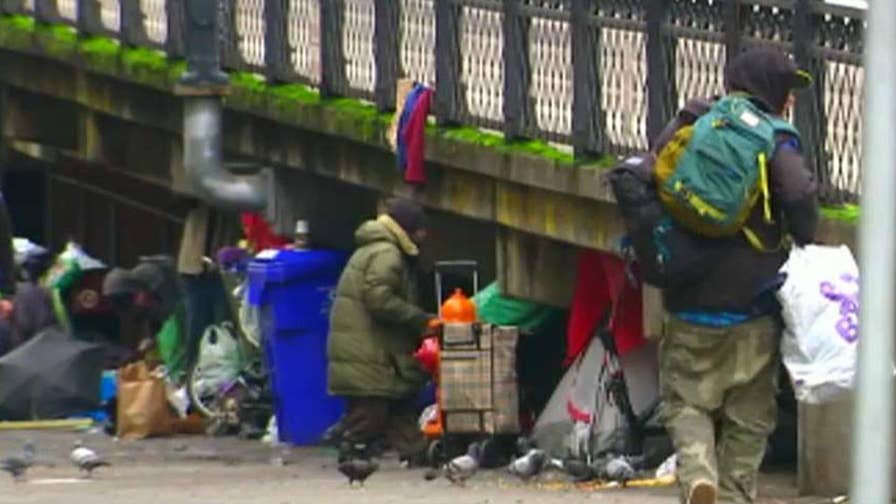
FoxNews – The specter of homeless encampments steadily expanding across the downtown streets of San Diego, Los Angeles and San Francisco – bringing with them a public health crisis – has one southern California community taking tough action to dismantle a two-mile-long camp just a short drive from Disneyland.

In a departure from the approach taken by other local governments in the state, officials in Orange County, Calif., have started to clear out the camp – by moving occupants and hauling away literally tons of trash and hazardous waste.

“It’s becoming part of the permanent landscape in those communities and there is no way we are going to allow Orange County land that is supposed to be used by residents to be occupied by the homeless,” said Todd Spitzer, who sits on the Orange County Board of Supervisors.

Homeless people line up in preparation to move from their homeless camp site along a riverbed in Anaheim, Calif. on Tuesday, Feb. 20, 2018. Authorities are being allowed to shut down a large homeless encampment in Southern California and move hundreds of tent-dwellers into motel rooms. (AP Photo/Amy Taxin)

Homeless people prepare to move from their camp along a riverbed in Anaheim, Calif., on Feb. 20, 2018.  (AP)

Trash trucks and contractors in hazmat gear have descended on the camp and so far removed 250 tons of trash, 1,100 pounds of human waste and 5,000 hypodermic needles.

But the effort hasn’t been without controversy as homeless advocates, the American Civil Liberties Union and a federal judge have all weighed in on the fate of some-700 people evicted from their home along the Santa Ana River — next to Angel Stadium of Anaheim and a few miles from Disneyland, outside Los Angeles.

Spitzer, whose district includes the encampment, has battled the advocates since last fall when the decision was first made to close the camp. The ACLU and others filed a federal civil rights lawsuit to stop this and several stays have ensued until last week, when the final go-ahead was granted.

For those being evicted, a mediation with U.S. District Court Judge David Carter offered the choice of a bed in a shelter or a month-long motel voucher; medical aid; drug treatment; job training; storage for their belongings and housing for pets at the county animal shelter.

So far, 544 people have been moved to shelters and motel rooms and approximately 100 remain at the riverbed. Crews counted 207 tents, but it is unclear if they are occupied.

‘That isn’t going to happen in our county. It’s not going to be our skid row.’

– Todd Spitzer, Orange County Board of Supervisors

But one option is not negotiable – the homeless cannot move back to the Santa Ana River channel, which has paved shoulders where residents used to walk and bike. The river, which runs from the mountains to the sea, is home to much of Orange County’s groundwater and empties between pricey Newport and Huntington beaches. The beach has been closed often over the years due to high bacteria levels.

Officials in the county are mindful of how these camps have expanded in other major California cities.

FILE - In this Dec. 19, 2017, file photo, two police officers, Eric Meier, right, and Curtis Bynum from the Anaheim Police Department's homeless outreach team walk through a homeless encampment set up outside Angel Stadium to hand out flyers about the community outreach day in Anaheim, Calif. Homeless residents and their advocates are expected to argue in U.S. court Tuesday, Feb. 13, that Orange County can't remove them from a riverbed bike trail without adequate housing options. Officials say they've offered shelter beds and housing. (AP Photo/Jae C. Hong, File)

Officers are seen walking through the homeless camp outside Angel Stadium in late 2017, before the mass move-out.  (AP)

Los Angeles’ homeless problem has now spread past Skid Row to much of downtown. The amount of feces littering the streets in San Diego, Los Angeles and San Francisco has led to a hepatitis outbreak that spread throughout the state’s homeless communities, infecting 694 people. It skipped Orange County.

Spitzer singled out for criticism Los Angeles and San Francisco. San Francisco’s feces problem is so bad that a website now exists to warn residents of which streets to avoid. Los Angeles raised taxes last year in order to build housing for the homeless and has started a roving toilet program.

“That isn’t going to happen in our county. It’s not going to be our skid row,” Spitzer vowed. “We need to be compassionate and empathetic. I’m writing checks all over the place. But I’m not going to intermingle this population with property owners, are you kidding?”

Reports from the scene in Orange County largely reflected an orderly move. Carter called it a “great credit to transparency, humanity,” according to The Los Angeles Times.

One advocate for the homeless told the same newspaper they heard reports of people who didn’t get food vouchers or couldn’t get to their destinations – but generally described the move as offering “better living conditions.”

Approximately a half-million people in the United States are homeless, with California accounting for 25 percent — the largest number of any state, according to a survey by the U.S. Department of Housing and Urban Development. Orange County has 4,792 homeless.

A Los Angeles Times editorial over the weekend called the problem in the city a “national disgrace.”

Spitzer blames the problem on two issues: legislation signed by Democratic Gov. Jerry Brown over the past several years that has eroded the penalties for drug use, possession and petty crimes to where police often don’t bother making arrests; and the change in a law so that treatment is no longer forced for drug abuse or mental health issues.

This week he wrote a letter to Brown, urging him to declare a state of emergency over the homeless issue and reverse previous forced-treatment laws.

“When I was a prosecutor, the law behind possession was a felony,” said Spitzer, a former deputy district attorney. “We would use the hammer under the law of a felony. We would force someone into treatment and upon successful treatment, the felony would be dismissed. Now look what we have as a result of ridiculous short-sighted liberalization of drug use.”

Source: US Government Class

Supreme Court rejects Trump administration’s appeal over DACA

CBS News – The Supreme Court is rejecting the Trump administration’s highly unusual bid to get the justices to intervene in the controversy over protections for hundreds of thousands of young immigrants.

The justices on Monday refused to take up the administration’s appeal of a lower court order that requires the administration to continue accepting renewal applications for the Deferred Action for Childhood Arrivals program, or DACA. The DOJ appealed a lower court’s decision in The Regents of the University of California and Janet Napolitano v. U.S. Department of Homeland Security and Elaine Duke, to the 9th Circuit Court of Appeals and asked the U.S. Supreme Court take up the case directly late last month.

The appeal came after a U.S. district court temporarily blocked the Trump administration from ending DACA, the program former President Barack Obama established to protect immigrants who came to the U.S. illegally as children.

What made the appeal unusual is that the administration sought to bypass the federal appeals court in San Francisco to appeal directly to the Supreme Court.

Since then, a judge in New York also has ruled in favor of immigrants challenging the end of DACA.

In a brief unsigned comment, the justices said they assume “the court of appeals will proceed expeditiously to decide this case.” The court order says applications must now be accepted indefinitely. DACA has provided protection from deportation and work permits for about 800,000 young people, many who were brought to the U.S. illegally.

In a statement from Department of Justice spokesman Devin O’Malley, the DOJ says they will continue to defend “DHS’ lawful authority to wind down DACA in an orderly manner.

“While we were hopeful for a different outcome, the Supreme Court very rarely grants certiorari before judgment, though in our view it was warranted for the extraordinary injunction requiring the Department of Homeland Security to maintain DACA,” O’Malley added.

In September, Mr. Trump said he would end the DACA program by March 5 but the court’s ruling now delivers a blow to the administration’s end date.  Congress still has yet to formally provide a fix the DACA program, with the Senate most recently rejecting all four immigration proposals brought to the Senate floor this month.

Source: US Government Class

Dems fume as Trump pushes low-cost, ObamaCare alternative health plans

FoxNews – The Trump administration moved Tuesday to allow health insurers to sell lower-cost, less-comprehensive medical plans as an alternative to those required under ObamaCare – in a plan that drew swift protest from congressional Democrats.

The proposed regulations would allow insurers to sell individual consumers “short-term” policies that can last up to 12 months, have fewer benefits, and come with lower premiums.

The plans also would come with a disclaimer that they don’t meet the Affordable Care Act’s consumer protection requirements, such as guaranteed coverage. Insurers could also charge consumers more if an individual’s medical history discloses health problems.

But at a time of rising premiums, Trump administration officials touted the option as a boost for those who need coverage but don’t qualify for the Affordable Care Act’s subsidies and would otherwise face paying the full premium cost.

“We need to be opening up more affordable alternatives,” Health and Human Services Secretary Alex Azar told reporters. “It’s one step in the direction of providing Americans with alternatives that are both more affordable and more suited to individual and family circumstances.”

Wary of any effort to under ObamaCare, however, Democratic leaders on Capitol Hill accused the administration of trying to green-light the sale of “junk” policies.

“Since day one, the Trump administration playbook on health care has been to sabotage the marketplaces, jack up costs and premiums for millions of middle-class Americans. Then – as a supposed life-line to a self-inflicted crisis – offering junk insurance that fails to offer protections for those with pre-existing conditions or coverage of essential health benefits and more,” Senate Minority Leader Chuck Schumer, D-N.Y., said in a statement.

House Minority Leader Nancy Pelosi, D-Calif., said in a statement, “Americans purchasing these shoddy, misleading short-term Trumpcare plans will be one diagnosis away from disaster, discovering they have been paying for coverage that may not cover basic care such as cancer treatment, preventative care or maternity care.”

She claimed the move would, in turn, drive up premiums for those with pre-existing conditions.

The proposal comes after congressional Republicans failed to pass legislation to repeal and replace the ACA, though did repeal the individual requirement to buy health insurance.

Critics of Trump’s approach say that making such short-term policies more attractive to consumers will undermine the health care law’s insurance markets, because healthy customers will have an incentive to stay away from HealthCare.gov and its state-run counterparts.

Democrats say the solution is to increase government subsidies, so that more middle-class people will be eligible for taxpayer assistance to buy comprehensive coverage. Under Obama, short-term plans were limited to periods of no longer than three months.

Trump administration officials reject the notion that they’re trying to undermine the ACA. One major health insurance company, United Healthcare, is already positioning itself to market short-term plans.

The administration’s proposal will be open for public comment for 60 days. However, for 2018, short-term coverage won’t count as qualifying coverage under the Obama health law, which means consumers with such plans would legally be considered uninsured, putting them at risk of fines.

The repeal of the individual mandate does not take effect until next year.

The Associated Press contributed to this report.

Source: US Government Class

Portraits or politics? Presidential likenesses blend fact and fiction

Santa Fe New Mexican – With the unveiling here Monday at the National Portrait Gallery of the official presidential likenesses of Barack Obama and the former first lady, Michelle Obama, this city of myriad monuments gets a couple of new ones, each radiating, in its different way, gravitas (his) and glam (hers).

Ordinarily, the event would pass barely noticed in the worlds of politics and art. Yes, the Portrait Gallery, part of the Smithsonian Institution, owns the only readily accessible complete collection of presidential likenesses. But recently commissioned additions to the collection have been so undistinguished that the tradition of installing a new portrait after a leader has left office is now little more than ceremonial routine.

The present debut is strikingly different. Not only are the Obamas the first African-American presidential couple to be enshrined in the collection. The painters they’ve picked to portray them — Kehinde Wiley, for Barack Obama’s portrait; Amy Sherald, for Michelle Obama — are African-American as well. Both artists have addressed the politics of race consistently in their past work, and both have done so in subtly savvy ways in these new commissions. Wiley depicts Barack Obama not as a self-assured, standard-issue bureaucrat, but as an alert and troubled thinker. Sherald’s image of Michelle Obama overemphasizes an element of couturial spectacle, but also projects a rock-solid cool.

It doesn’t take #BlackLivesMatter consciousness to see the significance of this racial lineup within the national story as told by the Portrait Gallery. Some of the earliest presidents represented — George Washington, Thomas Jefferson — were slaveholders; Michelle Obama’s great-great grandparents were slaves. And today we’re seeing more and more evidence that the social gains of the civil rights, and Black Power, and Obama eras are, with a vengeance, being rolled back.

On several levels, then, the Obama portraits stand out in this institutional context, though given the tone of bland propriety that prevails in the museum’s long-term “America’s Presidents” display — where Barack Obama’s (though not Michelle Obama’s) portrait hangs — standing out is not all that hard to do.

The National Portrait Gallery collection isn’t old. It was created by an Act of Congress in 1962 and opened to the public in 1968. (The Obama unveiling is billed as part of its 50th birthday celebrations.) By the time it began collecting, many chief executive portraits of note were already housed elsewhere. (The collection of first lady portraits is still incomplete; commissioning new ones started only in 2006.)

There are, for sure, outstanding things, one being Gilbert Stuart’s so-called “Lansdowne” portrait of George Washington from 1796, a full-length likeness packed with executive paraphernalia: papers to be signed, multiple quill pens, a sword, and an Imperial Roman-style chair. Even the clothes are an 18th-century version of current POTUS style: basic black suit and fat tie. As for Washington, he stands blank-faced, one arm extended, like a tenor taking a dignified bow.

Uninflected dignity was the attitude of choice for well over a century, with a few breaks. In an 1836 portrait, Andrew Jackson, a demonstrative bully, sports a floor-length, red-silk-lined Dracula cloak and a kind of topiary bouffant. (A picture of Jackson, one of President Donald Trump’s populist heroes, hangs in the Oval Office.) Abraham Lincoln, seen in several likenesses, is exceptional for looking as if he may actually have weighty matters on his mind. Most of the portraits that precede and follow his are pure PR.

This continues well into the 20th century. In a 1980 painting Jimmy Carter trades a black suit for a beige one. How revolutionary is that? And there’s a Casual Fridays vogue: Ronald Reagan and George W. Bush both go tieless for it. Under the circumstances, Elaine de Kooning’s 1963 portrait of John F. Kennedy, a fanfare of green and blue strokes, hits like a boost of adrenaline. Rousing too, though not in a good way, is a big head shot image of Bill Clinton by artist Chuck Close. Using his signature mosaic-like painting technique, Close turns the 42nd president into a pixelated clown.

Barack Obama has much better luck with his similarly high-profile portraitist. Wiley, born in Los Angeles in 1977, gained a following in the early 2000s with his crisp, glossy, life-size paintings of young African-American men dressed in hip-hop styles, but depicted in the old-master manner of European royal portraits. More recently he has expanded his repertoire to include female subjects, as well as models from Brazil, India, Nigeria and Senegal, creating the collective image of a global black aristocracy.

In an imposingly scaled painting — just over 7 feet tall — the artist presents Barack Obama dressed in the regulation black suit and an open-necked white shirt, and seated on a vaguely thronelike chair not so different from the one seen in Stuart’s Washington portrait. But art historical references stop there. So do tonal echoes of past portraits. Whereas Obama’s predecessors are, to the man, shown expressionless and composed, Obama sits tensely forward, frowning, elbows on his knees, arms crossed, as if listening hard. No smiles, no Mr. Nice Guy. He’s still troubleshooting, still in the game.

His engaged and assertive demeanor contradicts — and cosmetically corrects — the impression he often made in office of being philosophically detached from what was going on around him. At some level, all portraits are propaganda, political or personal. And what makes this one distinctive is the personal part. Wiley has set Obama against — really embedded him in — a bower of what looks like ground cover. From the greenery sprout flowers that have symbolic meaning for the sitter. African blue lilies represent Kenya, his father’s birthplace; jasmine stands for Hawaii, where Obama himself was born; chrysanthemums, the official flower of Chicago, reference the city where his political career began, and where he met his wife.

Michelle Obama’s choice of Sherald as an artist was an enterprising one. Sherald, who was born in Columbus, Georgia, in 1973 and lives in Baltimore, is just beginning to move into the national spotlight after putting her career on hold for some years to deal with a family health crisis, and one of her own. (She had a heart transplant at 39.) Production-wise, she and Wiley operate quite differently. He runs the equivalent of a multinational art factory, with assistants churning out work. Sherald, who until a few years ago made her living waiting tables, oversees a studio staff of one, herself.

At the same time, they have much in common. Both focused early on African-American portraiture precisely because it is so little represented in Western art history. And both tend to blend fact and fiction. Wiley, with photo-realistic precision, casts actual people in fantastically heroic roles. (He modifies his heroizing in the case of Barack Obama, but it’s still there.) Sherald also starts with realism, but softens and abstracts it. She gives all her figures gray-toned skin — a color with ambiguous racial associations — and reduces bodies to geometric forms silhouetted against single-color fields.

She shows Michelle Obama sitting against a field of light blue, wearing a spreading gown. The dress design, by Michelle Smith, is eye-teasingly complicated: mostly white interrupted by black op art-ish blips and patches of striped color suggestive of African textiles. The shape of the dress, rising pyramidally upward, mountain-like, feels as if it were the real subject of the portrait. Michelle Obama’s face forms the composition’s peak, but could be almost anyone’s face, like a model’s face in a fashion spread. To be honest, I was anticipating — hoping for — a bolder, more incisive image of the strong-voiced person I imagine this former first lady to be.

And while I’m wishing, let me mention something more. Barack Obama’s portrait will be installed, long-term, among those of his presidential peers, in a dedicated space on the second floor. Michelle Obama’s will hang in a corridor reserved for temporary displays of new acquisitions — on the first floor. It will stay there until November, after which there’s no set-aside place for it to land.

If first men have an acknowledged showcase, first women — ladies or not — should too. Better, they should all be together, sharing space, offering a welcoming environment to, among others, a future first female president, and creating a lasting monument to #MeToo.

Event information

Portraits of Barack Obama and Michelle Obama

At the National Portrait Gallery, Smithsonian Institution, Washington; 202-633-1000; npg.si.edu.

Source: US Government Class

Pence says U.S. is willing to have talks with North Korea

CBS News – Vice President Mike Pence has signaled that he is open to holding talks with North Korea, a sign that icy tensions in the Korean peninsula are beginning to warm up, CBS News’ Jackie Alemany has confirmed. While the U.S shows new openness to engaging with the regime, the administration has not changed its course of keeping the pressure on North Korean dictator Kim Jong Un.

In an interview with the Washington Post’s Josh Rogin, on his way home from South Korea where he led the U.S. delegation at the Winter Olympics, Pence said that during conversations with South Korea’s President Moon Jae-in, the U.S. and South Korea had agreed on terms for “further engagement” with the North. Such an engagement would be conducted first by the South Koreans and “potentially” with the U.S. shortly thereafter. But in the interim, the U.S. and allies would continue to pressure North Korea on denuclearization. This is, Rogin pointed out, differs from the prior position of the U.S., that the U.S. would only engage with the North if it made concessions on denuclearization first.

Just before departing for Washington, Pence said Saturday evening there was “no daylight” between the U.S. and South Korea, despite their different approaches to engagement with North Korea, evident during the Pyeongchang Olympic  Games. Moon had a luncheon earlier Saturday with the North Koreans, where he was invited by Kim’s sister, Kim Yo Jung, for a summit meeting in the North. Pence on the other hand, avoided interacting with the regime altogether.

Moon however provided Pence with a readout of the historic luncheon between the North and South. On the flight home, Pence told reporters that he appreciated Moon’s transparency and perspective on North Korea, but reiterated that the U.S. and South Korea would “continue to stand strong and to work in a coordinated way to bring maximum economic and diplomatic pressure on North Korea.”

“[N]o pressure comes off until they are actually doing something that the alliance believes represents a meaningful step toward denuclearization,” Pence told Rogin. “So the maximum pressure campaign is going to continue and intensify. But if you want to talk, we’ll talk.”

“I leave here very confident that we are going to continue to do the things we know have to be done to continue to pressure North Korea to abandon their nuclear ambitions,” Pence also said.

Pence’s remarks are in line with Secretary of State Rex Tillerson, who said in December that the U.S. was ready to talk to the North without preconditions.

“When do the talks begin? We have said, from the diplomatic side, we are ready to talk any time North Korea would like to talk. And we are ready to have the first meeting without preconditions. Let’s just meet,” Tillerson said at at the Atlantic Council in Washington, D.C. 

Upon his arrival back to D.C., Pence tweeted that the U.S. policy on North Korea is “unchanged.” He added that the president as said he “always believes in talking” but noted “there will be no reward for talks.”

Pence also suggested that while potential talks could take place, “new strong sanctions are coming very soon” and the pressure on North Korea will “intensify until North Korea abandons its nuclear program.”

Source: US Government Class

House committee OKs bill to consolidate nonpartisan local elections

Santa Fe New Mexican – Election day is not just a day in New Mexico.

Between school boards, soil and water conservation districts, community college districts and hospital districts, it can seem like the voting never stops.

“We have a vast number of small, rural elections in our state happening pretty much all the time,” Secretary of State Maggie Toulouse Oliver told a committee of the House of Representatives on Thursday.

But whether people actually know about, much less participate in, these myriad elections is another matter.

In response, the local government committee of the House approved a sweeping bill that would consolidate virtually all nonpartisan local elections on the same day.

Backers, including the Secretary of State’s Office and county clerks, say the measure would boost voter turnout.

But school board members from around the state have staunchly opposed the bill, and others have raised concerns about ballots growing too long with candidates and questions.

Under the measure, House Bill 98, local elections would be scheduled for the first Tuesday after the first Monday in November during odd-numbered years. General elections for offices such as governor and president are held in November of even-numbered years.

The bill would include school districts, community college districts, flood control districts, special zoning districts, soil and water conservation districts, and water and sanitation districts. In 2022, the law also would include conservancy districts.

Most town council and mayoral elections would be included, too, except for what are known as home-rule municipalities, such as Santa Fe, Albuquerque and Gallup. Those cities could opt in, though.

Though school districts could still choose to hold special elections for bonds, all special elections would be handled by mail.

Supporters contend the bill streamlines elections and would ensure more voters participate in the electoral process.

“All levels of local government in New Mexico are raising our taxes with fewer than 5 percent of people voting,” said Sen. Daniel Ivey-Soto, D-Albuquerque, the bill’s co-sponsor. “I’m the former state elections director, and I’ve never voted in the Ciudad Soil and Water Conservation District’s elections [in Albuquerque] because I don’t know when their elections are.”

Ivey-Soto said ballots in such elections would not include more than seven offices — fewer than in a general election.

And he said this year’s bill may better address concerns raised by Gov. Susana Martinez about previous versions.

Specifically, the four city governments around the state that require photo identification to cast a ballot in municipal elections would still hold their own elections on a separate date.

But school districts argued the measure might undercut the support for bonds and board members. School elections are usually scheduled for February of odd-numbered years.

And more voters does not necessarily mean more informed voters, some board members argued.

The city of Albuquerque argued it would have to change the dates of its municipal election because of the city’s charter.

Conversely, others argued cities like Santa Fe may not see any benefit to changing the dates of its school elections.

Linda Siegle, a lobbyist for Santa Fe Public Schools and chairwoman of the Santa Fe Community College Governing Board, questioned whether the bill would really boost turnout if the capital city’s government — one of those home-rule municipalities — were not included.

The college already works with the local school district on coordinating elections. That means Santa Fe would not see many elections combined, just moved from one end of the calendar to another.

“There is nothing to drive a higher voter turnout simply by having an election in November,” she said.

The bill also would impose fees on local governments for election administration. Siegle argued that, because schools in Santa Fe already coordinate on elections, the bill would end up costing those schools more money.

Ultimately, the measure cleared the committee with only one vote in opposition.

Rep. Daymon Ely’s reasons for voting against it may be the legislation’s biggest challenge.

The bill as introduced totaled more than 300 pages. Ely, D-Corrales, said he had concerns about rushing a bill with a pile of changes made shortly before the committee hearing.

Indeed, with the law touching various pieces of the electoral process, it may daunt lawmakers.

But the Legislature approved a similar measure last year with bipartisan support. It totaled 269 pages. Martinez never signed the bill.

Contact Andrew Oxford at 505-986-3093 or aoxford@sfnewmexican.com. Follow him on Twitter @andrewboxford.

Source: US Government Class