apgov

Dems’ emerging platform includes free money, guaranteed jobs, reparations

FoxNews – Free tuition, minimum wage hikes and “Medicare for all” are so 2016.

As Democrats look ahead to the midterms and the 2020 presidential race, lawmakers and candidates are pushing the agenda even further to the left — with bigger promises of sweeping government welfare programs ranging from guaranteed jobs to universal income.

Sen. Bernie Sanders, I-Vt., the standard-bearer for the party’s left flank in 2016, once again is helping to lead the charge. He reportedly is set to announce a plan that will guarantee a $15-an-hour job — and health-care benefits — to every American “who wants or needs one.” The plan, first reported by The Washington Post, would fund hundreds of government projects such as “infrastructure, care giving, the environment, education and other goals.”

Sanders’ office said they have not yet done a cost estimate or devised how they would pay for the massive government commitment. A spokesman for Sanders did not respond to a request for more details from Fox News.

But while Sanders once represented a fringe on the Democratic Party’s left, his views are becoming more mainstream in the party, with at least two other presidential prospects adopting similar policy proposals that would make Roosevelt’s New Deal look like old hat.

“I think Senator Sanders’ performance during the presidential campaign was much better than other Democrats expected, and this has given him a higher profile and greater standing in the campaign,” Stan Veuger, economist at the conservative American Enterprise Institute, told Fox News.

“Hillary [Clinton] losing to Trump has probably also convinced some people within the Democratic Party that a more populist platform would be electorally successful in general-election settings,” he said.

As the Democratic Party aims to win the House in November and has an eye on the 2020 presidential election, it is looking a lot more like Sanders’ party than it did in 2015, at least when it comes to economic policy.

Last week, Sen. Kirsten Gillibrand, D-N.Y., tweeted support for a jobs guarantee plan, saying it would help “regular Americans who are unemployed and willing to work to better their local community.” She also called for “big, bold ideas to fix our economy.”

On Friday, Sen. Cory Booker, D-N.J., announced the Federal Jobs Guarantee Development Act, which would call for the Department of Labor to select up to 15 areas to institute a job guarantee. According to Vox, which first reported on Booker’s plan, those jobs would pay the higher of $15 per hour or the prevailing wage and offer paid family leave and health benefits.

“The federal jobs guarantee is an idea that demands to be taken seriously,” Booker said in a statement. “Creating an employment guarantee would give all Americans a shot at a day’s work and, by introducing competition into the labor market, raise wages and improve benefits for all workers.”

While Democrats decry last year’s GOP-backed tax overhaul as a giveaway to wealthy families, others are countering with their own tax credit plans aimed at low-income Americans. In an interview with The Atlantic, Rep. Ro Khanna, D-Calif., said he was proposing a bill that would boost the Earned Income Tax Credit to almost double the current payout for families and tenfold for childless workers. He urged Democrats to go bold with big visions in response to the election of President Trump.

“The progressive wing of the party should not be afraid to lay out their vision of where do they want to take the country and what would an ideal society look like,” he said. “Then we can negotiate the details.”

Meanwhile Andrew Yang, an entrepreneur and a Democratic presidential hopeful, told Fox Business Network Monday that he is proposing $1,000 a month for all citizens between the ages of 18 and 64 as part of a universal basic income program — even as Finland announced it is scrapping a similar proposal after a two-year test period.

“The size of our economy is now $19 trillion a year. It’s grown by $4 trillion in the last 10 years alone. We can easily afford $1,000 a month per citizen,” Yang told Fox Business’ Stuart Varney.

Such policies would likely be opposed by Republicans — especially given the national debt is now over $21 trillion — but Veuger said that is not a given in the Trump era.

The economic push appears to be part of an embrace of more radical positions by the Democratic Party in the wake of Clinton’s defeat by Trump in 2016.

A number of Democrats have floated the idea of impeaching Trump should they take the House in November — a move that has some more mainstream Democrats jittery.

“I lived through the Clinton White House. This is a serious legal and constitutional, not political, issue,” Chicago Mayor and former Obama chief of staff Rahm Emanuel said at an Axios event on Monday. “I couldn’t be angrier at Donald Trump. … That said, you don’t just flippantly say: We’re for [impeachment].”

The Washington Free Beacon also reported that a wealthy Democratic donor club used an event attended by Democratic National Committee Chairman Tom Perez and former Virginia Gov. Terry McAuliffe to call for “reparations” — presumably to black people for slavery — along with other big spending projects.

“It’s 2022 and we are celebrating policy victories across the nation: Medicare for All and Free College, and next on the agenda is Reparations,” Democracy Alliance said in invitation to the event.

On immigration, while more Democrats have endorsed the “sanctuary” movement by which local authorities limit how they cooperate with federal immigration authorities, others have outright called for Immigrations and Customs Enforcement to be abolished.

“ICE operates as an unaccountable deportation force,” former Clinton spokesman and Democratic consultant Brian Fallon tweeted in January. “Dems running in 2020 should campaign on ending the agency in its current form.”

ICE REMOVAL KEY GOAL OF DEMOCRATS IN 2020 ELECTION 

“This is a growing position on the left, and I imagine 2020 Democratic presidential aspirants will have to grapple with it,” liberal writer and MSNBC host Chris Hayes tweeted last month.

Yet, other Democrats are not there yet. Sen. Kamala Harris, D-Calif., who is on the party’s left, spoke critically of ICE but declined to endorse such a proposal — a move which led to criticism from some liberal outlets.

“ICE has a purpose, ICE has a role, ICE should exist,” Harris said in an interview with Hayes. “But let’s not abuse the power.”

Fox News’ Samuel Chamberlain and Alex Pappas contributed to this report.

Source: US Government Class

Psychological Weapons of Mass Persuasion

Scientific American – (student submitted article) – When I was a teenager, my parents often asked me to come along to the store to help carry groceries. One day, as I was waiting patiently at the check-out, my mother reached for her brand new customer loyalty card. Out of curiosity, I asked the cashier what information they record. He replied that it helps them keep track of what we’re buying so that they can make tailored product recommendations. None of us knew about this. I wondered whether mining through millions of customer purchases could reveal hidden consumer preferences and it wasn’t long before the implications dawned on me: are they mailing us targeted ads?

This was almost two decades ago. I suppose the question most of us are worried about today is not all that different: how effective are micro-targeted messages? Can psychological “big data” be leveraged to make you buy products? Or, even more concerning, can such techniques be weaponized to influence the course of history, such as the outcomes of elections? On one hand, we’re faced with daily news from insiders attesting to the danger and effectiveness of micro-targeted messages based on unique “psychographic” profiles of millions of registered voters. On the other hand, academic writers, such as Brendan Nyhan, warn that the political power of targeted online ads and Russian bots are widely overblown.
In an attempt to take stock of what psychological science has to say about this, I think it is key to disentangle two prominent misunderstandings that cloud this debate.

First, we need to distinguish attempts to manipulate and influence public opinion, from actual voter persuasion. Repeatedly targeting people with misinformation that is designed to appeal to their political biases may well influence public attitudes, cause moral outrage, and drive partisans further apart, especially when we’re given the false impression that everyone else in our social network is espousing the same opinion. But to what extent do these attempts to influence translate into concrete votes?
The truth is, we don’t know exactly (yet). But let’s evaluate what we do know. Classic prediction models that only contain socio-demographic data (e.g. a person’s age), aren’t very informative on their own in predicting behavior. However, piecing together various bits of demographic, behavioral, and psychological data from people, such as pages you’ve liked on Facebook, results from a personality quiz you may have taken, as well as your profile photo (which reveals information about your gender and ethnicity) can improve data quality. For example, in a prominent study with 58,000 volunteers, a Stanford researcher found that a model using Facebook likes (170 likes on average), predicted a whole range of factors, such as your gender, political affiliation, and sexual orientation with impressive accuracy.

In a follow-up study, researchers showed that such digital footprints can in fact be leveraged for mass persuasion. Across three studies with over 3.5 million people, they found that psychologically tailored advertising, i.e. matching the content of a persuasive message to an individuals’ broad psychographic profile, resulted in 40% more clicks and in 50% more online purchases than mismatched or unpersonalized messages. This is not entirely new to psychologists: we have long known that tailored communications are more persuasive than a one-size-fits all approach. Yet, the effectiveness of large-scale digital persuasion can vary greatly and is sensitive to context. After all, online shopping is not the same thing as voting!
So do we know whether targeted fake news helped swing the election to Donald Trump?

Political commentators are skeptical and for good reason: compared to a new shampoo, changing people’s minds on political issues is much harder and many academic studies on political persuasion show small effects. One of the first studies on fake news exposure combined a fake news database of 156 articles with a national survey of Americans, and estimated that the average adult was exposed to just one or a few fake news articles before the election. Moreover, the researchers argue that exposure would only have changed vote shares in the order of hundredths of a percentage point. Yet, rather than digital footprints, the authors mostly relied on self-reported persuasion and recall of 15 selected fake news articles.

In contrast, other research combing national survey data with individual browser histories estimates that about 25% of American adults (65 million) visited a fake news site in the final weeks of the election. The authors report that most of the fake news consumption was Pro-Trump, however, and heavily concentrated among a small ideological subgroup.
Interestingly, a recent study presented 585 former Barack Obama voters with one of three popular fake news stories (e.g. that Hillary Clinton was in poor health and approved weapon sales to Jihadists). The authors found that, controlling for other factors, such as whether respondents liked or disliked Clinton and Trump, former Obama voters who believed one or more of the fake news articles were 3.9 times more likely to defect from the Democratic ticket in 2016, including abstention. Thus, rather than focusing on just voter persuasion, this correlational evidence hints at the possibility that fake news might also lead to voter suppression. This makes sense in that the purpose of fake news is often not to convince people of “alternative facts,” but rather to sow doubt and to disengage people politically, which can undermine the democratic process, especially when society’s future hinges on small differences in voting preferences.

In fact, the second common misunderstanding revolves around the impact of “small” effects: small effects can have big consequences. For example, in a 61-million-person experiment published in Nature, researchers show that political mobilization messages delivered to Facebook users directly impacted the voting behavior of millions of people. Importantly, the effect of social transmission was greater than the direct effect of the messages themselves. Notably, the voter persuasion rate in that study, was around 0.39%, which seems really small, but it actually translates into 282,000 extra votes cast. If you think about major elections, such as Brexit (51.9% vs. 48.1%) or the fact that Hillary ultimately lost the election by about 77,000 votes, contextually, such small effects suddenly matter a great deal.

In short, it is important to remember that psychological weapons of mass persuasion do not need to be based on highly accurate models, nor do they require huge effects across the population in order to have the ability to undermine the democratic process. In addition, we are only seeing a fraction of the data, which means that scientific research may well be underestimating the influence of these tools. For example, most academic studies use self-reported survey experiments, which do not always accurately simulate the true social dynamics in which online news consumption takes place. Even when Facebook downplayed the importance of the echo chamber effect in their own Science study, the data was based on a tiny snapshot of users (i.e. those who declared their political ideology or about 4% of the total Facebook population). Furthermore, predictive analytics companies do not go through ethical review boards or run highly controlled studies using one or two messages at a time. Instead, they spend millions on testing thirty to forty thousand messages a day across many different audiences, fine-tuning their algorithms, refining their messages, and so on.

Thus, given the lack of transparency, the privatized nature of these models, and commercial interests to over-claim or downplay their effectiveness, we must remain cautious in our conclusions. The rise of Big Data offers many potential benefits for society and my colleagues and I have tried help establish ethical guidelines for the use of Big Data in behavioral science as well as help inoculate and empower people to resist mass psychological persuasion. But if anything is clear, it’s the fact that we are constantly being micro-targeted based on our digital footprints, from book recommendations to song choices to what candidate you’re going to vote for. For better or worse, we are now all unwitting participants in what is likely going to be the world’s largest behavioral science experiment.

Source: US Government Class

Secretary’s school retention plan riles New Mexico lawmakers

Santa Fe New Mexican – The Public Education Department has long wanted school districts to hold back New Mexico third-graders who can’t read — and has long been frustrated by the Legislature’s rejection of mandatory retention.

But in the last months of Gov. Susana Martinez’s administration, Education Secretary-designate Christopher Ruszkowski is proposing a new rule — which some critics call an end run around the Legislature — that would require districts and charter schools to administer improvement and intervention plans to help students whose literacy skills are not at grade level.

Members of the Legislative Education Study Committee expressed displeasure with the idea Monday, arguing it’s a veiled attempt at imposing mandatory retention.

“This seems to be going around the will of the Legislature in a very deliberate manner,” said Sen. William Soules, D-Las Cruces.

Rep. Christine Trujillo, D-Albuquerque, had a much harsher view of the idea. “This is a terrible rule proposal,” she said.

She generated laughter from the assembly when she said the rule must have been created by Dogbert, the power-mad cartoon canine from the popular Dilbert comic strip by Scott Adams.

“I can’t imagine who else would be behind it,” Trujillo said.

Lida Alikhani, spokeswoman for the Public Education Department, did not respond to an email request for comment. Efforts to reach her by phone were unsuccessful.

The proposed rule once again played up the conflict between the governor, whose educational reform program includes a retention plan for students who cannot read, and Democratic lawmakers, some of whom have called her idea “the third grade flunking” plan.

The new proposal calls for early assessment of reading problems, intervention programs, communication with parents and offers some exemptions from retention (for example, special education students and students who have been retained at least once before). It still gives parents the right to override the first effort to retain a child, but says that if that student does not improve in reading, “the school shall retain the student” the following year.

No one on either side of the argument contests the poor reading scores among the state’s public school students. Since New Mexico initiated the PARCC standardized test three years ago, reading proficiency rates have never topped 28.3 percent.

Various reports, including New Mexico Voices for Children’s Annual Kids Count Data Book study, note that at least 75 percent of the state’s fourth-graders are not proficient in reading.

Some studies on the issue of student retention say that students are better off being held back a grade so they grasp important concepts like reading, which will help them succeed later in life. Others say that those children often feel depressed and disengaged because of being held back and thus are more likely to drop out of school.

Rep. Monica Youngblood, R-Albuquerque, a longtime supporter of the governor’s reading-retention initiative, said as much during Monday’s committee hearing.

“It’s no secret that … our young students in New Mexico in K-3 are not reading at grade level,” she said. Citing that trend as “alarming,” she said that despite various programs designed to help students learn to read, “we still are not successful.”

The committee unanimously voted to send a letter voicing its concerns to Ruzskowski. Even Rep. Dennis Roch, R-Logan and a supporter of intervention and retention policies, said the letter brings up “some points … that are valid” regarding possible violations of state statute. But he questioned why some members of the committee were concerned about including kindergartners in the plan, since those lawmakers had long advocated for assessment and intervention policies at the younger grades.

Several members of the committee raised the question of pursuing court action to stop the rule from going anywhere, though Sen. Carlos Cisneros, D-Questa, said that in a worst-case scenario, even if the new rules went into effect on July 1 as planned, a new governor will take office in January and could immediately throw them out.

“Is a court challenge a valid way to go … or just wait for the new administration to come in and change it?” he said.

Contact Robert Nott at 505-986-3021 or rnott@sfnewmexican.com

Public hearing

The Public Education Department will hold a public hearing on the issue from 9 a.m.-noon on Thursday, May 17, in Mabry Hall of the Public Education Department building at 300 Don Gaspar Ave., and take public input on the proposed rule until 5 p.m. of that day.

Source: US Government Class

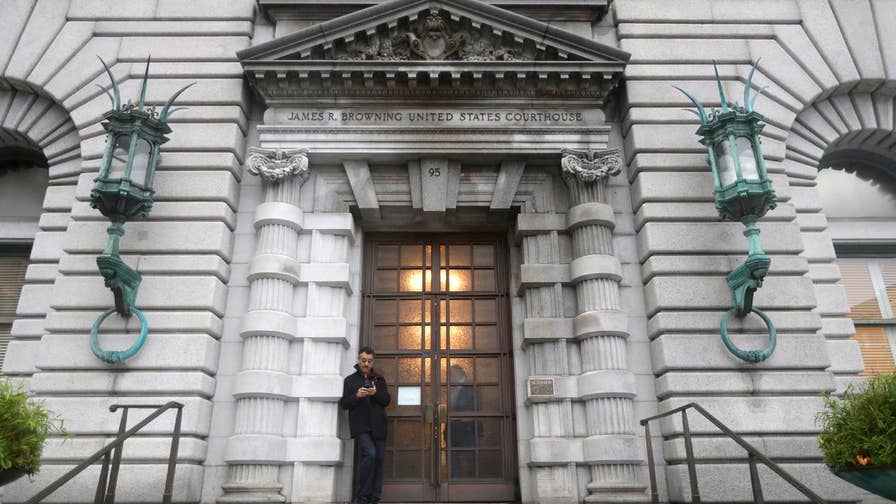
Trump poised for major makeover of liberal 9th Circuit court

FoxNews – The most liberal appeals court in America could soon be getting a Republican makeover if President Trump and Senate GOP leaders are able to fill seven open seats with conservative picks.

Standing in their way is a wall of Democrats hellbent on protecting the long-standing leftward lean of the 9th Circuit Court of Appeals.

The stakes are sky high because of the size, caseload and clout of the court. If Trump is successful in getting young, ideologically conservative nominees through the confirmation process, he could significantly alter the court’s DNA for decades to come.

“Adding seven conservatives to the court would very much affect its ideological balance,” Erwin Chemerinsky, dean of the UC Berkeley School of Law, told Fox News. “It would push the court much further to the right.”

If Trump wants to take advantage of this opportunity, he’ll have to act soon. So far, he’s only made two nominations.

Based in San Francisco, the 9th Circuit covers nine western states, has 29 active judgeships and seven vacancies, with an eighth coming in August. Its current political split is 16-6.

“The Ninth Circuit is out in left field and has been since a major expansion of the court allowed President Carter – and Senator Alan Cranston (D-Calif.) – to pack its left wing in the late 1970s,” Kent Scheidegger, legal director of the Criminal Justice Legal Foundation, said.

He told Fox News the court hasn’t been balanced politically ever since.

During their time in the Oval Office, former President George W. Bush appointed six justices to the 9th Circuit, while former President Barack Obama appointed seven.

When Trump took over, there were four vacancies to fill. Today, that number has almost doubled.

Conservatives have tried for years to chip away at the 9th. There have been multiple – unsuccessful – bids in Congress to split up the sprawling court.

Critics have slammed the 9th for being too big, too liberal and too slow at resolving cases.

They’ve also mocked it mercilessly, calling it the “Nutty 9th” or the “9th Circus,” in part because many of its rulings have been overturned by the U.S. Supreme Court. This includes an infamous 2002 ruling that the Pledge of Allegiance is unconstitutional because of its use of the phrase “under God.” The court over the years also has knocked down state bans on assisted suicide and ruled that no American has the constitutional right to own a gun.

Between 2010-2015, the Supreme Court reversed about 70 percent of the total cases before it — the 9th Circuit’s reversal rate was higher at 79 percent, though the highest in the nation was the 6th Circuit, which covers Ohio, Michigan, Tennessee and Kentucky and clocked in at 87 percent.

During the court’s 2016 term, however, the reversal rate for the 9th jumped to 88 percent. Still, most of the rulings that year were not reviewed by the high court, leaving them in place.

That’s why, some say, the liberal court needs a massive makeover and Trump might just be the president who gets it done.

To be sure, there is no love lost between Trump and the 9th Circuit.

He regularly rails against it, complains that it is “broken and unfair” and even called out “unelected” judges after his travel ban and sanctuary city policies were struck down.

But if Trump really wants to shake up the 9th, experts say he needs to prioritize it. The sooner the better because his success could hinge on the midterm elections.

“It really depends on whether the Republicans keep the Senate in November,” Chemerinsky told Fox News. “If they do, I think ultimately Trump will get his picks through unless they are unqualified or very objectionable. But if the Democrats take the Senate in November, I think it will be very difficult for him to get anyone confirmed.”

There are several Democrats who are committed to keeping the court’s balance of power the same. One weapon in their arsenal is blue slips.

Created in 1917, the blue slip is not a formal rule but instead a courtesy extended by the Senate Judiciary Committee chairman that allows home-state senators to approve or reject appointees from their states.

Over its 100-year history, lawmakers from both parties have used blue slips as an effective way to obstruct a president’s judicial pick. Both parties, depending on who is in power at the time, have accused the other of abusing the process and putting party politics ahead of confirming qualified candidates.

When Obama took office in 2009, every single Republican senator signed a letter that said they would use blue slips to block any nominee to their state they did not personally approve.

Senate Democrats unilaterally changed the rules in 2013 to prevent 41 senators from blocking nominees after evaluating their credentials.

But now that Democrats are in the minority, they argue a single senator should be able to block nominees before the Senate Judiciary Committee can check out a candidate’s credentials. And Republicans are now denying their Democratic counterparts the same tactic they took full advantage of just a few years ago.

In February, Senate Judiciary Committee Chairman Chuck Grassley, R-Iowa, came under fire for loosening the blue slip policy.

Grassley defended his decision, arguing that the policy isn’t a hard-and-fast rule, though his immediate predecessor, Democratic Sen. Patrick Leahy of Vermont, did honor blue slips and refused to move forward on a nomination without getting the consent of both home-state senators.

“It’s a very important part of the process but it’s not entirely definitive,” Grassley told TIME magazine.

Dianne Feinstein, the senior senator for California and the top ranking Democrat on the Senate Judiciary Committee, has called out the Iowa Republican for loosening the blue slip policy.

“The lengths to which Republicans are going to jam extremely conservative and controversial nominees through the Senate is unprecedented,” she has said. “What’s happening is diminishing the Judiciary Committee and the Senate and undermining the independence of the federal judiciary.”

She added, “Republicans shouldn’t have one blue slip policy for Democratic presidents and another for Republican presidents.”

Senate Majority Leader Mitch McConnell, R-Ky., has favored using blue slips for district court nominees rather than appeals court nominees.

It’s a compromise that could work, Elizabeth Slattery, a legal fellow at The Heritage Foundation, said.

“Customarily, home-state senators have played a larger role in the selection of district court nominees,” she said. “While appeals court judges are based in one state, they hear cases from all the states within their circuit. District court judges, on the other hand, hear only cases from the state where they sit. Thus, home-state senators’ opinions are more relevant for district court nominees.”

Slattery says another option might involve scrapping the use of blue slips altogether but warns the decision could come back to bite the party in power down the line.

Source: US Government Class

Las Vegas, N.M., school district may mandate drug tests for students, staff

Santa Fe New Mexican – LAS VEGAS, N.M. — A Northern New Mexico school district may require all teachers, staff and student athletes to undergo drug testing amid an opioid crisis that has severely hurt parts of the region.

West Las Vegas Schools is considering a proposal that would mandate drug testing aimed at monitoring staff as a precaution, the Las Vegas Optic reported.

“In light of the recent events of what’s happened at schools, I think that anybody, or any teacher, any administrator who may be using a prescription medication or may be using narcotics, poses a safety threat to the school,” said West Las Vegas school board member Ambrosio Castellano, who introduced the proposal this month.

Castellano said those using narcotics or medications may not be fully aware or fully coherent during an emergency.

He cited a poll conducted among teachers that found 35 percent of them said that their stress level was very high, and they were coping by taking antidepressants or other medications.

Superintendent Chris Gutierrez said he would look into the issue and conduct a survey to get feedback from teachers.

Castellano said he came up with the idea after he attended a National School Board Conference in San Antonio, Texas, where an insurance provider presented an opioid forum on the epidemic among teachers.

It’s unclear if the proposal would require testing of drugs such as marijuana, cocaine and opioids, or just opioids.

New Mexico had one of the highest overdose rates in the nation for the better part of two decades and only recently plateaued amid a series of pioneering policies aimed at combating opioid addiction, including becoming the first state to require law enforcement agencies to provide officers with overdose antidote kits.

The state also has a prescription monitoring database to prevent overlapping drug sales and has expanded access to naloxone, a drug that can reverse overdoses.

Source: US Government Class

CIA director met secretly with North Korea’s leader

Santa Fe New Mexican – WEST PALM BEACH, Fla. — President Donald Trump dispatched CIA Director Mike Pompeo to North Korea to meet with its leader, Kim Jong Un, in recent weeks to lay the groundwork for a summit meeting between Kim and Trump, two people briefed on the secret trip said Tuesday.

Trump alluded to Pompeo’s mission when he said during a Tuesday afternoon news conference that the United States was in direct talks with North Korea at “extremely high levels,” and that the White House was looking at five sites for a potential meeting of the two leaders.

The White House has used intelligence rather than diplomatic channels to communicate with North Korea since last month, when Trump unexpectedly accepted Kim’s invitation to meet.

Pompeo, who is awaiting confirmation as secretary of state, has been dealing with North Korean representatives through a channel that runs between the CIA and its North Korean counterpart, the Reconnaissance General Bureau, according to other officials. And he has been in close touch with the director of South Korea’s National Intelligence Service, Suh Hoon, who U.S. officials said brokered Kim’s invitation to Trump.

On Tuesday, Trump also said he would give his blessing to North and South Korea to “discuss the end of the war” when the leaders of those countries meet this month, opening the door to a peace treaty that would replace the armistice that halted the Korean War in 1953.

His statements, which came as he welcomed Prime Minister Shinzo Abe of Japan to his oceanfront estate in Florida, were fresh evidence of a diplomatic thaw underway on the Korean Peninsula, and made a once-unthinkable encounter between him and Kim far more likely.

The president did not specify who in his administration was talking to North Korea, nor did he give any hint of the sites under consideration — adding to the aura of mystery that has enveloped this potential meeting. The Washington Post first reported Pompeo’s trip, which took place over Easter.

But his comments could raise other thorny issues. A peace treaty with North Korea would greatly increase pressure to ease economic sanctions on the North and to withdraw American troops from the Korean Peninsula. It would also complicate the already tangled diplomacy in East Asia.

In his meeting with Abe, however, Trump projected optimism. He described North Korea in language worlds away from the speech he gave last November in Seoul, when he called it cruel and barbaric, “the results of a tragic experiment in a laboratory of history.”

“I really believe there’s a lot of goodwill,” Trump said. “They do respect us. We are respectful of them.”

He even suggested that the North and the South might announce some kind of deal before he met Kim.

On Tuesday, a South Korean newspaper, Munhwa Ilbo, reported that the two countries were negotiating an announcement “to ease military tensions and end a military confrontation,” as part of the summit meeting planned between Kim and President Moon Jae-in of South Korea.

That could involve pulling troops out of the Demilitarized Zone, making it a genuinely “demilitarized zone.” A South Korean government official later played down the report, saying it was too soon to tell what a joint statement by Moon and Kim would contain, other than broad and “abstract” statements about the need for North Korea to “denuclearize.”

But analysts said South Korea was aiming for a comprehensive deal, in which the North agreed to give up its weapons in return for a security guarantee, including a peace treaty. Trump’s comments suggested he backed that effort.

“They do have my blessing to discuss the end of the war,” he said. “People don’t realize that the Korean War has not ended. It’s going on right now. And they are discussing an end to war. Subject to a deal, they have my blessing.”

While Abe lavished praise on Trump for the sanctions campaign, which he said had brought North Korea to the table, he did not repeat the president’s words about an end to the Korean War.

“Donald,” he said, “you’ve demonstrated your unwavering determination in addressing the challenge of North Korea.”

Abe said only that he hoped that the talks with Kim would force the North to address the threats posed by its nuclear and missile programs, as well as its abduction of Japanese citizens — a politically resonant issue in Japan that Trump promised to raise with Kim.

“Abe put on a surprisingly brave face,” said Michael Green, a senior vice president at the Center for Strategic and International Studies who advised President George W. Bush on North Korea. “The president of the United States just endorsed a peace treaty with North Korea, a declared nuclear weapons state, and they offered nothing in return.”

China, which is a signer to the 1953 armistice, has long favored a peace treaty. But Japan, which did not sign it, is suspicious of one — as are some foreign policy experts in the United States, who point out that the North has yet to take any tangible steps to give up its nuclear arsenal.

The idea of a peace treaty is not new. The United States and North Korea discussed it in the 1990s and again in 2005. But it has never gone anywhere, largely because North Korea has reneged on pledges to give up its nuclear program.

Most scholars and officials agree that North and South Korea cannot themselves announce an end to the Korean War. It has to involve the United States and China as well, since both were signers to the armistice.

In welcoming Abe to his estate, Mar-a-Lago, for two days of meetings, Trump clearly hoped to change the subject from tampered documents, confiscated legal files and other symbols of the political storm clouds that hover over both leaders back home.

After days of ominous reports about his personal lawyer, Michael Cohen, and unflattering descriptions in a new book by James Comey, the FBI director he ousted, Trump appeared to savor the prospect of discussing trade and the nuclear threat from North Korea with Abe, whom he described in Twitter as a “truly fine gentleman.”

The stakes are even higher for Abe, whose political survival is in doubt after two domestic scandals have sapped his approval ratings and raised questions about whether he will be forced to resign.

Abe has invested heavily in his relationship with Trump, whom he first visited at Trump Tower even before he was sworn in. Preserving that relationship, in the face of fresh challenges in trade and from North Korea, could affect Abe’s standing in Japan.

The White House sought to put a good face on the meeting, describing Japan as a great ally of the United States and Abe as a friend of Trump. But officials acknowledged there would be differences over trade, with Trump pushing for a trade deal between the two countries and Abe stung by Trump’s decision not to exempt Japan, like other U.S. allies, from sweeping tariffs on steel exports.

“We have certain disagreements with respect to some of the trading issues,” Larry Kudlow, Trump’s chief economic adviser, told reporters before the meeting. “We’ll iron those out, hopefully.”

Kudlow said he expected Abe to petition Trump to grant Japan an exemption, but declined to predict how he would respond. He also tamped down expectations about the United States rejoining the Trans-Pacific Partnership, the Asian trade pact, now anchored by Japan, which Trump pulled out of during his first week in office.

“We are in the pre-preliminary stages of any discussions,” he said. “It’s more of a thought than a policy.”

Having met six times — including once before at Mar-a-Lago — and spoken by phone 20 times, Trump and Abe were likely to talk about the issues dogging them at home, officials said. But U.S. officials said they did not believe that would dominate their discussions.

“It’s all part and parcel of the relationship,” said Matthew Pottinger, the senior director for Asia at the National Security Council. “Sometimes they talk about the respective politics in each other’s countries. They enjoy talking about it.”

Source: US Government Class

17-year-olds prepare to vote in New Mexico primary

Santa Fe New Mexican – Some students in Meredith Tilp’s government class at Capital High School are in some ways a small voting bloc.

Many are registered to vote and participated in the city election last month.

With another election looming and renewed attention on the power of high school students to shift the political agenda, the question is whether the youngest voters will turn out and cast ballots — and whether New Mexico is doing much to engage them.

About 1,300 of New Mexico’s registered voters are 17 years old and will be 18 by Election Day, according to the Secretary of State’s Office.

The state has taken a first step to engage teenagers in the electoral process: For the second time since legislators changed the state’s laws in 2016, 17-year-old New Mexicans will be allowed to cast ballots in the upcoming June 5 primary election. New Mexico is one of a minority of states that allow underage residents to register to vote and participate in a political party’s primary, provided they will turn 18 by the time of the general election.

Fourteen other states have similar provisions, and many of those appear to have signed up larger shares of eligible voters.

Maryland has three times the population of New Mexico, for example, but its board of elections says nearly 33,000 residents on its voter rolls are 17 years old and another 12,000 are 16 years old (they cannot vote but will be ready when eligible).

Meanwhile, this will be the first year that 17-year-olds in Utah can vote in the primary election, and state officials there say about 4,000 are already on the voter rolls.

In New Mexico, state Sen. Jeff Steinborn says the policy on 17-year-olds voting in primary elections came at about the perfect time. Steinborn, D-Las Cruces, sponsored the measure, which took effect in time for the 2016 primary election.

“Young people have the majority of their lives ahead of them. Nobody has more at stake than they do,” Steinborn said.

Unusually, the 2016 presidential primary was hotly contested in both the Democratic and Republican parties in the June election in New Mexico. That gave an often overlooked state on the electoral map particular importance, and it might have helped galvanize interest among younger voters.

There could be another motivating influence this year as teenagers have led a push for gun control after a mass shooting at a Florida high school.

Will high school students go beyond marching and turn out in particularly large numbers to vote? At least in New Mexico, that does not seem to be reflected yet in the voter rolls.

Still, groups such as the League of Women Voters are making an effort to reach high school students. Those efforts can be diffuse in some parts of the state. In Doña Ana County, however, County Clerk Scott Krahling has worked to coordinate drives on campuses each spring.

“We have a goal of getting everyone who is eligible to register before they graduate high school,” he said.

There is new talk in some countries and in parts of the United States about lowering the voting age to 16. Scotland, for example, allowed 16-year-olds to vote in a referendum on whether to stay in the United Kingdom.

State Rep. Javier Martinez, D-Albuquerque, has proposed allowing 16-year-olds to vote in school board elections. He says such a move would boost turnout in what are often overlooked elections and engage the very students who stand to gain or lose the most from the education system.

Moreover, Martinez argues 18 can seem like an arbitrary age to limit voting rights.

“We trust 16-year-olds with a car, and we trust them to work and pay their taxes and be responsible,” he said. “Trusting them with their vote is equally important.”

Martinez said he would be interested in lowering the voting age for all elections but acknowledged the state may not be ready for that yet. And it would raise other questions: Could a 16-year-old, for example, run for office?

School board elections, he said, would at least be a start.

At Capital High, Tilp has encouraged students to register to vote and plenty have — whether online or through registration drives on campus. But new discussion about the role of teenagers in driving electoral change also comes at a time of mounting concern about the power of disinformation and social media to sway races.

Plenty of students in Tilp’s class said they would still rather see and hear the candidates for themselves.

How could a politician — a candidate for governor, say — get their votes in the coming months?

A quick show of hands served as a gauge of the issues that matter to the group of seniors on the cusp of graduation.

Education. Immigration. Health care.

Still, there is doubt that politicians will pay much attention to their issues.

“They’re focused on the present,” said Alejandra Mendoza-Reza, a senior. “This generation is the future, so they should focus on us as well.”

Whether New Mexico’s newest voters turn out this year may depend on how much candidates seek them out, sign them up and speak to their concerns from school funding to college tuition.

As senior Andres Rodriguez said: “They should show some initiative with the younger generation.”

Source: US Government Class

Clicking ‘checkout’ could cost more after Supreme Court case

Santa Fe New Mexican – Online shoppers have gotten used to seeing that line on checkout screens before they click “purchase.” But a case before the Supreme Court could change that.

At issue is a rule stemming from two, decades-old Supreme Court cases: If a business is shipping to a state where it doesn’t have an office, warehouse or other physical presence, it doesn’t have to collect the state’s sales tax.

That means large retailers such as Apple, Macy’s, Target and Walmart, which have brick-and-mortar stores nationwide, generally collect sales tax from customers who buy from them online. But other online sellers, from 1-800 Contacts to home goods site Wayfair, can often sidestep charging the tax.

More than 40 states are asking the Supreme Court to reconsider that rule in a case being argued Tuesday. They say they’re losing out on “billions of dollars in tax revenue each year, requiring cuts to critical government programs” and that their losses compound as online shopping grows. But small businesses that sell online say the complexity and expense of collecting taxes nationwide could drive them out of business.

Large retailers want all businesses to “be playing by the same set of rules,” said Deborah White, the president of the litigation arm of the Retail Industry Leaders Association, which represents more than 70 of America’s largest retailers.

For years, the issue of whether out-of-state sellers should collect sales tax had to do mostly with one company: Amazon.com. The online giant is said to account for more than 40 percent of U.S. online retail sales. But as Amazon has grown, dotting the country with warehouses, it has had to charge sales tax in more and more places.

President Donald Trump has slammed the company, accusing it of paying “little or no taxes” to state and local governments. But since 2017, Amazon has been collecting sales tax in every state that charges it. Third-party sellers that use Amazon to sell products make their own tax collection decisions, however.

The case now before the Supreme Court could affect those third-party Amazon sellers and many other sellers that don’t collect taxes in all states — sellers such as jewelry website Blue Nile, pet products site Chewy.com, clothing retailer L.L. Bean, electronics retailer Newegg and internet retailer Overstock.com. Sellers on eBay and Etsy, which provide platforms for smaller sellers, also don’t collect sales tax nationwide.

States generally require consumers who weren’t charged sales tax on a purchase to pay it themselves, often through self-reporting on their income tax returns. But states have found that only about 1 percent to 2 percent actually pay.

States would capture more of that tax if out-of-state sellers had to collect it, and states say software has made sales tax collection simple.

Out-of-state sellers disagree, calling it costly and extraordinarily complex, with tax rates and rules that vary not only by state but also by city and county. For example, in Illinois, Snickers are taxed at a higher rate than Twix because foods containing flour don’t count as candy. Sellers say free or inexpensive software isn’t accurate, more sophisticated software is expensive and that collecting tax nationwide would also subject them to potentially costly audits.

“For small businesses on tight margins, these costs are going to be fatal in many cases,” said Andy Pincus, who filed a brief on behalf of eBay and small businesses that use its platform.

The case now before the Supreme Court involves South Dakota, which has no income tax and relies heavily on sales tax for revenue. South Dakota’s governor has said the state loses out on an estimated $50 million a year in sales tax that doesn’t get collected by out-of-state sellers.

In 2016 the state passed a law requiring those sellers to collect taxes on sales into the state, a law challenging the Supreme Court precedents. The state, conceding it could win only if the Supreme Court reverses course, has lost in lower courts.

South Dakota says the high court’s previous decisions don’t reflect today’s world. The court first adopted its physical presence rule on sales tax collection in a 1967 case dealing with a catalog retailer. At the time, the court was concerned in part about the burden collecting sales tax would place on the catalog company. The court reaffirmed that ruling in 1992.

It’s unclear how the justices might align on the question this time. But three justices — Neil Gorsuch, Clarence Thomas and Anthony Kennedy — have suggested a willingness to rethink those decisions. Kennedy has written that the 1992 case was “questionable even when decided” and “now harms states to a degree far greater than could have been anticipated earlier.”

“Although online businesses may not have a physical presence in some states, the Web has, in many ways, brought the average American closer to most major retailers,” he wrote in suggesting the days of inconsistent sales tax collection may be numbered. “A connection to a shopper’s favorite store is a click away regardless of how close or far the nearest storefront.”

Source: US Government Class

Voters could decide whether to split California into three smaller states

CBS News -SAN FRANCISCO — California voters could soon be asked to decide whether their state is too big. Tim Draper, who pushed for a six-state proposal, now has a three-state proposal, according to CBS San Francisco.

Draper did not have enough signatures to get his six-state measure on the California ballot in 2016. For this new proposal, he needs 366,000 signatures. On Thursday, he announced that he has more than 600,000 signatures.

“I’m proud to announce we’ve collected more than enough signatures to qualify for the 2018 ballot,” Draper said.

If the proposal passes, the Bay Area, along with counties north of Merced, would be considered as Northern California. Along the coast, from Monterey to Los Angeles, would be California and the counties to the east would be Southern California.

The population of each new state would range from 13.9 million people in Southern California, 13.3 million in Northern California and 12.3 million in California. The three new states would still be among the top ten most populous in the country.

“This would make sure everyone has a government that is responsive and responsible,” Draper said.

But the devil is in the details, and there are a lot of details.

Joe Rodota is the founder of Forward Observer. He’s a longtime California political consultant who says this is all a “waste of time.”

“There area a lot of good ideas that come out of Silicon Valley and this isn’t one of them,” Rodota said.

Take the University of California (UC) system, for example. There are 10 UC campuses in California, which are built and paid for by taxpayers throughout the state.

“How are you going to tell a family that lives in Los Angeles they have to pay out of state tuition to go to Berkeley,” Rodota asked.

There’s also water rights, state pensions, prisons and education funding. Figuring all this out takes time and money, and so would setting up three new governments.

Rodota says that even if this makes it to the ballot, he doesn’t think voters will go for it.

“Voters have been skeptical in California,” he said.

And even if it passes, it all has to be approved by Congress, who might not be eager to dilute their own power by creating four new U.S. senators for the West Coast.

Still, Draper says it’s California’s nature to push the envelope.

“California dreams big,” he said.

Source: US Government Class