
apgov

Five rulings to watch at the Supreme Court

The HIll – Interns will soon be sprinting down the steps of the Supreme Court to deliver printouts of rulings to TV anchors, something of an annual tradition at the highest court in the land.

The justices heard their last arguments in April and will start issuing rulings next week in the most closely watched cases of the term, which ends in late June.

The justices often save the biggest decisions for last — and this year is no exception.

Since October, the court has grappled with several hot-button issues, including free speech and equality, partisan gerrymandering and the legality of President Trump‘s controversial travel ban.

ADVERTISEMENT

Here’s a look at the top five cases to watch as the term comes to a close.

Partisan gerrymandering 

The justices were asked this term to rule on whether Republican officials in Wisconsin unconstitutionally injected political bias into the redistricting process by drawing district lines to disadvantage Democrats.

The case, Gill v. Whitford, was one of the first heard at the beginning of the term in October, but the justices have yet to release their opinion. The delay is likely due to the fact that the court agreed to hear a second partisan gerrymandering case of out Maryland later in the term.

In the second case, Benisek v. Lamone, it’s Republicans who are protesting a redistricting decision. GOP voters say Democratic election officials packed the Maryland’s 6th Congressional District with Democrats to ensure Rep. John Delaney (D) beat the Republican incumbent, who at the time was Rep. Roscoe Bartlett.

The cases could result in the court striking down a redistricting plan as a partisan gerrymander for the first time, but that outcome is far from certain. During oral arguments, the justices appeared undecided on whether they should even review such claims and what standard should be used if they do.

It’s also unclear whether they will be able to settle on any of the methods that have been proposed to weigh if political bias has been unconstitutionally injected into a redistricting process.

Wedding cake

The court also has yet to rule in Masterpiece Cakeshop v. the Colorado Civil Rights Commission. The case centers on Jack Phillips, a Colorado baker who refused to make a wedding cake for a same-sex couple.

Phillips argues he can’t be forced to make the cake under the state’s anti-discrimination laws. He says his cakes are an artistic expression of free speech and religion that’s protected by the First Amendment.

Making a cake for a gay wedding, he says, would send the message that he supports same-sex marriage when he is morally opposed as a Christian.

The case is seen as the next big fight for LGBT rights after the justices’ landmark ruling in 2015 in Obergefell v. Hodges that legalized same-sex marriage.

“People in the LGBT community think this undermines Obergefell and LGBT rights if the court were to come down in favor of the baker,” said Carl Tobias, a University of Richmond School of Law professor. “I think that’s an important question that’s at stake here.”

Civil rights advocates fear a ruling in favor of Phillips will give businesses a license to discriminate against LGBT people.

Sports betting

Former New Jersey Gov. Chris Christie (R) could get a major win if the court sides with a challenge his state brought challenging a 1992 federal law that bans sports gambling in almost every state except Nevada.

During arguments, the justices appeared skeptical of the law.

“So the citizens of the state of New Jersey are bound to obey a law that the state doesn’t want but that the federal government compels the state to have?” Justice Anthony Kennedy asked. “That seems commandeering.”

Major sports leagues, including the NCAA, NBA, NHL and NFL, argue the law should be upheld.

The case, which was paired with another challenge from the New Jersey Thoroughbred Horsemen’s Association, could pave the way for legalized sports betting in states across the country.

The American Gaming Association in a friend of the court brief argued a legal sports-betting industry could generate up to $26.6 billion in total economic impact every year and support more than 150,000 well-paying American jobs.

Free speech and abortion

It’s a two-for-one in National Institute of Family and Life Advocates (NIFLA) v. Becerra, a lawsuit that pro-life pregnancy centers in California brought challenging a state law that requires licensed facilities to post information about where women can obtain a free or low-cost abortion from the state.

The law also requires unlicensed facilities to notify women that they do not employ a licensed medical professional.

NIFLA argues the state law forces them to promote a procedure they morally oppose, violating the First Amendment. The state says it’s well within its right to protect women from being misled about the medical services provided by the pregnancy centers.

Court watchers say the case could set new limits on how far the government can go in regulating speech.

Trump’s travel ban 

The last arguments the justices heard this term were a challenge to President Trump’s ban on nationals from certain Muslim-majority countries entering the United States.

A conservative majority of justices on the court seemed likely to rule in favor of the president, but court watchers are waiting to see how Trump’s statements on the campaign trail and in office play into their decision.

The challengers, led by the state of Hawaii, argue Trump’s remarks prove his ban is unconstitutionally rooted in an animus toward Muslim people.

But court watchers say the justices may decide not to reach the constitutionality question and rule that Trump has the statutory power to issue the travel ban as a matter of national security.

Source: US Government Class

Fewer voters eligible for New Mexico primaries

Santa Fe New Mexican – Early voting has begun and the independent-minded among you are not invited.

That includes some 1 in 5 New Mexico voters.

Under the state’s closed primary system, voters must be registered with a political party to participate in its primary election and that precludes independents. So, only voters who marked “Democrat” on their voter registration cards, for example, can vote in the Democratic primary.

But a growing share of the state’s voters are independents. Twenty years ago, only 10 percent of voters were not affiliated with a political party. Now, 22 percent of New Mexico’s registered voters are independents and so won’t have any electoral say in who ends up on the ballot in November’s general election.

For backers of the closed primary system, that is only fair. The thinking has been that if a voter cannot join a party in even the most basic sense, he or she should not get to decide which candidates that party nominates.

But that ideal appears to be on a collision course with the swelling ranks of independent voters, whose numbers are rising in line with a national trend and what some observers believe is no blip but instead a generational shift.

Lonna Atkeson, a professor of political science at The University of New Mexico, says several factors may be driving the increase in independent voters.

For one thing, there are just more voters than there were 20 years ago, and it is arguably easier to sign up nowadays. New Mexicans can register online or when they go to the driver’s license office.

Then there is the nature of politics today. The major parties are nominating candidates that polls indicate are polarizing figures, whether that is Donald Trump or Hillary Clinton.

And younger voters in particular are likely to see government as unresponsive, Atkeson adds.

“Young people aren’t as connected to parties,” she says.

The share of registered Republicans and registered Democrats have declined in roughly equal proportions during recent years, suggesting this is not a problem for just one party.

All of that can dampen voter turnout during the general elections, in Atkeson’s telling.

The primary election will decide many races in the deepest blue and deepest red parts of the state this year where the only candidates are members of the same party. For example, there will likely be only one choice for sheriff on the general election ballot in 17 of the state’s 33 counties — including Santa Fe, where all the candidates are Democrats.

And five races for seats in the state House of Representatives will likely be decided in the primary, too. Another 29 seats of the 70 seats are uncontested.

Independent and write-in candidates could still file to get on the ballot in November. But the state has set a fairly high bar for independents to qualify.

The only option, then, can be to register as a member of a party.

Laura Atkins, a local resident, has worked at the polls on primary election days and recounts having to turn away voters because they were registered as independents.

“It disenfranchises people,” says Atkins, who sits on the board of the League of Women Voters of Santa Fe County.

Atkins has registered as a Democrat to participate in the primaries but says she does not feel for a moment like she belongs to a major political party.

Instead, to her, the closed primary system feels like a way of consolidating power in the political parties.

“It protects the power of the parties. It does not, in my view, protect the integrity of the election or do anything to further participation,” she says.

New Mexico has ranked as average, if not worse, for voter turnout when compared to other states. Turnout among eligible voters during midterm years, like this one, recently has ranged from 35 percent to 45 percent.

Presidential election years have brought out New Mexicans in larger numbers. Sixty-three percent of those eligible cast ballots in 2016, for example. But these midterm elections include races such as governor, sheriff and magistrate judge that arguably have bigger effects on New Mexicans’ daily lives.

Still, New Mexico is party-oriented compared to some other states with closed primary elections. Groups such as Open Primaries have pushed to change the elections process, but recent proposals have met with resistance at the Legislature.

State Sen. Daniel Ivey-Soto, a Democrat from Albuquerque, is blunt: Open primaries are unconstitutional.

The state cannot force political parties to accept voters, he argues, contending that would violate the principle of freedom of association.

But Ivey-Soto, who often works on election-related legislation, says the current system is unconstitutional by that same logic.

“We are telling the political parties who they may not associate with,” he says.

One option, Ivey-Soto says, is for the state to let parties choose which voters may cast ballots in their primary elections. In some other states, for example, a party can say it will allow independent voters but not voters registered with rival parties.

Even then, primaries might violate the state’s policy against using public funds for private organizations given that taxpayers cover the cost of the elections, but the elections are closed to members of nonprofit groups, he says.

California has taken a different tack and adopted a “top-two” primary, in which voters choose from all the candidates from all the parties. The two candidates who get the most votes appear on the general election ballot, turning the primary election into a first round of voting instead of a party nominating process. A bill to establish a similar system in New Mexico did not make it out of a single committee in the 2017 legislative session. And critics argue that process may still leave voters with few choices.

Ivey-Soto says the solution might be to do away with primaries altogether and instead set requirements for candidates to get on the ballot through other means, such as circulating nominating petitions.

Changing anything about this system will require support from Democrats and Republicans in the Legislature — a place where there are no independents.

Coming this month

The New Mexican will begin its look at the 2018 primary election Monday, with profiles of candidates running throughout the month. That will start with in-depth looks at the the people running for the state’s gubernatorial nominations, and will include looks at contested primaries in statewide races, plus races on the legislative, judicial and county fronts.

Source: US Government Class

Blue states rally to upend Electoral College, with addition of Connecticut

FoxNews – Connecticut is joining a growing alliance of liberal states in a “pact” that would supposedly allow them to change the way presidents are picked — by allocating each state’s electoral votes to the winner of the national popular vote.

The uphill campaign, which if ever brought to fruition would almost certainly face a court challenge, has gained renewed attention amid Democratic grumbling about the Electoral College in the wake of President Trump’s 2016 win. While he defeated Hillary Clinton in the electoral vote, he lost the popular vote by 2.9 million ballots.

Enter the National Popular Vote Interstate Compact, which blue states are joining to commit to allocating their electoral votes to the national popular-vote winner — regardless of their own state results.

The pact is meant to be a work-around to the constitutional requirements that created the Electoral College system, which awards each state’s electors to the winner of that state.

In theory, the game-changing compact would take effect once it signs on states representing at least 270 electoral votes, the threshold to win the presidency. With the expected addition of Connecticut’s seven electoral votes, the group now has 172.

FILE - In this July 14, 2017 file photo, Connecticut Democratic Gov. Dannel Malloy addresses a Democratic Governors joint news conference during the National Governor's Association meeting in Providence, R.I.  Malloy is expected to veto a bill lawmakers passed that restores $54 million to program that helps about 140,000 seniors pay for Medicare expeness. The Democrat says the so-called "fix" adds to Connecticut's budget woes. Malloy has already temporarily delayed cuts to the program that were originally included in the new bipartisan state budget lawmakers had approved. (AP Photo/Stephan Savoia)

Democratic Gov. Dannel Malloy is expected to sign the legislation into law, following the State Senate approving legislation opting Connecticut into the National Popular Vote Interstate Compact on May 5.  (AP)

Democratic Gov. Dannel Malloy is expected to sign the legislation into law, following the state Senate approving legislation opting Connecticut into the National Popular Vote Interstate Compact on May 5. The state House passed the legislation last month.

“The National Popular Vote Compact will ensure an equal vote for every American citizen, regardless of which state they happen to live in,” Malloy said in a statement.

Other jurisdictions that have joined the pact include California, Hawaii, Illinois, Massachusetts, Maryland, New Jersey, New York, Rhode Island, Vermont, Washington and the District of Columbia — all places where Clinton defeated Trump in 2016. Connecticut would be the first state to sign on since 2014, when New York joined.

“The vote of every American citizen should count equally, yet under the current system, voters from sparsely populated states are awarded significantly more power than those from states like Connecticut,” Malloy said. “This is fundamentally unfair.”

But critics say the pact would actually hurt smaller states like Connecticut, given that candidates would be likely to only focus on large population centers and neglect rural areas.

And from a constitutional perspective, the proposal could also run into obvious legal challenges.

“Not only did the framers of the Constitution expressly reject the idea of a direct, popular election for president, but also not one state either in the wake of ratification or at any time thereafter has ever sought to appoint its presidential electors on the basis of votes cast outside the state, as the National Popular Vote Compact requires,” law professor Norman R. Williams argued in the BYU Law Review.

Trump has not publicly supported The National Popular Vote Compact. But he has said he would prefer picking a president based on the popular vote.

“I would rather have a popular election, but it’s a totally different campaign,” Trump said during an interview last month “Fox & Friends.”

The plan has been pushed for last several years, and proponents are working to get other states to pass legislation joining the pact. According to the National Popular Vote website, the proposal has passed in at least one house in 11 other states, including Arkansas, Arizona, Colorado, Delaware, Maine, Michigan, North Carolina, New Mexico, Nevada, Oklahoma and Oregon.

Source: US Government Class

California Will Require Solar Power for New Homes

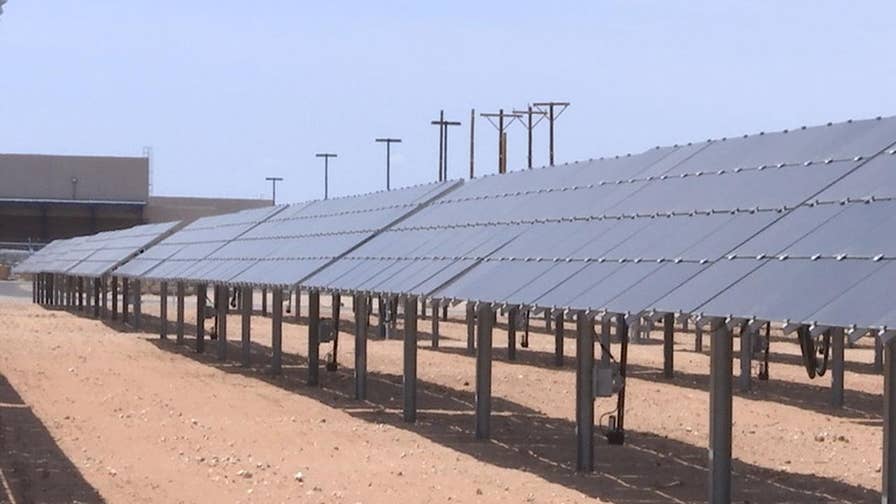
New York  Times – SACRAMENTO — Long a leader and trendsetter in its clean-energy goals, California took a giant step on Wednesday, becoming the first state to require all new homes to have solar power.

The new requirement, to take effect in two years, brings solar power into the mainstream in a way it has never been until now. It will add thousands of dollars to the cost of home when a shortage of affordable housing is one of California’s most pressing issues.

That made the relative ease of its approval — in a unanimous vote by the five-member California Energy Commission before a standing-room crowd, with little debate — all the more remarkable.

State officials and clean-energy advocates say the extra cost to home buyers will be more than made up in lower energy bills. That prospect has won over even the construction industry, which has embraced solar capability as a selling point.

“This adoption of these standards represents a quantum leap,” Bob Raymer, senior engineer for the California Building Industry Association, said during the public comments before the vote. “You can bet every state will be watching to see what happens.”

Several California cities have required that some new buildings include solar power, or have made commitments to 100 percent clean energy through various sources. New Jersey, Massachusetts and Washington, D.C., have also considered legislation to require that new buildings be solar-ready, according to the National Conference of State Legislatures. And Hawaii is among the states that have mandated other energy-efficiency measures, like solar water heaters.

But California’s move is by far the boldest and most consequential of any.

California law requires at least 50 percent of the state’s electricity to come from noncarbon-producing sources by 2030. Solar power has increasingly become a driver in the growth of the state’s alternative energy production.

And a new rate structure coming next year will charge California customers based on the time of day they use electricity. So homeowners with energy-efficiency features — a battery in particular, allowing energy to be stored for when it is most efficiently used — will avoid higher costs.

“Any additional amount in the mortgage is more than offset,” said Andrew McAllister, an Energy Commission member who led a building-code review that produced the proposal. “It’s good for the customer.”

The building-code change is one dimension of a broader transition away from centralized power. As with the breakup of the phone monopoly, which allowed customers to choose providers and shop for rates, changes in the way energy is delivered put more control into consumers’ hands.

Those goals have been furthered with smart meters that help control consumption, along with a choice of electricity retailers in many places. And with a combination of residential solar power and battery storage, homeowners can minimize their resort to the grid altogether.

At the end of 2017, California was by far the nation’s leader in installed solar capacity. Solar power provides almost 16 percent of the state’s electricity, and the industry employs more than 86,000 workers.

Under the new requirements, builders must take one of two steps: make individual homes available with solar panels, or build a shared solar-power system serving a group of homes. In the case of rooftop panels, they can either be owned outright and rolled into the home price, or made available for lease on a monthly basis.

The requirement is expected to add $8,000 to $12,000 to the cost of a home.

“Our druthers would have been to have this delayed another two or three years,” said Mr. Raymer of the building-industry group. But he was not surprised. “We’ve known this was coming,” he said. “The writing was on the wall.”

For residential homeowners, based on a 30-year mortgage, the Energy Commission estimates that the standards will add about $40 to an average monthly payment, but save consumers $80 on monthly heating, cooling and lighting bills.

Will Clever, a 67-year-old retired correctional officer, moved into a new house six months ago in Roseville, about 20 miles northeast of Sacramento, where the developer KB Home offered the buy-or-lease option for solar panels.

Not having the $14,000 it would cost to buy the panels, he chose a 20-year lease from SunPower, the nation’s No. 2 commercial solar-power company, for $76 a month.

The Sacramento area can have brutal summers, and having once lived in Phoenix, “I didn’t want to pay a fortune,” he said. “I was looking for a way of fixing my costs.”

So far, he considers it money in the bank. “As electricity costs go up, I don’t have to worry about it,” Mr. Clever said.

California averages about 80,000 new homes a year, with about 15,000 currently including solar installations. Over all, at the current rate of home building, the new requirement will increase the annual number of rooftop solar installations by 44 percent.

The approved requirement is expected to give a strong lift to California’s already hot solar market.

“This is a very large market expansion for solar,” said Lynn Jurich, co-founder and chief executive of Sunrun, a leading solar installation company. “It’s very cost effective to do it this way, and customers want it.”

“There’s also this real American sense of freedom of producing electricity on my rooftop,” Ms. Jurich said. “And it’s another example of California leading the way.”

A strategic plan drafted by the California Public Utilities Commission in 2008 called for all new construction by 2020 to have net-zero energy needs — that is, to produce enough electricity on their own to avoid having to buy it from the power grid.

The Energy Commission’s plan is less ambitious. It requires new homes to have a solar-power system of a minimum 2 to 3 kilowatts, depending mostly on the size of the home. Residential solar arrays are typically two to three times that size, often enough to put power into the grid.

In fact, the state itself generates so much solar and wind power that it must sometimes halt production at some facilities or give the electricity away to other states to avoid overloading the electric grid.

And there may be a downside for some consumers in the increasing reliance on alternative energy sources.

San Diego Gas and Electric, for instance, said it hoped the state would ensure that utilities can generate enough revenue to operate the electric grid, as homeowners who can afford solar leave those less fortunate to pick up the cost of running the electric system.

“It’s a growing problem,” Tim Carmichael, state agency relations manager for the utility, told the commission. “It’s hurting families that can’t afford solar. We continue to support solar growth. We want to ensure that program structure is appropriate.”

The utility industry has been preparing for the proliferation of energy-producing homes by studying its impact on the electric grid with tests like a net-zero community developed in Fontana, east of Los Angeles. The utilities are trying to determine how to manage a system where homes are putting electricity onto the grid during the day and consuming it at night.

“We’ve been working towards it,” said Ram Narayanamurthy, technical executive at the Electric Power Research Institute, a nonprofit group that does research for the nation’s power companies. “What we think we will see is greater and greater efficiency.”

The Fontana research has shown that with a combination of energy-efficiency measures and solar power, the overall cost of owning a home is reduced, he said.

The commission members saw their vote as advancing that vision of the future. “I’m really happy to get this to the finish line,” Mr. McAllister said. “One big step for mankind.”

Source: US Government Class

California becomes first state to mandate solar panels on new homes

FoxNews – California has become the first state in the nation to mandate solar panels for all new homes, in a move to cut greenhouse gas emissions that critics say will end up raising home prices in the already expensive market.

In a unanimous 5-0 vote Wednesday, the California Energy Commission approved the policy.

The regulation will require all homes and apartments built after 2020 to have solar panels, adding an average of roughly $10,000 to construction costs for a single-family home. On the flip side, the commission says, the panels could yield much more in energy savings.

Spokeswoman for the Energy Commission Amber Beck told Fox News that under the new standards, new homes would be expected to reduce energy use by more than 50 percent. She argued that the change will lead to savings in the long run.

“For residential homeowners, based on a 30-year mortgage, the Energy Commission estimates that the standards will add about $40 to an average monthly payment, but save consumers $80 on monthly heating, cooling, and lighting bills,” Beck said in a statement. “On average the 2019 standards will increase the cost of constructing a new home by about $9,500 but will save $19,000 in energy and maintenance costs over 30 years.”

Few industry groups outwardly oppose the plan after working for years with the commission to shape the regulations. But Republican legislative leaders said Californians can’t afford to pay any more for housing in the state’s already expensive market.

“That’s just going to drive the cost up and make California, once again, not affordable to live,” said Assemblyman Brian Dahle, the chamber’s Republican leader.

The solar panel decision is just the latest example of what critics see as the state’s ever-evolving nanny-state policies. California often is at the leading edge of government mandates and bans, having recently prohibited everything from plastic bags to foie gras – and even flirting with phasing out internal combustion engines.

Bill Watt, a homebuilder and design consultant, told The Orange County Register the added solar panel costs, in addition to other building mandates, will make homeownership out of reach for many buyers.

“We’re not building enough housing already,” Watt, former president of the Orange County Building Industry Association, told The OCR. “Why not just pause for a little while, focus on the affordability and housing issues, then circle back?”

Despite the increase in construction costs, the California Building Industry Association generally supports the plan, but expressed a preference to delay the launch.

“[W]e would prefer that this had been put off for a few more years, but the fact is that the California Energy Commission has been working on this, with us, for the past 10 years,” the association’s technical director, Robert Raymer, said in a statement, noting that the group worked with the state’s energy commission to alter the policy. “We know this is coming, we did everything we could to push down compliance costs and increase design flexibility.”

The mandate is the latest win for the solar industry, despite past controversies tied to companies’ use of taxpayer funds.

The most notorious example was California company Solyndra, which filed for bankruptcy in 2011. An Energy Department inspector general report in 2015 said the company misrepresented facts in order to secure a $535 million loan guarantee from the federal government. Taxpayer lost most of that money in the deal.

The new California measure would reduce greenhouse gas emissions by 700,000 metric tons over three years, according to the commission. The Energy Commission said this would be equivalent to taking 115,000 cars off the road.

The Associated Press contributed to this report. 

Source: US Government Class

Opposing Views – Should the US withdraw from Iran nuclear agreement?

Read both articles and share your thoughts. What parts of the articles do you agree or disagree with? What were the strongest points/arguments made in both articles? Comments on this article are worth 6 pts.

Majority say US should not withdraw from Iran nuclear agreement

Most Americans don’t know what U.S. should do on Iran deal – CBS News poll

CNN CBS News

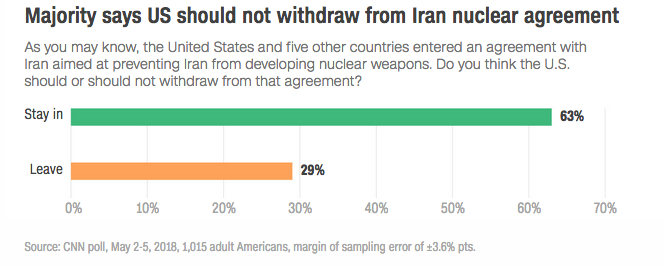
Almost two-thirds of Americans — 63% — believe that the US should not withdraw from the agreement made with Iran to prevent the country from developing nuclear weapons. Only 29% believe the US should withdraw, according to a new CNN poll conducted by SSRS.

 Shot 2018-05-08 at 1.10.41 PM
President Donald Trump is expected to announce Tuesday whether he will remove the US from the deal, which lifted some sanctions in exchange for curbs on Iran’s nuclear program. Trump has repeatedly criticized the agreement, which was made under former President Barack Obama, as a bad deal and has threatened to pull out the US even though Iran has been certified by a UN organization as complying with the terms of the pact.
The strongest proponents of withdrawing from the treaty are Republicans (51% say the US should withdraw), conservatives (47%) and those who approve of the job Trump is doing as President (46%).
Support for remaining in the agreement comes even as a strong majority of 62% say they believe Iran has violated the terms of the agreement. Nineteen percent said Iran has not violated the terms, with the same share saying they have no opinion.


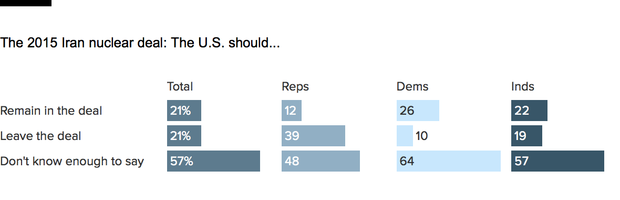
Fifty-seven percent of Americans say they don’t know enough to say what the U.S. should do about the Iran nuclear deal which was brokered in 2015. Those with an opinion divide evenly on whether the U.S. should remain in the deal (21 percent) or leave the deal (21 percent).

By a margin of more than 3 to 1, Republicans are more likely to advocate leaving the Iran deal than remain in it, although nearly half don’t know enough to say. Most Democrats (more than 6 in 10) don’t have an opinion either way, but those who do hold a view are more inclined to think the U.S. should stay in the deal.

1vk2s.png


The president said Monday he will announce his decision on the deal Tuesday afternoon.


This poll was conducted by telephone May 3-6, 2018 among a random sample of 1,101 adults nationwide.  Data collection was conducted on behalf of CBS News by SSRS of Glen Mills, Pa. Phone numbers were dialed from samples of both standard land-line and cellphones.

The poll employed a random digit dial methodology. For the landline sample, a respondent was randomly selected from all adults in the household. For the cellphone sample, interviews were conducted with the person who answered the phone.

Interviews were conducted in English and Spanish using live interviewers. The data have been weighted to reflect U.S. Census figures on demographic variables.

The error due to sampling for results based on the entire sample could be plus or minus three percentage points. The error for subgroups may be higher and is available by request. The margin of error includes the effects of standard weighting procedures which enlarge sampling error slightly.

This poll release conforms to the Standards of Disclosure of the National Council on Public Polls.

Source: US Government Class

Trump announces decision to “withdraw” from Iran nuclear deal

CBS NEWS – President Trump on Tuesday announced his much-anticipated decision to “withdraw” from the Iran nuclear deal, in keeping with a longtime campaign promise. The president claimed there is Israeli intelligence proving Iran is not in compliance with the agreement, and said he fears the 2015 deal will allow the Iranian regime to amass nuclear weapons.

“In just a short period of time, the world’s leading state sponsor of terror will be on the cusp of acquiring the world’s most dangerous weapons,” Mr. Trump said from the White House’s Diplomatic Room. “Therefore, I am announcing today that the United States will withdraw from the Iran nuclear deal.”

What that means practically speaking, is the U.S. will not renew sanctions waiver and will no longer participate in the Iran nuclear deal, CBS News’ Ed O’Keefe and Rebecca Kaplan have reported. According to the U.S. Treasury, its Office of Foreign Assets control is taking action immediately to implement Mr. Trump’s decision. Sanctions will have 90-day and 180-day wind-down periods, at the end of which relevant, previous sanctions the U.S. had waived will be reinstated.

U.S. intelligence has verified that the deal has been an effective arms control deal that has kept Iran’s nuclear program frozen for three years, CBS News “Face the Nation” host Margaret Brennan has noted. Mr. Trump is delivering on another campaign promise, says Brennan, but one which is arguably far more consequential than any other deal he’s torn up.

Mr. Trump did not answer shouted questions from a reporter in the room about how leaving the deal will make the U.S. safer.

The Iran nuclear deal, or Joint Comprehensive Plan of Action (JCPOA) was forged in 2015 during the Obama administration under then-Secretary of State John Kerry, as a multi-nation effort to keep Iran’s nuclear program at bay.

The United Kingdom, France and Germany were all unable to persuade the Trump administration to broker a side deal that would satisfy the U.S. enough to keep it a party to the 2015 agreement. Shortly before the president was to announce his decision, the leaders of those countries, U.K. Prime Minister Theresa May, French President Emmanuel Macron and German Chancellor Angela Merkel were on a call to discuss their response to Mr. Trump’s announcement, CBS News; Kylie Atwood reports, citing European diplomatic sources. The response from the international community was swift.

French President Emmanuel Macron tweeted that France, Germany and the U.K. “regret” Mr. Trump’s’ decision, saying the “nuclear nonproliferation regime is at stake.”

But Mr. Trump insisted Tuesday America will not be held “hostage” by such a deal.

“America will not be held hostage to nuclear blackmail,” the president said. “We will not allow American cities to be threatened with destruction and we will not allow a regime that chants ‘death to America’ to gain access to the most deadly weapons on Earth.”

Mr. Trump spent much of the 2016 campaign and early days of his presidency slamming the 2015 nuclear pact as “a mess” and “badly negotiated.” That sentiment did well with his supporters.

Source: US Government Class

Unemployment Rate Hits 3.9%, a Rare Low, as Job Market Becomes More Competitive

New York Times –

The Labor Department released its April hiring and unemployment report on Friday, providing the latest snapshot of the economy.

The Numbers

■ The unemployment rate was 3.9 percent, the lowest rate since 2000 and a sign that the job market has become even more competitive. It had been 4.1 percent since October.

■ 164,000 jobs were added last month. Wall Street economists had expected an increase of about 193,000, according to Bloomberg.

■ The Labor Department revised the job figures for February slightly downward, but revised the numbers for March sharply upward. The result was a net increase of 30,000 jobs, compared with previous estimates.

■ Average earnings rose by 4 cents an hour last month and are up 2.6 percent over the past year.

The Takeaway

American employers continue to find reasons to expand their payrolls. April marked the 91st consecutive month of job gains, far and away the longest streak of increases on record. The average monthly gain has declined each year since 2014, but that’s normal for an economy that’s been in recovery for such an extended period.

“We’ve continued to add jobs routinely every month for so long, and the unemployment rate we have reached is amazing,” said Catherine Barrera, chief economist of the online job site ZipRecruiter. “It’s very incredible.”

The drop in the unemployment rate may be partly explained by a contraction in the labor force last month. Still, the jobless rate is reaching historically low levels. In the last 60 years, there has been only one sustained period where unemployment stayed below 4 percent: the late 1960s.

Ms. Barrera said it was too early to worry about whether the economy is overheating. When the jobless rate hit these levels right before the dot-com bubble burst, the labor-force participation rate was significantly higher than it is today.

“It’s easy to try to analogize and say that’s what we should be preparing ourselves for right now,” Ms. Barrera said. That kind of thinking might prompt some employers to cut back on investments or hiring, which could begin to slow growth.

President Trump’s flirtation with a trade war has thrust uncertainty into the overall economic picture. The White House has offered little clarity about whether its newly imposed steel and aluminum tariffs will extend to allies like Mexico, Canada and the European Union, and it seems no closer to smoothing over economic tensions with China.

Economists say it is too soon to tell how employers may change their staffing or expansion plans in response to the tariffs on Chinese goods, or to Beijing’s retaliation. But there are signs that companies that buy metals are feeling the effects already. The Institute for Supply Management said this week that manufacturing activity grew in April at its slowest pace since last July.

Uncertainty over the price of raw materials could prompt factories to cut back from their recent hiring spree. Manufacturers added 73,000 jobs in the first quarter, much more than in the same period last year.

Wages and the Fed

Economists expect that low unemployment will lead to increasingly big pay bumps for workers as employers fight over a dwindling number of candidates. But this recovery has so far bucked that conventional wisdom.

Wages increased by 2.6 percent over the past year, not much faster than inflation. That modest uptick probably would not prompt the Federal Reserve to raise its benchmark interest rate more aggressively than it has signaled, economists said. Projections released at a Fed meeting this week suggested that officials were leaning toward a total of three rate increases this year.

“Wage growth is just not picking up as we would have expected at this point,” said Matthew Luzzetti, a senior economist at Deutsche Bank. As a result, he said, the Fed will be able “to continue moving gradually.”

One mystery of the American economy is this: How can employers can continue to raise pay so gradually, when the labor market keeps getting tighter? In the 1990s and early 2000s, the last time the job market looked like this, wages for rank-and-file workers rose at an annual rate of around 4 percent.

A host of explanations — ranging from globalization to slow gains in productivity — have been offered to explain the disconnect. Ms. Barrera says businesses may just be stuck in their ways.

“People are creatures of habit,” Ms. Barrera said. “If you have been using a strategy that has been working for you for a number of years, you aren’t going to suddenly change it.”

Who’s Been Left Out

Even though the labor force shrank over all, the report offered signs that the strong economy is coaxing some people back into the working world. A measure of unemployment that includes people who had given up looking for work hit 7.8 percent, a level not seen since 2001.

“We have realized that there were even more workers on the sidelines than we previously thought,” said Martha Gimbel, an economist at Indeed.com, a job-search site. Ms. Gimbel said that her site had seen an increase in people searching for things like “background check” and “full time,” which could indicate that the bustling job market has become irresistible for workers who might have been discouraged by a particularly bruising recession a decade ago.

For some groups, the market has been tougher. The unemployment rate for black workers, for example, has consistently hovered well above the rate for white workers, even as employers complain loudly about a labor shortage in sectors like construction and trucking. The job market has improved for black workers in recent years — they still faced a jobless rate of 6.6 percent in April, the lowest level on record. But it was still much higher than the 3.6 percent for whites.

If the numbers were reversed, “the country would be up in arms,” said Andre Perry of the Brookings Institution, whose research focuses on race and structural inequality. Differences in education or degrees don’t explain that gaping disparity, according to federal data.

Source: US Government Class

Can Trump fire Robert Mueller?

CBS News – Can President Trump fire special counsel Robert Mueller?

Well, it’s complicated.

Why?

Last month, White House Press Secretary Sarah Sanders said that Mr. Trump “certainly believes” he has the power to fire Mueller. “We’ve been advised that the president certainly has the power to make that decision,” she told reporters.

Sanders’ statement prompted a certain amount of head scratching in Washington, since it was generally understood that only Deputy Attorney General Rod Rosenstein could fire Mueller after Attorney General Jeff Sessions recused himself from the case, and then, only for “good cause.” Supreme Court decisions going back to 1839 would also indicate that government employees can only be fired by the person who appointed them.

So Mr. Trump could order Rosenstein to fire Mueller, but Rosenstein could resign instead of doing it. Mr. Trump could then keep firing Rosenstein’s successors until he found someone willing to dismiss Mueller, which is essentially what President Nixon did in his “Saturday Night Massacre” of 1973.

The move backfired on Nixon and set in motion a chain of events that culminated in his resignation, which partly explains why Republican senators had seemed confident that Mr. Trump won’t try to remove Mueller. But what Sanders said was that Mr. Trump could just go around Rosenstein and fire Mueller directly.

Meanwhile, the president is once again registering his disapproval of Mueller’s investigation, once again calling it a “witch hunt” in a series of tweets Tuesday morning. Mueller has provided Mr. Trump’s legal team with a list of nearly four dozen questions for the president. The questions were then leaked to the press, prompting Mr. Trump’s Tuesday tweet storm.

Could Trump fire Mueller directly?

This is where it gets tricky, because there’s some debate among legal scholars on the issue. The most legally safe way for the president to fire the special counsel is to order Rosenstein and, if need be, his successors to do it. Still, it’s something of an open question as to whether Mr. Trump can sidestep that process and just fire Mueller himself.

If the president decided he wanted to fire Mueller, one thing he could theoretically do is rescind the regulation that governs the special counsel’s appointment. But Neal Katyal, a former acting solicitor general who helped write the current regulation, said on Twitter that Mr. Trump doesn’t have the power to rescind it.

Scott L. Fredericksen, a former federal prosecutor, agrees that Mr. Trump doesn’t have the authority. “I think that would be unwise, if only because he’s going to expose himself to inevitable litigation challenging his power to unilaterally rescind the regulation,” Frederickson told CBS News.

Alternatively, Mr. Trump could argue that he’s not bound by the Justice Department regulation protecting Mueller. Or he could argue that, because Rosenstein technically invoked a different statute in appointing Mueller, the regulation doesn’t apply to the special counsel.

For his part, Rosenstein has said the regulation does apply to Mueller, meaning only he can fire the special counsel, and only for good reason. In theory, however, the president could disagree and insist that he can fire Mueller directly.

“I agree that the proper and most legally sound route would be to order Rosenstein to dismiss Mueller and then fire him if he doesn’t comply,” Jack L. Goldsmith, who led the Office of Legal Counsel under President George W. Bush, told the New York Times.

“That is clearly the right way under the law. That is the right way under the precedents. And that would be the legally safer way to do it. But there is an argument that he could do so directly and that question has never been tested in a context exactly like this.”

So he might be able to fire Mueller directly?

Experts disagree on the issue, in part because it’s never been done or really even contemplated much until recently.

“We’re in somewhat uncharted territory…one can certainly fashion that argument that the president has complete power in the executive branch and can do whatever he darn well pleases,” Fredericksen said. “I think the better argument, though, is that he is bound by the regulation in place governing the appointment of Mr. Mueller, that he doesn’t have unfettered discretion to do whatever he wants. But there is disagreement over that.”

In a recent blog post, former Deputy Assistant Attorney General Marty Lederman, who served in the Obama administration, argued at length that Mr. Trump does not have the power to fire Mueller directly.

“I’d be very surprised if [Mr. Trump] purports to remove Mueller,” Lederman wrote. “And if he does so, Mueller surely knows that [Mr. Trump] lacks such authority. Therefore, he might well respond as Secretary of War Edwin Stanton did when President Andrew Johnson purported to remove him in violation of a statutory restriction–namely, refuse to leave his office and continue performing his functions.”

Another idea that’s been floated is that Mr. Trump could use the Federal Vacancies Act of 1998 to fire Rosenstein and replace him with someone willing to fire Mueller. According to that law, in the event of a vacancy, the president can appoint someone who’s already been confirmed by the Senate, such as a loyal cabinet member, as a temporary replacement.

However, it’s unclear if it would be applicable in situations where the president has created the vacancy by firing someone. And if Mr. Trump is dead set on finding someone willing to carry out an order to fire Mueller, someone like that might appear somewhere down the Justice Department’s line of succession. Nixon, for example, had to fire both his attorney general and his deputy attorney general before finding someone willing to fire the Watergate special prosecutor, which turned out to be then-Solicitor General Robert Bork.

In any case, if Mueller were to be terminated, the investigation would continue under the auspices of the FBI. So even if Mueller goes, the investigation into Russian meddling in the 2016 election would continue.

Is Congress trying to do anything to remedy all this?

When Sanders suggested Mr. Trump did have the right to fire Mueller,  Republican Sens. Thom Tillis and Lindsey Graham teamed up with Democratic Sens. Chris Coons and Cory Booker to introduce legislation aimed at protecting Mueller. The legislation would allow Mueller to seek an expedited judicial review of his firing. The review would then determine whether he was fired for good cause.

Last week, Majority Leader Mitch McConnell announced that the Senate would not be voting on the bill, although Sen. Chuck Grassley, the chairman of the Senate Judiciary Committee, allowed his committee to vote on the legislation anyway. The bill was advanced by the committee last week.

Lawmakers have also been privately and publicly warning Mr. Trump not to fire Mueller.

“It would be suicide for the president to want to talk about firing Mueller,” Grassley recently told Fox Business Network. “The less the president said on this whole thing, the better off he would be, the stronger his presidency would be.”

And last month, conservative pundit Erick Erickson published a profanity-laced screed by an anonymous Republican congressman who, at one point, said that firing Mueller could lead to Mr. Trump’s impeachment.

“Judiciary is stacked with a bunch of people who can win re-election so long as they don’t p*** off Trump voters in the primary,” the unidentified lawmaker said. “But if we get to summer and most of the primaries are over, they just might pull the trigger if the president fires Mueller. The s** will hit the fan if that happens and I’d vote to impeach him myself. Most of us would, I think. Hell, all the Democrats would and you only need a majority in the House.”

Source: US Government Class