

Share:
Democrats Confront Democrats Over How to Confront Trump
New York Times – WASHINGTON — For more than two years, Democrats have struggled with how aggressively to confront Donald J. Trump, a political opponent unlike any other: Should they attack him over his hard-line policies; his inflammatory, norm-breaking conduct; or some combination of both?
In recent days, as institutional Democrats wring their hands, those deliberations have started to give way to furious liberal activists and citizens who have taken matters into their own hands beyond the corridors of power.
Progressives have heckled the homeland security secretary, Kirstjen Nielsen, and the White House aide Stephen Miller at Washington restaurants. They have ejected the White House press secretary, Sarah Huckabee Sanders, from a Lexington, Va., eatery. And they have screamed at one of Mr. Trump’s leading cable news surrogates, Florida’s attorney general, Pam Bondi, at a Tampa movie theater.
“Let’s make sure we show up wherever we have to show up,” Representative Maxine Waters, Democrat of California, said Saturday at a rally in Los Angeles. “And if you see anybody from that cabinet in a restaurant, in a department store, at a gasoline station, you get out and you create a crowd. And you push back on them. And you tell them they’re not welcome anymore, anywhere.”
The attempts at shaming have delighted many on the left, particularly following Mr. Trump’s policy of separating migrant children from their parents, and many progressives feel that the president’s incendiary messaging and actions must be met with something far stronger than another round of news releases from politicians.
But the social media-fueled confrontations have opened a rift in the party over whether stoking anti-Trump outrage is helping or undermining its prospects in the midterm elections. Many younger Democrats believe that conventional politics are insufficient to the threat posed by a would-be authoritarian — and that their millennial and nonwhite base must be assured that the party is doing all it can to halt Mr. Trump.
Older and more establishment-aligned party officials fear the attempts at public humiliation are a political gift to Republicans eager to portray the opposition as inflaming rather than cooling passions in the nation’s capital.
“Trump’s daily lack of civility has provoked responses that are predictable but unacceptable,” Representative Nancy Pelosi of California, the House Democratic leader, said Monday, rebuking Ms. Waters, a veteran flamethrower who is enjoying something of a renaissance in the Trump era.
This sort of talk infuriates the new guard of liberal leaders, who warn that Washington Democrats risk dampening enthusiasm among anti-Trump activists if they continue denouncing direct action.
“It’s completely tone deaf to discourage this type of activity,” said Quentin James, 30, a founder of the Collective PAC, an organization dedicated to electing more African-Americans. “They’re acting as accomplices.”
Mr. Trump did appear to relish the decision by a Virginia restaurant owner to ask Ms. Sanders to leave her establishment, the Red Hen, over the weekend.
“The Red Hen Restaurant should focus more on cleaning its filthy canopies, doors and windows (badly needs a paint job) rather than refusing to serve a fine person like Sarah Huckabee Sanders,” he taunted on Twitter.
Nor did he let Ms. Waters’s broadside go unanswered, calling her an “extraordinarily low IQ person” in a tweet.
And later Monday, at a rally for Gov. Henry McMaster of South Carolina, Mr. Trump said, “They are the party of Maxine Waters.”
Ms. Sanders used the moment to put Mr. Trump forward as an exemplar of civility against the braying hordes of Democratic activists, whose “calls for harassment” are “unacceptable.”
“America is a great country, and our ability to find solutions despite the disagreements is what makes us unique,” she said. “That is exactly what President Trump has done for all Americans.”
But it was not just the White House that was tut-tutting the public shaming.
“I think civil disobedience has had an important role in the sweep of history, but when it is done well, it has always been done strategically and with the high ground,” said Senator Brian Schatz, Democrat of Hawaii, who has used his Twitter account to urge activists to stay focused on the policy issues that he thinks move voters. “We have to be careful not to pick every battle in every place, both literally and figuratively.”
Like much else in the Trump era, however, it is not clear whether the episodes of “disobedience” will continue or at least continue garnering attention when other controversies flare up.
And having just returned from a weekend campaigning with Senator Sherrod Brown of Ohio, Mr. Schatz said he felt reassured that, away from the raging fires of social media, most Democrats on the ballot “understand that they need to focus on economic issues and health care.”
Other prominent Democrats, however, are alarmed at those in their ranks who believe these public clashes should be encouraged.
The party has found its greatest electoral success by casting itself as the antidote to Republican excess and divisiveness, these Democrats say, not by emulating the most heated talk and behavior on the right. When Republicans have prospered, they warn, it has often been when they can ride a public backlash against Democrats.
“It’s totally counterproductive,” said David Axelrod, the former chief strategist for President Barack Obama. “You’re making Sarah Huckabee Sanders a sympathetic figure.”
Mr. Axelrod, who received an avalanche of criticism online over the weekend after tweeting about his unease with how Ms. Sanders was treated, bristled at the criticism and noted his success in winning a pair of presidential elections.
“Organize, run for office, donate and most of all vote,” he said. “That’s how you change policy in a democracy.”
Yet a growing contingent of Democrats believes that up-for-grabs voters are scarcely paying attention to the Trump story du jour and that the president’s devotees are already roused.
There is little risk in speaking out about Mr. Trump’s demagogic conduct, these Democrats argue, and party elders should recognize how serious this moment is and not diminish the anger of activists.
“Individual citizens using what relatively little power they have to have a voice in what is a moral tragedy in our country is not the problem we face,” said Ilyse Hogue, who runs Naral Pro-Choice America, the abortion rights group. She argued that Mr. Trump and Ms. Sanders using their platforms “to publicly punish these individuals for using their voices is a larger problem.”
Brian Fallon, a Democratic strategist and senior official on Hillary Clinton’s campaign, likened the past few days to the end of the Virginia governor’s race last year, when a liberal Hispanic group ran an incendiary ad against the Republican nominee, Ed Gillespie, after he accused his Democratic opponent, Ralph S. Northam, of not being sufficiently tough on MS-13, the heavily Latino gang that has become a Trump talking point.
“Certain Democratic strategists wrung their hands when Hispanic groups correctly called out these attacks as racist,” Mr. Fallon said. “We don’t have to sit idly by and condone Trump’s racism and forcible separation of families for fear of awakening Trump’s base.”
And those who are enraged by Mr. Trump and determined to stop his agenda must know that their activism on behalf of Democratic candidates is worth the effort, Mr. James said: “If we aren’t showing solidarity and encouragement, they’re going to feel like voting isn’t the best pathway.”
Source: US Government Class
Share:
Teen on Alaska Airlines flight helps blind and deaf passenger traveling alone, goes viral
FoxNews – A 15-year-old girl is being praised for her hands-on approach to helping a blind and deaf passenger traveling alone on an Alaska Airlines flight last week.
Clara Daly and her mom, Jane, were traveling home from Boston, Mass., to Los Angeles when their flight was canceled. They were rebooked on another flight, where the pair encountered Tim Cook, a blind and deaf man traveling home to Portland, Ore.
Cook had been visiting his sister in Boston.
“I observed a woman signing into a man’s hand, so he could feel her words,” said Lynette Scribner, another Alaska Airlines passenger. “After watching them for a few minutes, I realized the man was both deaf and blind.”
Scribner said once Cook boarded the flight, other passengers tried their best to make his journey more comfortable — including a man who let Cook have his aisle seat.
“The man, who had given up his seat, did his best to assist with things like opening coffee creamer and pouring it in his coffee,” Scribner said.
However, the flight attendants needed someone who could communicate with Cook during the flight.

Clara Daly has been studying American Sign Language for the past year. (Alaska Airlines)
A flight attendant asked over the PA system in the plane if any passengers knew American Sign Language (ASL) to ring their call button.
Daly, who had been studying ASL for a year, rang her button.
“I sat with Tim a few times on the flight and toward the end for about 30 minutes,” Daly said, Alaska Airlines reported. “He just wanted to talk.”
“I went to [Cook] a total of three times, once to get him water, another to tell him the time, and the last hour of the flight to just talk to him,” Daly told FOX59.
“We talked about our family in Massachusetts and he asked me about my plans for my future,” she said.
Daly sign-spelled the words into his hand so he could understand.
The crew was delighted by Daly’s actions.
“Clara was amazing,” an Alaska flight attendant said. “You could tell Tim was very excited to have someone he could speak to and she was such an angel.”
Though they aren’t the only ones amazed by the sweet teen. Scribner posted a snap of the girl signing with Cook on Facebook, which has already been shared nearly 600,000 times as of Sunday afternoon.
Jane told Alaska Airlines her daughter felt their flight’s cancelation was meant to be.
“After the flight, Clara told me she thought it was meant to be that our original flight was canceled and we were placed on this flight, so she could be there to help Tim,” Jane said.
After the flight landed safely, Cook was picked up at the gate by a service provider from his senior living facility.
He reportedly told the airline it was the best flight he’s ever taken.
Source: US Government Class
Share:
High court: Online shoppers can be forced to pay sales tax
Santa Fe New Mexican -WASHINGTON — States will be able to force more people to pay sales tax when they make online purchases under a Supreme Court decision Thursday that will leave shoppers with lighter wallets but is a big financial win for states.
Consumers can expect to see sales tax charged on more online purchases — likely over the next year and potentially before the Christmas shopping season — as states and retailers react to the court’s decision, said one attorney involved in the case.
The Supreme Court’s 5-4 opinion Thursday overruled a pair of decades-old decisions that states said cost them billions of dollars in lost revenue annually. The decisions made it more difficult for states to collect sales tax on certain online purchases, and more than 40 states had asked the high court for action. Five states don’t charge sales tax.
The cases the court overturned said that if a business was shipping a customer’s purchase to a state where the business didn’t have a physical presence such as a warehouse or office, the business didn’t have to collect sales tax for the state. Customers were generally responsible for paying the sales tax to the state themselves if they weren’t charged it, but most didn’t realize they owed it and few paid.
Justice Anthony Kennedy wrote that the previous decisions were flawed.
“Each year the physical presence rule becomes further removed from economic reality and results in significant revenue losses to the States,” he wrote in an opinion joined by Justices Clarence Thomas, Ruth Bader Ginsburg, Samuel Alito and Neil Gorsuch. Kennedy wrote that the rule “limited States’ ability to seek long-term prosperity and has prevented market participants from competing on an even playing field.”
The ruling is a victory for big chains with a presence in many states, since they usually collect sales tax on online purchases already. Now, rivals will be charging sales tax where they hadn’t before.
Big chains have been collecting sales tax nationwide because they typically have physical stores in whatever state a purchase is being shipped to. Amazon.com, with its network of warehouses, also collects sales tax in every state that charges it, though third-party sellers who use the site don’t have to.
Until now, many sellers that have a physical presence in only a single state or a few states have been able to avoid charging sales taxes when they ship to addresses outside those states. Online sellers that haven’t been charging sales tax on goods shipped to every state range from jewelry website Blue Nile to pet products site Chewy.com to clothing retailer L.L. Bean.
Sellers that use eBay and Etsy, which provide platforms for smaller sellers, also haven’t been collecting sales tax nationwide.
Under the ruling Thursday, states can pass laws requiring out-of-state sellers to collect the state’s sales tax from customers and send it to the state. More than a dozen states have already adopted laws like that ahead of the court’s decision, according to state tax policy expert Joseph Crosby.
Retail trade groups praised the ruling, saying it levels the playing field for local and online businesses. The losers, said retail analyst Neil Saunders, are online-only retailers, especially smaller ones. Those retailers may face headaches complying with various state sales tax laws, though there are software options to help. That software, too, can be an added cost. The Small Business & Entrepreneurship Council advocacy group said in a statement, “Small businesses and internet entrepreneurs are not well served at all by this decision.”
Chief Justice John Roberts and three of his colleagues would have kept the court’s previous decisions in place.
“E-commerce has grown into a significant and vibrant part of our national economy against the backdrop of established rules, including the physical-presence rule. Any alteration to those rules with the potential to disrupt the development of such a critical segment of the economy should be undertaken by Congress,” Roberts wrote in a dissent joined by Justices Stephen Breyer, Elena Kagan and Sonia Sotomayor. The lineup of justices on each side of the case was unusual, with Roberts joining three more liberal justices and Ginsburg joining her more conservative colleagues.
The case the court ruled on involved a 2016 law passed by South Dakota, which said it was losing out on an estimated $50 million a year in sales tax not collected by out-of-state sellers. Lawmakers in the state, which has no income tax, passed a law designed to directly challenge the physical presence rule. The law requires out-of-state sellers who do more than $100,000 of business in the state or more than 200 transactions annually with state residents to collect sales tax and send it to the state.
South Dakota wanted out-of-state retailers to begin collecting the tax and sued several of them: Overstock.com, electronics retailer Newegg and home goods company Wayfair. After the Supreme Court’s decision was announced, shares in Wayfair and Overstock both fell. Shares in large chains with more stores traded higher.
South Dakota Gov. Dennis Daugaard called Thursday’s decision a “Great Day for South Dakota,” though the high court stopped short of greenlighting the state’s law. While the Supreme Court spoke approvingly of the law, it sent it back to South Dakota’s highest court to be revisited in light of the court’s decision.
The Trump administration had urged the justices to side with South Dakota. On Twitter, President Donald Trump called the decision a “Big victory for fairness and for our country.” He also called it a “Great victory for consumers and retailers,” though consumers will ultimately be paying more and businesses weren’t uniformly cheering the decision.
The case is South Dakota v. Wayfair, 17-494.
Source: US Government Class
Share:
“It is essential that this council address its chronic anti-Israel bias if it is to have any credibility,” she said last year, adding that it was “hard to accept” that resolutions had been passed against Israel, yet none had been considered for Venezuela, which at the time was witnessing the killing of protesters because of political turmoil. On Tuesday at the State Department, Ms. Haley said that if the council does reform, the U.S. “would be happy to rejoin.” But she said the move was ultimately made “because our commitment does not allow us to remain a part of a hypocritical and self-serving organization that makes a mockery of human rights.” Last week, reports speculated that frenzied behind-the-scenes negotiations to reform the council had failed between diplomats and U.S. officials, suggesting that the Trump administration would pull out.
Washington Times – U.S. Ambassador to the United Nations Nikki Haley and Secretary of State Mike Pompeo announced on Tuesday that the U.S. is pulling out of the United Nations’ main human rights body because of longstanding complaints the panel is biased against Israel.
“For too long, [the U.N. Human Rights Council] has been a protector of human rights abusers and a cesspool of political bias,” Ms. Haley said in announcing the move during a joint appearance at the State Department with Mr. Pompeo.
“Regrettably,” she added, “it is now clear that our call for reform was not heeded.”
The move comes a day after U.N. officials sharply criticized President Trump’s handling of refugee families at the Mexico border.
Tuesday’s withdrawal is unprecedented in the council’s 12-year history. While Libya was kicked out seven years ago, no country has ever dropped out voluntarily. But U.N. observers say they have seen it coming since the Trump administration’s start.
Last year, during her first address to the council, Ms. Haley threatened the pull-out. She cited Washington’s longstanding complaints that the Geneva-based 47-member council was biased against the Jewish state and warned members that the U.S. would leave if they failed to end their systematic scrutiny of alleged Israeli rights abuses against Palestinians.
“It is essential that this council address its chronic anti-Israel bias if it is to have any credibility,” she said last year, adding that it was “hard to accept” that resolutions had been passed against Israel, yet none had been considered for Venezuela, which at the time was witnessing the killing of protesters because of political turmoil.
On Tuesday at the State Department, Ms. Haley said that if the council does reform, the U.S. “would be happy to rejoin.” But she said the move was ultimately made “because our commitment does not allow us to remain a part of a hypocritical and self-serving organization that makes a mockery of human rights.”
Last week, reports speculated that frenzied behind-the-scenes negotiations to reform the council had failed between diplomats and U.S. officials, suggesting that the Trump administration would pull out.
Source: US Government Class
Share:
A Tale of Two Fact Checks
Real Clear Politics – Kalev Leetaru, in his piece inaugurating RealClearPolitics’ Fact Check Review, highlighted some of the problems inherent to fact checking as it is being conducted today. Fact checkers, for example, have the habit of “checking” subjective opinions rather than verifiable facts. This leaves them open to claims of bias, especially given that America’s political life — like any other — tends to involve hyperbole.
Also problematic are some of the processes used by the fact checkers. PolitiFact, one of the most respected outfits in the field, uses a scale to rate truthfulness that even the organization’s founder admits is purely subjective. Since the methodology is treated by the fact checkers as propriety information, this leaves the reader wondering what standards the fact checkers use when rendering their verdicts. Why are we told that a simple truth requires more context? What moves the lever between “half true” and “mostly false”? These would be merely philosophical questions if not for the awesome power fact checkers hold over information sharing.
It’s not hard to spot the inconsistencies. Two pieces, published by PolitiFact within days of each other and written by the same author, provide a representative sample of the sort of contradictions the careful reader will notice.
The first was published on March 14 and concerned the nonpartisan race for Wisconsin Supreme Court. PolitiFact’s Tom Kertscher evaluated a claim by Rebecca Dallet (pictured), considered to be the more liberal candidate in the race. Dallet said that her opponent Michael Screnock (also pictured) had “vowed to uphold the platform of the NRA.” Kertscher rates this claim as “half true.” But there is no indication that it is true at all. Kertscher examines the evidence and finds that although Screnock is endorsed by the NRA, his answers to the group’s questionnaire indicate that he “pledged to uphold the Constitution, including the Second Amendment, rather than to be a political activist.” “But,” notes Kertscher, “he didn’t vow to take a position on policies or laws or cases that might be part of a broader NRA platform.” Kertscher offers no explanation as to why this warrants any verdict but false.
Bias against gun owners does not seem to be the issue with Kertscher, however. In a March 16 piece, he rates a claim by Montana Gov. Steve Bullock, a possible Democratic presidential candidate. A supporter of universal background checks on firearm sales, Bullock asserted that one-quarter of guns are sold without background checks. Kertscher calls this claim “mostly false.” His rationale was that a January 2017 study showed that 22 percent of gun owners overall said that they obtained their guns without a background check. On the other hand, only 13 percent of those who purchased guns said that they did so without a check. Kertscher writes that “[t]he lower figure applies here, given that Bullock’s claim is about gun sales.” He further notes that the 22 percent figure is “close to Bullock’s figure. But it takes into account people who acquired guns either by purchasing them, or by simply receiving them, for example as a gift.” (Kertscher did not respond to an email request from RCP for insight into how he assigned the ratings.)
In could be perceived by some readers that Bullock was held to a higher standard than Dallet. Dallet made a claim that wasn’t “half true” — it wasn’t true at all. Her opponent did not pledge fealty to the NRA’s legislative agenda. Bullock was also incorrect, although it could be argued that his claim was more in the spirit of being true. The central aspect of his point is that he finds it disturbing that so many people acquire firearms without a background check. Whether those guns were purchased or obtained in some other way would strike many readers as having little bearing on the crux of Bullock’s argument.
Fact checkers have the unique ability to prevent the flow of information. This makes inconsistencies in their rating process troubling. Because they play such an outsized role in our national discourse, we need to know more about what they do and how they do it.
Source: US Government Class
Share:
California ‘three states’ plan OK’d for November ballot
FoxNews – An initiative to divide California into three states has received enough signatures to qualify it for the November ballot, the California secretary of state’s office confirmed Tuesday.
The three-states campaign, dubbed “Cal-3,” submitted more than 600,000 signatures.
Tim Draper, a billionaire Silicon Valley venture capital investor, sponsored the ballot measure to divide America’s most populous state into three jurisdictions, the Mercury News of San Jose, Calif., reported.
— California would be made up of six mainly coastal counties, including Los Angeles, Santa Barbara and Ventura counties.
— Northern California would include 40 counties from Santa Cruz to the Oregon border, including San Francisco and Sacramento, the state’s current capital.
— Southern California would comprise 12 counties, including Fresno, Kern, Orange and San Diego counties.
“California government has rotted,” Draper told the Mercury News last month. “We need to empower our population to improve their government.”
“California government has rotted. We need to empower our population to improve their government.”
However, the ballot measure faces long odds.
A SurveyUSA poll found that 72 percent of registered California voters opposed the proposal, while only 17 percent support it, the report said.
Even if voters approved the plan, it would still require approval from the California Assembly and Senate, the Los Angeles Times reported.
Then the plan would have to overcome likely court challenges — and still win approval from Congress, the Hill reported.
Steven Maviglio, a Democratic political consultant who opposes breaking up the Golden State, told the Mercury News that Draper’s initiative was taking the wrong track.
“Splitting California into three new states will triple the amount of special interests, lobbyists, politicians and bureaucracy,” Maviglio said in an email. “California government can do a better job addressing the real issues facing the state, but this measure is a massive distraction that will cause political chaos and greater inequality.”
If passed, it would be the first division of a U.S. state since 1863 when West Virginia was created, the Times reported. California, admitted to the Union on Sept. 9, 1850, has faced more than 200 attempts at boundary reconfiguration, divisions and even secession over the course of its history, the report said.
Draper previously proposed splitting the state into six separate states in 2012 and 2014, but election officials invalidated many of the signatures his campaign collected, the Hill reported.

Tim Draper previously proposed splitting California into six states.
Last summer, Draper formally submitted the three-states proposal.
“Three states will get us better infrastructure, better education and lower taxes,” Draper told the Times in an email. “States will be more accountable to us and can cooperate and compete for citizens.”
Analysts from the University of Virginia’s Center for Politics predict that the new California and Northern California would be Democratic-leaning, while Southern California would be a swing state.
“This measure would cost taxpayers billions of dollars to pay for the massive transactional costs of breaking up the state, whether it be universities, parks, or retirement systems,” Maviglio told the Times.
Meanwhile, Shaun Bowler, a political science professor at the University of California at Riverside, told the Mercury News that “this isn’t as easy or straightforward as its supporters want to make out.”
But Draper remains optimistic.
“These three states,” Draper told the Mercury News last month, “create hope and opportunity for Californians.”
Source: US Government Class
Share:
Trump resets the world stage
(CNN) – President Donald Trump returned to Washington on Wednesday to piece together a new world reality, one he hopes will result in a nuclear-free North Korea and maybe one day a Nobel Peace Prize. But as his estrangement from traditional US allies deepens and the outcomes of his summit with Kim Jong Un are disputed, an uncertain and challenging road is coming into clearer view.
After spurning close US partners at the G7 summit in Canada over his sense that the US is being cheated on trade, Trump turned to touting his historic summit with Kim as an unmitigated success that will quickly lead to North Korea abandoning its nuclear weapons — even though the regime offered no new concessions or verifiable commitments on paper.
Now, Trump’s work begins to ensure the new American outlook he’s projected onto the world endures. It’s one where bipartisan members of Congress are doubting the outcomes of his Singapore summit, while repudiating his rapprochement with Russia and his alienation of US allies. Meanwhile, the world awaits the concrete outcomes of the detailed US-North Korea negotiations that will decide whether Trump’s optimism was simply borne out of naiveté.
The President travels to Europe in a month to reckon with a fractured set of alliances, his decision to spurn loyal Western allies deepening the fissures in that longstanding partnership.
At least some level of participation by that group — which collectively applied enough pressure on Pyongyang to come to the negotiating table — will be necessary if Trump’s nuclear gamble is to succeed.
So, too, will cooperation from Russia and China, the two countries with the largest trading relationships with North Korea who also happen to be among the most fraught US foreign relationships — never more so with Trump. Already, Moscow and Beijing have released some of the pressure. A senior administration official said ahead of Trump’s summit that it’s likely the global sanctions on the rogue regime erodes further.
Secretary of State Mike Pompeo is bound for Seoul and Beijing this week to explain what, precisely, Trump’s summit with Kim achieved. Trump will likely do the same when he next travels abroad in July, to a NATO summit in Brussels and his long-delayed visit to the United Kingdom.
“There’s never been anything like what’s taken place now,” the President proclaimed Tuesday as Pompeo and other top aides looked on adoringly. “I think he might want to do this as much or even more than me because they see a very bright future for North Korea.”
As he touched down at Joint Base Andrews outside of Washington early Wednesday, Trump sought to amplify his achievements in a series of tweets.
“Just landed – a long trip, but everybody can now feel much safer than the day I took office,” he wrote. “There is no longer a Nuclear Threat from North Korea. Meeting with Kim Jong Un was an interesting and very positive experience. North Korea has great potential for the future!”
“Before taking office people were assuming that we were going to War with North Korea,” he went on. “President Obama said that North Korea was our biggest and most dangerous problem. No longer – sleep well tonight!”
The President’s reality
But that was only the President’s reality, one that he had forged on a hefty dose of optimism, wishful thinking and the private assurances of North Korea’s 34-year-old dictator.
It will only become a reality for the world if Kim bucks precedent and follows through on his broad pledges and the lead of a one-time nemesis twice his age. But for now, the truth is that Kim signed off only on an “unwavering commitment to complete denuclearization” — one North Korea has previously made as recently as a month and a half ago — and secured no written commitments to specific, verifiable actions on denuclearization or human rights.
Yet one thing is new in the burgeoning Trump-Kim relationship: face-to-face flattery. It was difficult to tell Tuesday which leader was more susceptible to being charmed, but it certainly could have been Trump, who emitted effusive praise.
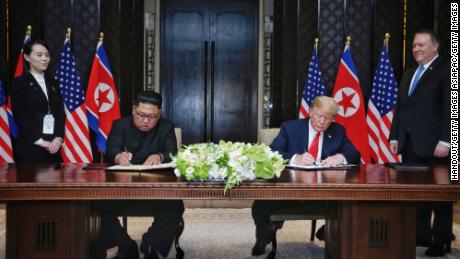
The President’s towering proclamations were bolstered by the made-for-TV optics of the first, indisputably historic meeting between a sitting US president and North Korean leader: Two men, who months ago appeared to be on the brink of nuclear war, shook hands, patted each other on the back, smiled, laughed and even strolled together through a garden like two old friends burying the hatchet, producing a palpable sense of good will. Each man signaled the prospect of inviting the other back home.
Despite the lack of printed North Korean concessions, Trump offered one of his own, vowing to end the “provocative” — to steal a term used by the North Koreans — joint military exercises regularly conducted between the US and South Korea.
The perils of Trump’s follow-his-gut approach to North Korean diplomacy quickly became apparent. Even as Air Force One headed back for the long journey to Washington, confusion spread as Republicans tried to explain — and understand — just what the President had done in Singapore.
It was clear the President hadn’t fully briefed US military brass or his allies about his plan to cancel joint military exercises in South Korea. And it was noted that he derisively described the drills as “war games,” remarkably adopting the language of Pyongyang over the Pentagon.
Vice President Mike Pence raced to Capitol Hill to try and bring Republicans up to speed, but the message became lost in translation.
Within hours of Trump claiming North Korea had given up “a tremendous amount,” Sen. Lindsey Graham, R-South Carolina, offered a dramatically different answer when asked what North Korea had given up.
“Nothing yet,” Graham said bluntly. “This is a first step, this is a good start, but we’re a long ways away from an agreement.”
Seduced by history
From the moment he accepted the invitation to meet with Kim, walking into the White House briefing room on March 8 with a wide smile, Trump seemed caught up by the potential for making history.
That sentiment played out in real time — for all the world to see — as Trump shook hands with Kim, smiled and reveled in the moment Tuesday.
“It’s my honor,” Trump said. “We will have a terrific relationship. I have no doubt.”
But the doubts were plentiful in the wake of the Singapore summit.
While even many of Trump’s biggest critics offered rare praise — that talking and the prospect of diplomacy are far preferable to a nuclear standoff — the pivotal question going forward remained: Is the President so thirsty for a deal that he gives away far more than he gets in return?
In the months before the high-stakes meeting, Trump took detailed interest in the planning for the event, including how it would look on television when he shook hands with the longtime US adversary. White House advance teams planned the moment precisely to meet Trump’s specifications that the episode appear monumental. Images were mocked up to show the President what the handshake might look like on camera.
But the optics were largely a significant win for the North Koreans, who have long sought the legitimacy of a meeting with a sitting US president, presenting the US and North Korea on level footing — something the officials from Pyongyang who negotiated the summit logistics with US counterparts were “very conscious” about, according to a US official involved in the discussions.
The US largely agreed to North Korea’s demand for parity in all aspects of the summit, from the number of officials during the bilateral meetings to the number of US and North Korean flags side by side during the arrival ceremony — a boon for North Korean propaganda.
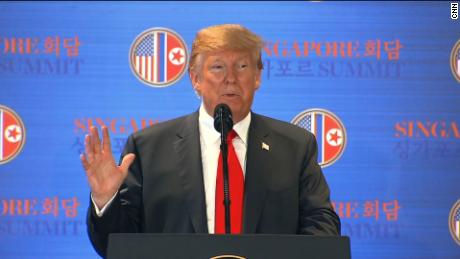
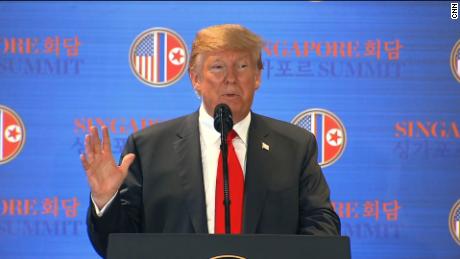
Trump stepped out onto the stage for his hour-long celebratory news conference on Tuesday after the dramatic airing of a movie trailer-like video that presented a glowing portrait of himself and Kim and clips of happy North Koreans, adoringly cheering their leader. With a Secret Service agent dutifully standing guard, the video first aired in Korean, leaving American reporters to raise their phones to capture the footage, wondering if they were watching North Korean propaganda.
The video, Trump later revealed, was perhaps his most prized piece of summit production, a video that he showed Kim on an iPad screen during their meetings to present him with the stark choice between military confrontation and Singapore-like modernity and prosperity in North Korea.
“I think he loved it,” Trump said, even though “we didn’t have a big screen like you have the luxury of having.”
Even as the summit was occurring, Trump did not give up his role as the event’s executive producer. As photographers snapped him sitting down for lunch, he checked to ensure they were taking flattering shots.
“Getting a good picture, everybody?” he asked. “So, we look nice and handsome and thin? Perfect.”
A sharp contrast
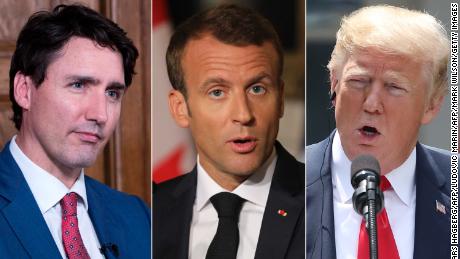
The conviviality stood in sharp contrast to the President’s earlier summit in Canada, where imagery of frustrated western allies crowding around a smirking Trump was quickly distributed by the German chancellery. After Trump met with his French counterpart Emmanuel Macron, photographs of the white marks Macron’s thumb left on Trump’s hand went viral.
At the red-shingled Capella hotel, the grip wasn’t quite as tight. But Trump’s repeated praise of the North Korean leader, his trumpeting of a still unwritten denuclearization agreement and the sense of history he imparted as he told even the press in the room “congratulations to everybody” could come back to bite Trump, similarly to how President George W. Bush came to regret his “mission accomplished” moment.
In many ways, the Singapore summit was the easy part. The true challenge, of course, will be to keep the momentum alive and to press North Korea into concrete steps to verify any dismantling of the nuclear program.
The two leaders’ handshake made history, to be sure, but it remains an open question whether their agreement will.
Source: US Government Class
Share:
Supreme Court to decide whether not voting can jeopardize a voter’s future
CBS NEWS – CINCINNATI—Do you have to vote even if you don’t want to? Not doing so could put you on the path to losing your vote in some states.
The U.S. Supreme Court is expected to rule soon on a lawsuit filed against Ohio’s secretary of state over the practice of flagging registered voters after they’ve missed one federal general election. They get a mailed notification asking them to confirm their address. If they don’t respond and don’t vote in the next two general elections, they could be purged from voter rolls.
In oral arguments Jan. 10, an attorney for civil rights groups said Americans not only have the right to vote, they have the right not to without worry about losing their registration. Attorneys for Ohio and the United States — President Trump’s administration reversed the position by former President Barack Obama by siding with Ohio — contended they are only trying to ensure the integrity of voting rolls. Mr. Trump has elevated the issue of voting fraud during his presidency. Ohio Secretary of State Jon Husted has said repeatedly that the state wants to “make it easy to vote and hard to cheat.”
Some questions and answers about the case:
Why should I care if I don’t live in Ohio?
Attorneys told the high court that at least six other states — Georgia, Montana, Oklahoma, Oregon, Pennsylvania and West Virginia — have similar practices. A ruling upholding Ohio’s practices could lead to more states adopting similar procedures.
Those in favor say states are mandated to maintain up-to-date voter lists. Those opposed to Ohio’s system see it as among moves by Republican officials in different states to add requirements such as presenting photo IDs or proving citizenship that tend to reduce voting among minorities and low-income people more likely to vote Democratic.
“All of us should be concerned if you have people who are running the electoral system who instead of trying to promote as much democracy as possible are trying to distort it in subtle ways to gain political advantage,” said attorney Paul Smith, of Washington, who argued against Ohio’s law before the justices in January.
Some states allow same-day voter registration and voting, but most don’t.
But don’t we want to be sure only legal voters vote?
State election officials and voting experts agree that having accurate registration lists is important to running smooth, fair elections. Removing people who have died, moved out of state, or are in prison for felony crimes helps reduce opportunities for fraud.
“Properly done, efforts to clean up voter rolls are important for election integrity and efficiency. Done carelessly or hastily, such efforts are prone to error, the effects of which are borne by voters who may show up to vote only to find their names missing from the list,” Jonathan Brater, counsel for the Brennan Center for Justice’s Democracy Program at New York University, wrote in a report earlier this year.
A 2013 Supreme Court decision cleared the way for local election officials in some parts of the country to make changes to election procedures without having to submit those plans for Justice Department review. Civil rights groups say that loss of protections has led to instances like one in 2015 in Hancock County, Georgia, where some black residents received summonses requiring them to appear in person to prove their residence or be removed from voting rolls.
President Trump’s unsupported assertions that millions voted illegally in the 2016 presidential election have added to uneasiness among voting rights groups about what steps states might take to add voter requirements. Trump hoped to prove widespread fraud when he appointed a commission to study the issue, but abandoned it as states refused to cooperate with expansive demands for personal voter data.
Is that really a big deal in Ohio?
The secretary of state’s office said Ohio has followed similar procedures for seeking voter confirmation of their status under both Democratic and Republican administrations since 1994.
Ohio records show more than 3 million notices seeking voter confirmation of their addresses beginning in 2011, when Husted, who is Republican, took office as secretary of state. Numbers under his Democratic predecessor weren’t available. Smith told the justices that some 70 percent of those receiving mailed notifications didn’t respond, often throwing them away without reading.
The numbers of voters listed as stricken or ready for striking — Ohio halted purges after the federal lawsuit was filed two years ago — were in the tens of thousands in urban counties such as Cuyahoga, Franklin, Hamilton and Lucas, where Democrats tend to do better than in much of the rest of the state.
However, it’s not clear how many voters lost their registrations even though they should have remained eligible. Associated Press calls to more than 100 people listed as removed in five mostly urban counties found that in the vast majority of cases, the people were no longer at the address where they lived when registered.
Some voters in the Ohio case say they were given provisional ballots, which are subject to verification, but believe their ballots weren’t counted.
Miami University political scientist Christopher Kelley said in a closely divided swing state like Ohio, anything done to “put your finger on the scales” can be decisive. He pointed to the 2004 election, when voting under a Republican secretary of state was plagued by long lines, faulty equipment and other problems in Ohio. President George W. Bush won by some 118,000 votes to carry Ohio and clinch his re-election, four years after he won election with a disputed 537-vote margin in Florida.
What do affected voters say?
Joseph Helle, an Army veteran, was removed from the rolls while serving in Iraq and Afghanistan.
He called voting a fundamental right that ensures all of the other ones protected by the Constitution.
“It affects me and it affects any veteran,” said Helle, now the mayor of Oak Harbor, Ohio. “But it also affects anyone who has never served. It affects everyone equally. It takes away our voice … I was incredibly emotional when I was taken off the rolls …”
Helle, who attended the Supreme Court arguments in January, said that not voting also is a right of free expression; it can be a way to express dissatisfaction with the candidates or the way the system is working.
Lisa Keil, of Toledo, found out she had been removed from the list of eligible voters when she tried to cast a ballot in a special mayoral election in 2015.
“It made me look really stupid. I felt humiliated,” she said.
She remembered that she tried to vote in 2012, but she showed up to find long lines and was worried she wouldn’t have enough time to get to her job, so she skipped voting. Keil said she never knew that could lead to her being removed from the voting rolls. She was separated from her husband for a short time and doesn’t recall getting a notification from the secretary of state.
Jennifer Arlinghaus, of Cincinnati, was listed in Hamilton County records as subject to removal for not voting or responding.
She acknowledged that sometimes she doesn’t vote if she’s not that interested in the candidates or issues. She said removing people for voting isn’t “necessarily good.”
But she cast her ballot without problem in 2016, for Trump. And she’s “very pleased” that she could exercise that choice.
___
Seewer reported from Toledo, Ohio. Associated Press writer Christina Almeida Cassidy in Atlanta and AP News Researcher Jennifer Farrar in New York contributed to this report.
Source: US Government Class
Share:
‘SPYGATE’: Trump blasts ‘Criminal Deep State’ amid reports of FBI informant spying on campaign
FoxNews – President Trump blasted the “Criminal Deep State” early Wednesday, suggesting things have “turned around” in “SPYGATE,” following revelations of a reported FBI informant snooping on the Trump campaign.
“Look how things have turned around on the Criminal Deep State. They go after Phony Collusion with Russia, a made up Scam, and end up getting caught in a major SPY scandal the likes of which this country may never have seen before! What goes around, comes around!” Trump tweeted Wednesday morning.
Minutes later, the president added: “SPYGATE could be one of the biggest political scandals in history!”
The president’s tweets come after reports that an FBI informant communicated with at least three members of his campaign—Foreign policy adviser George Papadopoulos, Trump aide Carter Page and campaign adviser Sam Clovis.
Trump then went on to quote former Director of National Intelligence James Clapper, who discussed the issue of an FBI informant Tuesday during ABC’s
President Trump blasted the “Criminal Deep State” early Wednesday, suggesting things have “turned around” in “SPYGATE,” following revelations of a reported FBI informant snooping on the Trump campaign.
“Look how things have turned around on the Criminal Deep State. They go after Phony Collusion with Russia, a made up Scam, and end up getting caught in a major SPY scandal the likes of which this country may never have seen before! What goes around, comes around!” Trump tweeted Wednesday morning.
Minutes later, the president added: “SPYGATE could be one of the biggest political scandals in history!”
The president’s tweets come after reports that an FBI informant communicated with at least three members of his campaign—Foreign policy adviser George Papadopoulos, Trump aide Carter Page and campaign adviser Sam Clovis.
Trump then went on to quote former Director of National Intelligence James Clapper, who discussed the issue of an FBI informant Tuesday during ABC’s “The View.”
“’Trump should be happy that the FBI was SPYING on his campaign’ No, James Clapper, I am not happy. Spying on a campaign would be illegal, and a scandal to boot!” Trump tweeted.
The Justice Department instructed its inspector general to investigate any alleged “impropriety or political motivation” in the FBI’s investigation into Russian interference and potential collusion with Trump campaign associates during the 2016 presidential election, following demands from Trump.
“I hereby demand, and will do so officially tomorrow, that the Department of Justice look into whether or not the FBI/DOJ infiltrated or surveilled the Trump Campaign for Political Purposes—and if any such demands or requests were made by people within the Obama Administration!” the president tweeted Sunday.
Earlier this week, the president met with Deputy Attorney General Rod Rosenstein and FBI Director Christopher Wray in the Oval Office, discussing the expansion of Inspector General Michael Horowitz’s investigation to include “irregularities” with the FBI or DOJ’s “tactics concerning the Trump campaign.”
White House Press Secretary Sarah Sanders also said that during the meeting, the three agreed that White House Chief of Staff John Kelly would “immediately set up a meeting with the FBI, DOJ, and DNI together with congressional leaders to review highly classified and other information they have requested.”
That meeting is slated for Thursday, and will be with House Intelligence Chairman Devin Nunes, House Oversight Committee Chairman Trey Gowdy, Wray, and Director of National Intelligence Dan Coats. Kelly will not attend the meeting — his role was simply to coordinate.
“If they had spies in my campaign…for political purposes, that would be unprecedented,” Trump said Tuesday during a meeting in the Oval Office with South Korean President Moon Jae-in, calling it a “disgrace.”
“I hope there weren’t,” Trump said. “[If there were], it would make every political event ever before look like small potatoes.”
“’Trump should be happy that the FBI was SPYING on his campaign’ No, James Clapper, I am not happy. Spying on a campaign would be illegal, and a scandal to boot!” Trump tweeted.
The Justice Department instructed its inspector general to investigate any alleged “impropriety or political motivation” in the FBI’s investigation into Russian interference and potential collusion with Trump campaign associates during the 2016 presidential election, following demands from Trump.
“I hereby demand, and will do so officially tomorrow, that the Department of Justice look into whether or not the FBI/DOJ infiltrated or surveilled the Trump Campaign for Political Purposes—and if any such demands or requests were made by people within the Obama Administration!” the president tweeted Sunday.
Earlier this week, the president met with Deputy Attorney General Rod Rosenstein and FBI Director Christopher Wray in the Oval Office, discussing the expansion of Inspector General Michael Horowitz’s investigation to include “irregularities” with the FBI or DOJ’s “tactics concerning the Trump campaign.”
White House Press Secretary Sarah Sanders also said that during the meeting, the three agreed that White House Chief of Staff John Kelly would “immediately set up a meeting with the FBI, DOJ, and DNI together with congressional leaders to review highly classified and other information they have requested.”
That meeting is slated for Thursday, and will be with House Intelligence Chairman Devin Nunes, House Oversight Committee Chairman Trey Gowdy, Wray, and Director of National Intelligence Dan Coats. Kelly will not attend the meeting — his role was simply to coordinate.
“If they had spies in my campaign…for political purposes, that would be unprecedented,” Trump said Tuesday during a meeting in the Oval Office with South Korean President Moon Jae-in, calling it a “disgrace.”
“I hope there weren’t,” Trump said. “[If there were], it would make every political event ever before look like small potatoes.”
Source: US Government Class