
apgov

One Topic Two Different Views

Read both articles and share your thoughts. What parts of the articles do you agree or disagree with? What were the strongest points/arguments made in both articles?

LeBron James accuses Trump of using sports to divide the nation

Cowboys’ star QB ‘scores touchdown’ against anthem kneelers

FoxNews FoxNews

LeBron James criticized President Trump on Monday, accusing him of trying to divide the country by using sports as his focal point.

The new Los Angeles Lakers star said Trump created a wedge by capitalizing on the controversy surrounding former San Francisco 49ers quarterback Colin Kaepernick kneeling during the national anthem.

“[Trump is] dividing us and what I’ve noticed over the last few months,” James told CNN before the official opening of his I Promise School in his hometown of Akron, Ohio. “He’s kinda used sport to kinda divide us, and that’s something that I can’t relate to because I know that sport was the first time I ever was around someone white and I got the opportunity to see them and learn about them and they got an opportunity to learn about me and we became very good friends.”

He continued: “Sports has never been something that divides people it’s always been something that brings someone together.”

The three-time NBA champion was also asked whether he’d sit down with Trump, who James once called a “bum” for disinviting Golden State Warriors star Stephen Curry from the White.

“I would never sit across from him. I’d sit across from Barack though,” he replied.

James opened up the I Promise School on Monday, describing it as the most meaningful moment of his career. He told ESPN he wants “to create an environment of family and not like a workplace.”

“Sometimes you can get tired if you look at it like work — you kind of get tired of it. We want to create an environment of family where you want to always be around your family,” he said.


When it comes to representing America’s team, Dallas Cowboys’ quarterback Dak Prescott scores a major touchdown. How ’bout them Cowboys?!

It’s time for Final Thoughts.

The NFL and its players association have issued a joint statement saying that “no new rules” related to anthem protests would be enforced while the two sides try to find “a solution” on the issue.

But Cowboys owner Jerry Jones isn’t playing those games.

In fact, last week Jones made it very clear his team’s players will be required to stand on the field for the anthem before games this season.

That’s when quarterback Dak Prescott weighed in on the controversy saying, “I never protest during the anthem, and I don’t think that’s the time or the venue to do so. The game of football has always brought me such peace, and I think it does the same for a lot of people…”

He added, “…When you bring such a controversy to the stadium, to the field, to the game, it takes away. It takes away from that, it takes away from the joy and the love that football brings a lot of people.

Well Amen to that! Finally, someone gets it!

It didn’t take long for the hip-hop community to shred Dak for his statement.

Rapper The Game took to Instagram, using racial invective to viciously suggest Dak is now a Trump supporter.

Source: US Government Class

Confederate monuments report raises idea of changing Texas capital’s name

FoxNews – Could the movement to purge Texas of Confederate symbols and monuments result in changing the name of its capital?

A report released by Austin’s Equity Office last week suggests renaming Austin and rechristening a number of other streets, markers and parks that honor the Confederacy.

Stephen F. Austin, known as the “father of Texas,” opposed an attempt by Mexico to ban slavery in the province of Tejas and said that if slaves were freed, they would turn into “vagabonds, a nuisance and a menace,” the Austin American-Statesman reports.

The report also lists other locales to possibly be renamed, including Pease Park, the Bouldin Creek neighborhood, Barton Springs and 10 streets named for William Barton—a slave owner who was known as the “Daniel Boone of Texas.”

However, all of these are only suggestions and renaming the city of Austin was included in a lower list of “assets for secondary review” in the report.

Across the U.S., communities have debated the merits of renaming streets and relocating monuments — with some saying the U.S. should not honor the Confederacy and others saying that history is being erased. In total, more than 30 cities have relocated or removed Confederate markers in recent years.

The Austin City Council renamed Robert E. Lee Road as Azie Morton Road — Morton was the first and only African-American to serve as U.S. Treasurer — and Jeff Davis Avenue is now known as William Holland Avenue.

The new report acknowledges the controversy that has surrounded these decisions and asks “what’s next and where do we stop?”

Any changes to road names would require public hearings and action from the City Council.

A change to the city’s name could require an election, the newspaper reports, since “Austin” would have to be struck from the city charter and replaced.

A marker for the Confederate States of America at Congress Avenue and Cesar Chavez Street would been approval from the Texas Historical Commission and the Travis County Historical Commission in order to be removed.

The report notes at its conclusion that “societal values are fluid, and they can be and are different today” compared to when the city made choices to honor the Confederacy with these street names and markers.

“It is also important to acknowledge that nearly all monuments to the Confederacy and its leaders were erected without a true democratic process. People of color often had no voice and no opportunity to raise concerns about the city’s decision to honor Confederate leaders.”

Source: US Government Class

Trump approval tough to pin down as president continues to confound pollsters

Washington Times – President Trump hit the campaign trail Tuesday riding high with his best poll numbers since his inauguration — or maybe not.

His approval ratings range from the high 30s to the mid-40s, so the true measure of Mr. Trump’s support is anybody’s guess.

Mr. Trump scored his all-time high of 45 percent approval in a recent Wall Street Journal/NBC News poll, but his numbers fell in other surveys. A Quinnipiac University poll showed his 38 percent approval rating was down 5 points from June.

The president, whose supporters famously defied polls and pundits in 2016, continues to be a nightmare for pollsters. Once again, he is confounding anyone trying to gauge whether he will be a boon or a bust for Republicans in this year’s congressional elections.

The Rasmussen Reports daily tracking poll Tuesday gave him a 46 percent approval rating, back where it was a week ago amid fierce criticism of Mr. Trump’s kid-glove treatment of Russian President Vladimir Putin at their meeting in Helsinki.

Predictions are difficult with Mr. Trump because the usual rules of politics don’t apply, said Vanderbilt University professor Marc J. Hetherington, who specializes in party polarization and voter behavior.

“On the one hand, the constant scandals capped by his performance in Helsinki might have ended other presidencies. On the other, the kind of success that the economy has enjoyed under his presidency would ordinarily produce approval ratings much higher than he has. The bottom line is that he’s the most polarizing president since we’ve had public opinion polls,” he said.

The professor added, “Unless something new and even more dramatic happens between now and November, it feels to me that the president is something of a wash in the midterm races.”

Others saw Mr. Trump tilting the scales toward Democrats in the same way his job performance ratings tilt toward disapproval.

“I wouldn’t say his job approval is up, but I would say it’s stable,” said Ron Faucheux, who runs the nonpartisan polling firm Clarus Research Group in Washington.

A polling average used by Mr. Faucheux has consistently put Mr. Trump’s approval rating in the 43 percent to 45 percent range.

As long as Mr. Trump’s negative rating tops 50 percent, he said, it is likely he will help Democrats in blue states, blue districts and in most swing states.

Trump won 46 percent of the vote in 2016, so his current job ratings are a little under that point. If he can keep his ratings at or near that point, it should be enough to keep Republican candidates afloat in most red states and districts,” said Mr. Faucheux.

Mr. Trump remains in demand on the stump for Republican candidates, especially in red-state Senate races where Democrats are on the ropes.

Missouri Attorney General Josh Hawley, the Republican challenger to Democratic Sen. Claire McCaskill in November, got a boost Tuesday from Mr. Trump.

At a Veterans of Foreign Wars convention in Kansas City, Mr. Trump hammered Ms. McCaskill for her “tremendous opposition” to the tax cuts that passed late last year.

“She voted against. Unbelievable. And she wants to now end it so that you pay more. You figure this one out. I don’t know, is that good?” said Mr. Trump.

Mr. Trump won Missouri by more than an 18-point margin. He also has a strong base in states including Indiana, North Dakota, Montana and West Virginia, where Democratic senators are endangered this year.

The president regularly points out that no Democrats in Congress voted for the tax cuts, which he credits with spurring an economic surge that has driven down the unemployment rate.

It’s a message that resonates with the Trump base and could give some Democratic voters second thoughts about their party. But the tax cut message will lose appeal if the economy falters before November.

Mr. Trump’s best poll numbers are for his handling of the economy. The Wall Street Journal/NBC News poll found 50 percent approval on the economic front, 41 percent for the border and immigration and 26 percent for U.S. relations with Russia.

“The magnitude to which Trump hurts or helps all depends on what kind of district you’re in but, overall, Republicans seem more wary of alienating their base voters who are very supportive of Trump, versus confronting the president as a demonstration of independence,” said Republican Party strategist Kevin Madden, who was a top aide to 2012 Republican presidential nominee Mitt Romney.

“The big risk for Trump right now is that he’s fomenting a trade war whose negative impact could be felt in local and regional economies right around the first week of November,” he said. “That’s bad timing for many Republicans who were hoping economic enthusiasm would be enough to buoy the president’s popularity and favorability ratings, which has a big impact in midterms.”

In Kansas City, Mr. Trump told the crowd that he is keeping his campaign promise to stand up to trade cheaters such as China and the European Union.

“They don’t want to have those tariffs put on them. They’re all coming to see us. And the farmers will be the biggest beneficiary. Watch,” he said. “We’re opening up markets. You watch what’s going to happen. Just be a little patient.”

The administration announced a $12 billion emergency aid package for farmers who have been targeted by China with retaliatory tariffs.

Trade war fears so far have not undercut Mr. Trump’s popularity.

His average job approval score in the Gallup poll inched up to 41.9 percent in the sixth quarter in office.

That is a personal best for Mr. Trump, though he still fares worse than every other president elected since World War II except Jimmy Carter.

Mr. Trump’s 41.9 percent average bested Mr. Carter’s 41.8 percent by one-tenth of a percentage point.

As in most polls, Mr. Trump’s numbers are bolstered by Republicans, who gave him an 88 percent average approval rating.

The average approval among independents was 36 percent. Among Democrats, it was 9 percent.

The approval rating among all party groups edged up in the sixth quarter: Republicans by 3 points, independents by 2 points and Democrats by 1 point.

Trump’s job approval has not followed the normal trajectory for presidential approval, and that is one reason for the rare increase in approval at this stage of his presidency,” said Gallup pollsters. “Whereas most prior presidents started with high approval ratings at the beginning of their terms and saw those decline through the second year in office, Trump’s started with low approval ratings, but they have been better more recently, likely because of consistent positive economic news.”

Source: US Government Class

One Story Two Different Views

Read both articles and share your thoughts. What parts of the articles do you agree or disagree with? What were the strongest points/arguments made in both articles?

How Much Damage Will Trump’s Trade War Do?

Trump is winning the trade war because China has more to lose

The Atalantic The Hill

Will Donald Trump’s trade war tip the economy into a recession?

It seems a reasonable question to ask. The White House has initiated a rapidly escalating global tit for tat, with thousands of products from the United States, China, Canada, Mexico, and Europe now affected or threatened by tariffs. The price of imported goods is increasing. The demand for exported goods is falling. American businesses are laying workers off, and some are warning that they might end up bankrupt.

In some sense, Trump could not have picked a better time to engage the country in a pointless, destructive round of mercantilism: The country’s pace of growth is so strong that the tariffs should have only a muted effect on headline GDP and jobs numbers, economists think. Still, certain industries and certain places stand to suffer considerably—and this growth-chilling trade war might be hard to call off in the event that the economy were to slow down.

The war is being fought on multiple fronts, and with several different justifications. Trump has taken aim at China for engaging in a variety of unfair market practices, including stealing American intellectual property. He has decried the North American Free Trade Agreement, shared with Mexico and Canada, arguing that it rips off American businesses. And he has said that the European Union’s trade practices are unfair, too. “They put up barriers so that we can’t sell our farm products,” Trump said at a Minnesota rally last month. “Yet they sell Mercedes and BMW, and the cars come in by the millions. And we hardly tax them at all.”

With the idea of aiding American businesses and punishing overseas trading partners, the White House has threatened or slapped tariffs on more than $200 billion of imported goods, leading to retaliation. Solar panels, jeans, motorcycles, pork, soybeans, steel, aluminum, cars, insect repellent, tilapia, lobsters, cranberries, cheese: The list of items caught in the crossfire is large and growing. That has forced more and more businesses to react. Some companies, like domestic commodity producers, have benefited from the tariffs. Others have said they would shift production overseas to avoid them, alter their supply chains to soften the impact, or start passing price increases onto consumers.

The effect on American growth stands to be small but noticeable, economists said. Paul Ashworth, the chief U.S. economist at Capital Economics, said he estimated the hit at 0.1 or 0.2 percentage points of GDP. Morgan Stanley put the direct impact at 0.3 percentage points, with a variety of other forecasters and economic analysts coming up with similar numbers. “There is no question that the short-run impact of the tariffs is to weaken GDP,” said Chris Varvares of Macroeconomic Advisers by IHS Markit, a forecasting firm. That said, he added, “even sizable tariffs are not recession inducing” given the kind of growth the country is seeing right now.

But the trade war is more than just tariffs. Trump’s actions might reduce consumer confidence, undercut business investment, and reduce investors’ appetite for risk. Companies anticipating more tariffs and export barriers, for instance, might choose not to expand their operations in the United States. “Since workers and firms don’t know if they might be impacted by retaliatory tariffs, including losing your job or shutting down your firm, the U.S. imposing tariffs is the economic equivalent of a game of Russian roulette,” Varvares said, adding that the economic impact of such decision making was far harder to model and measure.

Plus, there is the risk that the trade war could continue to escalate, doing far more damage to global growth. Economists at UBS have estimated that a leveled-up dispute might slow global growth down by a percentage point—including as much as 2.5 percentage points in the United States and 2.3 percentage points in China. In that scenario, there would be “severe” implications for the stock market, which could fall as much as 21 percent in the United States.

Even if the overall GDP effect remains muted—just a few tenths of a percentage point—some communities and consumers stand to feel it much harder than others. Agricultural businesses, for instance, are bracing for tariffs. “For soybean producers like me this is a direct financial hit,” Brent Bible, a soy and corn farmer based in Indiana, said in a statement. “This is money out of my pocket. These tariffs could mean the difference between a profit and a loss for an entire year’s worth of work out in the field, and that’s only in the near term.” The auto industry is also warning that Trump’s threatened tariffs might cost thousands of production jobs—losses that would be concentrated in Rust Belt states such as Michigan, among others.

The hit to consumers paying higher prices—estimated at something between 50 and a few hundred dollars a year—will be more diffuse. But lower-income consumers, who tend to buy more goods from countries such as China, might end up feeling squeezed more than their higher-income counterparts. “We know that China is producing goods that are lower quality,” said Mary Lovely, an economist at the Maxwell School of Citizenship and Public Affairs at Syracuse University. “Take any consumer product. Snowboards. A tennis racket. Luggage. Rich people buy stuff from Switzerland. They don’t go to Target to buy a tennis racket from China.”

Were the economy to slow, the sting from higher prices, layoffs, reduced business investment, and falling exports would be much bigger, of course. As Varvares said, “If the economy were already in the process of growth slowing toward trend or slightly below”—as expected, given rising interest rates, among other factors—“any additional negative shock could tip the economy over into recession.” There’s no need to worry about a trade-triggered recession today, then. But it might be worth worrying about one tomorrow.

 

 Don’t look now, but there are numerous signs that President Trump is winning the trade war with China. While the battle over tariffs and protecting intellectual property may eventually damage the United States’ economy, there are signs that China is already paying a price for its refusal to bend to Trump’s demands.

One indicator of that price is the sharp plunge in China’s stock exchanges. Since the White House announced the first tariffs — on washing machines and solar cells on Jan. 22 — the Shanghai Index of Chinese stocks is down nearly 20 percent, while the S&P 500 is off less than 1 percent.

That decline of share values is occurring in spite of the first-time inclusion in the MSCI, an important international index, of many Chinese stocks on June 1. That initial index listing attracted billions of dollars toward Chinese stocks, in expectation it would boost prices, but it did not.

What does that tell you? Investors think China has more to lose than the U.S. They are correct.

China’s government, determined to save face and match Trump’s tariff threats, is so concerned about the slide in share prices and what it might signal about the cost of the confrontation, that it will likely allow the $941 billion China Investment Corp. (CIC) to begin buying domestic stocks.

The sovereign wealth fund has petitioned to change its mandate, which formerly directed it to purchases of overseas shares; since most view the CIC as an arm of the Chinese government, the move may be interpreted as Beijing again intervening to prop up share prices.

It would not be the first time. From the middle of 2014 through the second quarter of 2015, Beijing encouraged China’s citizens to buy stocks, ballyhooing a booming economy and hinting that the government would stand behind markets.

Stocks soared as 38 million new accounts were opened, mainly by small investors. When share prices plunged in June 2015, officials stepped in to stabilize markets; the government intervened again later that year, loosening margin requirements, putting a “lockup” in place that prevented owners of large positions from dumping their positions while also banning short selling.

Most recently, the government reportedly stepped in this past March, hoping to stem a sharp selloff in share prices caused by fears of a trade war.

Another indication that Beijing is feeling the heat is that officials appear to be softening their bold “Made in China 2025” campaign. The Financial Times reported, “A propaganda directive leaked in late June ordered Chinese media no longer to refer to the term;”

The FT also noted: “Chinese leaders are also seeking to reassure foreign governments and companies that the programme is more benign than has been portrayed.”

Beijing is attempting to ally with the EU to push back against Trump’s trade stance; being less aggressive about dominating coveted industries is meant to help that effort.

Meanwhile, it’s not just Chinese stocks that have been walloped by trade concerns; the yuan has taken a beating, too. Since the end of March, when the battle over tariffs heated up, the yuan has slid nearly 7 percent, again demonstrating the impact the trade war might have on China’s economy.

After it hit a six-month low at the end of June, the government quietly stepped in to halt the slide, working through a large state-owned bank to sell dollars and prop up the yuan. Part of the currency’s weakness was attributed to a decision by China’s central bank to free up $100 billion in an attempt to boost lending and help out small businesses and state-owned firms threatened by escalating tariffs.

Meanwhile, growth in China is cooling. In the second quarter, the economy grew at 6.7 percent, the slowest rate since 2016. The International Monetary Fund (IMF) projected that China will grow 6.6 percent for the current year, but only 6.4 percent next year; in 2017 growth totaled 6.9 percent.

In describing the potential harm that might be done by Trump’s tariffs, the IMF economic guru Maury Obstfeld said recently: “As the focus of global retaliation, the United States finds a relatively high share of its exports taxed in global markets in such a broader trade conflict, and it is therefore especially vulnerable.”

Given that exports constitute 12 percent of the U.S. economy, versus 20 percent of China’s GDP and that the entire skirmish is over disparate tariffs (i.e., ours are higher) that seems more a political message than a reasonable assessment.

New numbers tell the story. China’s industrial production increased 6 percent year-over-year in June, short of an estimated 6.5 percent, while investment also was up only 6 percent.

By contrast, in the U.S., economic growth remains on the upswing, along with investment spending by businesses and industrial output. A recent NABE survey indicates that business economists are concerned about the effect of a trade war, but also bullish about the outlook for growth.

Specifically, they have substantially raised their expectations of industrial production, now looking for a gain of 3.8 percent this year, up from the 3.3-percent gain projected in March, and much higher than the 2.3 percent forecasted in the December survey.

Meanwhile, economists at ISI Evercore are reporting their private surveys of businesses support estimates that real GDP could grow at a nominal rate (including inflation) of 5.5 percent in the second quarter, a cyclical high.

The recent rise in retail sales, up 6.6 percent in June compared to last year, fuels continued optimism, as does data from the latest Empire State Manufacturing Survey, “suggesting a continuation of robust growth,” according to the press release.

President Trump is rightly pushing back against decades of Chinese misbehavior, punishing Beijing for ongoing unfair trade practices and theft of intellectual property. His imposition of tariffs are meant to force a change by damaging China’s economy.

The risk is that China stands firm and fails to make the concessions demanded by the White House. In that scenario, global growth will suffer, but Beijing will likely suffer most. It appears they already are.

Liz Peek is a former partner of major bracket Wall Street firm Wertheim & Company. For 15 years, she has been a columnist for The Fiscal Times, Fox News, the New York Sun and numerous other organizations.

Source: US Government Class

Mark Zuckerberg Tries to Clarify Remarks About Holocaust Deniers After Outcry

New York Times – Mark Zuckerberg, the Facebook chief executive, said in an interview published Wednesday that he would not automatically remove denials that the Holocaust took place from the site, a remark that caused an uproar online.

Mr. Zuckerberg’s comments were made during an interview with the tech journalist Kara Swisher that was published on the site Recode. (Read the full transcript here.) Hours later, Mr. Zuckerberg tried to clarify his comments in an email to Recode.

In the interview, Mr. Zuckerberg had been discussing what content Facebook would remove from the site, and noted that in countries like Myanmar and Sri Lanka, the dissemination of hate speech can have immediate and dire consequences. Moments earlier, he had also defended his company’s decision to allow content from the conspiracy site Infowars to be distributed on Facebook.

“The principles that we have on what we remove from the service are: If it’s going to result in real harm, real physical harm, or if you’re attacking individuals, then that content shouldn’t be on the platform,” he said.

“There’s a lot of categories of that that we can get into, but then there’s broad debate.”

Ms. Swisher, who will become an Opinion contributor with The New York Times later this summer, challenged Mr. Zuckerberg.

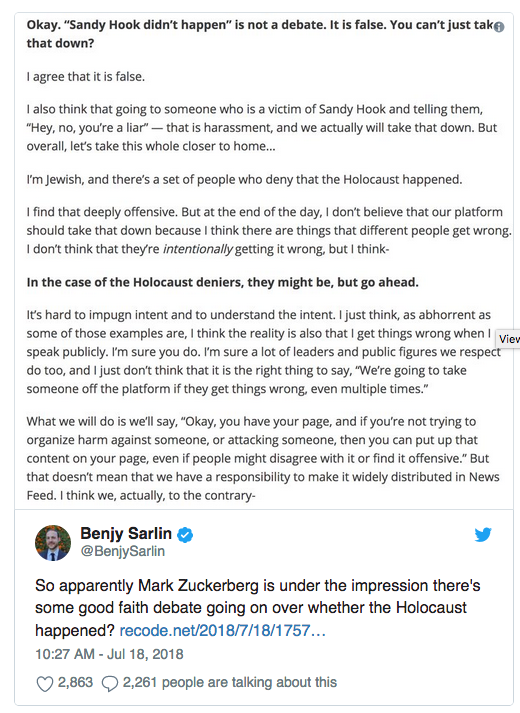
“‘Sandy Hook didn’t happen’ is not a debate,” she said, referring to the Connecticut school massacre in 2012, which Infowars has spread conspiracy theories about. “It is false. You can’t just take that down?”

Mr. Zuckerberg countered that the context of the remark mattered.

“I also think that going to someone who is a victim of Sandy Hook and telling them, ‘Hey, no, you’re a liar’ — that is harassment, and we actually will take that down,” he said.

That’s when Mr. Zuckerberg brought up the Holocaust.

“But over all, let’s take this whole closer to home,” he continued. “I’m Jewish, and there’s a set of people who deny that the Holocaust happened. I find that deeply offensive. But at the end of the day, I don’t believe that our platform should take that down because I think there are things that different people get wrong. I don’t think that they’re intentionally getting it wrong.”

Ms. Swisher interrupted him: “In the case of the Holocaust deniers, they might be, but go ahead.”

Mr. Zuckerberg’s response was somewhat muddled.

“It’s hard to impugn intent and to understand the intent,” he said, adding that he also gets things wrong when he speaks publicly, and other public figures do as well.

“I just don’t think that it is the right thing to say, ‘We’re going to take someone off the platform if they get things wrong, even multiple times,’” he said.

Instead, Facebook would allow the content to exist on its site, but would move it down in the News Feed so that fewer users see it, he said.

In his follow-up statement, the Facebook chief executive tried to clarify his remarks.

“There’s one thing I want to clear up. I personally find Holocaust denial deeply offensive, and I absolutely didn’t intend to defend the intent of people who deny that,” he wrote in the email.

“If something is spreading and is rated false by fact checkers, it would lose the vast majority of its distribution,” he wrote, adding that any post “advocating for violence or hate against a particular group” would be removed.

“These issues are very challenging,” he added, “but I believe that often the best way to fight offensive bad speech is with good speech.”

But the interview had already set off a reaction from online commenters and drew widespread news coverage.

Benjy Sarlin of NBC News seemed baffled by Mr. Zuckerberg’s choice of words.

Facebook did not immediately return a request for comment.

Jonathan Greenblatt, the chief executive of the Anti-Defamation League, said in a statement that Holocaust denial is “a willful, deliberate and longstanding deception tactic by anti-Semites.”

“Facebook has a moral and ethical obligation not to allow its dissemination,” he wrote

Source: US Government Class

Trump faces bipartisan criticism over press conference with Putin

FoxNews – President Trump faced harsh bipartisan criticism back home for his Helsinki press conference with Vladimir Putin on Monday, as lawmakers claimed the U.S. president missed a chance to “stand up” to the Russian president on election meddling.

The U.S. president, for his part, called the summit with Putin “deeply productive.” After Democrats for days called on him to nix the meeting in the wake of indictments against Russian officers for U.S. campaign hacking, Trump said he would “not make decisions on foreign policy in a futile effort to appease partisan critics.”

He cited progress on a range of issues, and said it would be a “good thing” to get along with Russia.

However, the president angered members of both parties by saying both countries share blame for damaged relations and by not firmly standing by U.S. intelligence assessments that Russia meddled in the 2016 elections.

Trump said he has great confidence in the intelligence community, but Putin gave a “strong and powerful” denial.

TRUMP BLASTS MUELLER PROBE, PUTIN DENIES MEDDLING AS LEADERS TOUT SUMMIT AS ‘SUCCESS’

“There is no question that Russia interfered in our election and continues attempts to undermine democracy here and around the world,” House Speaker Paul Ryan, R-Wis., countered.

Others were less reserved in their response.

Sen. John McCain, R-Ariz., who has been out of Washington for months battling brain cancer, issued a blistering statement calling the performance “disgraceful.”

“President Trump proved not only unable, but unwilling to stand up to Putin. He and Putin seemed to be speaking from the same script as the president made a conscious choice to defend a tyrant against the fair questions of a free press, and to grant Putin an uncontested platform to spew propaganda and lies to the world,” McCain said, calling the president’s comments at the press conference “a recent low point in the history of the American Presidency.”

Sen. Jeff Flake, R-Ariz., another Republican often critical of the president, also blasted Trump.

“I never thought I would see the day when our American President would stand on the stage with the Russian President and place blame on the United States for Russian aggression. This is shameful,” Flake tweeted.

Trump later clarified on Twitter: “As I said today and many times before, ‘I have GREAT confidence in MY intelligence people.’ However, I also recognize that in order to build a brighter future, we cannot exclusively focus on the past – as the world’s two largest nuclear powers, we must get along!”

Democrats, meanwhile, cranked up the volume on criticism that had already been building for days — especially after 12 Russians were indicted for allegedly hacking Hillary Clinton campaign and other Democratic groups’ emails in 2016.

Former CIA director John Brennan, another frequent critic of Trump, went so far as to effectively accuse the president of treason.

“Donald Trump’s press conference performance in Helsinki rises to & exceeds the threshold of ‘high crimes & misdemeanors.’ It was nothing short of treasonous. Not only were Trump’s comments imbecilic, he is wholly in the pocket of Putin. Republican Patriots: Where are you???”

House Democratic Leader Nancy Pelosi, D-Calif., said: “President Trump’s weakness in front of Putin was embarrassing, and proves that the Russians have something on the President, personally, financially or politically.”

Senate Democratic Leader Chuck Schumer made similar comments, while calling on Congress to ratchet up sanctions on Russia in response to Monday’s events.

“What the president has done is an insult to all Americans,” Schumer said.

Democrats continue to push claims that Russia has ‘dirt’ on Trump, though the so-called dossier that helped start those theories has not been verified. Monday’s press conference only fueled those claims.

Putin, though, was directly asked during the press conference whether he had compromising material on Trump, and dismissed such speculation as “nonsense.”

While the Finland summit between Trump and Putin apparently spanned a range of topics — from Crimea to missile defense and more — the press conference itself focused largely on the meddling allegations. Trump used the stage to again condemn Special Counsel Robert Mueller’s probe as a “disaster,” saying there was “no collusion” with his campaign.

“I didn’t know the president. There was no one to collude with, and there was no collusion with the campaign,” Trump said, suggesting Democrats have used the issue an excuse for losing. “We ran a brilliant campaign, and that’s why I’m president.”

Throughout the joint press conference, Putin emphatically and repeatedly denied meddling in the U.S. election, saying there’s “no evidence.”

In the wake of the comments, Trump’s Director of National Intelligence Dan Coats stood by their assessment: “We have been clear in our assessments of Russian meddling in the 2016 election and their ongoing, pervasive efforts to undermine our democracy.”

Sen. Elizabeth Warren, D-Mass., considered a potential 2020 presidential candidate, slammed Trump’s comments as “disgraceful.”

“Once again, @realDonaldTrump takes to the international stage to embarrass America, undermine our institutions, weaken our alliances, & embrace a dictator. Russia interfered in our elections & attacked our democracy. Putin must be held accountable – not rewarded. Disgraceful,” Warren tweeted.

Ranking Member of the House Intelligence Committee Adam Schiff, D-Calif., said that Trump’s attack on intelligence agencies would be taken as a “green light” by Putin to “interfere” in the 2018 midterm elections.

Other Republicans, while not as fierce as McCain, also criticized Trump, reminding him that Russia is not considered a “friend” of the U.S.

“Russia is not our friend. Russia attempted to undermine the fundamentals of our democracy, impugn the reliability of the 2016 election, and sow the seeds of discord among Americans. Our intelligence community, including the current one, concluded this, as did the Majority House Intelligence Committee report, as did our fellow Americans who served on grand juries which returned true bills on two separate occasions,” House Oversight Committee Chairman Trey Gowdy, R-S.C., said in a statement, urging administration officials to “communicate to the President it is possible to conclude Russia interfered with our election in 2016 without delegitimizing his electoral success.”

Senate Intelligence Chairman Richard Burr, R-N.C., also stressed that Putin “is not our friend and never has been.”

Source: US Government Class

Mueller indicts 12 Russians for hacking DNC, Hillary Clinton’s computers

WashingtonTimes –

Special counsel Robert Mueller on Friday indicted 12 Russian military officials, accusing them of massive attempts to interfere in the 2016 presidential election by emails from Hillary Clinton’s campaign chief and another political committee, and penetrating state elections computers.

Deputy Attorney General Rod Rosenstein announced the indictments at the Justice Department, just days before President Trump is to meet with Russian President Vladimir Putin for a one-on-one summit.

Mr. Rosenstein said he has briefed Mr. Trump on what investigators found, saying the attempts by Russian officials was an attack on American democracy.

“The blame for election interference belongs to the criminals who committed election interference. We need to work together to hold the perpetrators accountable, and keep moving forward to preserve our values, protect against future interference, and defend America,” Mr. Rosenstein said.

The White House released a defensive statement that didn’t acknowledge any of the charges or allegations, and instead focused on what wasn’t in the indictment.

“Today’s charges include no allegations of knowing involvement by anyone on the campaign and no allegations that the alleged hacking affected the election result. This is consistent with what we have been saying all along,” said White House spokesperson Lindsay Walters.

The indictment was handed up by a grand jury in Washington, D.C., Friday morning. Mr. Rosenstein said the timing was the result of “the collection of facts, evidence of law.”

Mr. Rosenstein said the hackers used spear phishing scams and malware to steal emails of Mr. Podesta and other campaign operatives, then injected it into the 2016 political campaign.

The operatives created two fictitious identities, a supposedly lone-wolf hacker Guccifer 2.0 and another supposed group of Americans dubbed DCLeaks, as cutouts to share the information.

And the operatives used an unnamed organization to spread the emails — apparently WikiLeaks, which published the Podesta emails in the late stages of the 2016 campaign, spawning thousands of stories.

Mr. Podesta told CNN Friday afternoon the indictment was an “important step.”

“At the heart of [the indictment] is criminal activity by the Russian government,” he said.

Americans were in contact with the operatives, Mr. Rosenstein said, but the indictment doesn’t allege any of them knew they were communicating with Russians attempting to influence the election.

But Mr. Podesta said he was skeptical that Americans were unaware they were communicating with Russians, citing U.S. intelligence reports linking Gufficer 2.0 and DCLinks to that country’s operatives.

“If anyone did not than that was willful ignorance on their part,” he said.

Rudy Giuliani, a member of President Trump’s legal team, praised the indictments as “good news” for Americans.

“The indictments Rod Rosenstein announced are good news for all Americans. The Russians are nailed. No Americans are involved,” he tweeted, “Time for Mueller to end this pursuit of the President and say President Trump is completely innocent.”

Mr. Rosenstein said they are not alleging that any votes were changed by the Russian operatives.

The indictment includes counts of unauthorized computer access, identity theft and money laundering, as well as an additional charge of conspiracy to access computers. That latter charge stems from the attempts to break into state elections officials’ systems.

Russian military intelligence officers did hack the website of one state board of elections and stole information about 500,000 voters; hacked a voter registration software company’s systems; and tried to plant malware on elections administration officials, the government charges.

In the campaign attack, the military officers created a fake email account with a similar name as a top Clinton campaign member, according to the indictment. They used that account to launch a spearfishing attack, giving them access to the email accounts of more than 30 campaign officials.

The 29-page indictment is a painstaking index of how the 12 Russians, who are all members of GRU Units 26165 and 74455, allegedly went to great lengths to hack the Clinton campaign and DNC. It details the steps the conspirators took to identify computers, steal documents without detection and cover their tracks.

By conducting transactions using Bitcoin, a virtual currency, the conspirators were able to avoid directly dealing with banks who require personal information, thus enabling them to evade law enforcement. The Russians purchased a server and the DCLeaks domain name with Bitcoin, according to the indictment.

“The conspirators acquired bitcoin through a variety of means designed to obscure the origin of the funds,” the indictment said.

The Russians targeted a domain hosted by provider used by Ms. Clinton’s personal office and 76 email addresses at the Clinton campaign on or about July 27, 2016, according to the indictment. On the same day, Mr. Trump jokingly urged the Russians to “find the 30,000 emails that are missing.”

Using the online persona of Guccifer 2.0, the conspirators tried to reach Trump campaign staff in August 2016, according to the indictment. The defendants wrote to an unidentified person who was in regular contact with senior members of the Trump campaign and asked how they could help.

The indictment does not allege that the Russians ever made contact with the Trump campaign staff.

Current DNC Chairman Tom Perez said the indictments contradict Mr. Trump’s claim the Mueller probe is a “witch hunt” and “hoax.”

“The Kremlin’s efforts to disrupt our electoral process have grave implications for our democracy,” Mr. Perez said. “Donald Trump and his Republican enablers’ efforts to discredit these established facts only embolden Putin’s Russia and invite further attacks on our country.”

Source: US Government Class

Is the US NATO’s piggy bank? Here’s what America gives and takes

(CNN) – US President Donald Trump has arrived in Brussels with a clear message: NATO members must hike their defense spending and they must do it now.

Trump has long called on other NATO members to spend at least 2% of their gross domestic product on defense, as the transatlantic alliance’s own guidelines recommend.
He has a point. The US spent more than 3.5% of its GDP on defense last year, and far more in previous years, while only three other member nations — the UK, Greece and Estonia — passed the 2% threshold last year, NATO data shows. Poland slipped in 2017 below the benchmark to 1.99%.
“I think these countries have to step it up, not over a 10-year period, but they have to step it up immediately,” Trump said in Brussels on Wednesday, on day one of the summit. NATO allies in 2014 agreed to try and reach their 2% target over a decade, by 2024, too long a time frame for Trump. He pointed specifically to Germany as a wealthy nation that could boost spending now.
There was never any doubt Trump would come down hard on his mostly European allies in the 29-member alliance. He has spent recent days on Twitter slamming NATO as “very unfair.”
A White House spokesman made clear last week the President will tell NATO that the US is not the world’s piggy bank.

Is the 2% threshold reasonable?

While the 2% threshold has eluded some members — whom Trump has slammed as “delinquents” — most have boosted their spending in real-dollar figures in recent years.
NATO was formed after World War II and on the principle of collective defense — an attack against one or more members is considered an attack against all. Each nation puts very little money in a NATO pot of funds. The idea is that each nation should have its own strong defense force, which requires a certain level of spending by individual members.
Trump is not the first US president to point this out.
“Lots of American presidents and administrations have made that point and pleaded with allies to increase spending. They just did it more politely,” Elisabeth Braw, adjunct fellow from the Center for European Policy Analysis, told CNN.
Defense expenditure had largely dropped at the beginning of the decade, because Europe was relatively peaceful.
But following Russia’s aggression in Ukraine and its annexation of the Crimean peninsula, all NATO members agreed in 2014 to reach the 2% threshold by 2024.
Trump has taken on a threatening tone ahead of the Brussels meeting, sending a series of letters to NATO allies, including Germany, Belgium and Canada, demanding they boost spending and threatening to shift the US military presence in Europe if they do not. The letters were first reported in The New York Times.
“I think Trump does have a point, but I think the way in which he’s making his point is very unhelpful, because he’s so unpopular here in Europe. If he bullies European leaders into spending more domestically, I think it would be foolish for them to spend as much as he wants them to because they will be seen as essentially just obeying his commands,” Braw said.
She added that US Defense Secretary James Mattis, for example, could have made the case.
“He enjoys wide respect among allies — but it seems to have almost become an obsession for Trump, and paradoxically I think it would lead to smaller increases, and that is very unfortunate, because it’s clear the security situation is deteriorating in Europe.”
Braw said, however, that expecting defense spending at 2% of GDP is largely reasonable.
“The idea is that every country should have strong armed forces on its own, so that NATO really just is for common defense — it shouldn’t be that there are free riders who spend almost nothing but say, ‘I’m a member of an alliance.’”

What does the US get out of NATO?

But Braw and other experts also acknowledge there is more than financial value to NATO. The alliance allows the US to have a strong foothold in Europe, a presence that has traditionally helped it counter Russia’s influence in the region.
It also allows the US to launch military action in other regions, mainly the Middle East, Africa and South Asia.
In Germany alone, the US has 152 military sites for its army and air force, US Defense Department data from 2017 shows. The US’ largest military hospital abroad is in Germany, and it uses bases in the country as “lily pads” to go back and forth from countries like Afghanistan.
The US also has six nuclear stockpiles in five European NATO countries — Germany, Belgium, Italy, the Netherlands and Turkey — according to the Federation of American Scientists. It also stores tanks and artillery in Norwegian caves.
Karen von Hippel, director-general of the Royal United Service Institute (RUSI), points to other nonfinancial benefits to the US being in NATO, such as support in times of conflict.
“I don’t think he understands what alliances are — everything is, ‘What are you going to give me and what am I going to get out of it?’” she said.
“I don’t think he understands all the other things that come with alliances, whether it’s your friends fighting in wars for you and losing lives. I mean, don’t forget, many countries went to Iraq and Afghanistan and many, many soldiers were killed from all these countries, and it was not their war, it was an American war really, more than anything else. And so alliances are a lot more than the balance sheet, and I don’t think he fully understands that.”

What does this mean for Russia?

NATO was founded partly in response to the threat by the Soviet Union after the war. It has also been used as show of unity and strength against Russia in the region more recently.
Moscow and Russian President Vladimir Putin, however, often say NATO is the aggressor, and bemoan NATO military exercises on Russia’s doorstep. NATO is also a painful reminder of the territory the Soviet Union lost, as Moscow watches countries it once ruled over join an alliance that was built to oppose it.
There is concern that Trump’s decision to meet with Putin right after attending the NATO summit and taking a trip to the UK, a key NATO member, spells trouble for the alliance.
Few think Trump will pull the US out altogether, but there are concerns that as NATO’s most powerful member, a US too close to Russia could complicate the alliance’s raison d’être to a degree.
“Putin is emboldened pretty much with or without Trump. We’ve seen that over the last few years. But Trump seems to be doing everything Putin wants him to do and why he is doing that is still a mystery to many people, including many people in Trump’s own government,” von Hippel said.
“Of course, he will be coming to the UK just after that meeting as well, and meeting with the Prime Minister here, and you know, this country is very committed to NATO. And if he really does drop a bombshell, that will obviously impact the visit here, and then of course who knows what will happen with Putin?”

Source: US Government Class

Trump revokes Obama guidance on race in school admissions

Santa Fe New Mexican – WASHINGTON — The Trump administration on Tuesday rescinded Obama-era guidance that encouraged schools to take a student’s race into account to promote diversity in admissions.

The shift suggests schools will have the federal government’s blessing to leave race out of admissions and enrollment decisions, and it underscores the contentious politics that continue to surround affirmative action policies, which have repeatedly been challenged before the Supreme Court.

The admissions memos were among 24 policy documents revoked by the Justice Department for being “unnecessary, outdated, inconsistent with existing law, or otherwise improper.” Attorney General Jeff Sessions called the changes an effort to restore the “rule of law” and blamed past administrations for imposing new rules without seeking public comment.

“That’s wrong, and it’s not good government,” Sessions said in a statement.

The action comes amid a high-profile court fight over Harvard University admissions as well as Supreme Court turnover expected to produce a more critical eye toward schools’ race-conscious admissions policies.

The court’s most recent significant ruling on the subject bolstered colleges’ use of race among many factors in the admission process. But the opinion’s author, Anthony Kennedy, announced his retirement last week, giving President Donald Trump a chance to replace him with a justice who may be more reliably skeptical of admissions programs that take race and ethnicity into account.

The new policy dramatically departs from the stance of the Obama administration, which in a 2011 policy document said courts had recognized schools’ “compelling interest” in ensuring racially diverse populations. The guidance said that while race shouldn’t be the primary factor in an admission decision, schools could lawfully consider it in the interest of achieving diversity.

“Institutions are not required to implement race-neutral approaches if, in their judgment, the approaches would be unworkable,” the guidance said. “In some cases, race-neutral approaches will be unworkable because they will be ineffective to achieve the diversity the institution seeks.”

That guidance has now been rescinded, as have more than a half-dozen other similar documents, including some that sought to explain court rulings affirming the use of race as one of several factors in the admissions process.

In one such document, the Obama administration stated, “As the Supreme Court has recognized, diversity has benefits for all students, and today’s students must be prepared to succeed in a diverse society and an increasingly global workforce.”

The Trump administration’s announcement is more in line with Bush-era policy that discouraged affirmative action and instead encouraged the use of race-neutral alternatives, like percentage plans and economic diversity programs.

Though such guidance doesn’t have the force of law, schools could presumably use it to defend themselves against lawsuits over admission policies.

The Trump administration’s Justice Department had already signaled concern about the use of race in admissions decisions.

The department, for instance, has sided with Asian-American plaintiffs who contend in a lawsuit against Harvard that the school unlawfully limits how many Asian students are admitted.

Students for Fair Admissions, the group suing Harvard, is led by Ed Blum, a legal strategist who also helped white student Abigail Fisher sue the University of Texas for alleged discrimination in a case that reached the Supreme Court.

Blum said Tuesday the organization “welcomes any governmental actions that will eliminate racial classifications and preferences in college admissions.” Harvard, meanwhile, said it would continue considering race as an admissions factor to create a “diverse campus community where students from all walks of life have the opportunity to learn with and from each other.”

Civil liberties groups criticized the Trump administration’s announcement, saying it went against decades of court precedent permitting colleges to take race into account.

“We condemn the Department of Education’s politically motivated attack on affirmative action and deliberate attempt to discourage colleges and universities from pursuing racial diversity at our nation’s colleges and universities,” Kristen Clarke, president and executive director of the Lawyers’ Committee for Civil Rights Under Law, said in a statement.

Lily Eskelsen García, president of the National Education Association, said “affirmative action has proven to be one of the most effective ways to create diverse and inclusive classrooms.” She said the announcement underscored the stakes surrounding the upcoming Supreme Court appointment.

The high court has been generally accepting of considering race in admissions decisions to achieve diversity. In a 2016 opinion written by Kennedy, the court granted affirmative action policies a victory by permitting race to be among the factors considered in the college admission process.

The ruling bitterly disappointed conservatives who thought Kennedy would be part of a Supreme Court majority to outlaw affirmative action in education. Justice Antonin Scalia died after the court heard arguments in the case but before the decision was handed down.

The new affirmative action guidance may add to an already contentious fight over the next justice.

With Trump expected to announce his nominee next week, the issue should be a central part of any confirmation process, said Howard University law school dean Danielle Holley-Walker.

She called the new guidance “highly unfortunate and counterproductive” and said the decision is another indication that the Justice Department under Sessions is likely to be aggressive toward schools that do continue to factor in race in admissions decisions.

“People have been talking about precedent in regard to Roe. v. Wade” — the landmark 1973 ruling affirming a woman’s right to abortion — “but it’s important to remember that affirmative action has been a precedent for the past 40 years,” she said. “This is a clear attack on precedent. Any Supreme Court nominee needs to be asked if they support precedent related to affirmative action.”

Source: US Government Class