apgov

City of Santa Fe considers changes to public campaign financing

Santa Fe New Mexican – Publicly financed candidates for city offices could raise additional money in small amounts, and whatever they mustered would be doubled by the city’s campaign finance fund, according to a proposal to reform the system after the most expensive mayoral race in Santa Fe history.

City candidates who qualify for a public campaign finance disbursement are prohibited from accepting outside money to boost their campaign.

Mayoral candidates receive $60,000, and City Council hopefuls get $15,000. Candidates who choose to privately finance a run may raise funds to their hearts’ content, or as far as their political appeal will go.

The privately financed campaign of Mayor Alan Webber, for instance, was more than five times richer than the $60,000 allotment received by runner-up Ron Trujillo. Trujillo was the only publicly financed candidate in the five-way March mayoral contest.

The new proposal would allow publicly funded candidates like Trujillo to also raise “small contributions,” or donations not to exceed $100 in aggregate from any one donor, which could then be matched 2-to-1 by money from the city’s public campaign finance coffers.

In the context of the dramatic private fundraising totals of the 2018 mayor’s race, in particular the record-shattering sum raised by Webber, the proposal would seem intended to balance the scales in favor of the little fish and restore the original idea of the Santa Fe public campaign finance system: keeping big money out of local politics.

“They won’t be helpless anymore,” said Jim Harrington of Common Cause New Mexico, an advocate of the proposal, referring to publicly funded office-seekers.

The legislation is sponsored by freshman City Councilor Carol Romero-Wirth.

“It’s not necessarily going to be even, but if you can’t reduce the influence of outside spending, it makes the public financing system less viable for candidates,” Romero-Wirth said.

Candidates who receive the 2-to-1 matching funds would be required to file regular donation reports with the City Clerk’s Office, according to a draft of the legislation. The payouts would never exceed the balance of the public campaign finance fund, which under the city code must contain at least $300,000 in election years without a mayor’s race and $600,000 in years with a mayoral election.

Romero-Wirth called the bill an “important counter” to unregulated political action committee money and the trend toward privately financed city campaigns.

The bolstered public campaign finance program is in fact an old idea, dating to the program’s inception a decade ago. As originally written, the city’s public campaign finance ordinance entitled publicly funded candidates to money that would match the spending of privately funded opponents and political action committees.

A 2011 U.S. Supreme Court decision about Arizona’s “clean elections” law put that dream to rest, however, finding such matching allowances were unconstitutional before the city could hold its first election with the new public system in 2012.

“Then we kind of went along with trying to run the system without any matching and [we] wanted to see if Santa Fe was a virtuous enough town that PACs weren’t going to go crazy, and people weren’t going to spend privately,” Harrington said.

The 2014 and 2018 mayoral elections deflated that hope, he and others said.

The 2014 mayoral race saw each of the three candidates take part in the public system. But private political action committees aligned with Javier Gonzales flooded the race and made a mockery of the idea that the publicly funded candidates stood on a level playing field, critics and Gonzales opponents said.

It was little surprise, then, when three of five candidates next time around — Webber, school board member Kate Noble and former City Councilor Joseph Maestas — spurned the public system in this year’s election. Webber, for his part, called it a “leaky vessel.”

Of the five candidates, only Trujillo qualified for the public campaign finance system. Councilor Peter Ives sought qualification but did not manage to compile the requisite number of $5 donations by the deadline.

Webber’s total — almost $316,000, with donors from at least 25 states, Washington, D.C., and Canada — lapped his rivals’ combined efforts.

Co-sponsoring Councilor Renee Villarreal said changes in public financing would “control the flow of who’s getting in — it’s one way to dissuade PACs from forming.”

Ives, another co-sponsor, said that while political action committees in this year’s mayoral weren’t a particularly influential bloc, the principle of empowering publicly funded candidates to compete was an important one.

“To allow people to get their message out, so they can reach the people of Santa Fe, helps voters understand their choices and have an opportunity to feel like real participants in the process,” he said.

The amendments to the public campaign finance code are scheduled for a hearing Thursday before the city’s Ethics and Campaign Review Board.

Source: US Government Class

Turks are smashing their iPhones to protest Trump

CBS News – The U.S. government insists the charges against Brunson are contrived and that he is an innocent family man being held for political reasons. Brunson had lived in Turkey for more than 20 years prior to his arrest. He was jailed for about two years before being moved to house arrest last month.

President Trump demanded Turkey free Brunson and then followed through with his threat to hit Ankara with sanctions and tariffs when he wasn’t released.

Erdogan’s government insists the Turkish judicial system must be respected, and Brunson’s fate currently rests with a court in Ankara that is expected to rule on the American’s legal appeal for release this week. A lower court rejected the appeal on Wednesday, but Brunson’s lawyer suggested to CBS News that he still had hope the higher court would reverse that decision.

The feud escalated into an economic battle with global consequences this week as the Turkish currency, the lira, plummeted in value over fears of the country’s economic stability stemming from the harsh U.S. sanctions.

Erdogan refused to relent, leveling the retaliatory measures on U.S. products and urging his citizens to reject American products.

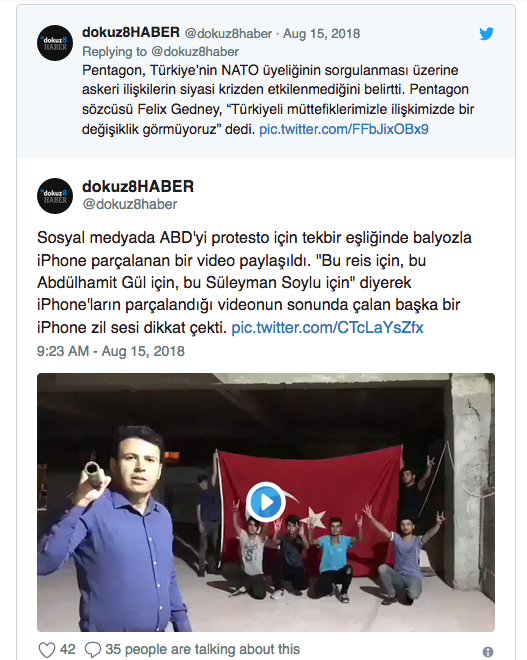
In one of the videos circulating online in Turkey, which have been picked up by the country’s online news organizations, an unidentified man with four boys kneeling behind him in front of a Turkish flag, addresses the U.S. leader directly, asking Mr. Trump, “who do you think you are?”

“If you threaten us with hunger you will only make us laugh. Do whatever in your power,” he says, before taking a sledgehammer to iPhones handed over by the boys. “Look now what will happen to you iPhones on the orders” of Erdogan.

Another video shows a lawmaker from the Turkish Nationalist Movement Party, Cemal Enginyurt, buying a Samsung smartphone and asking a fellow party member to throw his old iPhone on the floor and jump on it. His colleague complies, proclaiming that “the U.S. is being dragged across the floor.”

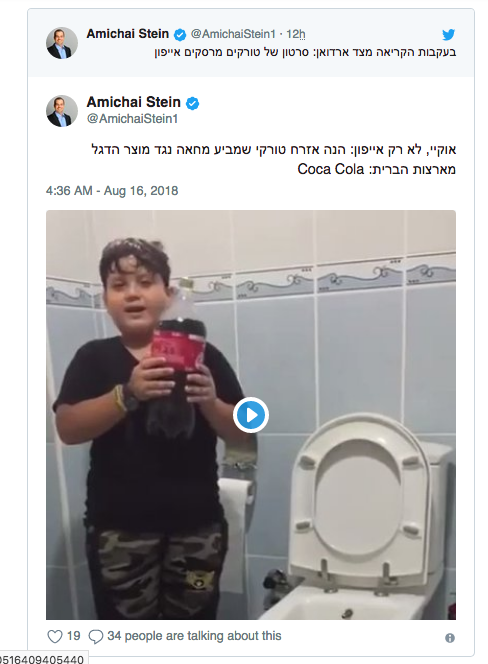
Other videos show a man shooting his iPhone point blank with a handgun, one being burned in a box full of matchsticks and another, circulated online by an Israeli journalist, of a Turkish boy dumping a bottle of Coca-Cola down the toilet — all in solidarity with Erdogan. Some Turkish news outlets have

As CBS News correspondent Holly Williams reported on Wednesday, angry Turks have also torn up fake dollar bills in protest. While many in the country believe the crisis is the fault of the U.S., even though experts have been warning of danger signs in the economy for months, Williams says some Turks do blame authoritarian President Erdogan for the crisis.

The lira has regained some of its value in the last 24 hours, following pledges from Arab nations to pour billions of dollars of funding into the Turkish economy.

CBS News’ Pinar Sevinclidir in Ankara and Ahmed Shawkat in Cairo contributed to this story.

Source: US Government Class

Uproar after judge OK’s freeing most New Mexico compound defendants

CBS News –

A judge’s decision to allow the release of an extended family accused of child abuse at a ramshackle desert compound in New Mexico prompted a political uproar Tuesday by prominent Republican lawmakers. The controversy was stoked even further when court officials condemned threats of violence made against the judge who issued the ruling and evacuated several administrative court offices as a precaution.

Administrative court officials say Backus was the target of threats via social media, email and telephone. One caller to the district court in Taos made a death threat, said Barry Massey, a spokesman for the Administrative Office off the Courts.

CBS Albuquerque affiliate KRQE-TV says court staff members told it they received more than 200 calls and emails Tuesday about the judge’s decision.

State District Court Judge Sarah Backus on Monday cleared the way for the release of four defendants, despite assertions by prosecutors that the group was training children to use firearms for an anti-government mission and should remain in jail pending trial.

The father of a severely disabled boy who was kidnapped in Georgia will not be released because an arrest warrant has been issued for him in that state.

Another defendant, Jany Leveille, was taken into custody by U.S. Citizenship and Immigration Services on Tuesday, Taos County Sheriff Jerry Hogrefe announced. The 35-year-old native of Haiti is the mother of six children taken into state custody during the compound raid.

Eleven children were taken into custody at the squalid compound near the Colorado border during an Aug. 3 raid by authorities who returned three days later and recovered the body of a small boy.

Backus, an elected Democrat, said her decision to grant release to house arrest, with conditions such as wearing ankle monitors, was tied to recent reforms of the state’s pre-trial detention system that set a high bar for incriminating evidence needed to hold suspects without bail.

Backus said Monday the state failed to provide evidence backing up key allegations in the case.

“The state alleges that there was a big plan afoot but the state hasn’t shown to my satisfaction and by clear and convincing evidence what that plan was,” Backus told the courtroom, noting that none of the defendants has a criminal record.

Initiated by a statewide vote in 2016, New Mexico’s bail reforms are modeled after similar changes made in New Jersey and under consideration in California that reduce the role of money as a means of ensuring court appearances or making release impossible for potentially dangerous suspects.

New Mexico Gov. Susana Martinez, a former district attorney, said Tuesday she “strongly disagreed” with the judge’s decision and renewed her criticism of rules for pre-trial detention that are determined in part by the state Supreme Court.

“You have a person who is training kids to shoot up schools, they have a compound that is like a third-world country,” State Republican Party Chairman Ryan Cangiolosi said. “There’s a child’s body on the compound – I believe that allowing them to be released is absurd.”

Medical examiners have yet to determine conclusively whether the body found at the compound outside Amalia was that of Abdul-ghani – the missing son of compound resident Siraj Ibn Wahhaj. Other relatives have said or told authorities that the remains are those of Abdul-ghani.

Prosecutors presented evidence that Siraj Ibn Wahhaj provided some of the children with firearms training, including tactical skills such as speed-loading guns and firing while in motion. Along with rifles, handguns and ammunition, authorities say they found books on being effective in combat and building untraceable assault-style rifles.

Backus, however, said prosecutors failed to articulate any specific threats or plan against the community.

She also pressed prosecutors for evidence to support allegations that the children were starving at the compound.

Agency Director Artie Pepin stressed that the judge’s responsibility is to make decisions based on evidence and “not popular sentiment that may develop from incomplete or misleading information.”

Suspect Siraj Ibn Wahhaj will remain in jail pending a warrant for his arrest in Georgia issued over accusations that he abducted his son, Abdul-ghani, from the boy’s mother in December and fled to New Mexico.

Three other defendants – Lucas Morton, Subhannah Wahhaj and Hujrah Wahhaj – had yet to be released on Tuesday.

Attorneys for those four defendants say volunteers have come forward to provide a suitable place for them to live as legal proceedings move forward.

Backus set bail at $20,000 with no up-front deposit – just a threat of a fine if defendants break condition of their release.

Court testimony Monday by an FBI agent shed light on the fate of the boy whose body was found.

Agent Travis Taylor said a 15-year-old resident of the compound described attempts to cast demonic spirits the child through a ritual that involved reading passages from the Quran while Siraj Ibn Wahhaj held a hand on the boy’s forehead,

The boy apparently died after one of the sessions, Taylor said.

Source: US Government Class

Police keep vastly outnumbered white nationalists separated from protesters

Washington Times – A small group of white nationalists and many more anti-racism protesters staged dueling rallies Sunday across from the White House, as a phalanx of police officers kept the two camps separated to prevent a repeat of the deadly violence that erupted last year at a white supremacist gathering in Charlottesville, Virginia.

D.C.-area police officers surrounded the 30 or so attendees of Sunday’s “Unite the Right 2” rally and escorted them at Metro stations, along Pennsylvania Avenue, and to and from Lafayette Square across from the White House. The white nationalists were vastly outnumbered by thousands of counterprotesters who filled the park.

“Show us your faces,” the counterprotesters chanted at the rally-goers, many of whom had concealed their faces behind bandannas or the American flag. “Go home!”

But the “Unite the Right 2” rally fizzled out as darkening clouds threatened rain. Scheduled to last until 7 p.m. Sunday, the white supremacist gathering broke up at about 5:15 p.m., and a cordon of police escorted the attendees from the square.

Amid the significant police presence, one counterprotester was arrested on charges of assaulting someone wearing a “Make America Great Again” hat, a police spokeswoman said.

However, someone, presumably police, released pepper spray among counterprotesters at 14th and G streets Northwest, a witness and two photojournalists told The Washington Times. A police spokeswoman said she did not have anything to report on the incident.

Source: US Government Class

Commerce chief scolds California over environmental policies he says hinder firefighters: ‘Lives are at stake’

FoxNews – The latest fight between the Trump administration and California’s liberal politicians has been over water.

The Trump administration believes the state’s stringent environmental protection policies are hampering efforts by firefighters to fight the largest fire in state history.

In a tweet sent Monday, President Trump said water that can be used for fires in California is “foolishly” being diverted into the Pacific Ocean.

“Think of California with plenty of Water – Nice! Fast Federal govt. approvals,” Trump tweeted.

On Wednesday, the federal government officially stepped in. Commerce Secretary Wilbur Ross ordered the National Marines Fisheries Service, which is under his jurisdiction, to take control of water use in California and override any efforts to protect endangered species.

“The protection of life and property takes precedence over any current agreements regarding the use of water in the areas of California affected by wildfires,” Ross said in a statement.

The directive asks the federal agency to “make clear” that water can be used as necessary to fight the fires, even if they impact endangered species.

The National Marine Fisheries Service works with the state to protect the delta smelt and Chinook salmon, two fish species under threat because of California’s drought, according to ABC News. The two agencies limit the amount the water taken from rivers to protect fish.

Several fires have consumed large swaths of California. One of them, the Mendocino Complex Fire, has become the largest in state history.

Water from ponds, lakes and reservoirs near the fires can be used to battle the blazes, whether it is scooped up by helicopter and dumped on the flames or drawn out by pumps and sprayed.

“American lives and property are at stake and swift action is needed,” Ross said.

But state fire officials say they don’t need more water to fight the fires raging across the state. Neither federal nor state officials said if direct action was being taken in response.

Mike Mohler, deputy director for the California Department of Forestry and Fire Protection, said he doesn’t know if the Trump administration had contacted any California state agencies before issuing Wednesday’s directive.

Critics blasted the directive and Trump’s statement blaming environmental policies on why the fires can’t be tamed.

“Despite the president’s tweet, there’s zero connection between the fires and the amount of water that is available to fight them,” Peter Gleick, founder of the Pacific Institute think tank, told the Washington Post. “And yet all of the sudden, now the federal agencies are starting to actually implement policies based on this completely false idea that will end up rolling back federal environmental protections. It’s weaponizing an ignorant tweet from the president.”

Gov. Jerry Brown has not commented.

Includes reporting by The Associated Press.

Source: US Government Class

New York City Votes to Cap Uber and Lyft Vehicles in a Crackdown

New York Times – New York became the first major American city on Wednesday to halt new vehicle licenses for ride-hail services, dealing a significant setback to Uber in its largest market in the United States.

The legislation passed overwhelmingly by the City Council will cap the growth of the services for a year while the city studies the booming industry. The bills also allow New York to set a minimum pay rate for drivers.

Uber has become one of Silicon Valley’s biggest success stories and changed the way people across the globe get around. But it has faced increased scrutiny from government regulators and struggled to overcome its image as a company determined to grow at all costs with little regard for its impact on cities.

New York’s move to restrict the number of ride-hail vehicles and to establish pay rules for drivers — another step no other major city has taken — could provide a model for other governments that want to rein in the industry. New York’s aggressive stance also raises questions over how fast Uber can continue to grow as the company, which has been valued at $62 billion, plans to move toward an initial public offering next year.

The proposal to cap ride-hail companies led to a clash among interest groups with taxi industry officials saying the companies were dooming their business and Uber mounting a major advertising campaign to make the case that yellow cabs have a history of discriminating against people of color.

Mayor Bill de Blasio and Corey Johnson, the City Council speaker, said the bills will curtail the worsening traffic on the streets and improve low driver wages.

“We are pausing the issuance of new licenses in an industry that has been allowed to proliferate without any appropriate check or regulation,” Mr. Johnson said before the vote, adding that the rules would not diminish existing service for New Yorkers who rely on ride-hail apps.

Mr. de Blasio praised the bills and said he planned to sign them into law. The cap on new for-hire vehicles would take effect immediately.

“More than 100,000 workers and their families will see an immediate benefit from this legislation,” Mr. de Blasio said, referring to the city’s army of for-hire drivers. “And this action will stop the influx of cars contributing to the congestion grinding our streets to a halt.”

But Uber has warned its riders that the cap could produce higher prices and longer wait times for passengers if the company cannot keep up with the growing demand. Ride-hail apps have become a crucial backup option for New Yorkers swept up in the constant delays on the city’s sputtering subway, as happened on Wednesday when signal problems again snarled train lines across a large swath of the city. Ride-hail services have also grown in neighborhoods outside Manhattan where the subway does not reach.

The battle over Uber’s future in New York has been prompted in part by growing concerns over financial turmoil among drivers — a problem underscored by six driver suicides in recent months. On Wednesday, a large group of drivers rallied outside City Hall before the vote and held signs displaying the names of the drivers who took their lives.

New York is the latest city to grapple with questions over how to regulate the company. In London, Uber’s most lucrative European market, Uber recently regained its taxi license after the company agreed to stricter regulations, including providing the city with the trove of traffic data that the firm collects and has often been reluctant to share. Uber has also faced regulatory battles in American cities, like Austin, Tex., and in countries like Canada, Brazil and Italy.

In Seattle, the City Council approved a bill allowing Uber drivers to form unions, but the measure has faced a legal challenge. Uber left Austin in 2016 after the City Council passed a measure requiring the company to perform fingerprint background checks, though Uber later returned to the city. The mayor of Honolulu recently vetoed a bill to cap price increases by Uber during busy periods.

[Read more about the potential impact of the Uber cap.]

The company’s new chief executive, Dara Khosrowshahi, has embarked on a global charm offensive to repair the company’s image after a series of controversies, including complaints among workers over gender discrimination and harassment.

Uber criticized the Council’s decision to approve the cap, but said the company would work to keep up with the increasing appeal of its service despite the limit on new vehicles.

“The City’s 12-month pause on new vehicle licenses will threaten one of the few reliable transportation options while doing nothing to fix the subways or ease congestion,” Josh Gold, a spokesman for Uber, said in a statement.

Anand Sanwal, chief executive of CB Insights, a software company that examines technology trends, said the cap could impact Uber’s public offering if it reduces revenues and emboldens other cities to take similar action.

“If it changes their growth trajectory, that could have an impact on their valuation and the narrative around the company,” Mr. Sanwal said.

Uber said the company would immediately reach out to tens of thousands of for-hire vehicle owners who are already licensed but work for other local car services and try to recruit them to work for Uber. The company said it would also continue to press for another solution, known as congestion pricing — a proposal to toll drivers entering Manhattan’s busiest neighborhoods and that would require approval from state lawmakers.

Many experts believe congestion pricing is the best way for New York City to fix congestion and secure the funds needed to fix the subway. Mr. Johnson supports the idea, but Mr. de Blasio has opposed it. Gov. Andrew M. Cuomo, who controls the subway, has said he will push for congestion pricing during the next state legislative session to help pay for an ambitious, multibillion dollar overhaul plan for the subway.

The City Council approved the cap in a 39-to-6 vote. Councilman Eric Ulrich, a Republican from Queens, said he opposed the cap, arguing that limiting Uber to help yellow taxis was similar to regulating Netflix, the streaming service, to help Blockbuster, the video rental chain.

The legislation allows for the city’s taxi commission to add more licenses if there is a clear need for more vehicles in some neighborhoods. In New York, many Uber drivers work full time and the city regulates Uber vehicles as part of the for-hire vehicle industry, which is different than other cities.

The City Council also moved recently to regulate Airbnb, another tech company that has upended the hotel industry. Mr. Johnson, a Democrat who became City Council speaker in January, has quickly taken bold steps to make a name for himself on high-profile issues, including convincing the mayor to pay for half-price MetroCards for poor New Yorkers.

Many taxi and Uber drivers say they support the cap proposal. They hope it will halt the flood of new vehicles clogging city streets and allow them to make more trips and improve their earnings. Uber and other ride-hail services could add new vehicles only if they are wheelchair accessible.

Lyft, the second most popular app in New York, also criticized the vote: “These sweeping cuts to transportation will bring New Yorkers back to an era of struggling to get a ride, particularly for communities of color and in the outer boroughs,” Joseph Okpaku, a vice president at Lyft, said in a statement.

The vote was a moment of vindication for Mr. de Blasio, a Democrat, who lost a bruising battle with Uber over a proposal for a cap in 2015. Since then, the number of for-hire vehicles in the city has surged to more than 100,000 vehicles, from about 63,000 in 2015, according to the city.

The taxi industry has also been decimated by Uber’s rise. The price of a taxi medallion, which is required to operate a taxi in New York, has plunged from more than $1 million to less than $200,000.

Elizabeth Cassarino, a yellow taxi driver, said she supports the cap and hopes it will improve business for taxis. As she drove a taxi through the clogged streets of Manhattan on Wednesday, she said her credit cards were maxed out and she had trouble making enough money to pay for food.

“Finally,” she said. “We’re starving to death.”

Source: US Government Class

U.S. to impose new sanctions on Russia over nerve agent attack

CBS News – The Trump administration will impose new sanctions on Russia, alleging that President Vladimir Putin and the Russian government used a chemical weapon to poison former Russian spy Sergei Skripal in an assassination attempt in Great Britain, the State Department said Wednesday. Congress has been notified, and the sanctions will go into effect on Aug. 22.

The sanctions aim to deny Russian state-owned and state-funded enterprises access to any national-security-sensitive goods and technologies originating in the U.S.

The U.S. will also ban Russia from receiving U.S. weapons or military technology and financial assistance. State Department officials told reporters on a call that the economic impact of the sanctions would be in the range of “hundreds of millions of dollars” and would target electronic devices and engines, for example.

There could also be a second round of sanctions that would be “more draconian” than the first round, the officials said. Russia would be subjected to new sanctions unless it agreed not to use chemical or biological weapons against its own citizens,

The State Department said that it had notified the Kremlin ahead of the public announcement and that it had had a “good deal of diplomatic engagement” with allies beforehand.

Earlier Wednesday, State Department spokesperson Heather Nauert released a statement explaining the sanctions.

“Following the use of a ‘Novichok’ nerve agent in an attempt to assassinate U.K. citizen Sergei Skripal and his daughter Yulia Skripal, the United States, on August 6, 2018, determined under the Chemical and Biological Weapons Control and Warfare Elimination Act of 1991 (CBW Act) that the Government of the Russian Federation has used chemical or biological weapons in violation of international law or has used lethal chemical or biological weapons against its own nationals,” Nauert said Wednesday. “Following a 15-day Congressional notification period, these sanctions will take effect upon publication of a notice in the Federal Register, expected on or around August 22, 2018.”

Skripal and his daughter were poisoned at their home in Salisbury, England, in March. Skripal was a former Russian spy who worked as a double agent for British intelligence. He was imprisoned in Russia, but was exchanged with Britain in a 2010 spy swap. The United Kingdom blamed Russia for the attack, resulting in the expulsion of 150 Russian diplomats from the U.K., U.S. and other allies.

Two other British citizens fell ill due to Novichok exposure in late June in a town close to Salisbury. One of them, Dawn Sturgess, died eight days later. Investigators believe she found the substance in a discarded bottle and thought it was perfume.

President Trump met with Putin at a summit in Helsinki, Finland, in July. The summit was widely criticized by Democrats and Republicans alike, fearing that Mr. Trump was too conciliatory to Putin.

Kylie Atwood contributed to this report.

Source: US Government Class

In one weekend in Chicago, 66 people were shot, including 12 who died, police say

CNN) – Chicago police announced at a Monday morning news conference that 66 people were shot, 12 of them fatally, between Friday at 6 p.m. and Sunday at 11:59 p.m.
Chicago Police Superintendent Eddie T. Johnson said it was “no secret that we had an unacceptably violent weekend,” at the news conference.

In three hours beginning at 1:30 a.m. Sunday, records show, 30 people were shot and two killed in 10 incidents. In all, over the weekend, there were 33 shooting incidents. Fourteen juveniles were shot, and an 11- and 13-year-old were killed.

“The city of Chicago experienced a violent night,” Bureau of Patrol Chief Fred Waller said Sunday afternoon. “Some of these instances were targeted and were related to gang conflicts in those areas.”

In at least one incident, shooters opened fire into a crowded street party, Waller said.

Johnson said the issue stemmed from a small group of people such as repeat gun offenders.

“This isn’t a widespread issue among citizens of this city. This is a small subset of individuals who think they can play by their own rules because they continue to get a slap on the wrist when we arrest them,” Johnson said.

“I’m tired of it. Everybody in this city should be tired of it.”

Johnson said 46 people were arrested this weekend on gun charges, and 60 guns were seized as a result of ongoing investigations. However, he said there have been no arrests made in connection with any violence from this weekend.

Experts say crime tends to pick up during the hot summer months, but Chicago Mayor Rahm Emanuel dismissed that.

“You can talk about the weather, but the weather didn’t pull the trigger,” he said.

“You can talk about jobs, and they count, but in parts of the city where there aren’t jobs, people did not pull the trigger.

“There are values. There are too many guns on the street, too many people with criminal records on the street, and there is a shortage of values about what is right and what is wrong,” he added.

Of the wounded who reported an age, the oldest was 62 and the youngest 11, police records show.

Before the particularly violent Sunday, there were six shootings, none fatal, on Friday, and 15 shootings, one fatal, on Saturday. The Sunday shootings occurred between midnight and 2 p.m., records show.

Chicago has struggled with high shooting and murder rates in recent years. Waller said shootings are down 30% from 2017, and murders are down 25%.
June marked 15 straight months of fewer killings and shootings, police said.

However, on June 25, at least 21 were shot and two died.

Johnson said that both murders and shootings are down on the year, but said this weekend showed there was still a lot to do.

“Despite what we saw this weekend, I’m still pleased between CPD’s work, the mayor’s investments, and the work of our community members, that we’re still reducing our gun violence this year,” Johnson said. “But we still have a lot more work to do, and I think that was evidenced by this weekend.”
CNN’s Marlena Baldacci contributed to this report.

Source: US Government Class

As midterm elections approach, a growing concern that the nation is not protected from Russian interference

Washington Post – Two years after Russia interfered in the American presidential campaign, the nation has done little to protect itself against a renewed effort to influence voters in the coming congressional midterm elections, according to lawmakers and independent analysts.

They say that voting systems are more secure against hackers, thanks to action at the federal and state levels — and that the Russians have not targeted those systems to the degree they did in 2016. But Russian efforts to manipulate U.S. voters through misleading social media postings are likely to have grown more sophisticated and harder to detect, and there is not a sufficiently strong government strategy to combat information warfare against the United States, outside experts said.

Despite Facebook’s revelation this week that it had closed down 32 phony pages and profiles that were part of a coordinated campaign, technology companies in general have struggled to curb the flow of disinformation and hacking and have received little guidance from the U.S. government on how to do so.

“Twenty-one months after the 2016 election, and only three months before the 2018 elections, Russian-backed operatives continue to infiltrate and manipulate social media to hijack the national conversation and set Americans against each other,” Sen. Mark R. Warner (D-Va.) said Wednesday at a hearing of Senate Intelligence Committee, of which he is vice chairman. “They were doing it in 2016; they are still doing it today.”

Experts say the lack of forceful administration leadership on the issue — with President Trump at times questioning the conclusions of the U.S. intelligence community about Russia’s disinformation and hacking campaign — renders less effective the efforts of agencies to mount a coordinated government action.

“If you can’t talk about Russia around the president, I don’t see how you get out in front of this, given that they’re the ones doing most of the foreign influence,” said Clint Watts, a former FBI agent and disinformation expert for the Foreign Policy Research Institute.

Administration officials dispute such criticism. The U.S. intelligence community for months has been meeting on the issue, including with National Security Council staff members, they said. But complicating their efforts, they argue, is the fact that the battleground is in the private sector — an area that is traditionally off-limits to intelligence agencies.

“National Security Council staff leads the regular and continuous coordination of the whole-of-government approach to addressing foreign malign influence and ensuring election security,” National Security Council spokesman Garrett Marquis said in a statement. “The President has made it clear that his Administration will not tolerate foreign interference in our electoral process from any nation state or other malicious actors.”

With the midterm elections looming, U.S. officials say the overall Russian effort is serious and has many elements that resemble what happened in 2016. These include efforts to hack into the emails of politicians and creating fake social media account to exploit racial, social, cultural and religious divisions in society.

“This issue goes far beyond elections,” Sen. Richard Burr (R-N.C.), chairman of the Senate Intelligence Committee, said at the hearing Wednesday. “We’re fighting for the integrity of our society. And we need to enlist every single person.”

The Obama and Trump administrations imposed sanctions on Russians in an effort to deter ­future influence campaigns and cyberattacks, but those actions appear to have had little effect.

U.S. officials have expressed the most worry about foreign disinformation, a point echoed by analysts who warned the Senate Intelligence Committee on Wednesday about Russia’s determination to again seek to influence American voters through social media.

Facebook has announced plans to increase transparency and beef up its security and content-review teams. Twitter is suspending suspicious accounts more than twice as quickly as before, at a rate of roughly 1 million a day.

Yet several experts said the technology companies need to do more.

“We’re in the midst of an arms race in which responsibility for the integrity of public discourse is largely in the hands of private social platforms, and determined adversaries continually find new ways to manipulate features and circumvent security measures,” Renée DiResta, director of research at New Knowledge and an expert on social media manipulation campaigns, said during the Senate hearing.

John W. Kelly, chief executive of Graphika, a marketing analytics firm based in New York, said ongoing Russian attacks exploit the highly partisan nature of political debate online, in which automated accounts called bots amplify messages on Twitter and other platforms. Bots on the far left and right of the political spectrum produce 25 to 30 times more messages per day than authentic mainstream accounts, Kelly said Graphika has found in its research.

“The extremes are screaming while the majority whispers,” Kelly said at the Senate hearing.

Russia has been particularly skilled at exploiting the seams among U.S. authorities, laws and values. Responding to the Russian disinformation campaign does not fall squarely in the province of any single U.S. agency, and they generally do not have visibility into the information that flows across social media platforms.

American respect for the free exchange of ideas, as enshrined in the First Amendment, has made it easier for outsiders to infiltrate national political conversations, especially in the online world, where it is simple to obscure identities and locations.

Russian operatives who paid for Facebook ads in 2016 using rubles, for example, have become more careful about leaving such telltale clues for investigators, experts say. Several major social media platforms allow users to operate under pseudonyms, making it harder for others to detect manipulations — especially from sophisticated foreign government operatives.

“What the Russians are doing is called information war. What the Americans are doing is called free speech. And you can’t square those circles very well,” said Steven Livingston, a professor of media and public affairs at George Washington University who did not testify at the hearing.

Facebook on Monday disclosed that it had closed 32 accounts and pages — possibly from Russia’s Internet Research Agency — used in a sophisticated campaign to spread divisive messaging ahead of the midterm elections. And several candidates running in the November elections have been targeted by the Russian military intelligence agency, the GRU. Sen. Claire McCaskill (Mo.), one of the most vulnerable Democrats seeking reelection, said she was among those targeted.

 Senior Trump administration officials have sought this week to signal a more aggressive response to Russian interference. On Tuesday, at a cybersecurity conference in New York, Vice President Pence and Homeland Security Secretary Kirstjen Nielsen in separate speeches warned Russia not to try again this year.

“The United States will not tolerate any foreign interference in our elections from any nation-state — not from Russia, China, Iran, North Korea or anyone else,” Pence said.

Nielsen said: “Let me be clear. Our intelligence community had it right. It was the Russians. They know that. We know that. And we cannot let it happen again.”

The president has not issued similarly tough admonitions. In a news conference in Helsinki at which he stood next to Russian President Vladimir Putin, Trump seemed to question the U.S. intelligence community’s assessment that Russia had interfered in the 2016 election. In subsequent remarks, he both said he agreed with the assessment and again cast doubt on it.

 Experts said that to deter Russia, the U.S. government message must be explicit and unwavering.

“It’s incredibly important, number one, that on the credibility front, we have very clear, consistent messages from across the government, starting with our leadership and all the way down . . . including the White House — that this behavior will not be tolerated and that there will be conse­quences for it going forward, and articulating what those consequences will be,” Laura Rosenberger, director of the Alliance for Securing Democracy at the German Marshall Fund of the United States, said at the Senate hearing.

On Friday, Trump convened a National Security Council meeting on Russian electoral interference. The session, which lasted less than an hour, resulted in no new directives from the president. Rather, Cabinet heads briefed Trump on their efforts to date to tackle the problem of election security and foreign influence.

Despite the president’s apparent lack of public urgency about confronting the Russian threat, agency heads are said to be doing what they can within their authorities.

The Department of Homeland Security has formed an election security task force and a foreign influence task force. The election security body is helping state and local election boards shore up their infrastructure, test their systems and coordinate information-sharing between the states and the federal government.

The FBI last fall created a foreign influence task force, which works closely with DHS, and it has sought to be more helpful to the social media firms. The FBI was criticized by Silicon Valley for failing to share threat information with the companies in the run-up to the 2016 election. In an effort to change that dynamic, Facebook in May convened a meeting with the major tech companies as well as the members of the FBI and DHS foreign influence task forces. The meeting helped to open lines of communication, some participants said.

Separately, National Security Agency Director Paul Nakasone has created a Russia task force of personnel from the NSA and the military’s U.S. Cyber Command to collaborate in detecting and countering potential Russian interference in the midterm elections.

The Justice Department last month also announced a policy to alert the public to foreign hacking and disinformation operations targeting U.S. democracy, such as the effort Russia undertook in 2016.

Tony Romm and Eddy Palanzo contributed to this report.

Source: US Government Class