apgov

Democrats have themselves to blame for Trump’s judicial juggernaut

Washington Post – OPINION – If only diamonds are forever, federal judges are the next-best thing. They form the nuclear isotope of a presidency, radiating energy long after their patrons have left the White House. Article III of the Constitution establishes the judiciary as an independent branch of the government, but who wields judicial power is dependent on who occupies the Oval Office.

Jimmy Carter’s incumbency ended in January 1981, before the world heard the name Indiana Jones and before Olivia Newton-John sang “Let’s get physical.” Yet Carter’s imprimatur endures in Ruth Bader Ginsburg and Stephen G. Breyer , whom he nominated to circuit courts of appeals from which they were promoted to the U.S. Supreme Court.

Or consider Ronald Reagan. Some 14 years after Reagan’s death in 2004, nine of his appeals court judges and 13 district court judges are still active today. Dozens of Reagan appointees continue to decide cases and issue opinions on senior status.

So while most of the media’s attention darts and swats at the president’s Twitter feed like a cat chasing a laser pointer, let’s spend a moment on one aspect of the Trump administration that is built to last. When it comes to nominating judges, the Trump White House purrs like a well-oiled machine.

As of Monday, when the White House announced its “seventeenth wave of judicial nominations” — picture Marines storming a beach — President Trump has nominated two Supreme Court justices, 36 court of appeals judges and 99 district judges.

That’s 137 judges in roughly 19 months on the job. If he maintains this pace, Trump could replace more than 30 percent of all active judges by the end of his first term.

Long after the timer dings on Michael Avenatti’s 15 minutes of fame — indeed, long after Trump hangs up his hairbrush and downs his last cheeseburger — Trump judges will still be influencing American lives.

Credit (or blame, depending on your point of view) for this enduring achievement belongs in several accounts. The most important is Trump’s. Beset by rats and flippers, he knows that the conservative base of the Republican Party will remain loyal as long as he’s busy stocking the courts with their brand of judges. Infighting and backstabbing are tolerated — even encouraged — in some parts of Trump’s operation, but he brooks none in the judge-making factory.

White House Counsel Donald McGahn, a libertarian with his own rock band, works in tandem with Leonard Leo of the conservative Federalist Society to keep a steady stream of bright, right-wing prospects rolling along the assembly line. Their results haven’t been perfect: One nominee to a U.S. District judgeship wilted when asked basic questions about conducting a trial. But they have been skillful enough to leave Democrats few openings to knock nominees from the conveyor belt.

Criticized for failing to nominate enough women, McGahn and Leo ordered up two from the factory this week. Allison Jones Rushing, of the Washington superfirm Williams & Connolly, was tapped for the U.S. Court of Appeals for the 4th Circuit. Her résumé includes clerkships with not one, not two, but three pillars of the conservative judiciary: Justice Clarence Thomas, Judge David Sentelle of the D.C. appeals court and Justice Neil M. Gorsuch (when he was serving on the U.S. Court of Appeals for the 10th Circuit ).

Bridget Shelton Bade’s destination is the powerful U.S. Court of Appeals for the 9th Circuit , whose jurisdiction includes California. A former U.S. prosecutor, Bade has only one clerkship on her résumé, but it is a doozy in terms of certifying conservative bona fides: Her boss was Judge Edith H. Jones of the 5th Circuit, an icon of the right.

Even so, as President Barack Obama learned during his last years in office, nominating judges is futile if the Senate won’t confirm them. Majority Leader Mitch McConnell and Judiciary Committee Chairman Charles E. Grassley have a machine of their own humming on Capitol Hill. As of this writing, 53 Trump judges have been confirmed, and 43 more have cleared Grassley’s committee. According to CNBC, Leo told a group of conservative donors this summer that he expects more than a quarter of all federal appeals court judges will be Trump picks by year’s end.

McConnell’s ability to leverage a mere one-vote margin to such effect suggests another factor in Trump’s judge-making prowess. In 2013, then-Majority Leader Harry M. Reid rallied his Democrats to eliminate the filibuster for most confirmations. A prescient McConnell warned Reid’s caucus at the time: “You’ll regret this. And you may regret it a lot sooner than you think.”

The time has arrived. Having undone the Senate’s traditional role as a moderating brake on presidential agendas, Democrats are now powerless to slow Trump’s judicial juggernaut. This is what happens when short-term thinking is applied to long-term institutions — an approach that is, sad to say, epidemic in today’s Washington.

Source: US Government Class

Arizona Governor Faces a Tough Choice: A Senator Made From McCain’s Mold or Trump’s

Senator John McCain’s death this weekend laid bare the long-simmering Republican tensions over who will be appointed to fill his Arizona seat, pitting the pragmatic wing of the party that Mr. McCain represented against the ascendant, hard-line forces loyal to President Trump — and hostile to the late senator.

On Sunday, a day after the senator and former prisoner of war succumbed to brain cancer, Gov. Doug Ducey of Arizona issued a statement through an aide indicating he will not appoint a successor to Mr. McCain until after what is expected to be nearly a weeklong series of services in his honor — in Arizona, Washington and Annapolis, Md.

“Out of respect for the life and legacy of Senator John McCain and his family, Governor Ducey will not be making any announcements about an appointment until after the senator is laid to rest,” said Daniel Ruiz II, an adviser to Mr. Ducey.

With Republicans clinging to a 50-49 Senate majority, hearings on the Supreme Court nominee Brett M. Kavanaugh looming and Mr. Trump under intensifying legal scrutiny, Gov. Ducey’s choice carries enormous implications in Washington.

And it is coming at a moment, in Arizona and beyond, when the Republican Party has rallied to the sort of nationalist and at-times nativist politics that Mr. Trump embodies and Mr. McCain scorned.

The governor’s appointee will represent the state through most of 2020, when there will be a special election to fill the rest of Mr. McCain’s term, and Republicans close to Mr. Ducey indicated he is likely to pick a replacement who intends to run again rather than a caretaker to temporarily fill the seat. Among the names under consideration, according to Arizona Republicans, are Mr. McCain’s widow, Cindy; a former Arizona senator, Jon Kyl; and two former Arizona House members, John Shadegg and Matt Salmon.

Other possibilities include Kirk Adams, Mr. Ducey’s top aide and a former state legislator; the state treasurer, Eileen Klein; a member of the state Board of Regents, Karrin Taylor Robson; and Barbara Barrett, a business executive and former United States ambassador to Finland.

But even as the governor sought to put off the inevitable debate over who should take the place of one of Arizona’s and America’s most towering political figures, and fill a seat that Barry Goldwater held before Mr. McCain succeeded him, the ferocious debate over Mr. Trump that has consumed the Republican Party for over three years quickly rose to the fore.

Mr. McCain’s admirers made clear their wishes that Mr. Ducey tap somebody as independent and willing to criticize the president as the departed senator, whose last high-profile moment in public life was to excoriate Mr. Trump’s July meeting with President Vladimir V. Putin of Russia as “one of the most disgraceful performances by an American president.”

“I like senators whose minds weren’t captured,” said Senator Jeff Flake, the state’s other senator, repurposing Mr. Trump’s caustic attack on Mr. McCain’s Vietnam service and appealing to his party to “get away from this personality cult.”

Some of Arizona’s pro-Trump conservatives say that Mr. Ducey’s top priority should be to appoint somebody who is unwaveringly loyal to the president.

“I think it should be a conservative, someone that supports President Trump — I think that should be the main issue,” said Joe Arpaio, the former county sheriff whom Mr. Trump pardoned last year and who is currently running for the seat now held by Mr. Flake, who is not seeking re-election. “I want somebody in there who will protect the back of our president and somebody that will not pursue impeachment if there is impeachment.”

Arizona’s primaries are Tuesday, and the race to replace Mr. Flake there has evolved into a contest over who can claim the mantle of the president — not that of the iconic war hero who got remarried to an Arizonan, settled in the state and frequently defied his own party over 35 years in Congress.

The Republican establishment’s favorite, Representative Martha McSally, has linked herself to the president as she tries to fend off far-right challenges from Mr. Arpaio and Kelli Ward, a onetime state senator who won nearly 40 percent of the vote in a 2016 primary against Mr. McCain. To do that, Ms. McSally has avoided any connection to Mr. McCain, a gambit that has infuriated the late senator’s family. (For her part, Ms. Ward suggested in a Friday Facebook post that the McCain family had timed their announcement about the senator stopping his treatment to undermine her campaign.)

A business-aligned conservative who was once an executive at the ice cream company Cold Stone Creamery, Mr. Ducey has jokingly said he’s “a former ice cream salesman.” He has sought to bridge the divide between the devotees of Mr. Trump who dominate Republican primaries in the state and a broader electorate more favorably inclined to Mr. McCain’s center-right politics. The governor faces a nominal primary challenge from the right on Tuesday, but is peering ahead to a far more competitive general election in November, in part because an acrimonious dispute earlier in the year with striking teachers dented his approval ratings.

Since Mr. McCain’s diagnosis last year, Mr. Ducey has handled questions about succession with the utmost caution, chiding those Republicans who talked openly about the matter while the senator was still alive.

But Arizona Republicans familiar with the governor’s thinking suggest he would like to appoint an individual who, in addition to running again in 2020, would be acceptable both to the conservative grass roots of the party he will need in November, and to Mr. McCain’s friends and family.

That search for a safe consensus pick has already left Mr. McCain’s allies deflated.

“Like with everything else in politics, these days we’ll end up with mediocrity,” said Grant Woods, Mr. McCain’s first congressional chief of staff and a former Arizona attorney general.

The McCains did not offer any guidance, let alone make suggestions about a successor, to Mr. Ducey in the days leading up to the senator’s death. If he had died earlier in the year, Ms. McSally would have been a leading choice, but selecting her now, immediately after she is expected to claim the nomination for Mr. Flake’s seat, would effectively hand that seat to the Democrats, and their expected candidate, Representative Kyrsten Sinema.

Arizona Republicans are skeptical Mr. Ducey would pick Mr. McCain’s widow, in part because of questions about whether she would want to seek the nomination in 2020, but also because it could anger the pro-Trump voters that the governor will need to win in November. To those voters, Ms. McCain would almost certainly be viewed as too politically moderate.

Source: US Government Class

John Stossel: Will social media put freedom of speech in jeopardy?

FoxNews – Are those who question the severity of global warming worse than Nazis? I wouldn’t think so, but YouTube, owned by Google, seems to.

I wrote last week that YouTube added a Wikipedia link about global warming to videos like ones I do about climate change.

Extra information sounds helpful. But when social media platforms only pick certain politically disfavored positions to add Wiki links to, they skew debate. Worse, Wikipedia’s global warming page has been captured by alarmist editors. It’s very one-sided.

On CNN last week, Twitter CEO Jack Dorsey said, “I think we need to constantly show that we are not adding our own bias, which I fully admit is left, is more left-leaning.”

Watch the latest video at foxnews.com
At least Dorsey admits that. Usually, powerful social media platforms push their political agendas while pretending not to have any.

Roy Spencer, author of “Climate Confusion,” points out that when he does a Google search for “climate skepticism,” the first 10 pages aren’t links to skepticism. Instead, they’re links to articles criticizing climate change skepticism.

By contrast, he points out, a search for “Nazi Party” yields mostly straightforward commentary about what Nazis believed.

Climate change skepticism is more in need of “correction” than Nazism?

(Spencer’s and my skepticism doesn’t mean we doubt global warming. The globe is warming. Climate changes! We just don’t think it’s been proven that humans are the main cause or that fossil fuel bans and the billions of dollars spent on things like solar subsidies will do any good.)

YouTube also continues its purge of political commentators it considers too far right. After taking down Alex Jones and his Infowars channel, YouTube expanded its ban to an old personal channel of Jones’ associates Owen Shroyer and Roger Stone.

Meanwhile, Facebook, now the world’s most powerful publisher, removes some political articles — not just so-called fake news created by malicious foreign actors or robots, but also ones by professional journalists.

Salena Zito posted a New York Post column about Trump supporters sticking with Trump. Facebook removed it. It reappeared only after she complained on Twitter and “went through the confusing messaging options” on Facebook’s page to ask why her article was removed.

She never got an explanation. “No one told me why it was taken down,” she writes. “Perhaps someone doesn’t like my stories and complained… (W)ho is that person and why does Facebook give them that sort of power?”

Good luck trying to get social media platforms to explain why they ban you.

Maybe the “content moderators” at tech companies want to narrow your choices to information from the political center and left — where most tech company workers live.

The tech giants gathered in secret last week to confer about how to “counter” political misinformation during the coming election season. They say they want to prevent disruption and interference by outside forces like the Russians. Good.

But I get nervous when I think about how broadly some liberals define “disruption.”

The purpose of the First Amendment is to let all of us say critical things about the politically powerful, even radical things.

I worry that tech companies, to avoid admitting they’re motivated by political bias, will do what many political activists have done: keep expanding the definition of “hate speech” until almost anyone can be accused of it.

A NASCAR driver just lost a sponsorship (although, of course, a sponsor has a right to decide whom to fund) because his father, during a radio interview, admitted to using a racial slur back in the 1980s, before the NASCAR driver was even born.

Now that Google can search everything you’ve said, YouTube may flag it as misinformation. Facebook can track what all your relatives and friends have said, too. Activists stand ready to get angry about all of it.

At this rate, future speech will be muted. Especially libertarian and conservative speech.

Source: US Government Class

US and Mexico reach a preliminary trade deal

(CNN) – The United States and Mexico have reached a preliminary agreement resolving key bilateral trade issues.

President Donald Trump made the announcement from the Oval Office.
Negotiations between the United States and Mexico resolved a major stumbling block on auto manufacturing, an official familiar with the negotiations said.
Under the current law, about 62% of the parts in any car sold in North America must be produced in the region or automakers have to pay import taxes. The new preliminary agreement would increase that requirement.
The agreement between the two countries could restart negotiations on NAFTA with all three parties — the United States, Mexico and Canada.
“Canada is encouraged by the continued optimism shown by our negotiating partners,” said a spokesperson for Canadian Minister of Foreign Affairs Chrystia Freeland.
“Progress between Mexico and the United States is a necessary requirement for any renewed NAFTA agreement,” he said.
Negotiations on rewriting the three-country NAFTA agreement began about a year ago.
The 24-year-old trade agreement generally prevents the three parties from imposing tariffs on imports from one another. But Trump has called the agreement “the worst deal maybe ever signed” and moved ahead with tariffs earlier this year.
In May, the United States imposed steep tariffs on steel and aluminum from much of the world, including Mexico. In response, Mexico slapped tariffs on $3 billion of US goods, including steel, pork, apples, potatoes, bourbon and different types of cheese. Canada imposed tariffs on $12.5 billion of US goods, including steel, toffee, maple syrup, coffee beans and strawberry jam.

Source: US Government Class

Supreme Court decisions could curb campus censorship

FoxNews – Recent First Amendment rulings by the Supreme Court could force courts and university administrators to take a closer look at controversial practices that have marginalized certain political views – often conservative ones – on campus.

Free speech on campus has emerged as a hot debate in recent years, amid a rash of speakers being disinvited or violently protested. These issues are often handled in-house – but now, the courts could hold sway.

“We should expect college campuses to truly be marketplaces of ideas where students learn to value free speech and open inquiry and take that lesson with them as they become the next generation of judges, legislators, teachers and voters,” Casey Mattox, senior fellow for free speech and toleration at the libertarian Charles Koch Institute, told Fox News.

One key ruling could be in Janus v. American Federation of State, County, and Municipal Employees, which struck a direct blow to public-employee unions by holding government workers don’t have to pay certain fees to labor groups.

But it included a free-speech component that could have a ripple effect on campus.
Watch the latest video at foxnews.com

Most public universities require students to pay student activity fees, which in some cases support lopsided politics, according to a report by the Foundation for Individual Rights in Education (FIRE), a campus free speech legal group.

The Supreme Court had rejected a 2000 challenge to such fees, determining a school could require students to pay for the expression of views with which they disagree, as long as the university doesn’t engage in viewpoint discrimination when allocating funds. However, the Janus decision more broadly prevents forcing one person to pay for someone else’s political expression.

Mattox argued schools may have to then take a close look at whether their student fees are used in a partisan way. Ironically, cracking down on these fees could free up student groups to bring more speakers onto campus – in turn, representing a more diverse set of views.

“Currently, many universities limit student group fundraising and prohibit dues – essentially requiring groups to be funded from these mandatory fees,” said Mattox, also the former senior counsel for academic freedom at the Alliance Defending Freedom, a religious liberty group. “If student groups could raise their own funds for speakers and have members pay dues, they could fund their own speakers even without mandatory dues.”

Public universities have long made news for blocking speakers, mostly from the right, such as Ben Shapiro, Dennis Prager and Ann Coulter — but also some on the left including Bill Maher and William Ayers. FIRE, the legal group, even assembled a “Disinvitation Database” of blocked speakers.

Similar to Janus, other recent cases don’t directly speak to campus free speech, but could establish new precedents, Mattox said.

The Supreme Court, in Minnesota Voters Alliance v. Mansky, struck down a Minnesota law that prevented anyone in close proximity of a polling place from wearing certain political-oriented clothing and apparel. The high court held the Minnesota law gave too much discretion to the interpretation of a polling worker or election judge. But, it said states can regulate expression near polling places if it is “guided by objective, workable standards.”This could push public universities and colleges to set more finite guidelines to determine how student fees are spent to avoid viewpoint discrimination, Mattox said.

“The Mansky decision means that universities will need to guarantee they have systems in place to prevent discrimination against student groups seeking recognition, funding, or to reserve meeting space,” Mattox said.

The states of Missouri, Arizona, Virginia, Utah, Colorado and Tennessee, North Carolina and Wisconsin all passed free speech laws for college campuses, according to an American Association of University Professor report in April. Most of these laws prohibit limiting speech to free speech zones and bars viewpoint discrimination.

However, the AAUP opposes these laws and proposals.

“Even if the current political environment poses significant problems for free speech, the view that the free exchange of ideas no longer occurs on campuses is grossly exaggerated,” the AAUP’s April report concludes. “Many of the most difficult issues surrounding free speech at present are about balancing unobstructed dialogue with the need to make all constituencies on campus feel included.”

The Supreme Court, in National Institute of Family and Life Advocates (NIFLA) v. Becerra, also struck down a California law regulating professional speech by requiring pro-life pregnancy centers to provide information on abortion. Mattox anticipates this could impact how certain professional schools and university degree programs have used professional ethics codes as speech codes for students.

Fred Lucas is the White House correspondent for the Daily Signal.

Source: US Government Class

One of a kind: The remarkable life and times of Senator John McCain

CBS News – He was, truly, one of a kind. Chip Reid looks back on the remarkable life and times of Senator John McCain:

“I’ve been an imperfect servant of my country for many years. But I’ve been a servant first, last, and always.”

He was called a maverick. (“If you want the status quo in Washington, do not support John McCain,” he said while campaigning in 1999.) He was an American hero (“What the Vietnam experience did for me was crystallize the importance of doing what’s right.”) And, as a military man and statesman, by most any standard, Arizona Senator John McCain was a man of courage and ideals.

But last summer, McCain began another fight – a personal struggle he took public when he voted against the Republican health care bill. It was the latest example of John McCain voting his conscience even if it meant bucking his own party.

“I was raised in the concept and belief that duty, honor, country is the lodestar for the behavior that we have to exhibit every single day,” he said.

Born in 1936, John Sidney McCain III was the son and grandson of four-star Navy admirals. And the “maverick” in him came out early. “I was very rebellious,” he told “Sunday Morning” in 1999. “I was a person who didn’t conform to the rules and regulations of either high school or the Naval Academy.”

Nevertheless, he volunteered for combat duty during the Vietnam War. In October 1967, as a Navy pilot flying his 23rd bombing mission over North Vietnam, his plane was shot down. “It was hit by either missile or anti-aircraft fire, I’m not sure which. And the plane continued straight down, and I ejected, and broke my leg and both arms,” he said on camera from his prison cell.

Severely injured, McCain was captured and held at the so-called “Hanoi Hilton,” the infamous prison known for its brutality. After about a year, he was offered early release because of his family connections, but McCain refused to leave his fellow POWs behind..

He languished in captivity for a total of five-and-a-half-years. He withstood frequent beatings and torture, leaving his arms with permanent damage.

“In many ways it was the most uplifting experience in my life, because I was privileged to serve in the company of heroes,” he said.

In 1982, after he retired from the military, he took his fighting spirit to Washington, as a United States Congressman. He went on to be elected six times to the Senate, where he stood out for his “straight talk,” especially on subjects like campaign finance.

“If the special interests continue to play a greater and greater role in the formulation of legislation, then we will see a breakdown of democracy as we know it, and I’m not exaggerating!” McCain said.

But in the late 1980s, McCain himself, along with four other senators, was accused of exerting improper influence on regulators who were investigating allegations of savings and loan fraud against financier Charles Keating. McCain was never disciplined.

He ran for president twice – first in 2000, and then in 2008, when he won the Republican nomination to run against Democratic Senator Barack Obama. (“It is because I owe America more than she has ever owed me that I am a candidate for president of the United States,” he said.)

During that historic 2008 campaign, which at times was racially charged, McCain’s sense of right and wrong was on display. When a woman in the audience criticized Barack Obama and called him an Arab, McCain calmly corrected her, “No, Ma`am. He`s a decent family man, citizen, that I just happen to have disagreements with.”

Though he led the ticket, McCain’s campaign may be best remembered for his controversial choice of running mate: Alaska Governor Sarah Palin.

McCain was defeated, with Obama winning twice as many electoral college votes. During his concession speech, McCain asked his audience to refrain from booing when he said, “I had the honor of calling Senator Barack Obama to congratulate him on being elected the next president of the country that we both love.”

He returned to the Senate, where he led the Armed Services Committee.  But in 2015, he would find himself in the crosshairs of then-Republican presidential candidate Donald Trump, who said of the veteran, “He’s not a war hero. He is a war hero because he was captured; I like people that weren’t captured, I hate to tell you.”

A year later, McCain withdrew his endorsement of Trump after audio emerged of the candidate bragging about groping women.

The strain between the two Republicans continued after President Trump took office, when Senator McCain was blunt with his criticism. Speaking at the International Republican Institute in May 2017, McCain said, “I think we have seen this movie before. I think it`s reaching the point where it`s of Watergate-size and scale, and a couple of other scandals that you and I have seen. It`s the centipede that the shoe continues to drop.”

Last summer, when the senator’s health issues became public, the outpouring of respect and admiration overflowed the aisles.

McCain told “60 Minutes,” “I got very choked up. And then, of course, you know, all of them coming over and giving me a hug. It was deeply moving. I had never seen anything like that.”

To the end, John McCain faced cancer as he had any adversity – with strength, integrity, and gratitude.

He told “60 Minutes” last September, “I have feelings sometimes of fear of what happens. But as soon as I get that, I say, Wait a minute, wait a minute: You`ve been around a long time, old man. You`ve had a great life. You`ve had a great experience.

“I want, when I leave, that the ceremony is at the Naval Academy and we just have a couple of people that stand up and say, ‘This guy, he served his country.’”

Source: US Government Class

Big oil asks government to protect it from climate change

Santa Fe New Mexican – PORT ARTHUR, Texas — As the nation plans new defenses against the more powerful storms and higher tides expected from climate change, one project stands out: an ambitious proposal to build a nearly 60-mile “spine” of concrete seawalls, earthen barriers, floating gates and steel levees on the Texas Gulf Coast.

Like other oceanfront projects, this one would protect homes, delicate ecosystems and vital infrastructure, but it also has another priority — to shield some of the crown jewels of the petroleum industry, which is blamed for contributing to global warming and now wants the federal government to build safeguards against the consequences of it.

The plan is focused on a stretch of coastline that runs from the Louisiana border to industrial enclaves south of Houston that are home to one of the world’s largest concentrations of petrochemical facilities, including most of Texas’ 30 refineries, which represent 30 percent of the nation’s refining capacity.

Texas is seeking at least $12 billion for the full coastal spine, with nearly all of it coming from public funds. Last month, the government fast-tracked an initial $3.9 billion for three separate, smaller storm barrier projects that would specifically protect oil facilities.

That followed Hurricane Harvey, which roared ashore on Aug. 25, 2017, and swamped Houston and parts of the coast, temporarily knocking out a quarter of the area’s oil refining capacity and causing average gasoline prices to jump 28 cents a gallon nationwide. Many Republicans argue that the Texas oil projects belong at the top of Washington’s spending list.

“Our overall economy, not only in Texas but in the entire country, is so much at risk from a high storm surge,” said Matt Sebesta, a Republican who as Brazoria County judge oversees a swath of Gulf Coast.

But the idea of taxpayers around the country paying to protect refineries worth billions, and in a state where top politicians still dispute climate change’s validity, doesn’t sit well with some.

“The oil and gas industry is getting a free ride,” said Brandt Mannchen, a member of the Sierra Club’s executive committee in Houston. “You don’t hear the industry making a peep about paying for any of this and why should they? There’s all this push like, ‘Please Senator Cornyn, Please Senator Cruz, we need money for this and that.’ ”

Normally outspoken critics of federal spending, Texas Sens. John Cornyn and Ted Cruz both backed using taxpayer funds to fortify the oil facilities’ protections and the Texas coast. Cruz called it “a tremendous step forward.”

Federal, state and local money is also bolstering defenses elsewhere, including on New York’s Staten Island, around Atlantic City, N.J., and in other communities hammered by Superstorm Sandy in 2012.

Construction in Texas could begin in several months on the three sections of storm barrier. While plans are still being finalized, some dirt levees will be raised to about 17 feet high, and 6 miles of 19-foot-tall floodwalls would be built or strengthened around Port Arthur, a Texas-Louisiana border locale of pungent chemical smells and towering knots of steel pipes.

The town of 55,000 includes the Saudi-controlled Motiva oil refinery, the nation’s largest, as well as refineries owned by oil giants Valero Energy Corp. and Total S.A. There are also almost a dozen petrochemical facilities.

“You’re looking at a lot of people, a lot of homes, but really a lot of industry,” said Steve Sherrill, an Army Corps of Engineers resident engineer in Port Arthur, as he peered over a Gulf tributary lined with chunks of granite and metal gates, much of which is set to be reinforced.

The second barrier project features around 25 miles of new levees and seawalls in nearby Orange County, where Chevron, DuPont and other companies have facilities. The third would extend and heighten seawalls around Freeport, home to a Phillips 66 export terminal for liquefied natural gas and nearby refinery, as well as several chemical facilities.

The proposals approved for funding originally called for building more protections along larger swaths of the Texas coast, but they were scaled back and now deliberately focus on refineries.

“That was one of the main reasons we looked at some of those areas,” said Tony Williams, environmental review coordinator for the Texas Land Commissioner’s Office.

Oil and chemical companies also pushed for more protection for surrounding communities to shield their workforces, but “not every property can be protected,” said Sheri Willey, deputy chief of project management for the Army Corps of Engineers’ upper Texas district.

“Our regulations tell us what benefits we need to include, and they have to be national economic benefits,” Willey said.

Once work is complete on the three sections, they could eventually be integrated into a larger coastal spine system. In some places along Texas’ 370-mile Gulf Coast, 18 feet is lost annually to erosion, threatening to suck more wetlands, roads and buildings into rising seas.

Protecting a wide expanse will be expensive. After Harvey, a special Texas commission prepared a report seeking $61 billion from Congress to “future proof” the state against such natural disasters, without mentioning climate change, which scientists say will cause heavier rains and stronger storms.

Texas has not tapped its own rainy day fund of around $11 billion. According to federal rules, 35 percent of funds spent by the Army Corps of Engineers must be matched by local jurisdictions, and the GOP-controlled state Legislature could help cover such costs. But such spending may be tough for many conservatives to swallow.

Texas “should be funding things like this itself,” said Chris Edwards, an economist at the libertarian Cato Institute. “Texans are proud of their conservatism, but, unfortunately, when decisions get made in Washington, that frugality goes out the door.”

State officials counter that protecting the oil facilities is a matter of national security.

“The effects of the next devastating storm could be felt nationwide,” Rep. Randy Weber, a fiercely conservative Republican from suburban Houston who has nonetheless authored legislation backing the coastal spine.

Major oil companies did not return messages seeking comment on funding for the projects. But Suzanne Lemieux, midstream group manager for the American Petroleum Institute, said the industry already pays into programs such as the federal Harbor Maintenance Trust Fund and the Waterways Trust Fund, only to see Congress divert that money elsewhere.

“Do we want to pay again, when we’ve already paid a tax without it getting used? I’d say the answer is no,” she said.

Phillips 66 and other energy firms spent money last year lobbying Congress on storm-related funding post-Harvey, campaign finance records show, and Houston’s Lyondell Chemical Co. PAC lobbied for building a coastal spine.

“The coastal spine benefits more than just our industry,” Bob Patel, CEO of LyondellBasell, one of the world’s largest plastics, chemicals and refining companies, said in March. “It really needs to be a regional effort.”

Source: US Government Class

Democrats call for delaying Kavanaugh hearings

CBS News – A number of Democrats are calling for the Senate to delay the hearings for Judge Brett Kavanaugh’s nomination to the Supreme Court. The announcements by several Senate Democrats come the day after former Trump campaign chairman Paul Manafort was found guilty on charges including tax fraud. Also on Tuesday, former Trump lawyer Michael Cohen pleaded guilty to eight counts, including two campaign finance violations involving payments to silence women who allegedly had an affair with President Trump before the 2016 election.

A number of Democrats believe that the president is implicated in the wrongdoing admitted by Cohen. Senate Minority Leader Chuck Schumer said on the Senate floor Wednesday that he believed the hearings should be delayed, in large part because Kavanaugh has previously shown support for the idea that a president cannot be indicted.

“It is unseemly for the president of the United States to be picking a Supreme Court justice who could soon be effectively a juror in a case involving the president himself,” Schumer said, in reference to a potential case that could be brought before a Supreme Court if the president refuses to submit to a subpoena in the future. “The doubts about Judge Kavanaugh’s fitness for the bench was just magnified by Mr. Cohen’s plea agreement. The prospect of the President being implicated in some criminal case is no longer a hypothetical that can be dismissed.”

Kavanaugh argued in a 2009 article that “we should not burden a sitting president with civil suits, criminal investigations, or criminal prosecution.” A recently released memo from Kavanaugh’s time on the Kenneth Starr team investigating Bill Clinton also revealed that he opposed issuing an indictment to a sitting president.

Several Democrats called for the delay of confirmation hearings Wednesday, or said that they would not meet with Kavanaugh at all, a typical courtesy by senators before hearings begin. New Jersey Sen. Cory Booker and California Sen. Kamala Harris, who are both considered to be potential 2020 presidential candidates, had previously raised concerns about Kavanaugh’s views on executive privilege.

“As it relates to the Kavanaugh nomination and the hearings that are scheduled to happen in just two weeks, I would suggest that an unindicted co-conspirator to a crime should not be in the business of having the ability to appoint someone to a lifetime position on the highest court in our land, a court which, invariable, would hear the matters that are the subject of this very discussion,” Harris told MSNBC Wednesday.

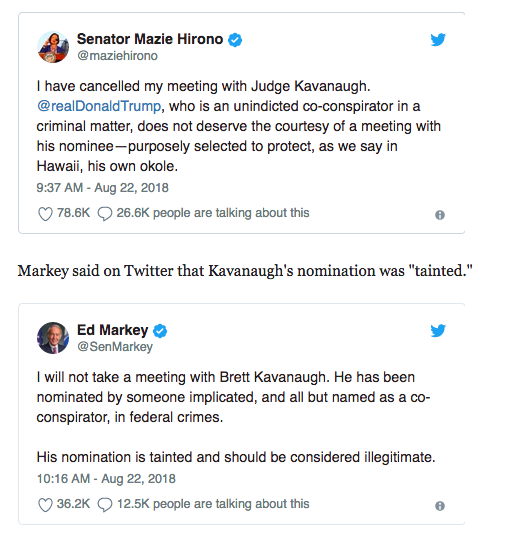
Sens. Mazie Hirono of Hawaii and Ed Markey of Massachusetts canceled their meetings with Kavanaugh Wednesday.

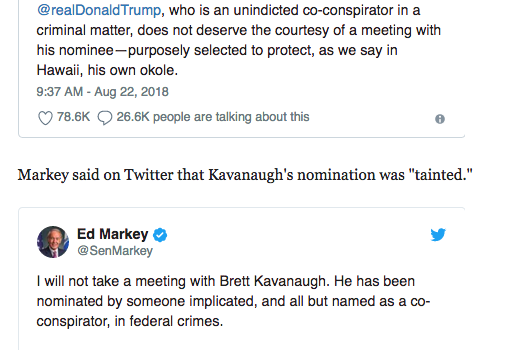
“I have cancelled my meeting with Judge Kavanaugh. @realDonaldTrump, who is an unindicted co-conspirator in a criminal matter, does not deserve the courtesy of a meeting with his nominee—purposely selected to protect, as we say in Hawaii, his own okole,” Hirono tweeted Wednesday. “Okole” is a Hawaiian term for backside.

Sen. Richard Blumenthal of Connecticut and Sen. Jeanne Shaheen of New Hampshire were also among the senators who called for the postponement of confirmation hearings.

Republicans pushed back against the idea that hearings for Kavanaugh should be delayed.

“That’s an important position and he’s very qualified for it, and there’s no reason to hold that up,” Republican Sen. Orrin Hatch told CBS News’ Nancy Cordes Wednesday.

Democrats have very little recourse as members of the minority in blocking Kavanaugh’s confirmation.

Hearings into Kavanaugh’s nomination are set to begin Sept. 5.


Source: US Government Class

Oil boom means extra $1.2 billion for New Mexico

Santa Fe New Mexican – To say New Mexico’s government will be operating in the black next year might be an understatement.

Economists expect the state will be flush.

A spike in oil production means the state could have as much as $1.2 billion in new money for the fiscal year that begins next summer. That is an 18 percent increase in revenue over current spending, according to a forecast presented to lawmakers here Wednesday.

Published by a group of experts from the Legislature and several state agencies, the report describes the projected increase in revenue as “astonishing.”

Such a windfall would give wide latitude for the next governor, who will take office in January. And most simply, it means the financial belt-tightening the state has seen in recent years is over, at least for now.

But the forecast also calls for caution, noting that most of this money is coming from an oil boom that is at the whim of the energy markets.

“We’re relying on the oil industry more now than we ever have before,” said Legislative Finance Committee economist Jon Clark.

In turn, the committee’s economists recommend the state build up its reserves to at least 20 percent of spending.

The state also faces significant financial problems, including major lawsuits over funding for public education and water rights. These cases could prove costly to resolve. Tax protests also cast uncertainty over just how much the state will raise in revenue.

Source: US Government Class