apgov

Land Commissioner Dunn plans to auction disputed border plot

Santa Fe New Mexican – Seven-and-a-quarter-acre plot. Desert views.

For less than the price of a new pickup, you could own your own piece of the U.S.-Mexico border.

In a move to wash New Mexico’s hands of an ongoing feud with the federal government over a small stretch of state trust land on the international boundary, Land Commissioner Aubrey Dunn said Thursday he plans to auction off the property to the highest bidder.

With the commissioner planning to do the bid calling himself Dec. 3 in front of the Doña Ana County courthouse, the auction could end up being the strangest turn yet in a bizarre dispute between the state and federal governments over a parcel that sits right where President Donald Trump has pledged to build a wall. Dunn has demanded the federal government pay to access the property near Santa Teresa and for building a fence at the site. But he has rebuffed previous offers from Washington as less than than what his office could ordinarily get for a lease. So, it’s off to the auction block.

The sale effectively will take New Mexico’s government out of this novel, if not exactly high-dollar, fight.

“This is my last fiasco,” said Dunn, a Republican-turned-Libertarian who is forgoing re-election and leaving office at the end of the year.

But with the federal government still wielding the power of eminent domain and the right to condemn property such as this, it is unclear whether selling the site could do much to stop construction of a new wall.

The federal government controls a 60-foot-wide buffer zone along much of the border under a 1907 proclamation by President Theodore Roosevelt.

But the federal government already had conveyed the patch of land in question to the territory of New Mexico in the late 1800s, and it remains state trust land.

Nonetheless, the federal government has installed a fence on the site, and the Border Patrol uses a road running through the property.

Dunn erected “no trespassing” signs on the property earlier this year, denouncing what he called a federal land grab.

The land commissioner controls around 9 million surface acres of state trust land. Leasing the land for oil production, livestock grazing and development generates funds for New Mexico’s public education system as well as other institutions, such as hospitals.

The commissioner said he will not take anything less than what the state could get for either a 35-year lease — that’s about $20,000 — or a 99-year lease. That would amount to about $54,000.

Dunn will open bidding at $40,000. The State Land Office will keep the mineral and geothermal rights as well as certain water rights.

What can you do with this land?

“Well, you can own a mile of the border wall,” Dunn said.

State Rep. Stephanie Garcia Richard, the Democrat running to succeed Dunn, questioned whether the sale really will be in the best interests of the trust. The legislator from Los Alamos said she opposes selling any state trust land if it is not in the interests of the beneficiaries.

The Santa Teresa area is booming, she noted.

“Why would you take your stake out of a booming economy?” said Garcia Richard. “The wall aside, it doesn’t make economic sense to me.”

The sale also will leave New Mexico with one less possible bulwark against a wall.

Garcia Richard sponsored legislation earlier this year that would have prohibited the New Mexico government from allowing any of its property to be used for constructing a border wall. The bill would have barred selling state land for that purpose, too.

The bill did not pass, but it reflected the fact that plenty of New Mexicans are not inclined to help Trump build the border wall he promised.

Meanwhile, the federal government has used eminent domain to obtain other property on the border. But many landowners say they have received inadequate compensation in that process.

Source: US Government Class

New Mexico observatory’s sudden closure sparks wild speculation

FoxNews – The temporary closure of a New Mexico observatory last week sparked wide-ranging theories, especially after reports that federal authorities were involved.

The Sunspot Solar Observatory, located near the Sacramento Mountains, closed over an unspecified security issue, the facility said in a statement posted to Facebook on Sunday.

“Sunspot apologizes for the continued closure of the facilities,” the statement said. “The Association of Universities for Research in Astronomy (AURA) is addressing a security issue at the National Solar Observatory facility at Sacramento Peak, New Mexico and has decided to temporarily vacate the facility as a precautionary measure.

“AURA, which manages Sacramento Peak with funding from NSF (National Science Foundation), is working with the proper authorities on this issue. We have no further comment at this time.”

Otero County Sheriff Benny House told the Alamogordo Daily News last week the sheriff’s office was asked to stand by and mentioned that the FBI was involved.

“The FBI is refusing to tell us what’s going on,” House told the newspaper. “We’ve got people up there (at Sunspot) that requested us to standby while they evacuate it. Nobody would really elaborate on any of the circumstances as to why. The FBI were up there. What their purpose was nobody will say.”

House said there were a lot of unanswered questions over Sunspot’s closure.

“But for the FBI to get involved that quick and be so secretive about it, there was a lot of stuff going on up there,” House told the newspaper. “There was a Blackhawk helicopter, a bunch of people around antennas and work crews on towers but nobody would tell us anything.”

It was unclear when the observatory was going to re-open and workers decided to evacuate the facility as a “precautionary measure,” AURA spokeswoman Shari Lifson told the Alamogordo Daily News. Lifson couldn’t comment as to whether the FBI was involved.

Frank Fisher, an FBI spokesman, couldn’t confirm or deny the agency’s involvement, according to the Albuquerque Journal.

The mysterious nature of the closure sparked all kinds of speculation on the internet.

“When the aliens invade we have nowhere to evacuate to anyway; the truth will be our destiny,” Gene Alexander wrote on the observatory’s Facebook page, according to the Kansas City Star.

“There was a Blackhawk helicopter, a bunch of people around antennas and work crews on towers but nobody would tell us anything.”

– Otero County Sheriff Benny House

“Maybe a celestial body that we have not encountered in a long while for thousands of years is finally making its way back into our solar system,” John Pleites-Sandoval hypothesized.

Whatever is happening at the observatory, one employee told the Albuquerque Journal they weren’t too concerned just yet because they didn’t have enough information.

“That’s what happens when you do something and don’t tell anybody why,” the employee said.

Source: US Government Class

FEMA official defends agency over stockpiled water bottles left in Puerto Rico

CBS News – A senior Federal Emergency Management Agency official is defending the agency after images surfaced showing what appear to be millions of water bottles sitting on a runway in Puerto Rico more than one year after Hurricane Maria devastated the island.

“Those are excess water bottles. Those were not needed during the response phase and were not distributed by the governor of Puerto Rico or FEMA for that reason,” FEMA deputy administrator Daniel Kaniewski told “CBS This Morning.”

Kaniewski confirmed he was comfortable with how FEMA handled the situation and said the agency will be putting out a statement on Thursday with an exact timeline.

“I’m confident that those that needed those bottles of water got them during the response phase and these were excess bottles of water that were, again, transferred to save money for the American taxpayer in January,” Kaniewski said.

His comments diverge significantly from what another senior FEMA official told CBS News’ David Begnaud on Wednesday. “If [FEMA] put that water on that runway, there will be hell to pay … If we did that, we’re going to fess up to it,” the official told him.

According to a new Washington Post Kaiser Family Foundation survey, 50 percent of Puerto Ricans say people in their households could not get enough water to drink in the year since Maria.

The General Services Administration in Puerto Rico (GSA) says it requested FEMA’s inventory of excess water through a federal program on April 17 and was given approval to use the supplies on April 26. In total, documents show the GSA claimed about 20,000 pallets of bottled water.

On Wednesday, the Puerto Rican government placed much of the blame for the abandoned bottles on FEMA. A statement from the Puerto Rico Federal Affairs Administration on Wednesday outlined what they saw as FEMA’s missteps in handling the water bottles. They said FEMA should have distributed the water to victims on the island, since they were in the agency’s possession. They also said the runway in Ceiba is federally managed land, and that FEMA should have deemed the water bottles “excess inventory” months before it did.

Puerto Rico’s governor last month raised the official death toll from Hurricane Maria from 64 to 2,975. President Trump questioned the numbers on Twitter Thursday morning, blaming Democrats who he said were trying “to make me look as bad as possible.”

Source: US Government Class

John Kerry slammed for ‘shameful’ shadow diplomacy after admitting to meetings with Iran

FoxNews – Former Secretary of State John Kerry is being slammed for conducting shadow diplomacy with Iran after admitting to multiple meetings with Iranian officials behind the backs of the Trump administration — including over the scrapped nuclear deal.

An administration official on Thursday told Fox News Kerry’s meetings are “shameful,” pointing out what Iranian-backed militias are doing to kill and injure people in Syria, Iraq and Yemen.

Other Republicans suggested it may not even be legal.

“John Kerry is out giving advice to Iran about how to maneuver around what Donald Trump is doing, it’s insidious,” Ari Fleischer, the former White House press secretary for George W. Bush, said Wednesday on Fox News’s “Special Report.” “I don’t know if it’s legal or illegal, I don’t care about that side of it. It’s wrong.”

Kerry, the former Massachusetts senator who worked as the nation’s top diplomat in the Obama administration, made the comments about his interactions with Iran as he promotes his new book, “Every Day Is Extra.”

During an appearance on Hugh Hewitt’s radio show on Wednesday, Kerry acknowledged meeting with Iranian Foreign Minister Javad Zarif “three or four times” since leaving office, admitting to discussing the scrapped nuclear deal and other issues.

“What I have done is tried to elicit from him what Iran might be willing to do in order to change the dynamic in the Middle East for the better,” Kerry said.

Later Wednesday, during an appearance on Fox News’ “The Daily Briefing with Dana Perino,” Kerry did not deny the suggestion he’s telling the Iranians to wait out Trump until there is a Democratic president again.

“I think everybody in the world is talking about waiting out President Trump,” said Kerry, who ran unsuccessfully for president in 2004 and who has not ruled out a 2020 bid.

It was first reported in May that Kerry met Zarif as he worked to preserve the deal, as part of what the Boston Globe called an “aggressive yet stealthy” mission to put pressure on the Trump administration to keep the deal in some form. Kerry was part of the team that negotiated the deal for the Obama administration.

Trump in May, though, announced plans to leave the Iran nuclear deal, declaring the pact has failed to halt the country’s nuclear ambitions. Last month, the Treasury Department restored sanctions against Iran.

It has been suggested before that Kerry’s meetings with high-profile foreign leaders could violate the Logan Act—which prohibits private citizens from negotiating on behalf of the U.S. government without authorization. No one has ever been successfully prosecuted under the law, however.

“This is the question: what was John Kerry doing?” Fleischer asked Wednesday on “Special Report.” “What was he saying, what were the specifics? I don’t think it was general, I think he was giving Iran advice about how to wait out President Trump.”

Others suggested hypocrisy was at play, given the suggestions then-Trump national security adviser Mike Flynn violated the Logan Act for his meetings with the ambassador to Russia during the transition. Flynn was not charged with violating the act.

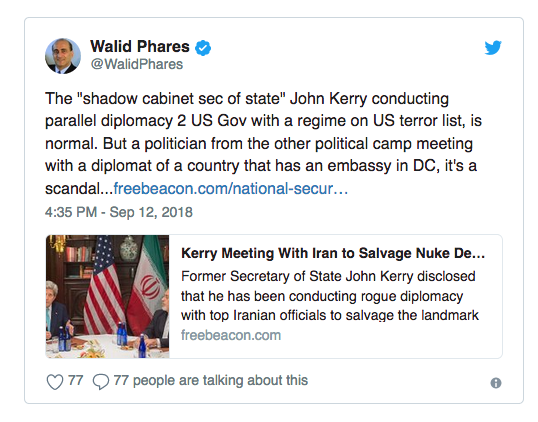
Fox News security analyst Walid Phares referred to Flynn’s situation, pointing out the media considered it a “scandal” when Flynn met with “a diplomat of a country that has an embassy in DC.” But, he said, they consider it “normal” when Kerry conducts “parallel diplomacy” with “a regime on the US terror list.”

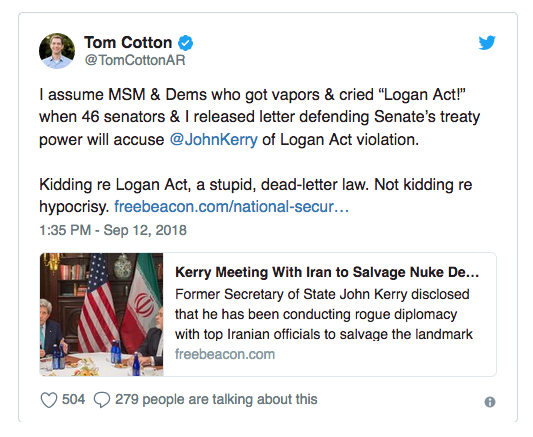
Arkansas Republican Sen. Tom Cotton also knocked Democrats and the media for their “hypocrisy” over not raising the alarm about Kerry’s comments, though he called the Logan Act “a stupid, dead-letter law.”

When the reports of Kerry’s contacts first surfaced this year, Trump blasted Kerry for what he called “possibly illegal Shadow Diplomacy.”

“The United States does not need John Kerry’s possibly illegal Shadow Diplomacy on the very badly negotiated Iran Deal. He was the one that created this MESS in the first place!” Trump tweeted Monday.

Kerry, though, speaking to Perino on Wednesday denied his conversations were inappropriate.

“Every secretary of state, former secretary of state continues to meet with foreign leaders, goes to security conferences, goes around the world,” Kerry said. “We all do that. And we all have conversations (about) the state of affairs with the world in order to understand them.”

Fox News’ Brooke Singman contributed to this report.

Source: US Government Class

High court blocks plan to restore straight-party voting

Santa Fe New Mexican – There will be no straight-party voting option this year in New Mexico.

The state Supreme Court on Wednesday unanimously ruled in favor of a petition by the state Republican and Libertarian parties and others arguing that Secretary of State Maggie Toulouse Oliver does not have the power to put straight-party voting back on ballots without legislative approval.

The court didn’t buy Toulouse Oliver’s argument that the secretary of state’s power to decide the form of the ballot includes resurrecting the straight-ticket option.

“Did the Legislature intend to delegate its decision-making authority over straight-party voting to the secretary of state?” Chief Justice Judith Nakamura said when announcing the high court’s decision. “The answer to this question is no.”

Opponents of straight-party voting — which allows a voter to select candidates in all races at once by choosing a party of choice — have claimed Toulouse Oliver was trying to revive the practice to help Democratic candidates, including herself. The argument is that candidates in down-ballot races who aren’t Democrats will suffer if enough voters choose to vote straight Democratic.

More voters in New Mexico are registered with the Democratic Party than with any other.

After the hearing, Toulouse Oliver said she was disappointed in the decision but glad the Supreme Court cleared up the issue.

“I truly believe that [the straight-ticket option] makes voting more accessible to people,” she told reporters.

Toulouse Oliver, who is running for a four-year term, said she will continue to work toward making state elections more secure and pushing legislation on such issues as allowing independents to vote in primaries, same-day voter registration and possibly voting at home.

But asked whether she’ll push legislation to re-establish straight-party voting, she said she doesn’t know whether the issue will stay on her agenda.

Gavin Clarkson, Toulouse Oliver’s Republican opponent in the secretary of state’s race, called Toulouse Oliver a “partisan Democrat” after the hearing and said her argument about the straight-party issue “doesn’t pass the giggle test.”

The court’s decision “was a win for all New Mexicans regardless of party or those with no party,” Clarkson said.

Toulouse Oliver moved to restore the straight-party voting option last month. That option for voters had been part of the law until 2001, when the state Legislature passed House Bill 931, which dealt with electronic voting machines.

The bill repealed a section of the state Election Code dealing with technical requirements for old lever-operated voting machines — everything from the construction materials and workmanship to the machine’s ability to print out voting results. The bill didn’t mention the phrase “straight-party voting.”

Still, the state kept straight-party voting for 10 years — without major public outcry from Republicans or others — after HB 931 became law.

In 2011, when Dianna Duran became secretary of state — the first Republican to hold that position in decades — she got rid of the straight-party option.

There was discussion during Wednesday’s hearing about Toulouse Oliver’s contention that even though the Legislature in 2001 struck language requiring the straight-party option, the secretary of state retained power over the form of the ballot.

Nakamura said there’s a difference between “form” and “substance” — and that the straight-ticket issue was a matter of substance.

“What’s clear is that there is a lot of uncertainty about what the Legislature was trying to accomplish,” Nakamura said.

She pointed out that in recent years, there have been nine unsuccessful attempts by lawmakers to either prohibit or authorize straight-party voting.

“If the secretary of state wants to make law,” Nakamura said, “she should resign and run for the Legislature.”

Nakamura asked Toulouse Oliver’s attorney, Jane Yohalem, whether the secretary of state had the power to to establish a straight yes-or-no option for constitutional amendments, bond issues or judicial retention.

“We could reduce the ballot to four questions,” the chief justice said.

The national trend in recent years among states is to do away with straight-party voting. Only nine states allow it, according to the National Conference of State Legislatures.

One of the plaintiffs in the case is Unite New Mexico, a group backing independent legislative candidates on the ballot — namely Jarrett Applewhite, who is running against state Rep. Matthew McQueen, D-Galisteo, in District 50, and former state Rep. Treciafaye “Tweeti” Blancett of Eagle Nest, who is running against Democrat Joseph Sanchez of Alcalde for retiring Rep. Nick Salazar’s seat in District 40.

Other plaintiffs are Heather Nordquist, a Democrat running as a write-in candidate against Democratic nominee Andrea Romero for the state House District 46 seat in Santa Fe County, and the Elect Liberty PAC, a Libertarian political action committee supporting former Gov. Gary Johnson, who is trying to defeat incumbent Democratic U.S. Sen. Martin Heinrich and GOP Senate candidate Mick Rich.

Source: US Government Class

It’s not just CNN’s poll. All polling shows Trump’s approval rating dropping.

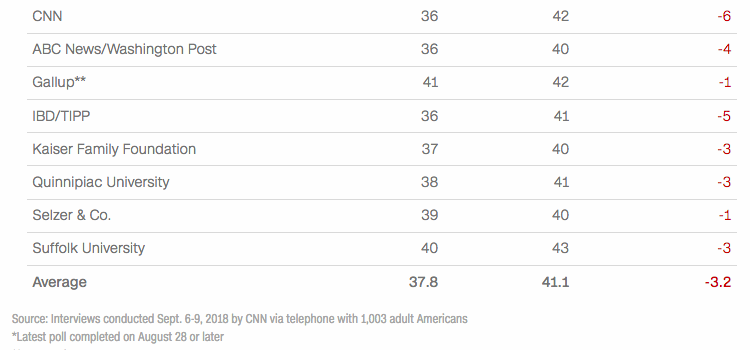
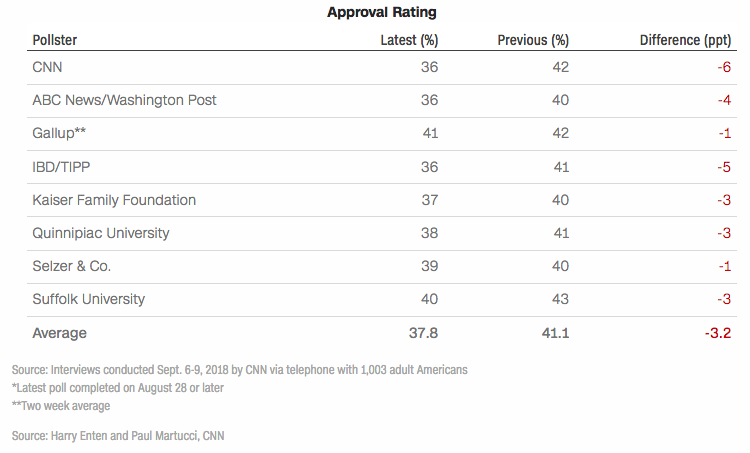
(CNN)President Donald Trump’s approval rating in the latest CNN poll stands at just 36%. That’s a 6-point drop from 42% last month.

Normally, I’d dismiss such a decline as statistical noise and want to see other polls before declaring that the President’s standing among the public has diminished.

Here’s the thing: CNN’s poll is only the latest in a series of high-quality, live-interview polling over the last two weeks to show that Trump’s approval rating is down. This dip could have a major impact on the midterms if it holds.

Eight high-quality polls have been completed over the two last weeks — and every single one of them has Trump’s approval falling.


In the latest average, Trump’s approval rating is about 38% in eight polls from ABC News/Washington Post, CNN, Gallup, IBD/TIPP, the Kaiser Family Foundation, Quinnipiac University, Selzer & Co. and Suffolk University.

If we just took an average of the last polls by these organizations completed August 27 or earlier, Trump’s approval rating stood at 41%.

Now, not all of these pollsters show the same drop. Trump’s 6-point decline in CNN’s poll is the largest. When you take an average of their latest two tracking polls compared with their prior two, Gallup has Trump dipping just a percentage point.

You’d expect such differences though given sampling error.

An average 3-point decline is rather remarkable for a President whose approval rating has been one of the steadiest on record. It would suggest that something the President did had a real impact on public perception.

House Republicans should worry about Trump’s approval rating drop, if it holds through November. Voter opinions of the President have been increasingly tied up with how they vote in midterm elections.

CNN polling has regularly found that more than 80% of voters who approve of Trump are voting for Republican House candidates, compared with more than 80% of voters who disapprove of Trump voting for Democratic House candidates.

As I noted last week:

For Republicans to have a realistic (i.e. within the margin of error) shot of maintaining control of the House in 2018, Trump’s approval rating must remain at least in the low 40s nationally.

For them to have a 50% chance of holding on to power in the House, Trump’s approval rating will likely need to rise into the mid-40s.

Right now, Trump and his fellow Republicans are … going the other (i.e. wrong) way.

Source: US Government Class

Ayanna Pressley defeats Dem. Rep. Michael Capuano in upset primary victory

CBS News –

Boston City Council member Ayanna Pressley has unseated 10-term incumbent Rep. Michael Capuano, in a surprise upset in the Massachusetts Democratic primary Tuesday.

Pressley, the first African-American woman elected to the Boston City Council in 2009 was considered by many to be an outsider candidate, drawing comparisons to Alexandria Ocasio-Cortez, the young democratic socialist who shocked the Democratic establishment by defeating New York Rep. Joe Crowley in his primary in June. Ocasio-Cortez tweeted Tuesday night, “Congratulations to my sister in service, @AyannaPressley, on continuing her historic path into Congress tonight. Let’s push together to make Medicare for All, tuition free college, & living wages a reality in America – all without corporate PAC money.”

Capuano, a vestige of Boston’s white ethnic political machine, was first elected in 1998. He has been a reliable liberal vote in the House for nearly 20 years, and is a longtime supporter of progressive policies such as Medicare for All. Pressley argued in her campaign that Capuano represents an old guard of politics, and it’s time for a change. The race for Capuano’s seat was less about policy issues than representation — Massachusett’s 7th Congressional District is the only one in the state with more non-whites than whites.

Capuano was endorsed by prominent Massachusetts figures, including former Gov. Deval Patrick, the state’s first black governor. He also had the support of the Congressional Black Caucus. He raised twice as much money as Pressley. However, Pressley had the endorsement of popular state Attorney General Maura Healey.

Pressley is likely to become the first black woman elected to Congress from Massachusetts in November, since there are no Republican candidates in the race.

Pressley may be considered an outsider by virtue of who she is. Capuano is a white man who was born and raised in the district, and served as mayor of Somerville before he was elected to his congressional seat. Pressley is originally from Chicago, Illinois. As a black woman, Pressley is challenging the traditional political hierarchy that has defined Boston politics for decades.

But both Pressley and Capuano admit there’s likely no difference between them in terms of the way they’ll vote in Congress, and moreover, neither one has expressed outright opposition against Democratic leader Nancy Pelosi. Still, Pressley joins Ocasio-Cortez in New York, Stacey Abrams in Georgia and Andrew Gillum in Florida in the ranks of progressive, non-white politicians who represent demographic change and perspective in the Democratic Party. Pressley was endorsed by Ocasio-Cortez, and has been profiled in several news outlets. Capuano may have had the name recognition, but Pressley had the momentum.

Jack Turman contributed to this report.

Source: US Government Class

Arizona governor names former Sen. Jon Kyl as McCain’s replacement

(CNN) – Arizona Republican Gov. Doug Ducey is appointing former US Sen. Jon Kyl to replace the late John McCain, the governor said at a news conference Tuesday.

Kyl’s appointment means the Republican attorney who had been guiding President Donald Trump’s Supreme Court nominee, Brett Kavanaugh, through the confirmation process will now have a vote on Kavanaugh’s confirmation.
Ducey is appointing a McCain replacement until a special election is held at the same time as the November 2020 general election. But Ducey said at the news conference it’s not clear whether Kyl will remain in the Senate through 2020. And Kyl said he won’t run for re-election.
“I haven’t been able to get that assurance from Sen. Kyl yet. What I have gotten is a commitment to serve Arizona through at least this session of Congress, and it’s my hope that he serves longer,” Ducey said. “I’m hoping that the senator will consider serving longer.”
Kyl added: “I have committed to serving at least through the second session of the 115th Congress. I do know I will not seek this seat in 2020, nor any other office in the future.”
The appointment means Trump could have a reliable vote for the rest of the year. Ducey, meanwhile, will placate Arizona Republicans through his own re-election bid this fall.
Cindy McCain praised the selection of Kyl on Twitter, calling him “a dear friend of mine and John’s.”
“It’s a great tribute to John that he is prepared to go back into public service to help the state of Arizona,” she said.

Source: US Government Class

Democrats press for delay at start of Kavanaugh hearing — live updates

CBS – Tuesday marks the first day of Judge Brett Kavanaugh’s confirmation hearing before the Senate Judiciary Committee, as Republicans aim to swiftly confirm President Trump’s second Supreme Court nominee and Democrats demand more answers and more time.

The hearing is expected to be grueling, as Democrats insist on obtaining and reviewing more records from Kavanaugh’s tenure in the George W. Bush administration, and question whether he believes a sitting president can be indicted. Some Democrats have called for a delay in a vote on the nominee until after November’s midterm elections. Republicans, on the other hand, largely satisfied with Kavanaugh and looking for another win before the November midterms, want a speedy confirmation process.

The hearing begins at 9:15 a.m.
Kavanaugh confirmation hearing live updates:
Sasse slams Kavanaugh opponents’ “drivel” as “patently absurd”

Sen. Ben Sasse, R-Nebraska, said that “deranged” comments about Kavanaugh’s record have nothing to do with him and that senate confirmation hearings have not worked for over 30 years in America.

Sasse said the “hysteria” around Supreme Court confirmation hearings “comes from a fundamental misunderstanding” of the role the high court has in American life. He said the public has grown to expect an overblown “circus” of a hearing.

The Republican slammed Democrats’ “90 minutes of theatrics” as showing “us a system widely out of whack.”
Klobuchar: “Our Democracy is on trial”

“Our democracy is on trial,” Sen. Klobuchar warned. “To weather this storm the nation’s highest court must serve as a ballast in this turbulent times,” she added, suggesting that the next Supreme Court pick must be “fair, impartial and unwavering.”

Klobuchar said President Trump’s repeated attacks on his own Justice Department “have made me pause and think many times about why I decided to come to the senate….and go into law in the first place.”
Kavanaugh confirmation returns to session

Grassley thanked Kavanaugh for returning from recess in a timely manner. The chairman gaveled-in shortly after 1:17 p.m. to restart the hearing.
Kavanaugh hearing breaks for short recess

Upon conclusion of Sen. Cruz’s remarks, Chairman Grassley called for a break in the confirmation hearing, warning Kavanaugh to “be on time please.”
Ted Cruz on Democrats complaints: “What’s all the fuss”

Sen. Ted Cruz, R-Texas, said that the over half million documents that have been turned over to the senate account for “more than the last five nominees submitted to this committee combined.”

Cruz said Democrats are making a demand “they know is impossible to meet and irrelevant to what Kavanaugh thinks, believes or has said.”

The senator instead suggested his democratic colleagues’ effort to “distract and delay” on Tuesday is an effort to “re-litigate the 2016 presidential election.”
Durbin calls Democratic opposition the “noise of democracy”
“What we’ve heard is the noise of democracy,” Durbin said of Democrats’ and protesters pleas to adjourn the hearing.

“It is not mob rule,” he argued, saying that while at times the hearing so far has been “uncomfortable” for Kavanaugh and his family present, it “represents what we are about in this democracy.”

Durbin also noted that being the nominee of President Trump shows he’s the “personal choice” of someone who has “shown us consistently he’s contemptuous of rule of law.”
Leahy to Kavanaugh: “You shouldn’t be sitting in front of us”

“Mr. Kavanaugh, you shouldn’t be sitting in front of us today,” said Sen. Leahy citing incomplete reviews of the judge’s record. “Your vetting is 10 percent complete.”

“Judge Kavanaugh, there’s so many things wrong with this committee’s vetting of your record it’s hard to know where to begin…I never thought the committee would sink to this,” he added.

Leahy called the hearing “the most incomplete, most partisan, least transparency for any Supreme Court nominee I have ever seen and I have seen more of those than any person serving in the senate today.”
Orrin Hatch defends Kavanaugh as “most distinguished”

Sen. Orrin Hatch, R-Utah, who impressively pointed out to the committee that he has participated in the confirmation process for every justice currently on the Supreme Court, said that Democrats are trying to “paint you as one of the four horsemen of the apocalypse.”

He called Kavanaugh one of the “most distinguished judges” on the court today, with a “sterling character” of integrity and sound judgement, saying he was “unquestionably qualified” for his role on the Supreme Court.
After lengthy delay, Grassley begins opening statements

Following over an hour-long delay prompted by Democrats looking to move the confirmation, Sen. Grassley finally began his opening statement for Kavanaugh’s hearing.
Grassley said that expects “Judge Kavanaugh will follow the example set by [Justice Ruth Bader] Ginsburg, and all the nominees that followed her, that a nominee should offer ‘no hints, no forecasts, no previews’ on how they will vote” on the Supreme Court bench.

The chairman called Kavanaugh “one of the most qualified nominees – if not the most qualified nominee -I have seen.”

In a jab at Democrats, Grassley said that Americans have had “unprecedented access and more materials to review for Judge Kavanaugh than they ever had for a Supreme Court nominee. And to support the review of Judge Kavanaugh’s historic volume of material, I’ve worked to ensure that more Senators have more access to more material than ever.”
Cornyn: Hearing running by “mob rule”

Sen. John Cornyn, R-Texas, argued that “this is the first confirmation hearing subject to mob rule” as Democrats continue to shift the focus off of Kavanaugh and onto outstanding document requests.

“I’ve been accused of having a mob rule session… if we have a mob rule session it’s because the chairman is not running the committee properly,” said Grassley. “This is the same Chuck Grassley that ran the [Neil] Gorsuch hearings,” he pointed out, citing Democrats’ claims how well-run that previous hearing was.

In contrast, Sen. Leahy told his colleagues that he’s “sorry to see the Senate Judiciary Committee descend this way.”

“I felt privileged to serve here under Republican and Democratic leadership for over 40 years. This is not the Senate Judiciary Committee I saw when I came to the U.S. Senate,” he added.

Grassley informed the body that due to delays, Kavanaugh will likely be heard from later than 2:30 p.m.
Grassley calls Democrats’ motion to adjourn “out of order”

Sen. Richard Blumenthal said the confirmation process will be “tainted and stained forever” if they are not allowed to move to postpone the hearing in an executive session of the senate. Grassley responded several times: “The motion is out of order.”

CBS News’ Nancy Cordes reports that a source familiar with the discussions confirms that Sen. Schumer held a conference call with Judiciary Committee democrats over the Labor Day weekend to discuss the strategy they are now deploying in a coordinated manner, interrupting the start of the hearing to call – one after the other – for a delay in the proceedings until senators get all the Kavanaugh documents they want and have time to read them.

Sen. Thom Tillis, R-North Carolina, cited this reporting in the hearing in an attempt to undermine Democrats’ arguments.
Feinstein cites Trump’s “serious problems” at start of hearing

Ranking member Sen. Dianne Feinstein said that besides the argument over documents, Kavanaugh comes to the Senate with a backdrop of political turmoil and frustration in the country and the White House. Feinstein said the Senate is looking at whether Kavanaugh is “within the mainstream of American legal opinion and will he do the right thing by the constitution.”

Feinstein said the Senate has instead cast aside tradition for speed with regards of the vetting process of the nominee.

“Give us the time to do our work so we can have a positive and comprehensive hearing on the man who may well be the deciding vote for many of America’s futures,” said Feinstein.
At start of hearing, Democrats call for confirmation to be moved
Democrats including Sens. Kamala Harris, Amy Klobuchar and Richard Blumenthal interrupted Chairman Chuck Grassley’s opening statements, calling for the hearing to be moved due to Democrats’ argument that they have not been given adequate time or access to documents to review Kavanaugh’s fitness for the bench.

“We have not been given the opportunity to have a meaningful hearing on the nominee,” said Harris. Blumenthal argued that the lack of access to documents “turns this hearing into a charade and mockery of our norms.”

Democrat Corey Booker meanwhile called for debate on the issue, asking Grassley “what is the rush” on Kavanaugh’s confirmation. “What are we hiding by not letting those documents come out” to the public Booker inquired. Sen. Durbin echoed, urging the Senate to take a “few days or weeks” to have a complete review of Judge Kavanaugh’s record, adding that not doing so is “unfair to the American people.”

As of late Monday, the Senate had been given an additional 42,000 pages of documents about Kavanaugh, according to Sen. Chuck Schumer, D-New York.

The White House said Friday that it would not be releasing 100,000 Kavanaugh’s records from the Bush White House on the basis of presidential privilege.

Sen. Patrick Leahy, D-Vermont, said it was the first time in his 44 years in Congress that there has been such a claim of executive privilege, saying it “just puts everything under doubt. What are we trying to hide, we are we rushing?”

As Democrats made their case, protesters seated inside the chamber began shouting to stop the hearing making for a chaotic first few moments of Kavanaugh’s appearance before the Senate.
Kavanaugh arrives for hearing

Shortly after 9:30 a.m., Kavanaugh entered the chamber to begin his first day of confirmation hearings.

DOJ’s Rod Rosenstein at Kavanaugh hearing

Deputy Attorney General Rod Rosenstein is seated near the front of the Kavanaugh hearing on Tuesday. According to the DOJ, Kavanaugh and Rosenstein are friends going years back.
Tuesday hearing’s schedule of events

Kavanaugh’s hearing before the Senate Judiciary Committee begins with a round of opening statements from Committee members and from Kavanaugh himself who will be introduced by former Secretary of State Condoleezza Rice, Sen. Rob Portman, R-Ohio, and Arnold & Porter partner Lisa Blatt.

Members will be allowed roughly 10 minutes of time to speak on Kavanaugh’s fitness for confirmation. Questioning of Kavanaugh will begin on Wednesday.
Kavanaugh: “I’m a pro-law judge”

In excerpts of Kavanaugh’s prepared remarks released by the White House ahead of Tuesday’s first hearing, the judge is expected to make the case that he will remain a “neutral and impartial arbiter who favors no litigant or policy.”

“A good judge must be an umpire,” Kavanaugh said in prepared remarks. “I don’t decide cases based on personal or policy preferences. I am not a pro-plaintiff or pro-defendant judge. I am not a pro-prosecution or pro-defense judge. I am a pro-law judge.”

“If confirmed to the Court, I would be part of a Team of Nine, committed to deciding cases according to the Constitution and laws of the United States. I would always strive to be a team player on the Team of Nine,” Kavanaugh adds in excerpts released.

Kavanaugh also makes note of former President Barack Obama’s one-time pick to the court, Judge Merrick Garland. “I have served with 17 other judges, each of them a colleague and a friend, on a court now led by our superb chief judge, Merrick Garland.” Garland’s own nomination to the high court was effectively blocked by Senate Republicans in Obama’s final year in office.
What to watch for

The confirmation hearing process is expected to last much longer than one day. Here are some things to watch for during the back-and-forth of questioning.
Senators to watch

Senators to watch for: Keep an eye on questions and reactions from senators who are vulnerable this fall. Sen. Joe Manchin, D-West Virginia, Sen. Joe Donnelly, D-Indiana, Sen. Heidi Heitkamp, D-North Dakota, and Sen. Clare McCaskill, D-Missouri, have yet to say whether they will support Kavanaugh.
Executive power

Democrats are sure to ask hammer Kavanaugh with questions about whether he believes a sitting president can be indicted, particularly after former longtime Trump lawyer Michael Cohen alleged that Mr. Trump directed him to take actions that violated campaign finance law.

In 2009, Kavanaugh seemed to suggest that presidents should be immune from criminal prosecutions and investigations until after leaving office, writing, “I believe it vital that the president be able to focus on his never-ending tasks with as few distractions as possible.”
Abortion

Kavanaugh’s views on abortion are documented but still unclear. He has approved some restrictions on abortion, such as for an underage undocumented immigrant who wanted one. But he also gives much weight to precedent. After meeting with Kavanaugh lsat month, Sen. Susan Collins, R-Maine, said Kavanaugh assured her that he views Roe v. Wade as “settled law.”

Source: US Government Class