apgov

Ted Koppel mocks Brian Stelter: ‘CNN’s ratings would be in the toilet without Donald Trump’

FoxNews – Journalism legend Ted Koppel mocked CNN’s Brian Stelter to his face on Monday, telling the “Reliable Sources” host that “CNN’s ratings would be in the toilet without Donald Trump.”

While on stage for a National Press Club panel discussion, Koppel attempted to make a point that many media executives admit Trump is good for ratings, as viewers on both sides of the aisle tune in to see the round-the-clock drama unfold.

Stelter responded by asking, “That means what? If ratings are up, that means what?”

Koppel – who anchored ABC News’ “Nightline” for 25 years and has been a working journalist for over four decades — quickly answered.

“The ratings are up, it means you can’t do without Donald Trump. You would be lost without Donald Trump,” Koppel said as Stelter shook his head in disagreement.

“Ted, you know that’s not true,” Stelter said.

“CNN’s ratings would be in the toilet without Donald Trump,” Koppel said as the audience laughed.

“You know that’s not true. You’re playing for laughs,” Stelter shot back before explaining it would be “Okay” if CNN lost significant viewership during the next administration.

“I reject the premise that these networks are making so much money off of Trump,” Stelter said.

Koppel noted that it was clearly a “sensitive subject” and pointed out that MSNBC also spends most of its coverage on Trump. Stelter has emerged as a prominent figure on CNN during Trump’s political rise and often questions the president’s fitness for office. CNN and Trump have an on-going feud, as the network is loaded with anti-Trump programming and the president often responds by mocking CNN as “fake news.”

Stelter took to Twitter on Wednesday in response to the attention the exchange has received.

“I admire Koppel, but I think the cable news biz is a lot more complex than he makes it seem. Ratings rise, ratings fall. Stories come, stories go. It’s important to cover Trump and it’s important to cover what comes next,” Stelter wrote.

Ironically, CNN finished well behind Fox News and MSNBC during the third quarter of 2018. Fox News averaged 1.4 million total viewers compared to 1 million for MSNBC and only 722,000 for CNN. Both Fox News and MSNBC gained viewers compared to the third quarter of 2017, but CNN was down nine percent.

During the primetime hours of 8-11 p.m. ET, Fox News averaged 2.5 million viewers – up 14 percent from Q3 2017 — compared to 1.9 million for MSNBC and 1 million for CNN. Both MSNBC and CNN saw a decline compared to last year.

Fox News was home to nine of the top 15 cable news programs among total viewers and seven of the top 15 in the demo, as “Hannity” topped both categories. The most-watched show on CNN was “Cuomo Prime Time,” which finished No. 23 overall in the cable news rankings, averaging 1.2 million viewers.

Source: US Government Class

rump touts NAFTA overhaul in press conference

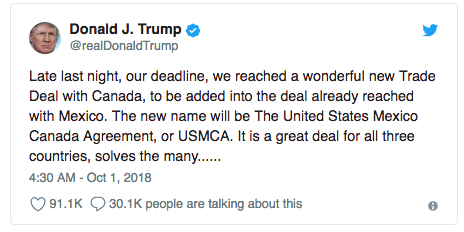
CBS News – President Trump touted the 11th-hour overhaul of a trade agreement among the United States, Mexico and Canada in a Rose Garden news conference on Monday. The White House announced the deal an hour before a deadline of midnight on Sept. 30

The president celebrated the new deal — the “U.S., Mexico, Canada agreement, called USMCA” — as keeping a campaign promise to renegotiate the North American Free Trade Agreement. Mr. Trump has long blasted NAFTA as perhaps the worst deal ever made. As the Sept. 30 deadline approached, it appeared less likely that the U.S. would reach an agreement to keep Canada in a trilateral trade agreement.

Asked about the greatest concession the U.S. made in the agreement, Mr. Trump said it was probably making the deal at all, because everyone else is trying to take from the U.S.

“I think my biggest concession would be making the deal,” the president said.

The commander-in-chief mocked the “babies out there” who have bemoaned the tariffs he has engaged in with other nations. Some of those people have been members of Congress, Mr. Trump said, adding, “We wouldn’t be here without tariffs.”

The steel and aluminum tariffs, Mr. Trump said, will stay in place for the time being. Those tariffs are separate from the USMCA.

Mr. Trump declared the USMCA an “historic transaction!” Canadian Prime Minister Justin Trudeau meanwhile said it was a “good day for Canada & our closest trading partners.”  The warm reception of the deal comes after months of trade disputes between the two North American allies. Trudeau previously called the administration’s tariff action against Canada “totally unacceptable” and “an affront to the longstanding security partnership between Canada and the United States.”

White house economic adviser Larry Kudlow told reporters he isn’t concerned about any lasting tensions between Canada and the U.S., after Mr. Trump has publicly criticized Canada and Trudeau over trade negotiations. Mr. Trump himself acknowledged that he had “very strong tensions” with Trudeau.

“There was a lot of tension, I will say … it’s all worked out,” said Mr. Trump, who claimed that tension ended around midnight Sunday when the deal was reached.

But relationships with other nations on trade are unclear. Mr. Trump, who has declared the European Union one of the nation’s greatest foes, gave few specifics on the future of that trade relationship.

“We’ll see what happens. Who knows, I always say who knows. But we will see, I have a feeling we will be successful,” Mr. Trump said.

The new trade agreement will need to be ratified by Congress — something that could be in jeopardy if Democrats take the House come November.

Kudlow did not express concern about what might happen if Democrats take control of the House — but Mr. Trump left room for doubt.

In his news conference, Mr. Trump said he didn’t think Congress would be a problem — but then again, “anything you submit to Congress is trouble,” he added.

Source: US Government Class

6 Months Before Brexit, Many in U.K. Fear ‘It’s Looking Very Grisly’

New York Times – LONDON — When Theresa May appears on stage at the Conservative Party’s annual meeting this week, it will take all her determination to drown out the ticking of an invisible clock.

One hundred and eighty days stand between Britain and an uncontrolled exit from the European Union. Then it will be 179, 178. …

After two years of negotiation, Britain has reached a moment of consequence for the process known as Brexit. The insulating layer of time that had protected the country from a potentially failed divorce from the bloc is thinning. Soon, it will be gone, with the threat of major new trade restrictions closing in.

What this could mean for ordinary Britons has been seeping into the newspapers, sometimes in leaks from secret government reports: Northern Ireland has only one energy link to the mainland, so a no-deal Brexit could lead to rolling blackouts and steep price rises; and the energy system could collapse, forcing the military to redeploy generators from Afghanistan to the Irish Sea.

With an eye toward the March 29 deadline, the government has appointed a minister to guarantee food supplies. Pharmaceutical companies are planning a six-week stockpile of lifesaving medications like insulin and considering flying planeloads of medicine into the country until imports resume. That’s if planes can still land in Britain — something thrown into doubt after the government admitted that aircraft could, in theory, be grounded by a sudden exit.

In many ways, the country is in the same position it was on the morning after the 2016 referendum: without a clear plan.

British leaders remain mired in infighting, still presenting competing visions as the Brexit countdown enters its final stage. Supporters of a so-called soft-Brexit would keep Britain closely tied to European economic rules and standards so as to minimize disruption to trade. The hard-Brexit camp backs the opposite approach: quitting Europe’s customs union and single market and freeing Britain to draw up its own trade rules.

On Friday, Boris Johnson, the former foreign minister and standard-bearer for the hard-Brexit faction, proposed starting over with a tougher negotiating approach, hinting that he might try to topple Mrs. May in the coming weeks.

Jeremy Corbyn, the opposition Labour leader, rallied his own troops in Liverpool last week and all but promised that Parliament would vote down any deal that Mrs. May could strike.

In the meantime, there is a strange calm, as if the country is waiting to see if a storm will make landfall. On Twitter, the novelist Robert Harris recently compared the atmosphere to the months before Britain entered World War I, when the authorities watched helplessly as they were dragged toward war by the momentum of events.

“We’re just rolling toward the cliff, and nobody out there is going to stop it,” said Bill Wolsey, who owns a chain of hotels, pubs and restaurants based in Belfast, Northern Ireland.

“We’re just rolling toward the cliff, and nobody out there is going to stop it,” said Bill Wolsey, who owns a chain of hotels, pubs and restaurants based in Belfast, Northern Ireland.

Source: US Government Class

Kanye West goes on pro-Trump rant after “SNL” performance

Kanye West is back in the spotlight after performing on the season premiere of NBC’s “Saturday Night Live.” The 40-year-old rapper performed three songs and spoke about his support of President Trump in a rant that didn’t make it to air.

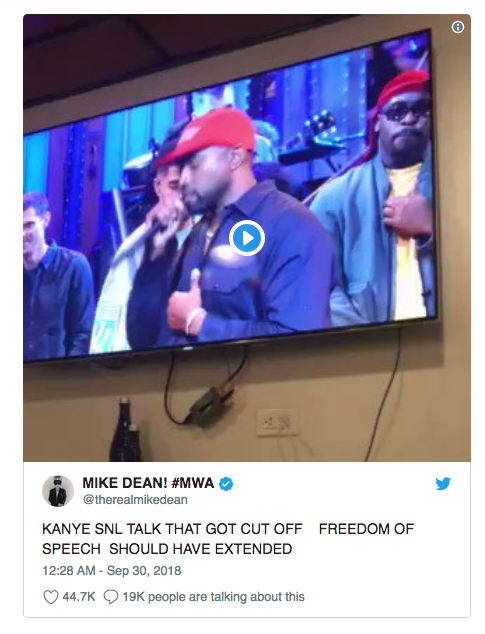
West performed his song “Ghost Town” in Mr. Trump’s signature “Make America Great Again” hat as the show’s credits rolled on screen. In clips that circulated on social media but were not broadcast, West discussed his plans to run for president and his support for Mr. Trump.

“It’s so many times that I talk to a white person about this, and they say, ‘How could you support Trump? He’s racist.’ Well, if I was concerned about racism, I would have moved out of America a long time ago,” he said. “We don’t just make our decisions off of racism. I’ma break it down to you right now … If someone inspires me and I connect with them, I don’t have to believe in all they policies.”

Mike Dean, West’s longtime producer and collaborator, shared video of the speech on Twitter.

West pointed out members of the audience he said were laughing at him and claimed the show’s producers said he couldn’t wear the MAGA hat on stage. “You see they laughing at me. You heard ’em. They scream at me. They bully me. They bullied me backstage. They said, ‘Don’t go out there with that hat on.’”

West has been vocal in his support of Mr. Trump since his victory in 2016. He previously tweeted images of a MAGA hat that was signed by the president and said the two share the same “dragon energy.”

On “SNL,” West said that 90 percent of news, writers, rappers and Los Angeles are liberal and that it’s easy for things to appear one-sided. He later added: “Thank y’all for giving me this platform. I know some of y’all don’t agree. But y’all be going at that man neck a lot, and I don’t think it’s actually that helpful.”

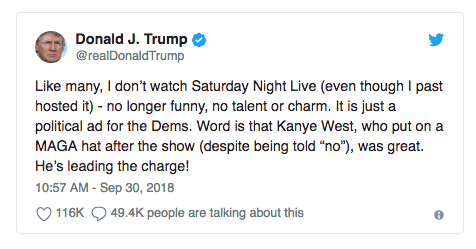
On Sunday, Mr. Trump praised Kanye for wearing his signature MAGA hat on stage despite being told not to.

Source: US Government Class

Trump delivers address to United Nations General Assembly — live updates

  • President Trump is taking to the world stage on Tuesday to deliver his address before the United Nations General Assembly in New York. It is his second time addressing the body since taking office.Senior administration officials previewed the president's speech on Monday, saying Mr. Trump would discuss topics including the denuclearization of the Korean Peninsula, Iran and the theme of "sovereignty." In the year since his last address, the president has taken a soft stance at times towards North Korea's Kim Jong Un and Russian President Vladimir Putin, while blasting America's closest allies.

    Trump’s U.N. speech – live updates below:


  • Trump on Iran

    Iran and the U.S.' pullout of the internationally-accepted Obama-era nuclear pact is expected to be raised in the president's address on Tuesday.Pompeo said that the administration's goals of reimposing strict sanctions on Iran and those that do business with the regime "have made clear we will not continue to accept Iran's bad behavior."He said that Mr. Trump has "well-deserved strong words for the Iranian regime" that he will also raise during a meeting of the UN Security Council on Wednesday. There he will stress the threat of nonproliferation and the need for the global community to "stop the spread of weapons and technologies.""He'll call on every country to join our pressure campaign in order to thwart Iran's global torrent of destructive activity," said Pompeo.Meanwhile, National Security Adviser John Bolton was adament that regime change in Iranian leadership is "not the administration's policy.""What we expect from Iran is massive changes in their behavior. And until that happens, we will continue to exert what the President has called 'maximum pressure.' That's what we intend to do," Bolton added.
  • Trump to press maximum pressure on North Korea

    Secretary of State Mike Pompeo told reporters on Monday in advance of the president's speech that Mr. Trump would make the case in his second address to the UNGA that "now is not the time to ease pressure" on North Korea as the administration continues its "maximum pressure" campaign until complete and verifiable denuclearization is achieved.Mr. Trump earlier on Monday told reporters that that a second meeting with North Korean dictator Kim Jong Un would be taking place "quite soon.""Kim Jong Un wrote a letter, a beautiful letter, asking for a second meeting, and we will be doing that. Secretary Pompeo will be working that out. In the immediate future, it looks like it's moving very well," the president said.At last year's address to the U.N., Mr. Trump said that the North risked "total destruction" if it continued to pursue nuclear weapons, and he said of Kim, "Rocket Man is on a suicide mission for himself and his regime."

Source: US Government Class

Andrew Cuomo using banks to target NRA, faces major legal test

FoxNew – A campaign by New York Democratic Gov. Andrew Cuomo to crack down on the National Rifle Association and similar groups is facing its first big legal test, with a federal judge expected to decide soon whether to allow a challenge to go forward.

Cuomo’s administration has asked Judge Thomas McAvoy of the U.S. Northern District of New York to throw out a First Amendment lawsuit by the NRA that claims the policy restricting financial activity with pro-gun organizations amounts to viewpoint discrimination.

The judge heard arguments on the motion to dismiss on Sept. 10. The decision, whatever it may be, will have far-reaching ramifications for free-speech and gun rights, the limits of financial regulation and possibly even the 2020 presidential contest.

The case has prompted an unusual alliance. The liberal American Civil Liberties Union, despite its support for gun control, filed a friend of the court brief in defense of the free-speech rights of the NRA.

Earlier this month, Cuomo defeated actress Cynthia Nixon in the Democratic gubernatorial primary, and he will likely coast to re-election to a third term in November. Though he said he won’t run for president, he’s widely seen as a potential contender for the 2020 Democratic nomination, and going after one of the left’s most reviled organizations could only help in that pursuit.

The case is more important than anyone’s political aspirations, said William Brewer, the lawyer for the NRA in the case.

“This is giving the power to a state to discriminate against entities based on viewpoint,” Brewer told Fox News.

“If the script was flipped, and a conservative governor of Kansas was very pro-life, his administration could target Planned Parenthood’s financial activity,” Brewer added. “Or, if it’s another governor, the administration could target the finances of Friends of the Earth or the Sierra Club.”

In April, Cuomo directed the state’s Department of Financial Services to encourage insurance companies, banks and other financial services companies licensed in New York state to review whether business interactions with the NRA and “other similar organizations” would pose “reputational risk.”

“New York may have the strongest gun laws in the country, but we must push further to ensure that gun safety is a top priority for every individual, company, and organization that does business across the state,” Cuomo said at the time.

New York Financial Services Superintendent Maria T. Vullo said the agency “urges all insurance companies and banks doing business in New York to join the companies that have already discontinued their arrangements with the NRA.”

In May, the department hit Lockton Affinity with a $7 million fine and Chub Ltd. with a $1.3 million fine for their involvement with the NRA’s “Carry Guard” insurance for gun owners that use a firearm in self-defense but face civil or criminal liability expenses. Both companies dropped the NRA. The Second Amendment group now contends it has trouble getting corporate insurance because companies fear state investigation, while banks have declined to provide financial services for the organization.

Cuomo also urged fellow governors in an August letter to ban Carry Guard because the NRA’s insurance policy is “providing illegal insurance coverage to gun owners for intentional criminal conduct.”

In the motion to dismiss, New York Attorney General Barbara Underwood argued, “Both the guidance letters and the press releases are classic government speech—they are expressing the government’s position in the public gun control debate, which is entirely permissible.”

However, Cuomo may have undermined Underwood’s argument when he gleefully tweeted in August, “If the @NRA goes bankrupt because of the State of New York, they’ll be in my thoughts and prayers. I’ll see you in court.”

New York has definitely used state power going well beyond expressing an opinion, Brewer argues.

“The state took actions well beyond the guidance letters,” Brewer told Fox News. “The dots connect themselves. The governor sent out a press advisory that Superintendent Vullo is monitoring not just the NRA but other pro-Second Amendment groups. Shortly after, within days, the department issued fines.”

The New York Department of Financial Services referred Fox News to the April announcement on the policy and, when asked if someone could speak on the policy, a spokesperson said “unfortunately no, not at this time.”

Neither Cuomo’s office nor Underwood’s office responded to inquiries for this report.

The program is similar in spirit to the Obama administration’s Operation Choke Point, which tried to discourage banks from offering financial services to “high risk” customers – which included short-term lenders and firearms dealers. The Trump Justice Department later ended the program.

The liberal ACLU and the conservative Texas Public Policy Foundation each filed a friend of the court brief in the New York case siding with the NRA’s ability to move for discovery.

The ACLU brief in August said New York “indisputably targeted the NRA and similar groups based on their ‘gun promotion’ advocacy.”

“It is important to note that, however controversial it may be, ‘gun promotion’ is core political speech, entitled to the same constitutional protection as speech advocating for reproductive rights, marijuana legalization, or financial deregulation,” the ACLU brief continued. “The central questions, then, are whether the guidance letters threatened adverse action against banks and insurers that associate with the NRA or other ‘gun promotion’ advocacy groups, and whether this threat was motivated by the government’s hostility to a ‘gun promotion’ viewpoint.”

Fred Lucas is the White House correspondent for the Daily Signal. Follow him @FredLucasWH. 

Source: US Government Class

Deputy Attorney General Rod Rosenstein to meet Trump Thursday

(CNN) – President Donald Trump will meet with Rod Rosenstein Thursday after the deputy attorney general went to the White House Monday expecting to be fired. Rosenstein met with chief of staff John Kelly and spoke with Trump, who is in New York.

“At the request of Deputy Attorney General Rod Rosenstein, he and President Trump had an extended conversation to discuss the recent news stories,” White House press secretary Sarah Sanders said in a statement. “Because the President is at the United Nations General Assembly and has a full schedule with leaders from around the world, they will meet on Thursday when the President returns to Washington, DC.” If he leaves, Rosenstein’s departure would spark immediate questions about the long-term job security of special counsel Robert Mueller.

Noel Francisco, the solicitor general, would take on oversight of Mueller’s investigation into Russian meddling in the 2016 presidential election. The expectation that Rosenstein will leave the administration came after The New York Times reported he secretly discussed recording President Donald Trump and invoking the 25th Amendment to remove the President from office.

But GOP allies of Trump urged him to hold off on a purge of Justice Department officials until after the confirmation of Supreme Court nominee Brett Kavanaugh. People familiar with the conversations said in the hours after the Times report, Trump questioned whether to fire him immediately.

Rosenstein denied the Times report as “inaccurate and factually incorrect.” “I never pursued or authorized recording the President and any suggestion that I have ever advocated for the removal of the President is absolutely false,” Rosenstein said in a later denial. Trump appointed Rosenstein as deputy attorney general but had expressed extreme frustration with him for months, partly over his decision to hire Mueller last year.

Trump has repeatedly branded the investigation a “witch hunt” and complained that Rosenstein is “conflicted” because he is a witness in the investigation after writing a letter advocating the firing of former FBI Director James Comey over his handling of the Hillary Clinton email investigation.

Rosenstein also signed off on Mueller sending a tax and fraud case against Michael Cohen to the US Attorney’s office for the Southern District of New York, a move that ultimately led to an FBI raid on the offices and homes of the President’s former lawyer, who is now speaking with prosecutors.

A career official Rosenstein, born in Philadelphia, graduated from the University of Pennsylvania and later Harvard Law School before starting a 27-year run at the Justice Department. After rising through the ranks, Rosenstein was unanimously confirmed as United States attorney for the District of Maryland in 2005 under then-President George W. Bush.

Rosenstein was nominated by Bush to the federal appeals court in Richmond in 2007, but his nomination was blocked by Maryland’s two Democratic senators. He became the only Bush-appointed US attorney to serve throughout all of President Barack Obama’s eight-year tenure. His time under Bush, Obama and then Trump made him the longest-serving US attorney in the nation’s history when he was confirmed to his current role under Sessions.

Rosenstein was confirmed to the deputy attorney general post by an overwhelmingly bipartisan Senate vote of 94-6 last year. This story is breaking and will be updated.

Source: US Government Class

Google employees discussed changing search results after Trump travel ban

USA Today – Google employees debated ways to alter search results to direct users to pro-immigration organizations and to contact lawmakers and government agencies after President Donald Trump’s immigration travel ban against predominantly Muslim countries.

That’s according to internal company emails obtained by the Wall Street Journal. The newspaper reported that employees in January 2017 wanted to counter what they saw as “islamophobic, algorithmically biased results from search terms ‘Islam’, ‘Muslim’, ’Iran’, etc.” and “prejudiced, algorithmically biased search results from search terms `Mexico’, `Hispanic’, `Latino’, etc.”

Google says none of the ideas were implemented.

“Google has never manipulated its search results or modified any of its products to promote a particular political ideology — not in the current campaign season, not during the 2016 election, and not in the aftermath of President Trump’s executive order on immigration,” the company said in a statement to USA TODAY.

Google has a corporate culture where staffers are encouraged to express themselves freely but periodically has faced accusations that the political views of its staff, which slant liberal, shape its influential search engine. In this case, a group of employees brainstormed ways to change the online debate on immigration in emails on Jan. 29, two days after Trump first signed the executive order.

One executive cautioned those taking part in the discussion, according to the Wall Street Journal. “This is a highly political issue, so we need to remain fair and balanced and present facts,” the executive wrote. “Very much in favor of Google stepping up, but just have a few questions on this,” including “how partisan we want to be on this,” a public affairs executive wrote. Another company official chimed in: “We’re absolutely in…Anything you need,” the Journal reported.

No action was taken, Google says. The emails were later posted in an online group and then leaked.

“Our processes and policies would not have allowed for any manipulation of search results to promote political ideologies,” the company said.

The revelation that Google employees discussed changing search results comes after Breitbart News released a video of a 2016 all-hands meeting at Google in which senior executives expressed dismay at Trump’s election win. The leaked video added fuel to charges leveled by Trump and some on the political right that Google is biased against conservatives.

Google’s corporate position on immigration has been public and consistent. Google’s Sundar Pichai was one of a number of chief executives who spoke out after Trump’s travel ban.

“It’s painful to see the personal cost of this executive order on our colleagues,” Pichai said at the time. “We’ve always made our view on immigration issues known publicly and will continue to do so.”

Google then joined with other companies to oppose the travel ban in amicus briefs. It also created a $4 million fund to support those working with immigrants and refugees.

In January 2017, thousands of Google employees staged protests over the Trump executive order on immigration. Pichai and Google co-Founder Sergey Brin — both immigrants — voiced their concerns over the order that limited travel to the U.S. from Muslim-majority countries.

Next week Attorney General Jeff Sessions is slated to meet with state attorneys general to discuss concerns of anti-conservative bias by the technology industry including Google.

Google’s political fortunes in Washington have dramatically shifted. It now faces tougher scrutiny of its business practices and new threats of regulation. And it’s being stalked by allegations of partisan bias that have intensified in recent weeks. Digital experts had shot down assertions by Trump that Google has rigged search results to promote negative news about his presidency.

Republicans on Capitol Hill are pushing to have Google testify. And congressional lawmakers slammed the Internet giant for failing to send a top executive to testify at a hearing alongside Facebook and Twitter earlier this month. The Senate Intelligence Committee left an open chair to underscore Google’s absence. Sen. Orrin G. Hatch, R-Utah, has also called for the federal government to reopen its antitrust probe of Google, which was closed in 2013.

Source: US Government Class

Health care a top issue in New Mexico race for U.S. Senate seat

Santa Fe New Mexican – Health care reform may have galvanized the tea party movement eight years ago and contributed to a wave of Republican victories. But now Democrats in congressional races around the country are hoping the issue will rally voters to their side.

For proof, just turn on the television in New Mexico.

Democratic Sen. Martin Heinrich’s re-election campaign came out with a new ad last week pledging to expand health care coverage and protect Social Security.

The ad comes as Heinrich heads into the last couple of months of a race that was quiet until former Gov. Gary Johnson dove in as a Libertarian, turning the contest on its head.

Johnson has staked positions on issues such as immigration and drug reform that may appeal to some left-leaning voters. And the Affordable Care Act, which Heinrich supported, is hardly universally popular. But Heinrich is sticking to bread-and-butter issues such as health care and Social Security that many in the Democratic Party hope will shore up its base while attracting independents.

Heinrich does not mention his opponents in the 30-second spot, which features him speaking to an audience from the back of a pickup. But he takes a swipe at arguments against Democratic proposals for expanding health care coverage.

“The biggest con out there is politicians who claim we can’t afford to lower the cost of health care or help our seniors retire with dignity. But then they hand billions in tax breaks to corporations,” he says.

The senator also wrote in an email to supporters that Johnson and Republican nominee Mick Rich are “so extreme that they’d proudly stand with the Trump administration to roll back health care access so they can provide tax breaks to billionaires and special interests, all while claiming that we can’t afford to invest in health care.”

Heinrich has signed on as a cosponsor to several Democratic proposals for expanding government health insurance programs. For example, he cosponsored the Choose Medicare Act. The bill would allow anyone who is not now eligible for Medicaid or Medicare to enroll in Medicare.

He also was a cosponsor of Vermont Sen. Bernie Sanders’ Medicare for All Act of 2017, which would establish a federally administered national health insurance program. And Heinrich backed another bill last year that would allow those not already eligible for Medicaid to buy into a state Medicaid plan.

Progressives criticized the senator last year, however, after he voted against a measure by Sanders that would have allowed for the import of less-expensive prescription drugs from Canada — a proposal long opposed by the pharmaceutical industry. The measure failed on a narrow vote. Heinrich later sponsored another prescription drug bill with Sanders.

Conservatives argue that proposals such as the Choose Medicare Act would prove costly and ultimately leave consumers with fewer choices. And even after the Affordable Care Act’s rollout, cost and bureaucracy are still a source of frustration for many.

Rich says the Affordable Care Act has failed to deliver on its promise of providing affordable health insurance. He supports allowing insurance companies to sell plans across state lines. And he says the federal government should not dictate what benefits plans must provide, a provision known as essential health benefits.

This provision is cheered by the act’s proponents as ensuring a minimum of coverage but criticized by conservatives as driving up premiums.

“Mick 100 percent supports affordable, accessible health care for all New Mexicans. But he believe the way to do that is to let people decide for themselves — not the federal government — what health care benefits they want to buy from a marketplace of national insurance providers,” said Nathan James, a campaign spokesman.

Meanwhile, Johnson’s campaign called Heinrich’s claims “boilerplate, Democratic status quo rhetoric.”

Johnson would prefer to give states more flexibility with federal funding to address health care, spokesman Joe Hunter said.

It’s not about expanding or not expanding health care programs, Hunter said. Instead, he said, the question is how to “change the programs so you are not bankrupting the system.”

“Governors have experience doing that, unlike members of Congress,” Hunter added.

Still, the issue could be a boon for Heinrich. More than a quarter-million New Mexicans have health insurance coverage through the state’s expansion of Medicaid under the Affordable Care Act.

“No one doubts what expanding Medicaid did for New Mexico,” says Barbara Webber, executive director of the advocacy group Health Action New Mexico.

Public opinion on the act has flipped, too. More Americans have come to view the law favorably, according to polls by the Kaiser Family Foundation. The foundation also has found growing support in recent years for a single-payer or national health plan.

Polls also show health care ranking as a priority not just for the Democratic Party’s base but for independent voters, too.

But Webber says the Affordable Care Act is facing a series of attacks from the Trump administration and Republicans in Congress.

In turn, Democrats have been campaigning on the the law, Medicare for all and protections for pre-existing medical conditions in congressional races around the country.

The Cook Political Report found last month that Democrats in congressional races aired far more ads on health care than on any other issue. And that is a theme that will likely hold until Election Day on Nov. 6.

Source: US Government Class