

Share:
San Francisco’s plan to sign up illegal immigrants to vote fails spectacularly
FoxNews – San Francisco reportedly spent $310,000 on a new registration system aimed at getting non-citizens to cast votes in school board elections.
The program resulted in 49 new voters, which turned out to cost the city $6,326 each, The San Francisco Chronicle reported. The paper called the effort “pretty much a bust the first time out.”
Local officials suggest residents who might otherwise consider registering are worried the Trump administration would learn their identities.
The voters are only able to vote in a school board race. John Arntz, the city elections chief, In San Francisco, noncitizens who opt to vote will be listed on a separate roster from citizens and will get a ballot with just the school board contest, city elections chief John Arntz said.
Robin Hvidston, the executive director of We the People Rising, group that calls for tougher immigration enforcement, told The Los Angeles Times that the program could ultimately backfire with those who take a moderate stance on immigration.
San Francisco is not the first place with such a measure. In Maryland, where an estimated 15 percent of residents are foreign-born, at least six cities allow noncitizens to vote in local elections.
In Massachusetts, the cities of Amherst, Cambridge, Newton and Brookline have advanced laws to allow noncitizen voting, but they cannot implement them because they need the approval of state lawmakers, who have not acted, said Ron Hayduk, an associate professor of political science at San Francisco State University who studies noncitizen voting laws.
The Times said the San Francisco Unified School District does not have exact numbers on how many students in its system are noncitizens. The report, citing the district’s website, said 29 percent of its 54,063 students are English-language learners.
Shamann Walton, a district commissioner in the city’s schools, told the paper that he wants families with children in these schools to have a voice.
“Trump will not always be president,” he told The Times. “Hopefully we’ll have leaders who are inclusive and really believe that if you are a resident of this country, you should have the same rights as other people. I’m looking forward to a time when our families will have a bigger voice.”
Source: US Government Class
Share:
Trump on suspicious packages: ‘Threats or acts of political violence have no place’ in US
(CNN) – President Donald Trump addressed on Wednesday suspicious packages sent to former President Barack Obama, 2016 Democratic presidential nominee Hillary Clinton and other individuals as well as CNN, saying the country’s leaders must “come together” to speak out against threats of political violence.
“I just want to tell you that in these times, we have to unify,” Trump said at an unrelated opioid bill signing event at the White House. “We have to come together and send one very clear, strong, unmistakable message that threats or acts of political violence have no place in the United States of America.”
“It’s a very bipartisan statement,” he added. “This egregious conduct is abhorrent to everything we hold dear and sacred as Americans.”
Earlier Wednesday, authorities have intercepted suspicious devices intended for Obama and Clinton, and the Florida office of Democratic Rep. Debbie Wasserman Schultz was evacuated Wednesday after a suspicious package was mailed there.
Also, CNN’s New York bureau in the Time Warner Center was evacuated after a package with an explosive device, addressed to former CIA Director John Brennan, was discovered, city and local law enforcement officials said.
In addition, sources told CNN that a suspicious package intended for California Democratic Rep. Maxine Waters was intercepted at a congressional mail screening facility in Maryland and the San Diego Union-Tribune evacuated its building after “suspicious looking packages” were spotted outside. New York Gov. Andrew Cuomo said he received a “device” at his office in Manhattan, but that package was later determined to be literature and not related to the other packages
The President noted he had just concluded a briefing with the FBI, Department of Justice, Homeland Security Department and Secret Service.
“The full weight of our government is being deployed to conduct this investigation,” Trump said. “We will spare no resources or expense in this effort.”
The President spoke from TelePrompTer but added this line at the end — not on screen in front of him:
“We are extremely angry, upset, unhappy about what we witnessed this morning, and we will get to the bottom of it,” Trump said.
Trump is still planning to travel to Mosinee, Wisconsin on Wednesday evening for a political rally in support of embattled Republican Gov. Scott Walker, White House communications director Bill Shine tells CNN.
Source: US Government Class
Share:
Who’s Winning the Social Media Midterms?
New York Times – After President Trump’s popularity on social media helped propel him to an upset victory in 2016, Democrats vowed to catch up.
Two years later, their efforts appear to be paying off.
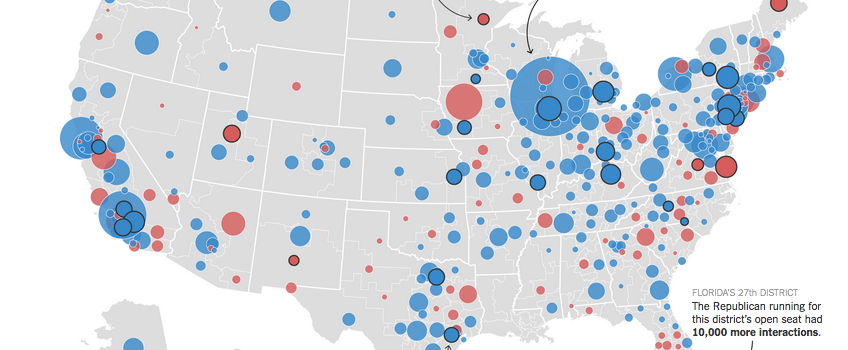
A New York Times analysis of data from the Facebook and Instagram accounts of hundreds of candidates in next month’s midterm elections reveals that Democrats — and especially Democrats running for House seats — enjoy a sizable national lead in engagement on the two influential platforms.
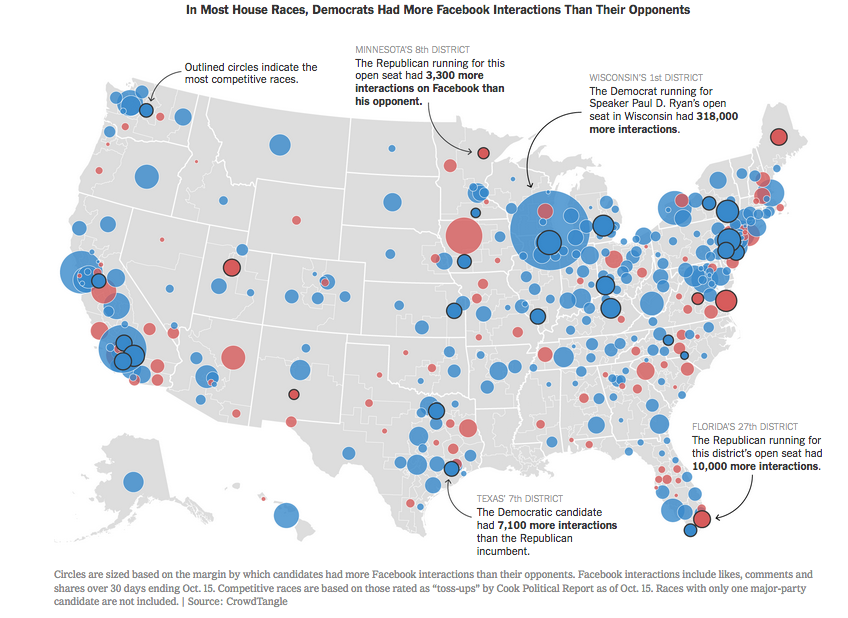
But the analysis of the engagement data, which includes all non-advertising content, also shows that Republicans in many closely contested races for Senate and governor are faring better on Facebook than their Democratic challengers.
The data, collected from more than 53,000 posts by more than 1,100 accounts, reflects a month’s worth of social media activity by nearly all of the Republican and Democratic candidates running for House, Senate or governor this year. The data, which covers 30 days ending Oct. 15, was gathered using a Facebook-owned tool called CrowdTangle. The tool counts the number of times users comment on, react to or share a user’s posts, a measure of popularity known as “total interactions.”
The data includes public posts made by candidates on Facebook and Instagram. It does not include paid ads unless those ads began as organic, non-paid posts that were subsequently “boosted” using Facebook’s advertising tools. It also does not include activity on private accounts, or posts made visible only to specific groups of followers. In instances where candidates had an official government account as well as a campaign account, both accounts were included in the calculations. In some instances, politicians who are independent, but who caucus with Democrats or Republicans, were included on those parties’ lists.
Together, the data amounts to a revealing picture of how those candidates’ messages are resonating with a digital audience, and how social media activity both mirrors and departs from more traditional polling methods.
It also shows that Democrats often dominate the conversation on Instagram, but Republican candidates are finding their biggest audiences on Facebook, the largest and most influential social network.
Measuring total interactions on social media is an imperfect way to gauge a candidate’s electoral chances, in part because it does not distinguish between types of engagement. A negative comment left on a Republican candidate’s page by an angry Democrat would still count as an interaction, for example. In addition, it does not account for the fact that some candidates have more followers than others.
But social media engagement can be a crude measure of popularity, and a bellwether of shifts in public opinion that often turn up in polls days or weeks later. In 2016, many polls and pundits gave Mr. Trump little chance of winning, but his performance on Facebook was soaring, bolstered by millions of dollars in targeted advertising. His digital campaign director, Brad Parscale, later credited Facebook’s scale and influence with his victory.
As some Republican lawmakers accuse Facebook of anti-conservative bias, the party’s candidates are still intensely interested in using it to get elected. Even the most tech-skeptical candidates have recognized that when it comes to modern political campaigning, there is no avoiding Facebook.
“Facebook is the most widespread platform, and for campaigns, it’s like broadcast television,” said Tim Lim, a Democratic digital consultant. “You have so much reach, and so many ad units, and probably more eyeballs than anywhere else.”
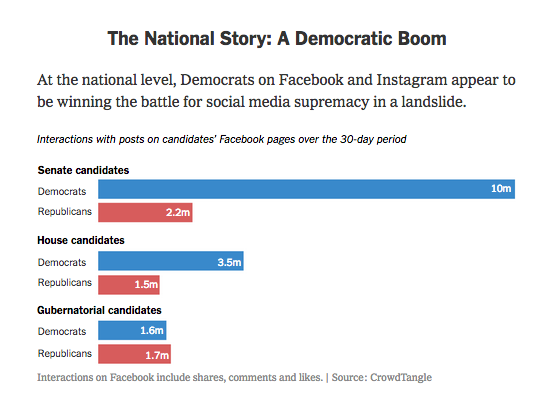
Democrats running for House, Senate and governor’s seats in this fall’s elections received a combined 15.1 million interactions on Facebook in the 30-day period, roughly three times the 5.4 million interactions received by Republican candidates.
Some of the Democrats’ social media gains can be attributed to a well-organized online resistance movement. An influx of small-dollar donations has given Democrats a large fund-raising lead, which has allowed them to spend more on digital campaigning and advertising. A surge in involvement from organizations like Tech for Campaigns — which has mobilized nearly 10,000 volunteers from the tech industry to help Democratic campaigns use digital tools — has also helped.
Jonathan Strauss, a former advisor to Democratic campaigns who is now head of product at Swing Left, said that investments made by Democrats after Mr. Trump’s election were paying dividends.
“I don’t want to jinx anything, but we’re definitely doing a lot better than 2016,” Mr. Strauss said.
The Democrats’ Superstar Problem
Democrats’ national success on social media may not translate to the “blue wave” many liberals are hoping for in November.
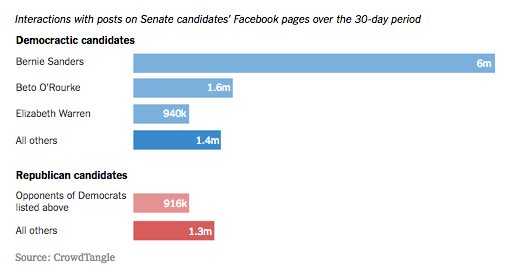
That’s because much of the left’s firepower is concentrated among a few of its high-profile candidates — namely, Senators Bernie Sanders of Vermont, Elizabeth Warren of Massachusetts, and the Texas Senate candidate Beto O’Rourke, who has more than 600,000 followers on Facebook and Twitter and more than 250,000 on Instagram.
Of those candidates, only Mr. O’Rourke is running in a competitive race this year.
During the 30-day period, Mr. Sanders, Ms. Warren and Mr. O’Rourke accounted for 86 percent of Democratic Senate candidates’ Facebook interactions and 92 percent of their Instagram interactions.
If you strip away those three Democrats and their challengers, the left’s social media advantage in Senate races virtually disappears.
Excluding Mr. Sanders, Ms. Warren, Mr. O’Rourke and their challengers, Democrats and Republicans are essentially tied, with Democrats getting only about 8 percent more Facebook interactions over the 30-day period.
Part of the popularity of Mr. Sanders, Ms. Warren and Mr. O’Rourke on social media is their political personas, which are punchy, passionate and tailor-made to resonate with fired-up progressive audiences online. They also have dedicated digital staff members and sophisticated tools to create custom content and test various messages for impact.
Smaller campaigns often have fewer resources devoted to digital campaigning, and few have captured the attention of huge online audiences.
“We only have one Beto O’Rourke,” said Mr. Lim, the Democratic consultant. “In reality, we should have 20 Beto O’Rourkes.”
Instagram Is for Democrats
In addition to revealing which candidates are finding the biggest audiences online, the data also hints at the partisan balance of each network.
Instagram, the Facebook-owned photo app, has a younger and more progressive crowd than its parent company’s namesake social network.
In the past 30 days, the number of interactions on Democrats’ Instagram accounts dwarfed those on Republican accounts. These interactions were again led by Mr. Sanders, Ms. Warren and Mr. O’Rourke, whose posts received a combined 5.2 million favorites and comments in the past 30 days.
The political tilt of platforms reflects the demographics of the people who use them. According to the Pew Research Center, Facebook is used by 65 percent of Americans over 50, and by 58 percent of rural users and 60 percent of users with a high school degree or less, all groups that often lean more conservative.
Instagram, by contrast, is most popular with users between ages 18 and 29, who tend to vote for Democrats.
In Close Races, Some Republicans
Are Surging on Facebook
Of course, not all midterm races matter equally.
The social media activity in races rated as toss-ups by the Cook Political Report, an independent election analyst, mirrors many recent polls, which show a slight edge for Republicans in the Senate and an edge for Democrats in the House.
In five of the nine toss-up Senate races, Republicans received more interactions on Facebook than Democrats.
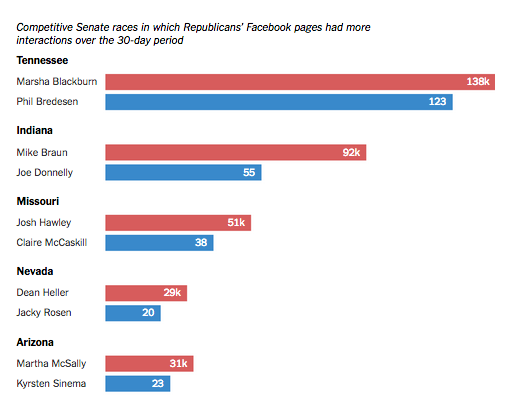
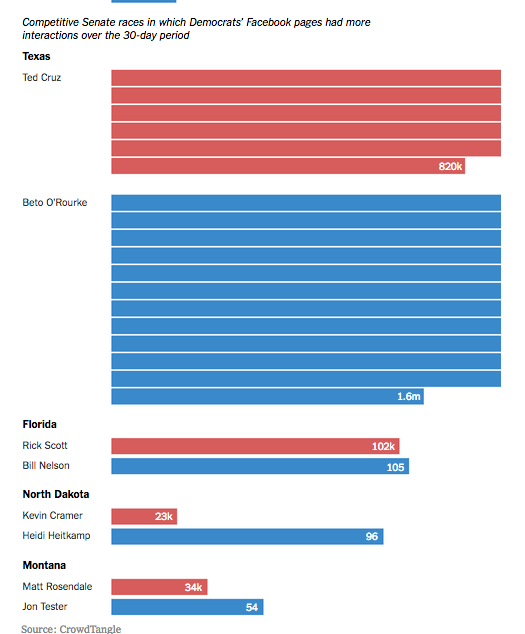
In Tennessee’s Senate race, for example, Representative Marsha Blackburn, a Republican who is leading in the polls by a slight margin, got 77,000 more interactions on Facebook over the 30-day period than Phil Bredesen, her Democratic opponent. (Mr. Bredesen has an overwhelming lead on Instagram, where he got more than three times as many likes and comments as Ms. Blackburn.)
In five of 10 gubernatorial toss-up races, Republican candidates saw more engagement on Facebook than their opponents.
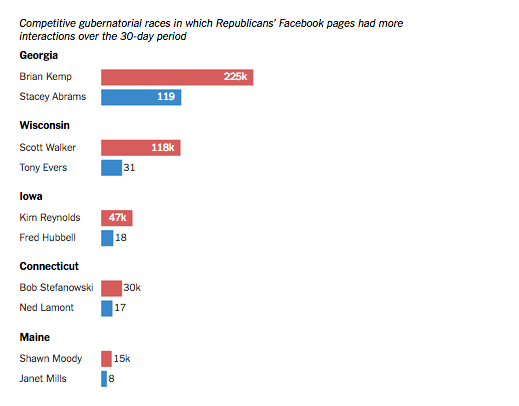
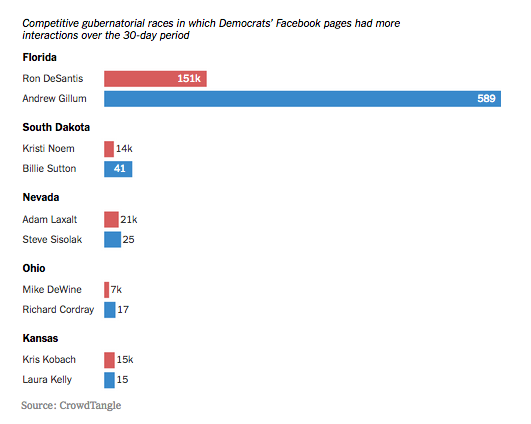
In Georgia, Brian Kemp, the Republican running for governor, has outperformed Stacey Abrams, his Democratic challenger, on Facebook. Despite Ms. Abrams having thousands more Facebook followers than Mr. Kemp, Mr. Kemp received 90 percent more Facebook interactions than Ms. Abrams over the 30-day period. His most popular post, in which he accused Ms. Abrams of raising money from “radical liberals who want to turn Georgia into the next California,” was shared more than 9,000 times.
In close House races, things look a bit better for Democrats. Of the 31 House races listed as toss-ups by Cook Political Report, Democratic candidates received more interactions than their Republican opponents in 23 of them.
Republicans Benefited More From the Kavanaugh Effect
Candidates from both parties appear to have benefited from the late September fervor surrounding the contentious confirmation of Brett M. Kavanaugh, which galvanized conservatives in his favor and created a surge in left-wing support for Christine Blasey Ford, who accused Justice Kavanaugh of sexual assault.
But Republicans in close races appear to have benefited slightly more from a “Kavanaugh bump” than Democrats.
In Indiana’s Senate race, Mike Braun, the Republican running against the incumbent Democrat, Joe Donnelly, was trailing Mr. Donnelly in Facebook interactions for the two weeks leading up to Sept. 27, the day that Dr. Blasey testified in front of the Senate Judiciary Committee.
For nearly three weeks following the testimony, Mr. Braun led Mr. Donnelly on Facebook by a significant margin.
In the week of Sept. 30, the period following Dr. Blasey’s testimony when the Senate would vote to confirm Justice Kavanaugh, interactions on the Facebook pages of Republican Senate candidates shot up by 64 percent. Democratic Senate candidates saw an increase of just 30 percent.
Republicans in toss-up races may have benefited even more from the Kavanaugh effect. Among the nine most competitive Senate races, interactions on Facebook for Republicans rose by 94 percent during the week of Sept. 30. Interactions for Democrats in those races remained flat.
What’s a “Like” Worth?
Political strategists disagree about the importance of social media popularity. Some think it amounts to a kind of real-time voter sentiment index, while others play it down as, at most, one piece of a successful campaign.
“Retweets don’t vote,” Mr. Strauss of Swing Left said. “All of this social engagement is really just a proxy for the results that matter, which is what happens at the polls on Nov. 6.”
For Republicans who are worried about a wave of progressive enthusiasm sweeping Democrats to victory, though, the data from swing district social media accounts may be comforting.
“The Democrats are constantly saying, ‘Oh, there’s this huge sea of angry Democratic voters and they’re ready to erupt,’” said Rory McShane, a Republican digital strategist. “There’s just as much, if not more, enthusiasm on the Republican side, and that’s seen by how much these people are doing online.”
Source: US Government Class
Share:
Heinrich seeks bipartisan appeal in New Mexico race for U.S. Senate
Santa Fe New Mexican – PIE TOWN — There are not many voters in Pie Town. In fact, there are not many voters in all of Catron County — 2,865 as of late last month. And most of them are Republicans.
So, Martin Heinrich, a freshman Democratic senator, kept it short.
Speaking at the community’s annual Pie Festival earlier this fall, Heinrich talked about water rights, hunting and keeping the local post office open.
In all, he spoke for about one minute.
There was no mention of President Donald Trump or Judge Brett Kavanaugh, who had just gone through his first round of confirmation hearings for a seat on the U.S. Supreme Court. Heinrich certainly made no mention of his two opponents.
For the candidate of a party that seems to be banking on an anti-Trump backlash to win congressional races around the country, it seemed an unlikely approach just a couple of months ahead of Election Day.
Why not throw a few barbs?
To be sure, Heinrich was speaking to the audience in front of him. But it seemed to reflect something about his entire campaign so far.
“Trump will take care of the backlash by himself,” Heinrich said. “People want something proactive.”
The senator had just worked his way through a line of local residents, shaking hands, posing for photos and receiving plenty of thanks for his work on the post office issue — a big deal in a town of a little more than 100 people. Now, he was headed to get some pie because what else do you do at the pie festival? A folk band was playing and kids ran around the town’s park.
For a moment, the strategy all seemed to make sense. You could not get much further from Washington politics.
Heinrich, 47, has spent much of his first term playing up his pragmatic side. Often looking as if he just walked out of an REI catalogue, he can fluently speak about hunting and fishing in the backcountry. But he also has shifted further to the left on a number of issues, from marijuana to gun control.
So, while he has sought to be viewed as one of the hook-and-bullet crowd, he is increasingly signing on to the priorities of progressive Democrats.
Has he not moved to the left?
“I’m not the kind of elected official who makes big movements one way or another,” Heinrich said. “I think about things over time. I watch what’s going on. And I make a decision based on what I can. The facts and the data.”
Heinrich can come off as trying to offer a little something for nearly everybody. It was a tried and true formula for men like Domenici, Bingaman, Montoya: U.S. senators from New Mexico who were familiar and familial enough to be known by their first names — Pete, Jeff and Joe — as much as their voting records.
In this day and age, however, that kind of one-size-fits-many governance may not be enough for anyone.
Trump already has tilted the ideological bent of the U.S. Supreme Court, kneecapped the Affordable Care Act and slashed corporate tax rates in what Heinrich argues was a giveaway to the rich. His opponents are an unabashed conservative, Republican Mick Rich, and Libertarian Gary Johnson, a former governor who is blunt that the federal government needs to overhaul major programs like Medicare.
For all his talk about bipartisanship, the biggest thing Heinrich has to offer his base has nothing to do with joining arms with Republicans and everything to do with being the one candidate in this race who could be a fairly reliable bulwark against them.
The way here
Heinrich was born in Fallon, Nev., and grew up in Cole Camp, Mo., where his dad worked as an electric company lineman and his mom as a factory worker.
He graduated from the University of Missouri-Columbia with a degree in engineering. After college, he settled in New Mexico with his girlfriend, Julie Hicks. They married in 1998 and Heinrich ended up running the Cottonwood Gulch Foundation, a nonprofit group promoting environmental education. In past interviews, he has chalked up the move to the state’s scenery and culture. But the city would also prove to be fertile ground for a political career.
In 2003, he won a seat on the Albuquerque City Council and cut a direct path to Congress; he won a seat representing New Mexico’s 1st Congressional District in 2008. And four years after that, he won a race for U.S. Senate.
New Mexico was arguably more of a purple state at that time than it is now. After all, it was not too far removed from having had a Republican senator. And Gov. Susana Martinez would handily win a second term in 2014.
But jump ahead to 2018 and the political landscape has shifted, with New Mexico becoming bluer, the Democratic Party defining itself roughly through its opposition to Trump, and gridlock becoming the status quo in Congress.
Depending on whom you ask, Heinrich’s approach to the times has either been deliberate and thoughtful or overly cautious and coldly calculated.
Take guns, for example.
Heinrich hedged on the issue when he first got to the U.S. Senate. He had an A rating from the National Rifle Association while in the U.S. House. And the senator has angled to keep sportsmen in his base.
But he publicly split with the NRA in recent years, quitting the organization and coming out in support of a new ban on so-called assault weapons as well as high-capacity magazines.
Then, there is marijuana.
Heinrich was noncommittal about legalizing the drug when first elected. But he took to Twitter earlier this year to support legalization.
Johnson’s supporters argue Heinrich has been behind the curve on issues like drugs. This dovetails with the oft-cited point that Heinrich’s family has moved to the Washington, D.C.-area, where his wife works at a public relations consulting firm. Rich accuses Heinrich of having abandoned the state.
Is he just a politician?
Others say all of this is just Heinrich’s style.
“I think Martin kind of tows a pragmatic line,” said Garrett VeneKlasen, a supporter who was recently a candidate for land commissioner and got to know the senator about 10 years ago while fishing.
Indeed, Heinrich has seemed most at home talking about issues that appealed to more than Democratic voters, like public lands. He pushed for the creation of the Organ Mountains-Desert Peaks National Monument as well as the Río Grande del Norte National Monument and has backed the expansion of wilderness areas from the Columbine-Hondo to the Sabinoso.
Meanwhile, he has touted bipartisan efforts to change how the federal government pays for fighting wildfires and pushed with Republicans to save Amtrak’s Southwest Chief route. In 2014, Heinrich even traveled to a small island in the Pacific Ocean with Arizona Republican Sen. Jeff Flake for a Discovery Channel show called Rival Survival. It was a reality television version of bipartisanship.
None of this is to say Heinrich has shrunk from being a Democrat. He has supported the Affordable Care Act and emerged as a leading critic of the National Security Agency. His guest at the president’s State of the Union address this year was New Mexico’s teacher of the year, who also happened to have been brought to the country as an undocumented immigrant when she was a child.
And this year, it is bread-and-butter Democratic issues, not bipartisan legislation, that he seems to be betting will be the key to his re-election.
With polls showing his two opponents splitting many of the same voters and Johnson, a two-time presidential candidate, performing well among independents, Heinrich’s best path to re-election may be rallying the party faithful.
In his television ads (he is the only candidate on air at the moment), Heinrich pledges to protect Medicare and Social Security, contrasting himself to Johnson. He has signed on to legislation such as Sen. Bernie Sanders’ “Medicare for All” bill. And he opposed Kavanaugh’s nomination from the start.
Still, Heinrich is a pragmatist or a realist or perhaps more simply put, a shrewd politician.
Ask him, for example, what would be the best way to extend health insurance to everyone.
“I’m not that doctrinaire about how you get there,” he said.
Instead, Heinrich suggested the country should probably expand on programs it already has.
“I do think if you’re going to build a program and you have to bring the public along. The best thing you can do is to build on programs that already exist,” he said. “Expansions to either Medicare or Medicaid, I think, are the right way to get there.”
Or, take Heinrich’s vote to confirm Ryan Zinke as Secretary of the Interior. As might have been expected, Zinke has infuriated environmentalists, no small part of the Democratic Party’s base.
But Heinrich defends his vote, pointing out the Trump administration did not cut the size of two national monuments in New Mexico that it had put under review. And it stopped dragging its feet on a land deal that expanded the Sabinoso Wilderness after he went horseback riding with Zinke at the site in San Miguel County.
“I don’t regret it,” Heinrich said of his vote to confirm Zinke. “I don’t think I would have the relationship that I have with him if I hadn’t. I know he would have gotten confirmed. And I worry as to how those two monuments and Sabinoso would have turned out if I hadn’t been able to press my case.”
Some could argue that if ever there were a moment to go at the other side with everything you have got, this would be it. In a recent interview, Heinrich ticks off a list of the Republicans he sometimes worked with on legislation. Flake is leaving, as is Bob Corker of Tennessee. Dean Heller of Nevada may be on the way out, too.
If voters don’t want compromises and deal-makers these days as much as they want crusaders, zealots and evangelists, it begs the question where Heinrich fits in the Trump era.
That is not how Heinrich reads the moment, at least not in New Mexico. Certainly not in Pie Town.
The local fire chief had just stopped to chat with Heinrich about the post office and raising some money for a new playground. A slide behind the two men bent precariously as one child after another descended.
Heinrich the pragmatist, Heinrich the engineer, Heinrich the politician, took stock of the scene.
“People are hungry for optimism right now,” he said. “What have we done well? What can we build on? How do we diversify and how we do move this state forward? I wanted to run a campaign based on the places I can have an impact on.”
Martin Heinrich
Age: 47.
Profession: U.S. Senator.
Experience: Member of the U.S. House of Representatives from 2009-12. Member of the Albuquerque City Council from 2003-07, with one term as council president. Former natural resource trustee for the state of New Mexico and executive director of the Cottonwood Gulch Foundation.
Education: Bachelor’s degree in mechanical engineering from University of Missouri-Columbia.
Family: Married with two sons.
Criminal record: None.
Source: US Government Class
Share:
Midterm Seat Loss Averages 37 for Unpopular Presidents
Gallup Polling – WASHINGTON, D.C. — The president’s party almost always suffers a net loss of U.S. House seats in midterm elections. However, losses tend to be much steeper when the president is unpopular. In Gallup’s polling history, presidents with job approval ratings below 50% have seen their party lose 37 House seats, on average, in midterm elections. That compares with an average loss of 14 seats when presidents had approval ratings above 50%.
Source: US Government Class

Share:
Study: Recent network Trump coverage has been negative
Washington Post – The mainstream-media critics over at the Media Research Center have been evaluating “evaluative” statements about President Trump on the three main nightly newscasts — ABC’s “World News Tonight,” “CBS Evening News” and “NBC Nightly News.” Over the summer — June, July and August — 91 percent of such statements have been negative, as opposed to 9 percent positive, the organization has determined. “Analyzing the networks’ spin makes it clear that the goal of all of this heavy coverage is not to promote the President, but to punish him,” write Rich Noyes and Mike Ciandella in a posting on NewsBusters, the very prolific blog of the MRC.
For the sake of comparison, Harvard University’s Shorenstein Center earlier this year found that negative Trump coverage swamped positive Trump coverage over his first 100 days in office. See the chart below, but beware: Those red and green bars don’t include a significant portion of the coverage that Shorenstein categorized as “neutral.”
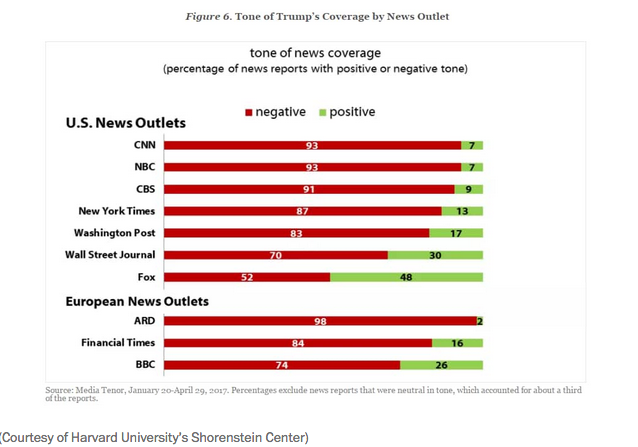
In their nightly newscasts over the summer, the MRC found, the big three networks covered the Russia investigation with 415 minutes (94 percent negative); the effort to repeal and replace Obamacare with 176 minutes (97 percent negative); the North Korean nuclear saber-rattling with 136 minutes (86 percent negative); and Trump’s reaction to the violence in Charlottesville with 97 minutes (97 percent negative). “All Presidents deserve critical news coverage from time to time, but the relentlessly hostile coverage Trump has seen thus far is as much a reflection of the media’s ideological bias as anything else,” conclude Noyes and Ciandella.

Perhaps it’s as much a reflection of reality as anything else. Take Obamacare: Here, the president promised to do away with his predecessor’s signature domestic program and has failed to deliver. Meanwhile, his administration has proceeded to undercut the existing system. Just what would positive coverage look like? And on the mid-August Charlottesville rallying with neo-Nazi and Ku Klux Klan groups: One day, Trump was citing problems with “both sides”; then, in prepared remarks, he called out neo-Nazis; then he returned to his both-sides line of analysis. How to engineer a positive spin on that progression?
Another finding in the MRC analysis relates to volume. Whereas the networks devoted just 10 percent of their airtime to President Barack Obama in 2015 and 2016, according to the MRC, they’re bingeing on Trump. More than a third of their airtime over the summer hovered over Trump, and more in the preceding months. Again, there’s a reality-based explanation here. Trump appears to relish creating news, which he frequently does on his Twitter account and elsewhere. Remember his explanation as to why he announced the pardoning of former Maricopa County, Ariz., sheriff Joe Arpaio just as Hurricane Harvey bore down on Texas? “In the middle of a hurricane, even though it was a Friday evening, I assumed the ratings would be far higher than they were normally,” said the president.
Source: US Government Class

Share:
Taylor Swift urges fans to vote in midterm elections at American Music Awards
CBS News – For the month of October so far, 153,978 people have registered to vote. In the entire month of September, 190,178 people registered to vote.
In Tennessee, voter registration for October has already outstripped September registration figures. At this point, 5,183 have registered in Tennessee, compared to 2,811 for September.
The pop star — who lived for several years in Tennessee — told her Instagram followers that though she remained quiet in the past about her politics, she had to speak out against Blackburn because her “voting record in Congress appalls and terrifies me.” Swift added, “These are not MY Tennessee values.” Swift objects to Blackburn’s opposition to certain LGBTQ rights and her vote against the Reauthorization of the Violence Against Women Act in 2013.
The singer echoed her own political Instagram post and said, “And you know what else is voted on by the people is the midterm elections on Nov. 6. Get out and vote. I love you guys.”
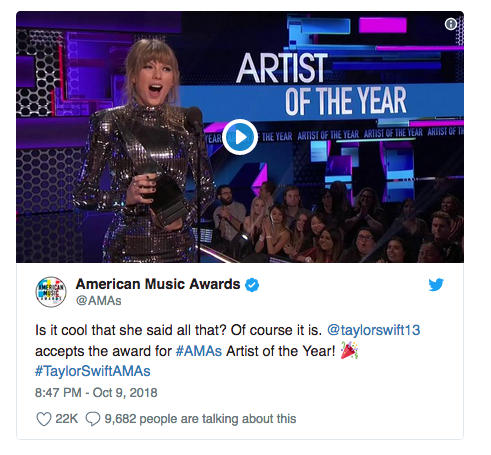
Swift wrote in her Instagram announcement Monday that she is supporting Tennessee’s Democratic Senate candidate Phil Bredesen, who is running against Republican Marsha Blackburn for Sen. Bob Corker’s seat.
According to the group Vote.org, Swift’s post to her 112 million Instagram followers seems to have “helped bring out young voters.” “A majority of new registrations since Sunday have been from people between 18 and 29 years old,” the group said in a release Tuesday. About 64,000 out of the 105,000 total new registrations nationwide since Sunday are in this age group.
For the month of October so far, 153,978 people have registered to vote. In the entire month of September, 190,178 people registered to vote.
In Tennessee, voter registration for October has already outstripped September registration figures. At this point, 5,183 have registered in Tennessee, compared to 2,811 for September.
The pop star — who lived for several years in Tennessee — told her Instagram followers that though she remained quiet in the past about her politics, she had to speak out against Blackburn because her “voting record in Congress appalls and terrifies me.” Swift added, “These are not MY Tennessee values.” Swift objects to Blackburn’s opposition to certain LGBTQ rights and her vote against the Reauthorization of the Violence Against Women Act in 2013.
Source: US Government Class
Share:
Joe Biden not running for President in 2020 — ‘at this point’
CNN – Former Vice President Joe Biden sidestepped a question Wednesday about his 2020 intentions, saying he is not running for president “at this point.”
Speaking at an event in London, Biden was asked about whether he could provide the best alternative to President Donald Trump when it comes to foreign policy.
Instead, Biden argued every potential Democratic contender for the 2020 presidential campaign would adopt a “more enlightened foreign policy” than the current president.
“I think there are many people in the Democratic Party that can defeat Trump and not a single aspiring candidate that I can think of for the nomination — and I am not one at this point — does not have a better understanding and formulation of American foreign policy than President Trump,” Biden told CNN during a question and answer session at an event at Chatham House.
“I’m not being rankly partisan here — the President acknowledged at the outset he didn’t know a lot about foreign policy. He said he watched the news, although I think he’s getting more and more informed out of necessity,” he added. “I think there are any number of potential candidates seeking the nomination from (California Democratic Sen.) Kamala Harris to a whole range of people in my party who would pursue a much more enlightened foreign policy than the President.”
The former vice president has said he will decide whether to pursue a presidential bid after the midterm elections. Trump has previously described the prospect of running against Biden in 2020 as a “dream.”
Biden’s comments came after he delivered remarks on the transatlantic relationship at Chatham House. During those remarks, he refrained from criticizing the President directly by name but warned of a “siren call of phony nationalism and populism and xenophobia that exists in many western democracies today, including the UK and the United States of America.”
Trump has turned to criticizing his potential rivals, including Biden, during campaign events. At a rally in Kansas last week, the president called Biden “Sleepy Joe” and noted the former vice president’s suggestion that if he were in high school, he’d take Trump “behind a gym” after his crude comments about women captured on the infamous “Access Hollywood” tape.
“I’d love that,” Trump said. “Go like this,” he said, blowing into his hand, “and he’s down. He would never get up.”
Source: US Government Class
Share:
Sen. Heinrich’s challengers Rich, Johnson tout tax cuts; he warns of rising federal debt
Santa Fe New Mexican – If there is one thing U.S. Sen. Martin Heinrich’s two challengers can agree on, it is cutting taxes.
Heinrich, the Democratic incumbent, opposed President Donald Trump’s signature tax bill last year. Republican Mick Rich has touted the measure and Libertarian Gary Johnson has argued for not only cutting taxes but for cutting government spending.
As unusual as the three-way race has been, it is following a nationwide trend when it comes to taxes. Republicans hope to ride the Tax Cuts and Jobs Act of 2017 to victories around the country in the Nov. 6 election.
But while Rich and Johnson are appealing to fiscal conservatives, Heinrich offers a darker view of the measure. Heinrich said the tax cuts Congress approved last year represent a giveaway to the rich and will only increase the national deficit, prompting cuts to programs such as Medicare and Social Security.
In turn, the Tax Cuts and Jobs Act has become a key part of each campaign’s pitch. Rich and Johnson contend they will back measures to rein in the federal government and lower taxes on businesses. Heinrich counters that re-electing him will ensure something of a bulwark to support programs many New Mexicans rely on to make ends meet.
“You’re seeing a concerted effort to now say, ‘Well, the budget’s not balanced so we have to go after these programs,’ ” Heinrich said in an interview.
He said he will not accept cuts to Medicare, Medicaid or Social Security. Instead, Heinrich argued the federal government will have to undo some of tax cuts.
“We’re going to have to raise taxes because this is just a terrible use of money,” he said, adding that much of the tax cuts have gone not to workers but stock buybacks for corporate shareholders.
In Johnson’s pitch to fiscally conservative voters, this seems to be what he hopes will set him apart. Republicans applaud cutting taxes. But he is pushing to rein in government more broadly, such as withdrawing soldiers from wars overseas and decriminalizing drugs.
“I happen to believe the key to success is not just lower taxes but lower spending,” Johnson said in a recent interview.
And yes, that includes changing major programs such as Social Security and Medicare, he added.
The federal government’s deficit is a catastrophe waiting to happen, Johnson said.
And while many on both sides of the Senate have been cautious about overhauling Medicare of Social Security, Johnson said plenty of voters recognize the need to take big steps to reduce the deficit.
To Johnson, the question for politicians is: “Are you going to be scared or are you going to fess up to the reality that what you’re doing is unsustainable?”
Rich said the tax cuts, which significantly lowered corporate rates, are already helping businesses to grow in New Mexico. The owner of a construction company in Albuquerque, Rich points to the oil fields in Southern New Mexico, contending cutting corporate tax rates encouraged them to invest even more in the already booming Permian Basin.
“Tax reform changed the ability of oil companies to invest in these oil fields,” he said.
Whether the Tax Cuts and Jobs Act of 2017 has really been a boon for New Mexicans might depend on who you ask.
Some might argue the legislation will spur businesses to expand and hire more workers — sorely needed in a state that still claims one of the highest rates of unemployment in the country.
An analysis by the right-leaning Tax Foundation estimated the bill would create 6,881 full-time jobs in New Mexico by 2027.
Still, while the Tax Foundation projects the average tax cut in New Mexico this year will amount to $1,391, other organizations such as the liberal-leaning Institute on Taxation and Economic Policy warn most New Mexicans will see their taxes rise within a decade. The biggest beneficiaries, the institute says, will be the state’s wealthiest residents.
And New Mexico also has an inordinately high rate of people relying on programs and jobs that are at least in part funded by the federal government, from Medicaid to military bases.
For many families, the tax savings may prove relatively small.
So, the big question is whether that will be enough to sway voters.
Source: US Government Class