


Share:
Harris backs ‘Medicare-for-all’ and eliminating private insurance as we know it
(CNN) – California Sen. Kamala Harris fully embraced “Medicare-for-all” single payer health insurance at a CNN town hall Monday and said she’s willing to end private insurance to make it happen.
“We need to have Medicare-for-all,” Harris told a questioner in the audience, noting it’s something she feels “very strongly” about.
When pressed by CNN’s Jake Tapper if that means eliminating private insurance, the senator answered affirmatively, saying she would be OK with cutting insurers out of the mix. She also accused them of thinking only of their bottom lines and of burdening Americans with paperwork and approval processes.
“The idea is everyone gets access to medical care,” she responded when Tapper asked if people who like their insurance would get to keep it. 
It was an answer that Republicans immediately jumped on. Michael Ahrens, rapid response director for the Republican National Committee, said on Twitter, “Dems in 2019: If you like your plan, we’re eliminating it.”
Many Americans don’t want to give up their private plans for universal coverage. A recent Kaiser Family Foundation poll found that 74% of respondents favor creating a national health insurance program similar to Medicare, but allowing people to keep the coverage they currently have. Only 56% said they favor Medicare-for-all, in which all Americans would get their insurance from a single government plan.
Still, the question — and answer — is important to “Medicare for all” supporters on the left, who — despite being pleased at the policy’s growing popularity — worry that it could be watered down in a crowded primary field.
“There’s going to be a question if any of those (other potential presidential candidates) take power: Do they actually want to create a single-payer program or is it just a messaging strategy to win people over with big ideas?” Waleed Shahid, a spokesman for the progressive group Justice Democrats, told CNN last year. “Do they support the end of private health insurance in the United States of America? Because that is what the bill is proposing to do. We’re going to get way more into the specifics than we did in 2016.”
Harris framed Medicare-for-all as a moral question, saying, “We have to appreciate and understand that access to health care should not be thought of to be a privilege. It should be understood to be a right.”
The current system, where insurers are more focused on profits, is “inhumane,” she said.
Harris noted that her mother was fortunate to have Medicare when she dying of cancer a decade ago. Last month, the candidate wrote an opinion piece in The New York Times saying she will fight for a better health care system in her mother’s name.
Source: US Government Class
Share:
Dems push bills aimed at making voting easier
Santa Fe New Mexican – Fresh off a midterm election that saw unusually high turnout for a midterm, New Mexico lawmakers are working on multiple pieces of legislation that proponents say would make it easier to register to vote and to cast a ballot.
Democrats in the state House of Representatives are pushing ahead with bills that would automatically register voters when they get a driver’s license and allow voters to sign up on the day of an election.
Backers argue the measures would boost participation in elections. But critics say such laws could open up opportunities for voter fraud, and some election administrators say they do not have the equipment or staff for some of the proposed changes.
Either way, as some states have moved in recent years to tighten restrictions on voting, New Mexico appears poised to head in a different direction.
“They are in the position to make New Mexico one of the most voter-friendly states in the country,” Secretary of State Maggie Toulouse Oliver said Friday.
Toulouse Oliver, a Democrat, has thrown her support behind House Bill 84, which would automatically register qualified voters when they obtain a driver’s license.
New Mexico is already a so-called motor-voter state, where drivers have the option of registering to vote when they go to a licensing office.
This bill would flip that process around, giving motorists the choice of opting out.
The Secretary of State’s Office said in an analysis of the bill that the measure would boost voter registration by as much as 30 percent, or 385,000 voters.
If it adopted automatic voter registration, New Mexico would join 15 other states, a mix of red and blue, as well as the District of Columbia.
Another measure, HB 86, would allow voters to registers at a polling place during early voting or on Election Day.
Voter registration currently ends 28 days before an election.
Toulouse Oliver told a House committee Friday that the 28-day cutoff for voter registration is arbitrary. It might have made sense when county clerks were dealing with paper voter rolls, but the state’s systems are very different today and can handle same-day registration, she argued.
Plenty of voters show up on Election Day to cast a ballot but have not registered, she said.
And proponents argue it would make voting all the more convenient, particularly for younger people.
“It’s the direction our new voter base is asking for,” said Rep. Patricia Roybal Caballero, a Democrat from Albuquerque and co-sponsor of the bill.
The New Mexican found that while younger voters cast ballots in larger numbers than usual last year, older voters were still overrepresented, with people older than 50 amounting to 63 percent of the voters who participated in the 2018 general election. Advocates for engaging more young people in the electoral process have said same-day registration is one method for boosting turnout among relatively youthful voters.
But the state’s association of county clerks has come out against the proposal, raising concerns that election administrators might not be able to handle an influx of registrations and pointing out that some are already short-staffed.
Lea County Clerk Keith Manes pointed out that not all polling locations have internet access to reach the statewide voter database and that the cost of new equipment could prove substantial for some communities.
“Not to mention the potential for fraud,” he wrote in an email.
HB 86 would require voters who register on the day of an election to show some sort of identification verifying their address.
But Republicans have argued that opposition of county clerks is cause for concern.
More broadly, GOP lawmakers have raised concerns that neither measure provides for adequate verification of whether a voter is qualified to register or not.
“It seems there’s a potential for more nonqualified electors to then be in the system, and there need to be some checks and balances on the other side,” Rep. Greg Nibert, R-Roswell, told the House State Government, Elections and Indian Affairs Committee.
When it comes to getting a driver’s license, the Secretary of State’s Office says voters already have to present documents showing whether they are a citizen or attest under penalty of perjury that they are a citizen. Either way, the process requires more documentation than filling out a voter registration card.
And the Secretary of State’s Office contends that reducing the number of paper registration forms it receives would cut down on data entry and typographical errors in the voter rolls.
Still, all of this is unlikely to assuage the long-running concerns of Republicans who question whether the state has made it too easy to commit voter fraud.
The House State Government, Elections and Indian Affairs Committee voted along party lines Friday to advance the automatic voter registration bill. It goes next to the House Judiciary Committee.
The elections committee is expected to vote in the coming days on the same-day voter registration bill.
Democrats want changes to felon voting bill
A House committee on Friday voted along party lines to advance a bill that would end the practice of suspending felons’ voting rights, opening the way for prison inmates to cast ballots from behind bars, critics argued.
But at least one Democrat said he will not vote for the bill unless lawmakers change it in another committee.
“What this bill does is that anybody in jail, out of jail at any time can vote. That’s not a bill I can support,” said Rep. Daymon Ely, D-Corrales.
New Mexico law allows felons to vote once they have completed their sentences.
House Bill 57, sponsored by Rep. Gail Chasey, D-Albuquerque, would ensure those rights are never suspended.
Several countries, including neighboring Canada, allow at least some prison inmates to vote. But Chasey acknowledged it would be a big jump in public policy, undoing an approach that stretches back to slavery.
Indeed, lawmakers said they had received an outpouring of feedback on the measure.
The bill goes next to the House Judiciary Committee, where it is likely to be amended.
Source: US Government Class
Share:
Democrats meddle where they don’t belong — the soccer field
Santa Fe New Mexican – (OPINION) Democrats who dominate the state House of Representatives can’t get out of their own way.
They are intent on meddling in intercollegiate athletics at the University of New Mexico. UNM decided to eliminate four sports teams, a decision that should be left alone by state legislators with many more important issues on their agenda.
Instead, the Democrats say these sports programs rate as a priority.
Now they’re positioning themselves as a modern-day posse riding to the rescue of a university athletics department operating in red ink. The Democrats’ plan is to add money to the state budget to save these teams.
Legislators know the political hacks on the UNM Board of Regents were asleep at the wheel for years when it came to overseeing the school’s Athletics Department. The regents did nothing to address deficit spending until they faced a splash of publicity about taxpayers being charged for a golf junket to Scotland by UNM’s Athletics Department.
So the regents last year voted to eliminate men’s soccer, beach volleyball and men’s and women skiing.
I would have preferred that they put the football program out of its misery. This would have saved more money, but the regents were afraid dozens of people might complain if they axed football.
Rep. Brian Egolf, speaker of the House of Representatives, and other Democrats in leadership positions then joined the debate about UNM sports teams. They said saving men’s soccer is a priority.
That’s right. In a state filled with poverty, a collegiate soccer program is a priority for House Democrats. In a state where 1 in 4 kids doesn’t finish high school, a few sports teams at UNM are a matter of importance for legislators.
These are the same lawmakers who only two years ago swiped $40 million from school districts and charter schools. State government was broke then. The treasurer worried about violating state law by operating at a deficit.
Times are better now. An oil boom in the southeastern section of the state means revenue for state government should be up about $1.1 billion this year, according to state analysts.
Egolf, of Santa Fe, told me Thursday this economy provides an opportunity to save the men’s soccer program and also restore money to university academic programs.
But Title IX, the law banning gender discrimination at schools that receive federal funding, would be thrown out of whack by simply reviving men’s soccer. Beach volleyball and the ski teams also would have to be saved to maintain compliance with the law.
Democratic leaders in the House are willing to allocate taxpayers’ money to salvage those sports, too.
For the moment, the state could cover these expenses without pain. But what happens the next time revenues collapse?
Egolf told me Thursday that economists agree the oil boom in the Permian and Delaware basins shows no sign of slowing down.
Those are confident words, bordering on cocky. Every boom in extraction industries becomes a bust. This one will, too. Then state government, with shrinking revenue, would still have to pay for athletic programs that the UNM regents tried to discontinue.
Sources at UNM say saving all four sports might lead to another $5 million a year in expenses.
These athletic teams are not essential to UNM or its mission. They should not be resurrected by legislators trying to wear Superman’s cape.
Egolf holds a different view. He said regents under former Gov. Susana Martinez overreacted by cutting intercollegiate sports teams.
Men’s soccer, Egolf says, is especially worth keeping because it’s successful and made up of many players from New Mexico.
He says the state and UNM, with combined budgets of about $9 billion, can help rescue UNM’s Athletics Department, which is running a deficit of about $3.3 million.
A million here, a million there and someday even Democratic House members might admit we’re talking about real money.
Source: US Government Class
Share:
Trump tells Pelosi he plans to proceed with State of the Union next week
FoxNews – President Trump told House Speaker Nancy Pelosi in a new letter Wednesday that he still plans to deliver next week’s scheduled State of the Union address from the House floor even though Pelosi urged him to delay the speech because of the government shutdown.
The president, in his letter, said there are “no security concerns” surrounding the event, in response to Pelosi raising that as a potential issue because of the partial shutdown.
“Therefore, I will be honoring your invitation, and fulfilling my Constitutional duty, to deliver important information to the people and Congress of the United States of America regarding the State of our Union,” Trump wrote. “I look forward to seeing you on the evening on January 29th in the Chamber of the House of Representatives. It would be so very sad for our country if the State of the Union were not delivered on time, on schedule, and very importantly, on location!”
Whether the speech takes place in the House chamber remains Pelosi’s call. The House and Senate still must approve a concurrent resolution approving the use of the chamber for the State of the Union.
Last week, Pelosi urged Trump to delay his State of the Union address until the partial government shutdown ends, or submit the address in writing.
“Sadly, given the security concerns and unless the government re-opens this week, I suggest that we work together to determine another suitable date after government has re-opened for this address or for you to consider delivering your State of the Union address in writing to Congress on January 29,” Pelosi wrote.
A senior Homeland Security official later told Fox News, however, that they have been preparing for months for the State of the Union event.
“We are ready,” the official said. “Despite the fact members of the Secret Service are not being paid, the protective mission has not changed.”
On Tuesday, an official confirmed to Fox News that DHS and the Secret Service are continuing their plans for a State of the Union on Jan 29.
Even as Trump says he plans to be at the Capitol next Tuesday, the White House is readying a Plan B. White House officials told Fox News they essentially are preparing for two tracks for next week’s speech. The preferred track is an address, as per custom, at the Capitol. The second track is a backup plan for a speech outside of Washington, D.C.
In an appearance on Fox News on Tuesday, White House Deputy Press Secretary Hogan Gidley suggested the president could move the location of the speech should Pelosi block it in the House.
“There are many ways he can deliver the State of the Union address,” Gidley said on “America’s Newsroom.” “I’m not going to get ahead of anything he would announce.”
Gidley accused Pelosi of “trying to play politics with that venue.” He also dinged the speaker for suggesting it may be difficult to provide security for the event because of the partial government shutdown.
“If the Secret Service can protect the president of the United States on a trip to Iraq, chances are they can protect the American president in the halls of Congress,” Gidley said.
After Pelosi called for a delay in the speech, Trump last week abruptly denied military aircraft to her and other Democrats for a foreign trip just minutes before the congressional delegation was set to depart.
The State of the Union address, historically, has not always been delivered in person. Thomas Jefferson started the practice of submitting the address in writing, and it was not until Woodrow Wilson’s administration that the speech was delivered in person again.
The government first ran out of funding on Dec. 22, as the president requested $5.7 billion in funding for border security and construction of a border wall or physical barrier along the U.S.-Mexico border, citing an “invasion” and a “humanitarian crisis.”
Fox News’ Chad Pergram, John Roberts and Brooke Singman contributed to this report.
Source: US Government Class
Share:
Democrats’ competing bills aim to boost state’s minimum wage
Santa Fe New Mexican – How high will the statewide minimum wage go?
 |
How high will the statewide minimum wage go?
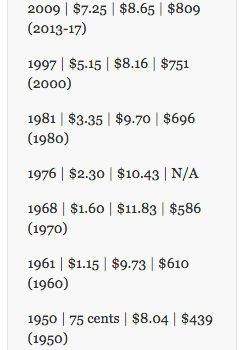
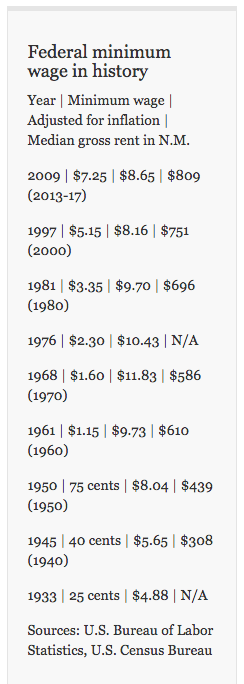
Or will it go up at all? For many business owners, those are key questions of the 60-day legislative session. The minimum wage in New Mexico, unchanged since 2009, could see an upward adjustment from $7.50 an hour. Rep. Patricia Roybal Caballero, D-Albuquerque, wants to double it to $15 an hour Jan. 1, 2020. That would make it the highest state minimum wage in the country. “So be it,” said Roybal Caballero, who has introduced House Bill 46 to create that change. “We’ve been the lowest in the nation” in many areas. “Why not be the highest in the nation?” Her bill is a long shot, having received three committee assignments in the House of Representatives. Roybal Caballero’s measure is almost certain to die with so many committees to clear before it could receive a vote by the full 70-member House. Rep. Miguel Garcia, also a Democrat from Albuquerque, is proposing a smaller increase through three annual adjustments. He wants to raise the minimum wage to $10 an hour July 1, $11 in July 2020 and $12 in July 2021. Garcia’s proposal, HB 31, advanced on a 6-3 party-line vote, from the first of two House committees assigned to hear it — a much more manageable path than Roybal Caballero’s bill faces. Both bills would adjust the minimum wage annually based on inflation — Garcia’s starting in 2022 and Roybal Caballero’s in 2021. Washington and Massachusetts have the highest state minimum wages at $12 an hour. The highest minimum wage among cities is $15.65 in Sunnyvale and Mountain View, both in California’s Silicon Valley. Among the New Mexico locales that have enacted higher minimum wages, the city of Santa Fe and Santa Fe County have a minimum wage of $11.40, which likely will rise slightly in March. Santa Fe has annual cost-of-living adjustments built into its Living Wage Ordinance. Albuquerque’s minimum hourly wage is $9.20, Bernalillo County’s is $8.85 and Las Cruces’ is $10.10. “The underlying thing is New Mexico children and families deserve a better quality of life and not worrying where their next meal comes from or how to pay the rent,” Garcia said. “Parents have to work multiple part-time jobs to make ends meet.” The U.S. Bureau of Labor Statistics in 2017 cited 14,000 people earning minimum wage. But that number was based on the federal minimum wage of $7.25. The New Mexico Department of Workforce Solutions cites the bureau’s number and does not have an employment figure based on $7.50 an hour, spokeswoman Stacy Johnston said. New Mexico has some 245,000 people, or 31 percent of its workforce, earning low wages at or near a proposed minimum wage of $12 per hour. About 159,000 or nearly 20 percent of workers are paid less than $12, said Sharon Kayne, a spokeswoman at the nonprofit New Mexico Voices for Children, which issued a report in August on the minimum wage based on data from the Economic Policy Institute. Both Roybal Caballero’s and Garcia’s bills also would eliminate the lower minimum wage for tipped workers, which is $2.13 per hour in New Mexico. That’s also the federal minimum wage for tipped workers. These employees would receive the new minimum wage, plus tips. The bill would make a big difference to workers paid the lower minimum wage for tipped workers. Alejandro Medina of Santa Fe, who works at a local restaurant, is one of them. “If I get an increase, it would help me pay rent, get a house,” said Medina, who was at the state Capitol on Tuesday, joining other low-wage workers to testify for a higher minimum wage. Medina’s family makes ends meet because his wife works, too. But that means they have to find care for their 2-year-old daughter. He says his wife might be able to stay home with their daughter if he received a raise. Restaurants and hospitality are New Mexico’s third-largest employment sector behind health care and retail. New Mexico has 3,500 restaurants with 90,000 employees, said Carol Wight, executive director of the New Mexico Restaurant Association. “Servers don’t want this,” Wight said, taking a position opposite from Medina’s. “They understand the economics of restaurants.” If the minimum wage goes up, all other wages in restaurants would have to increase, Wight said. “For every $1 increase in the minimum wage, that costs a restaurant $2,000 per full-time employee,” she said. “You can’t sell enough enchiladas to make that work. … To go from $7.50 in the rural areas to $10 immediately will be a huge burden on the restaurants.” The New Mexico Association of Commerce and Industry, the statewide chamber of commerce and business advocate, seems more resigned to the idea of an increase in the minimum wage than the restaurant association. “We understand an increase will happen,” said Rob Black, CEO of the Association of Commerce and Industry. “We don’t have a number that we think would be appropriate. Obviously, there will be a lot of interest in raising the minimum wage in New Mexico. There needs to be a responsible way of approaching that. Our concern is any efforts done would pay attention to the effect on small businesses.” Roybal Caballero would rather look at the effect of the minimum wage on the people who live on that wage. “Those taking the highest risk have to live at $7.50 an hour in 2019,” she said. “That, to me, is offensive. You’re going to need the assistance of subsidies.” The Pew Research Center reports New Mexico is among the 29 states and Washington, D.C., with a minimum wage higher than the federal minimum. But New Mexico has the lowest minimum wage among those 29 states at 25 cents above the federal minimum. An increase to $10 on July 1, as proposed by Garcia, would put New Mexico at No. 14. The issue is not merely confined to the state’s more urban areas. Even in some of its smaller towns, minimum wage matters. Todd Duplantis, owner of Cornerstone First Edition Pizza & Subs in Tucumcari, says personal ambition has a lot to do with what someone earns. “If you’re at a job at $7.50 an hour for six years, you’re not doing something right,” he said. Duplantis said he needs to keep labor costs below 30 percent of his total cost to stay afloat. He’s currently at 25 percent to 28 percent. He pays servers $5 per hour. He has seven cooks. “My cooks are not qualified to make $10,” said Duplantis, also mayor pro tem of Tucumcari. “If I had to bring everybody up to $10, I would have to raise prices 38 percent.” Mike Calhoun, owner of Red River Brewing in Red River, said a higher minimum wage could reduce his town’s affordability advantage over Colorado resorts. Colorado’s minimum wage is $11.10 per hour. “My math is it would cost a business like mine about $110,000,” Calhoun said about a $10 minimum wage. “That cost has to go somewhere. It will cost some people their jobs and prices would go up. I ballpark a 10 percent increase.” Red River Brewing has 15 to 20 employees under the age of 21. It employs 40 to 70 people, depending on the season. State Rep. Rod Montoya, R-Farmington, isn’t moved by the Democrats’ ideas. “I think they should leave the minimum wage alone,” he said. “If they are going to mess with it, they need to put in a wage for those who are just entering the workforce.” Montoya calls this a training wage. “I think the biggest hole is not leaving some sort of entry wage for teenagers. A teenager doesn’t need a living wage, just a first job.” Opponents of a training wage say it would set the stage for employers to hold down costs by firing workers when they are about to advance from trainee to the regular staff. Montoya and Wight also said employers prefer to hire more experienced people the higher the minimum wage goes. “When you raise the minimum wage, teens are left out of a job,” Wight said. Gov. Michelle Lujan Grisham, a Democrat, designated Bill McCamley, her secretary-designate of the Department of Workforce Solutions, to testify Tuesday at the hearing on Garcia’s bill. McCamley said the governor supports an increase in the minimum wage, and Garcia’s bill tracks with the adjustments she favored during her campaign. So, how high might the minimum wage go? Roybal Caballero said the political climate is right for a substantial increase. “What we need to demonstrate is a political will. My sense is we will see an increase. Right now, going in, I believe we still suffer from the residual of being under a Republican administration. We’re still thinking incrementally. We want to proceed cautiously. Why do we want to proceed cautiously? The political climate is in place. We now need to execute the political will.” |
Source: US Government Class
Share:
Appeal on monetary bonds to be heard
Santa Fe New Mexican – A federal appeals court in Denver is scheduled to hear oral arguments Tuesday in the New Mexico bail bonds industry’s legal challenge to reforms that essentially eliminated monetary bonds in New Mexico in the last few years.
The Bail Bond Association of New Mexico and five state lawmakers filed the class action lawsuit in 2017, contesting the constitutionality of new rules governing the imposition of monetary bonds after voters approved a constitutional amendment that made it legal for judges to hold dangerous defendants without bond but illegal to keep indigent defendants in jail simply because they couldn’t afford bail.
The industry claims the new rules, which greatly reduced the imposition of money bonds on criminal defendants, violate defendants’ protected rights to reasonable bond.
U.S. District Judge Robert A. Junell dismissed the lawsuit in 2017, saying it was based on a misinterpretation of the law and lacked legal merit.
“While the United States Constitution and the New Mexico Constitution forbid excessive bail,” he wrote, “they do not guarantee an absolute right to bail or money bail.”
Junell even sanctioned Albuquerque lawyer A. Blair Dunn for filing the case, saying it was frivolous and that Dunn — who was a candidate for New Mexico attorney general — appeared to have filed it for political reasons.
The U.S. Court of Appeals for the Third Circuit recently disallowed a similar challenge to New Jersey’s no-money bond system, finding there is no right to monetary bail.
But plaintiffs are forging ahead, hoping in part that the U.S. Supreme Court might agree to examine the issue in the future.
“A favorable decision for the plaintiffs by the [Denver-based] 10th Circuit… will almost certainly guarantee a trip to the U.S. Supreme Court,” the American Bail Coalition said in a news release Monday. “If the plaintiffs were to lose the case, they might also appeal to the Supreme Court. The highest court in the land has not touched the issue of bail in more than 30 years.”
Dunn said Monday his clients are “more likely than not” to appeal the case to the high court if they lose in Denver but won’t decide until after reading the court’s ruling.
“If we don’t lose everything, and we do pick up some points… it may warrant making that decision to drive legislative change in New Mexico rather than expending the resources to go to the Supreme Court,” Dunn said.
Administrative Office of the Courts Director Arthur Pepin said in an email Monday the lawsuit is an attempt by the bail bond industry to “turn back the clock on bail reform efforts approved by voters that enhance justice, fairness and public safety.”
“Because New Mexico has moved away from a money-based bail system, dangerous defendants no longer can buy their freedom with a bail bond despite the risk they could pose to the safety of our citizens,” Pepin said. “A ruling over a year ago by a federal district court judge recognized the lawfulness of New Mexico’s reform of the pretrial justice system.”
Source: US Government Class
Share:
Gas tax hike backers say New Mexico roads need funding
Santa Fe New Mexican – New Mexico’s government has not raised the tax on gasoline since 1993.
This year, that could change.
A sweeping tax bill sponsored by Democrats in the state House of Representatives would increase the tax on gasoline by 10 cents a gallon, from 17 cents to 27 cents, starting in mid-2020. The special fuels tax would go up a nickel, too, from 21 cents to 26 cents.
Backers say New Mexicans do not have to look any further than the wear and tear on the state’s highways for a reason to raise the tax, proceeds of which have traditionally paid for road maintenance.
But opponents contend the state has plenty of money to cover the cost of improving and building roads without putting the burden on taxpayers.
Economists expect the state will have more than $1 billion in additional revenue for the fiscal year that begins in July on top of hundreds of millions of dollars in a surplus for the current budget year. Some lawmakers argue a big chunk of that money should go towards infrastructure.
While plenty of lawmakers agree the state needs to spend money to improve its roads, the question is who should pay and how. Should New Mexico use the money it has now or also try to shore up a source of funding for the future?
“We’re way behind,” says Rep. Roberto “Bobby” Gonzales, a Democrat from Taos who has proposed increasing the gas tax in previous years and is a co-sponsor of this year’s legislation, House Bill 6. “We really need to catch up and to be safe.”
A report from the private nonprofit research group TRIP found that nearly half of New Mexico’s major local and state-maintained roads were in poor or mediocre condition as of 2017.
The same group estimated this had cost motorists around $900 million in vehicle depreciation, additional repair costs, increased fuel consumption and wear on tires.
Roads are a particularly pressing concern in southeastern New Mexico, where the bustle of an oil boom has taken a big toll on rural roads that were not designed for parades of tanker trucks. Improving infrastructure, then, could prove key to the boom that is buoying New Mexico’s finances as well as for economic development elsewhere.
Proponents of raising the gas tax note New Mexico already has a lower rate than all of its neighbors, according to data from American Petroleum Institute.
New Mexico’s excise tax totals 17 cents a gallon. When other fees are added, motorists pay a little less than 19 cents per gallon in state tax. Arizona charges a total of 19 cents a gallon, Texas 20 cents, Colorado 22 cents and Utah 30 cents. Nationwide, states charge an average of about 34 cents a gallon in taxes and fees.
The state’s tax does not go as far as it did in 1993, lagging behind inflation. As Gov. Susana Martinez repeatedly vetoed proposals to raise the gas tax during her eight years in office, manufacturers were marketing more fuel efficient vehicles that could give drivers more out of each gallon of fuel.
Drafts of the state budget call for steering hundreds of millions of dollars from the state’s windfall of oil revenue into infrastructure but backers of raising the gas tax argue the government needs a steady stream of revenue to pay for maintaining its highways into the future.
Using money that may not be around in future years, when the oil market tanks, could only squeeze out other priorities in the future, the thinking goes.
“We need to have a recurring revenue stream of revenue,” said Rep. Jim Trujillo, a Democrat from Santa Fe who chairs the Taxation and Revenue Committee and is a co-sponsor of House Bill 6.
Trujillo cautioned that the bill is at an early stage, with everything up for discussion.
At this point, House Bill 6 aims to lower the overall gross receipts tax that New Mexicans pay on many goods and services.
Still, going over the math of the state budget that is beginning to take shape, he argues new revenue is going to have to come from someplace and reinstating the tax on food seems to be a nonstarter.
If the state gives teachers a raise, for example, that’s a recurring expense lawmakers will have to account for in coming years.
When lean times return, he argued, New Mexico could end up right back where it was a few years ago, sweeping money meant for infrastructure to patch holes in other parts of the budget.
Republicans counter that the potentially fleeting nature of the state’s current windfall is all the more reason to put much of that money into roads and projects that will not require the same level of spending year after year.
Rep. Jason Harper, R-Rio Rancho, said the gas tax may need to be raised to keep pace with rising costs. But he argued for a more modest increase — perhaps 5 cents per gallon — if one is necessary.
But the questioned whether that is even needed this year.
“In a year when we have huge surpluses, why are we even talking about raising taxes?” said Rep. Jason Harper, R-Rio Rancho.
Critics have also long argued that increasing the gas tax is regressive, falling disproportionately on low-income people and especially those in rural areas as well as those who cannot afford newer, fuel-efficient vehicles.
All of this has combined to make raising the gas tax a very politically sensitive issue.
After all, Democrat Bruce King was the last governor to sign a law raising the gas tax. And it handed plenty of fodder for attacks by Republican Gary Johnson during the 1994 campaign. Johnson, of course, ended up winning the election.
Source: US Government Class

Share:
Shutdown in U.S., slowing growth in China fuel concerns over global economy
Washington Post – DAVOS, Switzerland — Fears are rising about the state of the world’s biggest economies, with China posting its worst annual growth in decades and the United States injecting more uncertainty with tariffs and a lengthy government shutdown.
China reported Monday that its economy expanded by 6.6 percent last year — a figure that would be good for many countries but represents the slowest growth for China in 28 years. Meanwhile, the International Monetary Fund downgraded its expectations for the global economy, highlighting sharp declines in Europe and warning that the risks of a major slowdown have increased.
The pair of announcements came as top executives and world leaders gathered in this ritzy ski resort town for the annual World Economic Forum. In contrast to a year ago — when President Trump and other world leaders talked about global prosperity — this year attendees expressed worry that the United States was undermining its own economy, and the rest of the world’s, via a trade war and the longest partial government shutdown in U.S. history.
In the United States, the shutdown has already cut into growth, according to numerous economists. Even U.S. consumers, who have remained resilient for months, have been shaken. Early this month, consumer confidence slumped to the lowest level of Trump’s presidency, according to the University of Michigan’s consumer sentiment survey.
While few see a recession as imminent, the high-level officials and executives at Davos catalogue a growing number of risks, including the trade war, the potential of Britain leaving the European Union without a final agreement with the E.U., rising interest rates, high global debt levels, and more polarized politics around the world.
“After two years of solid expansion, the world economy is growing more slowly than expected and risks are rising,” said Christine Lagarde, managing director of the International Monetary Fund. “Does that mean a global recession is around the corner? No. But the risk of a sharper decline in global growth has certainly increased.”
The scene at Davos epitomized the changes in the world economy. A year ago, Trump and other foreign leaders gathered here to try to put their differences aside. It came at a time when the major countries were growing in sync with one another, and Trump received a warm welcome after large U.S. corporate tax cuts.
But now Trump, British Prime Minister Theresa May and other world leaders are sitting out the conference, dealing with problems back at home, and the hope for expanded global business has been dashed by the trade war and other setbacks.
“I think there is anxiety. There are concerns the slowdown could be quite deep,” said John Hagel, co-chairman of Deloitte’s Center for the Edge, a research group. “The more we can show some progress and resolution of some trade disputes, that would help.”
The IMF is the latest institution to scale back its growth forecasts, following downward revisions by the Federal Reserve and many banks. The IMF predicts 3.5 percent global growth in 2019 and 3.6 percent in 2020, down from 3.7 percent forecasts for both years in the fall.
But IMF economists warned that they had already downgraded growth in China and the United States in the autumn because of the trade war and that they only see greater risks of a slide from here.
“It’s absolutely crucial for us to turn around the momentum, and policy can really help,” said Gita Gopinath, the new head of research at the IMF. “The downward revisions are modest; however, we believe the risks to more significant downward corrections are rising.”
The rapidly slowing euro zone, especially Germany, France and Italy, was the biggest factor in the revised predictions. Germany is struggling as exports weaken and its auto sector tries to adjust to new regulations. France is trying to rebound from street protests over a climate tax that have dampened sentiment. And Italy is battling debt problems and sluggish spending.
“I think it’s not ruled out that you might see one or two weak quarters in the European economy bordering on a technical recession,” said Axel Weber, chairman of UBS. But he said he was optimistic that it would be a temporary “soft spot.”
The IMF forecasts that the U.S. economy will grow at 2.5 percent this year and 1.8 percent next year. These predictions are unchanged from what the IMF said in October, but they represent a noticeable decline from about 3 percent growth last year. China is expected to grow at 6.2 percent both years, even slower than last year.
As an economy slows, it’s easier for it to be knocked off track, many economists say. “When you’re growing at 3 percent, you need a big shock to hurt the economy,” said Nariman Behravesh, chief economist at IHS Markit. “When you’re down to 1.5 to 2 percent growth, all it takes is a little shock.”
In Beijing and across China, authorities have been pulling out all the stops to try to avoid a hard landing for the economy, promoting measures that are both traditional and inventive. China’s central bank has allowed banks to lend more against their reserves, a move that could free up almost $120 billion for loans.
The central government is cutting tax rates for small businesses and reducing value-added taxes in some industries, particularly in manufacturing. It is also pouring more than $125 billion into new rail projects.

Retail sales, industrial production and property sales in China all slowed in the final quarter of last year. Car sales were particularly poor, recording the first annual drop in more than two decades, and the unemployment rate is climbing.
But many economists consider official Chinese figures too rosy.
Using a range of data to come up with a more reliable figure, Julian Evans-Pritchard, a China analyst at the Capital Economics consultancy, said that the growth rate probably slowed to 5.3 percent in the last three months of the year.
A key question is how far Beijing will go to mollify Trump and end the trade war.
“The economy is a much bigger problem for Xi Jinping than the trade war. The last thing he wants is a bunch of angry people protesting because they’ve lost their jobs,” said Andrew Collier, managing director of Orient Capital Research, a Hong Kong-based consultancy.
“Slowing economic growth is putting pressure on him to solve as many problems as he can, and the trade war will be top of his list,” he said.
In the United States, there is no end in sight to the government shutdown, and Trump has not removed any of the tariffs he put in place. Twelve percent of U.S. imports still have new levies on them, and Trump has threatened to impose more.
Trump has argued that any short-term pain will be worth the long-term benefit — border security in the case of the government shutdown, and more beneficial trade deals in the case of the tariffs.
“China posts slowest economic numbers since 1990 due to U.S. trade tensions and new policies. Makes so much sense for China to finally do a Real Deal, and stop playing around!” Trump tweeted Monday evening.
But in Davos, others argued the United States was relinquishing its historic role in the global economy.
“If you want to be a superpower in the world — and the U.S. still is — you have to engage with people,” said Hans-Paul Bürkner, chair of the Boston Consulting Group. He warned that “everybody will be a bit more careful” until the shutdown and trade disputes are resolved.
Surveys released in recent days by global consultancies show more alarm bells in boardrooms around the world.
Chief executives ranked a global recession as their No. 1 concern for 2019, according to a survey of nearly 800 top business leaders around the world released Thursday by the Conference Board. Global trade threats came in second.
A survey of 1,300 chief executives released Monday by PwC found that 30 percent of business leaders believe that global growth will decline in the next 12 months, a record jump in pessimism to about six times the number who said that last year.
The most pronounced decline in optimism was in North America, where it dropped from 63 percent a year ago to 37 percent now, largely because of the fading fiscal stimulus from the tax cuts and the ongoing trade standoff that business executives thought would be short-lived but keeps going.
“With the rise of trade tension and protectionism, it stands to reason that confidence is waning,” said Bob Moritz, global chairman of PwC. Executives “want a little bit more certainty and they want stability.”
Fifield reported from Beijing.
Source: US Government Class
Share:
New proposal floats salary for lawmakers
Santa Fe New Mexican – Rep. Roberto “Bobby” Gonzales has been in the state House of Representatives for nearly 25 years. Plenty of colleagues have come and gone. And he’s noticed something about many of those who can afford to stick around in nonsalaried jobs as state legislators.
“You have to be wealthy, retired or have a very supportive employer,” said the Democrat from Ranchos de Taos.
New Mexico is one of only a few states that do not pay lawmakers an annual salary. Instead, legislators received a $161 stipend each day they are at the Capitol or attending committee meetings.
The consequence, Gonzales argued, is that many — particularly young professionals and parents with young children — simply cannot afford to sit in the Legislature.
“That limits individuals with great potential who could be here,” Gonzales said.
With that in mind, the longtime legislator wants to send voters a constitutional amendment that would create a commission to set a salary for lawmakers.
With 112 legislators, paying each a salary likely would cost millions. And it would mark an official end to the sort of part-time citizen Legislature envisioned by the drafters of the New Mexico Constitution more than a century ago.
For some, it might well amount to a needless expansion of government. For others, though, it would represent a step toward a more professional and perhaps more diverse government.
The idea is far from new, but voters repeatedly have rejected proposals to pay more money to legislators. Several proposed amendments since the 1940s would have set a specific salary for lawmakers.
Each failed.
New Mexico long has held to the idea of a citizen Legislature. In turn, lawmakers usually have full-time jobs aside from their work at the Capitol. Some are teachers and farmers, but many others are people who have a better chance to control their own schedules and whose jobs pay better — often, lawyers and retirees.
Plenty of legislators also argue their duties can be a full-time job. There are the annual sessions, which last 30 to 60 days. Committees meet year-round. Meanwhile, constituents can be in constant contact on everything from problems at the driver’s license office to obtaining funding for a local water system.
All those obligations can rule out professionals or parents who cannot take the time off.
“I’m taking a lot of time away from my job. I’m taking a pay cut,” said Rep. Angelica Rubio, a Democrat from Las Cruces who works as executive director of a nonprofit advocacy group and is co-sponsoring the constitutional amendment. “I don’t come from money. I’m not retired. But I have a very supportive employer.”
Meanwhile, good government advocates argue that an unpaid Legislature can be too reliant on committee staff and on lobbyists who often have a hand in crafting laws.
A 2007 report noted that lawmakers and others involved in the legislative process were divided on the question of creating a salaried Legislature.
Some respondents argued that increasing compensation might allow for a broader cross section of the population to serve at the Capitol. Others felt it would not be necessary given the concept of a citizen Legislature in which members have careers beyond their political work.
Pay varies in legislatures across the country.
On the high end, California’s full-time legislators were paid $107,241 as of last year, according to the National Conference of State Legislatures.
Colorado, where regular sessions last 120 days, pays $30,000 a year, and Arizona pays a couple of thousand dollars a month. Both states also pay a per diem that varies based on how far lawmakers live from their respective capitals.
On the other end, Texas pays about $7,200 a year and a per diem. Wyoming doles out $150 a day.
The amendment Gonzales and Rubio are sponsoring would not set a salary for lawmakers but would create a commission to set a rate of pay for legislators. The governor and chief justice of the state Supreme Court each would appoint two members to the commission from different political parties. The speaker of the state House and president pro tempore of the state Senate also would get to appoint a member each. None of them could be serving legislators, family members, government employees, or current or former lobbyists.
Not only would the commission set pay for legislators, it also would set pay for the governor; all statewide elected officials; members of the Public Regulation Commission; and judges on the Supreme Court, Court of Appeals and district courts.
The House and Senate would have to approve the proposal, House Resolution 5, before it goes to voters. If they approved it, the commission would not be established until 2023.
Source: US Government Class