

Share:
In California, a campaign to oust Gov. Gavin Newsom qualifies for the ballot.
New York Times – Fueled by partisan fury and a backlash against pandemic shutdowns, a Republican-led campaign to oust Gov. Gavin Newsom of California has officially qualified for the ballot, setting the stage for the second recall election in the state’s history, officials said on Monday.
In a widely expected filing, the California secretary of state’s office found that recall organizers had collected 1,626,042 signatures on their petition, more than the roughly 1.5 million required to ask voters to remove Mr. Newsom from office.
The announcement sets in motion a series of procedural steps that will culminate in a special election. No election date has been scheduled, but it is expected to be sometime in November. Between now and then, the state will review the cost of the election, and voters who signed the petition will have 30 business days to ask to have their names removed if they so choose.
State officials say, however, that those hurdles are unlikely to prevent a vote, even though only a year or so will remain before Mr. Newsom, who was elected in 2018, comes up for re-election.
Several Republican candidates have already announced challenges to Mr. Newsom, including Caitlyn Jenner, a transgender activist; Kevin Faulconer, a former mayor of San Diego; and John Cox, a Republican businessman who lost to Mr. Newsom in 2018.
More are expected to follow, although Mr. Newsom, a Democrat, is widely expected to prevail in the deep-blue state. In recent polls, a majority of California voters have said they were disinclined to remove him from office, and his approval ratings have improved as the coronavirus crisis has waned. Mr. Newsom’s backers have characterized the recall effort as a futile bid by extremists to make Republicans relevant in the state.
Launched early in Mr. Newsom’s administration by conservative activists who took issue with his stance on immigration, the campaign gained traction late last year as the state struggled to contain the spread of the coronavirus.
But the drive did not gather real momentum until early November, when its organizers, arguing that the pandemic had impaired their ability to circulate petitions, persuaded a judge to extend the signature-gathering deadline. That evening, Mr. Newsom attended a birthday dinner for a lobbyist friend at an exclusive wine country restaurant after exhorting Californians to stay at home to curb the spread of the coronavirus.
On the night of the dinner, only 55,588 people had signed the petitions. One month later, there were nearly 500,000 signatures.
Recall attempts are common in California, but few make it onto the ballot. The last governor to face one was Gray Davis, who was ousted by Arnold Schwarzenegger in 2003.
Source: US Government Class

Share:
DC statehood: Why it should (and should not) happen
EDITORIAL (CNN) – Democrats in the House voted on Thursday to make portions of Washington, DC, the 51st US state.
It’s important because it is an official step toward creating a new state for the first time in a lifetime, but also no big deal because the proposal is DOA in the Senate, where Republicans have enough votes to block it.
This issue is not going away, however. 2021 is the second consecutive year House Democrats have voted to make DC a state.
Why do supporters think DC should be a state?
The more than 700,000 people who live in Washington, DC, don’t have a voting member of Congress — only a delegate in the House — or representation in the Senate. Seven hundred thousand people isn’t nearly the size of most states, but it is certainly more than the populations of two, Vermont and Wyoming, and on par with Alaska, each of which has two senators and a voting member of Congress.
So DC residents have no say in the federal government?
Actually, they do — a little. The 23rd Amendment, enacted in 1961, gives District residents a say in presidential elections. The District is treated like a state for that purpose only, and it gets three Electoral College votes. But that’s only one portion of the representation a US citizen should probably get.
Are DC residents the only Americans not represented in Congress?
Far from it. DC residents have it better than Puerto Ricans. The residents of that US territory are American citizens but they don’t have voting members of Congress and don’t get to vote in presidential elections unless they’re living in a state.
Wait a minute. There are more than 3 million Americans living in Puerto Rico, but only about 700,000 living in DC. Why isn’t anyone talking about making Puerto Rico a state?
They are, but the process does not have nearly as much political momentum.
Everybody should get representation in Congress. Why NOT make DC a state?
For starters, the Constitution sort of seems to say it can’t be done. Article 1, Section 8, of the Constitution says Congress should be in charge of the seat of government, which will be a “District (not exceeding ten Miles square).”
So you’d have to change the Constitution to make DC a state?
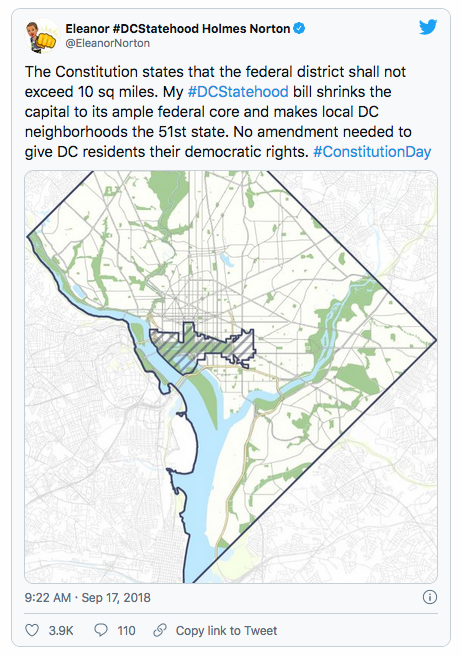
Maybe not. The bill passed by the House offers a sneaky and elegant solution. It simply shrinks the size of the federal district to the area just around the National Mall, the White House and Capitol Hill, where pretty much nobody but the President lives. The bill would make a state out of the bulk of the city. There would still be a district, but there would also be a new state.
Can you do that? Just change the size of the district?
It’s been done before. When it was originally conceived, Washington, DC, was formed from land ceded by both Virginia, west of the Potomac River, and Maryland, east of the Potomac. In the 1840s, the areas west of the Potomac rejoined Virginia in a process called “retrocession.”
What is today Arlington and parts of Alexandria used to be part of Washington, DC. Where today DC’s map looks like a square on two sides with a river bordering part of the rest, it used to just look like a square. This new proposal would shrink it even further.
Why was Alexandria allowed to retrocede in 1846?
The main stated reason was that the former Virginians on the west side of the Potomac felt neglected by the power base across the river, where the federal buildings were being erected. The real reason may have been that the Virginians feared slavery would be outlawed in DC and they would lose the slave market in Alexandria.
Why haven’t DC residents been given full rights before?
The short answer is equilibrium. Or Republicans’ version of it, considering there are fewer Republicans in the US than Democrats. And two senators elected from DC would almost surely be Democrats, so with the Senate currently split 50-50, expect the GOP to fight this tooth and nail.
Is there a middle ground? Why not just give most of the Maryland side of DC back to Maryland?
DC residents have their own all-or-nothing approach, choosing not to pursue retrocession of the portion of the District that was formerly part of Maryland. That would give DC residents a say in Congress without upsetting the current equilibrium.
“DC voters have already said loud and clear that we do not want retrocession, we want statehood,” Mayor Muriel Bowser said in 2019. She has repeatedly rejected this idea.
What would happen to the 23rd Amendment if Congress made DC a state?
The bill before Congress says the US would start undoing the amendment. But it takes an amendment to undo an amendment. A constitutional amendment takes years of effort. While the statehood bill envisions a fast track to this process, it’d have to work flawlessly, otherwise the few people who still lived in the federally controlled district might continue to get three electoral votes. (This type of thing will be the subject of lawsuits.)
What do Americans in general say?
About two-thirds of Americans opposed making DC a state in a Gallup poll in 2019. Interestingly, polling found the reverse for Puerto Rico — two-thirds of Americans supported statehood for the territory.
What’s it take to make a new state?
Adding a state does not require a constitutional amendment. It just requires the OK of the House, the Senate and the President, although Congress can — and usually has — made it more complicated than that.
When was the last time a state was added?
1959. See that note about equilibrium above. In the late 1950s, when Dwight Eisenhower was President, Alaska and Hawaii were added at roughly the same time. Since the Senate operates with a requirement for a supermajority (60 senators) to enact legislation, Republicans can effectively block any moves by Democrats to make DC or Puerto Rico a state.
This will be one of a large number of reasons a lot of Democrats are calling to end the filibuster. Republicans have already been chipping away at the filibuster, too.
Are there any other obstacles?
The plan to simply shrink the capital district is clever. But it’s not a foregone conclusion that it’s legal. The Supreme Court currently has a Republican-appointed majority, and it’s an open question how it would rule if Republicans took the case to court.
Anything else?
Yes. So much more. It’s certainly worth noting that Democrats in particular have been talking about fundamental changes to the US system of government in recent years. A lot of Democrats want to change the format of the Supreme Court, and overhaul the Electoral College, which gives so much power to states with fewer people.
There’s also the weirdness of a country where such tiny states have such power int he Senate, which can put a stop to any legislation it wants. If we’re going to add seats for DC, why not add seats by breaking up California or Texas or Florida, massive states that only get two senators.
Last thing: Where would you fit a 51st star on the American flag?
Great question. People are already thinking about that. But trust me. They’d find space.
Source: US Government Class
Share:
Governors Urge Biden To Order 100% Zero-Emission Car Sales By 2035
NPR – Governors from a dozen states are asking President Biden to ban the sale of cars and light trucks that emit greenhouse gases by 2035.
In a letter to the president, the governors of California, New York, North Carolina and nine other states — all but one a Democrat — asked for the change ahead of a White House climate summit, scheduled to begin Thursday.
“By establishing a clear regulatory path to ensuring that all vehicles sold in the United States are zero-emission, we can finally clear the air and create high-road jobs,” the governors wrote in the letter.
“Moving quickly towards a zero-emission transportation future will protect the health of all communities,” they added.
Between now and the target date, the governors called for “significant milestones along the way to monitor progress.”
The other signatories were Massachusetts Gov. Charlie Baker, the lone Republican, and the governors of Connecticut, Maine, New Jersey, New Mexico, Oregon, Washington, Rhode Island and Hawaii.
The 12 governors also called on the Biden administration to set standards and adopt incentives to ensure 100% zero-emission sales of medium-duty and heavy-duty vehicles by 2045.
While the letter urges a transition to entirely zero-emission vehicles by that date, it does not specifically call for the elimination of gasoline-powered vehicles.
The 2035 goal matches one already adopted by California. The other states whose governors signed have ambitious goals to increase zero-emissions vehicles, such as electric vehicles, and/or invest heavily in such technology in the coming years.
The letter follows similar appeals in March from 71 House lawmakers and 10 senators, all Democrats, urging Biden to reinstate Obama-era vehicle emissions standards through 2025 and do more to move the U.S. in the direction of electric vehicles. They urged the president “to set a date by which new sales of fossil fuel vehicles will end entirely.”
In 2020, electric vehicles made up less than 2% of the U.S. car and light-truck market, according to IHS Markit, but the research firm expects that figure to surpass 3.5% nationally in 2021.
The United Auto Workers, in a letter to the White House in March, urged caution, saying any plan to increase zero-emission vehicles should take “the present market realities into consideration,” according to Reuters.
“Neither the current trajectory of consumer adoption of EVs, nor existing levels of federal support for supply- and demand-side policies, is sufficient to meet our goal of a net-zero carbon transportation future,” it said.
Last month, Biden invited the leaders of 40 countries to participate in a virtual White House summit to “underscore the urgency — and the economic benefits — of stronger climate action.”
As part of the meeting, the administration is expected to promise to reduce U.S. greenhouse-gas emissions sharply, help poorer countries pay for the costs of climate change and encourage the rest of the world to announce new, bolder climate goals.
The summit, set to run Thursday and Friday, is part of Biden’s effort to reverse course from the Trump administration, which withdrew from the Paris climate accord and sought to weaken auto emissions standards and generally roll back environmental regulations.
Biden has pledged to restore much of what Trump undid. Among other steps since taking office, he has had the U.S. rejoin the Paris Agreement.
Source: US Government Class
Share:
Teacher raised $41,000 to help local families hurt by COVID-19. He now owes $16,000 in taxes.
CBS News – Louis Goffinet, a 27-year-old teacher in Connecticut, said he started a fundraiser a year ago to aid local families affected by the coronavirus pandemic. The campaign was a smashing success, collecting more than $41,000 to help them pay for groceries, meals and rental assistance.
But Goffinet said he recently learned of a downside to his efforts: He now owes $16,031 in personal income tax on the funds he raised via Facebook Fundraisers.
“After consulting with several tax professionals, the unanimous consensus seems to be that I am responsible for paying income tax on the funds I was able to raise through Facebook,” Goffinet wrote in a Facebook post.
In his April 10 post, Goffinet is again turning to charity — this time to cover his own tax bill. “This is more than I can reasonably afford to pay alone, and am asking for the community’s help,” he wrote.
In an interview with CBS MoneyWatch, Goffinet said he was in “genuine shock” after getting the tax form.
“I had spent the better part of my 2020 devoting my weekends and free time to volunteering and helping the community,” he said. “It was a powerful thing to be part of it. But then to be told not just by the 1099-K, but to be told by tax professionals that I do owe taxes on funds I raised for my community, it didn’t feel right.”
Goffinet said he raised funds through two Facebook fundraisers, one to assist local families with groceries and the other aimed at providing financial help over the holidays. He didn’t create an IRS-approved charity, but instead deposited the funds in his bank account and then spent the money on whatever local families needed, he told the Hartford Courant, which earlier reported on his predicament.
Goffinet told CBS MoneyWatch that he’s concerned his experience may send the wrong message to other would-be volunteers and samaritans.
“Part of the message people are seeing now is it’s not worth it to help others because you will only set yourself up for a really tough situation,” he said. But, he added, he plans to continue his efforts in some way.
“This is probably the most rewarding thing I’ve done,” Goffinet said.
Facebook said that it’s unable to provide tax advice to people who use the platform to raise funds because individual situations can vary and the tax code can change from year to year.
Pitfalls of donating via Facebook
The 8th-grade math and science teacher said he organized two fundraisers: One at the start of the pandemic, which helped pay for groceries for community members in need, and another in November to help with holiday meals and gifts. He said he paid for 31 Thanksgiving dinners, and provided 20 gift cards for families to buy holiday gifts, on top of about 140 grocery store visits.
In early 2021, he received a 1099 form from Stripe, the payment processing company used by Facebook, stating that he would owe more than $16,000 on the fundraisers, he said.
Goffinet’s tax bill is due May 17, the date of the extended filing deadline set by the IRS. The situation highlights the pitfalls of raising funds through online services such as Facebook, rather than donating money through an IRS-qualified charity.
Facebook cautions in its terms of service for personal fundraisers that it is “solely your responsibility to assess, collect, report or remit the correct tax, if any, to the appropriate tax authority.” Donations made through personal fundraisers “generally are not tax-deductible under applicable law,” the company notes.
Goffinet said Facebook should more explicitly state that raising money for a cause on the site could cause a tax liability.
“Especially in a circumstance like this, where a fundraiser is set up for a broader community and not one individual person’s gain,” he said. “I don’t think it’s clear enough to warn people like me that even if you are going to turn around and pass on all the money you raised, that there is still an income tax burden on that.”
In the meantime, he said he has received some donations from people who want to help him pay his tax bill — including two offers from people who said they would cover the entire IRS bill once the final amount is certain.
“I would really encourage people who are considering something like this to go out and do it — and make sure you are well versed on the tax code,” Goffinet added.
Source: US Government Class
Share:
Biden will hold a big climate summit this week to reestablish U.S. leadership. Not everyone may follow.
Washington Post – President Biden will convene dozens of world leaders this week for a virtual climate change summit, marking not only an effort to restart the global push to address the rising threat but also the new president’s first grand gesture as a world leader.
But it’s far from certain that other nations will follow suit if Biden pledges, as expected, that the United States will aim to significantly cut emissions, given the logistical and economic challenges of doing so. That makes the summit a political and diplomatic risk.
Beyond that, this is the first time a global summit has been held virtually and live-streamed around the world, and it is difficult to predict what various world leaders, especially those who relish tweaking the United States, will say when given the opportunity.
Biden has already rejoined the Paris climate accord that Trump renounced and signed a slate of executive orders to reverse his predecessor’s environmental and climate decisions. But officials, activists and allies describe this week’s meeting of approximately 40 leaders as Biden’s first major effort beyond wiping away Trump’s policies.
“The president wanted to convene this summit early in his presidency to ensure close coordination with key players in the international community and at the highest levels of government,” said White House press secretary Jen Psaki. “Obviously, the United States is one of the world’s largest emitters, but so are a number of countries who will be represented.”
She said the session, which will feature speeches, scientific presentations and smaller virtual “breakout sessions,” would address technological innovation, job creation and ways to pay for the far-reaching changes needed to slow the pace of climate change.
Yet the perils for Biden are clear, while the summit unfolds, as he is trying to steer the United States past the coronavirus pandemic and navigate disputes with the leaders he has invited, including Russian President Vladimir Putin and Chinese President Xi Jinping.
Biden also risks raising expectations among close allies, especially in Europe, who are delighted by the U.S. turnabout but skeptical about its long-term commitments in a volatile American political environment. The summit will examine ways to reduce warming through the rest of this decade, a span longer than Biden will be in office.
“The rest of the world was deeply relieved” when Biden rejoined the Paris accord, said Rachel Kyte, dean of the Fletcher School of Law and Diplomacy at Tufts University. “But the rest of the world also knows that the United States has a political system that means that it could leave again.”
The summit will be of little value, Kyte said, unless Biden’s updated climate pledge is sufficiently ambitious. Only that will give the administration credibility to keep pushing other major economies to follow suit ahead of a key United Nations climate conference this fall in Scotland.
“It’s always easier to be able to say, ‘Do as we do, not do as we say,’ ” Kyte said.
The administration’s expected aggressive plan to cut U.S. emissions — probably around 50 percent by the end of the decade, compared with 2005 levels — has been telegraphed by officials for weeks. It would basically double the goal first put forward by President Barack Obama as part of the 2015 Paris climate agreement.
The hope is that such an ambitious U.S. pledge would give Biden and European allies more leverage with other key countries, such as China, Russia, India and Brazil. While the United States remains the world’s second-largest emitter, roughly 85 percent of global emissions now come from other nations.
Some Biden advisers hope that other top emitters will show up with bolder promises this week, but it is not clear that any will.
“This is a crucial early moment, and it’s a moment for the U.S. to shine, to show it’s really committed,” said Rachel Cleetus, policy director of the climate and energy program at the Union of Concerned Scientists. “This is a moment not just for rhetoric about leadership. We have to lead by example.”
Her group is among a growing number of voices that have pushed the Biden administration not only to declare that the United States intends to lead on climate, but to do so in a big way.
More than 300 businesses, including Apple, Starbucks and Walmart, wrote an open letter to Biden recently asking for a bold pledge.
Environmental groups, Democratic lawmakers and other world leaders have expressed similar expectations, saying Biden needs to put the United States on par with the sort of aggressive promises the United Kingdom and the European Union already have locked in.
“Rejoining [Paris] is not enough. We have to show the world that we are willing to contribute in a robust way” that won’t be undone, Cleetus said.
Biden’s effort and the new target come as the president is trying to secure billions from Congress for infrastructure, job creation and pandemic recovery, including funding for some of the practical shifts required for the country to attempt a major emissions cut. Additional money would also be required, along with changes in behavior and priorities for American businesses, workers, families and governments.
A U.N. climate report released Monday described a “relentless” worsening of climate conditions in 2020 and concluded that the coronavirus pandemic has done little to slow the warming of the planet.
U.N. Secretary General António Guterres asked countries to commit to a target similar to the one Biden will probably endorse: a cut in global emissions of 45 percent by 2030. “The climate is changing, and the impacts are already too costly for people and the planet,” Guterres said Monday.
At a news conference, Guterres welcomed a joint statement over the weekend that pledged U.S.-Chinese cooperation on climate change.
The United States and China, the world’s two biggest carbon polluters, agreed to address climate change with “seriousness and urgency” during talks last week between Biden’s climate envoy, John F. Kerry, and a counterpart from China.
In Europe, Biden’s election has been greeted with relief.
For four years, Europeans stood largely alone on climate issues as Trump pulled the United States out of any leadership role. They talked to Beijing about potential goals, but few European policymakers felt they had much sway without Washington’s participation.
“I really want to tell our American friends, ‘Welcome back, welcome home,’ ” French President Emmanuel Macron said in December, greeting Biden’s plans to rejoin the Paris accord.
Now Europeans see a new chance to seize the moment, especially as Biden also seeks to mend other irritations from the Trump years. They say that their long-term goals — to completely decarbonize their economies by 2050 — for the first time line up with U.S. ambitions, thanks to Biden.
“When you look at the dependency of China on exports, you see that if we set new standards to access the E.U. and the U.S. market, the two of them amounting to 40 percent of the global economy, then it will have a direct impact on China,” said Pascal Canfin, a French lawmaker who heads the environment committee of the European Parliament and is an ally of Macron. China “will have to change its process to comply,” he said.
European allies have greeted Kerry’s involvement with similar enthusiasm. He is well known to European leaders from his tenure as Obama’s second-term secretary of state. Some top policymakers said they trade text messages with Kerry about strategy and believe they have an advocate in the White House.
Kerry has already begun traveling around the world, including recently to China, to make the case that the Biden administration is serious about rejoining the climate fight in a big way and to urge other countries to take part.
Some nations that are still industrializing have been reluctant to make major commitments to cut emissions. But European officials said the combined forces of the United States and Europe will have a powerful influence.
“It will be quite an effort to convince other major players in the world to do the right thing,” the top E.U. climate official, European Commission Vice President Frans Timmermans, said when Kerry visited Brussels last month. “But I am absolutely convinced that the United States and Europe working together, we can move mountains and make sure we hand over a climate our children and grandchildren can live in.”
Christiana Figueres, a former U.N. climate chief who oversaw the Paris agreement negotiations in 2015, said Biden has already gone a long way toward establishing American bona fides by rejoining the compact. Doing so was a key part of Biden’s 2020 presidential campaign platform.
“On the other hand, four years went by, and in those for years, the science has become much more granular, and we understand the urgency much more than we did,” so signing back up to the Paris goals won’t be enough, Figueres said.
The new U.S. emissions target will help, and most other nations will welcome seeing Biden take some responsibility for the United States having fallen short in the past, she said.
“Everybody understands that democracy has a price,” she added. “I think actually there will be excitement and gratitude that U.S. is finally sitting at the adult table again.”
Birnbaum reported from Chicago. Quentin Ariès in Brussels contributed to this report.
Source: US Government Class
Share:
Watchdog groups, others critical of proposed New Mexico utility merger
Santa Fe New Mexican – Public Service Company of New Mexico’s proposed merger with a Connecticut company is good for shareholders but of scant benefit to customers, numerous watchdogs and government entities say.
Hearings on PNM’s and Avangrid’s merger before the New Mexico Public Regulation Commission are scheduled to start May 3 and may continue through much of the month. Testimony already filed with the commission reflects skepticism, at the least — and in many cases opposition.
Stephen Fischmann of Las Cruces, chairman of the Public Regulation Commission, said there could still be an agreement reached between the “intervenors” — entities that have weighed in on the merger — and PNM and Avangrid. The commission would have to approve such an agreement.
“It’s a complicated issue that’s going to take a lot of review by all parties involved,” Fischmann said. “There’s all kinds of potential outcomes, and as commissioners, we have to keep an open mind. … And our charter is the public interest.”
Although the criticisms vary, one that stands out comes from the New Mexico Attorney General’s Office and other entities: the big benefit PNM shareholders will enjoy compared with the slight rate change customers are expected to see.
Building their arguments from the merger application and a question-and-answer discovery process, critics also expressed concern about environmental issues, lack of competitiveness in the market and high payouts for officers, directors and departing executives.
“This merger is not in the public interest,” said Mariel Nanasi, executive director of Santa Fe-based New Energy Economy.
Nanasi said “this might be the biggest change in the electric industry in 50 years in New Mexico.”
An expert for Nanasi’s group, former utilities attorney Christopher Sandberg, said if PNM has about 80 million shares outstanding, with an expected increase per share at $3.29 in the merger, the 7,902 shareholders (as of Feb. 19) would profit by an average of more than $32,000.
Meanwhile, he said, the merger applicants propose “trickling out” $24.6 million of rate credits to hundreds of thousands of customers, including business customers, over 36 months. The benefit would average 59 cents per month per residential customer, he said, based on a usage formula provided by PNM.
A consultant for the attorney general called the customers’ gain of $24.6 million minimal. But shareholders’ gain of $713 million is a different matter, said Scott Hempling, a Maryland attorney and public utilities analyst speaking through testimony submitted for the Attorney General’s Office.
“Customer benefit was nearly irrelevant,” Hempling said of the proposed merger. He contended “the sole goal was value for shareholders; customers were relevant only as sources for that value.”
Avangrid will pay $4.3 billion to shareholders as part of the agreement, he said.
Adding to the complexity of the deal is the fact that Avangrid is largely owned by Iberdrola, an energy company based in Spain.
Attorney General Hector Balderas said in a statement: “I strongly support the transition of the state’s largest utility to Avangrid, a leader in clean energy, but I remain concerned that the deal results in overwhelming profit for PNM” — profit that will largely leave New Mexico.
Balderas said he remains committed to “equitable distribution of clean energy to underserved New Mexicans and ensuring benefits to consumers.”
Ray Sandoval, a spokesman for PNM, said in a written statement: “PNM Resources shareholders own the 86 million shares of PNM Resources stock, and this merger involves the purchase of all of the PNM Resources stock by Avangrid shareholders. PNM customers receive electricity services and pay for the services they use, but do not own any of the business or its infrastructure — similar to paying for mobile phone services or wireless internet.
“PNM customers will continue to receive services,” his statement continued, “and Avangrid has made significant commitments to continue PNM’s operations and contributions to the community, and to add 100 new jobs and provide additional economic development funding. In addition, Avangrid has committed to pay customers rate credits as a gesture of goodwill and demonstration of its good intentions for this transaction.”
Sandoval also said that each party commenting on the proposal “shares with us an interest in our state’s future. We look forward to working with them throughout the proceeding.”
PNM’s partner in the plan supplied a statement late last week that said in part: “Avangrid has a record of bringing jobs, rate credits and better service to the communities we serve. We are committed to doing the same in New Mexico. … We are ready to partner with ratepayers, workers and communities to benefit the entire state.”
Critics see various problems with the proposed merger. Some scoff at what they view as small concessions to the state in the giant deal.
For instance, the proposal mentions creating 100 jobs in the state — critics ask where and what kind of jobs — and giving $2.5 million to economic development, which one analyst described as “parsimonious,” or stingy.
Avangrid already has two wind-energy projects in New Mexico, in the Encino area of Torrence County. A commission staffer has said in both cases, full compliance with orders wasn’t achieved.
Avangrid said it corrected documentation issues on one of the projects this month when it learned about the concerns.
Groups including the Sierra Club, the city of Albuquerque, Bernalillo County, the San Juan Citizens Alliance and Tó Nizhóni Ání, a Navajo community organization, have filed analyses and critiques with the PRC.
The Sierra Club criticized an element of the merger in which Avangrid requires PNM to unload its stake in the Four Corners Power Plant. PNM intends to transfer its interest in the plant to the Navajo Transitional Energy Co., which plans to keep the plant operating for at least a while.
“PNM shouldn’t get out of Four Corners by prolonging the life of a dirty, polluting power plant,” Matt Gerhart, a Sierra Club attorney, said by email. He said PNM “is planning an exit that harms everyone else, including everyone who breathes air in that area as well as our children.”
Larry Blank, a New Mexico State University faculty member and consultant in utility industry policy, said PNM holds a monopoly in electric service over much of New Mexico. New technology will emerge for production and storage of renewable energy, he said.
But with Avangrid and PNM involved in alternative power in the state, Blank said, they could chase off competitors and “stifle adoption of the most innovative ways” for New Mexico to procure alternative power.
Analysts also criticized payouts that are expected to go to executives.
Andrea Crane, a financial consultant testifying for the Attorney General’s Office, said the merger is expected to lead to the termination of three officers who will be compensated with “golden parachutes” totaling about $31 million. Two others will get “golden parachute compensation of $3.17 million and $2.99 million respectively,” Crane said.
She also said that based on shares held, six corporate officers and 10 directors anticipate compensation totaling between $84.3 million and $94.3 million.
The commission’s own staffers also found the commission shouldn’t approve the plan in its current form. John Reynolds of the commission’s utility division observed, as Blank did, that the presence of Avangrid and PNM in the renewable energy market here “would likely chill a competitive climate.”
Reynolds said: “There will undeniably be a loss of independence for PNM as well as additional risk exposure to Iberdrola’s global activities and investments that will bear little connection to PNM’s local mission.”
Source: US Government Class
Share:
Republicans slam ‘assault’ on Supreme Court by Dems’ court-packing bill, say move will help GOP in elections
FoxNews – Republicans recoiled Wednesday night and Thursday morning over a bill some Democrats are proposing to pack the Supreme Court, calling it an “assault” on judicial independence.
But they also predicted that the move would prove unpopular and help Republicans in the midterm elections.
“Democrats are launching a full assault on the independence of the federal judiciary. Republicans will stop them,” Rep. Ken Buck, R-Colo., said in a tweet.
“This is such a fantastic gift to the NRSC,” added Matt Whitlock, a former staffer at the National Republican Senatorial Committee (NRSC). “And making it a bill instead of a Senate rules process means we get to get moderate House D’s on the record on it too. Just a fantastic turn of events.”
Sen. Ed Markey, D-Mass.; House Judiciary Committee Chairman Jerrold Nadler, D-N.Y.; Rep. Hank Johnson, D-Ga.; and Rep. Mondaire Jones, D-N.Y.; will announce the bill at 11:30 a.m. Thursday in a press conference on the steps of the Supreme Court.
The legislation would expand the Supreme Court to 13 seats. There are currently nine seats on the court. That number has remained the same since 1869.
Some Democrats have been loudly calling for the expansion of the Supreme Court after former President Donald Trump had three nominees confirmed during his presidency. They decry some of the rulings the court has issued, accusing the justices of being biased toward Republicans.
“Republicans packed the court when Mitch McConnell held Merrick Garland’s seat open nearly a year before an election, then confirmed Amy Coney Barrett days before the next election. Disarming the Court’s radical right-wing majority would correct this injustice,” Jones said Thursday.
But court-packing is not filling empty seats on the Supreme Court, as Jones says. It instead means adding seats to the Supreme Court in order to change the results of its rulings. The term was first coined when it was unsuccessfully attempted by former President Franklin Delano Roosevelt.
Jones added Wednesday that expanding the Supreme Court “is infrastructure.”
“He doesn’t even mean this is a parody, which is what makes it great. His moderate Democrat colleagues facing tough races next year won’t thank him for this stunt,” Whitlock responded.
Democrats’ court-packing proposal is in contrast to comments made by Justice Stephen Breyer last week opposing court-packing.
“My experience of more than 30 years… as a judge has shown me that once men and women take the judicial oath they take that oath to heart. They are loyal to the rule of law, not to the political party that helped to secure their appointment,” Breyer said. “These considerations convince me that it is wrong to think of the court as just another political institution and it is doubly wrong to think of its members as junior league politicians.”
Breyer added: “Structural alteration motivated by the perception of political influence can only feed that latter perception, further eroding that trust. There is no shortcut.”
Republicans said that they plan to fight hard against the Democrats’ effort. The conservative Judicial Crisis Network (JCN) is launching a $1 million ad campaign, spanning three weeks, opposing the court-packing bill. The ads will air on national cable and in the Washington, D.C., area.
“The Left and the liberal dark money groups that support them won’t stop agitating to pack the Court,” JCN President Carrie Severino tweeted. “They won’t be satisfied with a report from a commission. They want to pack the Court with politicians in robes who will advance their radical agenda.”
Some Republican senators also weighed in.
“Packing the court is an act of arrogant lawlessness. Those behind this effort spit in the face of judicial independence,” Sen. Mike Lee, R-Utah, said.
“Here are some facts: The Supreme Court isn’t supposed to be America’s super-legislature; Democrats don’t have some historic mandate in a 50-50 Senate to nuke the Court; the progressive activists who wrote this bill are high on their own supply; and a whole bunch of sane Democrats are quietly praying this thing dies,” Sen. Ben Sasse, R-Neb., said. “The court-packing bill is delusional.”
Added Sen. Tom Cotton, R-Ark.: “Packing the Supreme Court would destroy the Supreme Court. The Democrats will do anything for power.”
Sen. Steve Daines, R-Mont., meanwhile said that he will reintroduce a resolution against court-packing. This follows constitutional amendments proposed earlier this week by Rep. Mike Gallagher, R-Wis., and earlier this year by Rep. Dusty Johnson, R-S.D., that would limit the number of justices to nine.
“Packing the Supreme Court is an attack on our Montana way of life,” Daines said. “It is a blatant power grab by the Democrats to pave the way for the Left’s radical agenda. We cannot let this happen. We must protect our freedoms and the future of our country.”
“It’s taking over an entire branch of government, the judicial system, and it’s packing them,” House Minority Leader Kevin McCarthy, R-Calif., said in a radio interview. “It goes against everything we believe as Americans… It goes against what Joe Biden back in the day when he was a senator would say ever to do.”
“This should scare every single American, regardless of where you stand politically,” McCarthy added in an interview on “Mornings with Maria.” “This just goes to show how far the Democrat Party has moved. There almost are no longer common-sense or moderate Democrats elected… It’s overtaking a branch of government simply to have your control over a nation. It must be the scariest thing I’ve ever heard them do.”
Other high-profile Republicans, including Senate Minority Leader Mitch McConnell, R-Ky., have yet to weigh in. Several moderate Democrats, including Sens. Joe Manchin, D-W.Va., and Kyrsten Sinema, D-Ariz., Rep. Jared Golden, D-Maine, and Josh Gottheimer, D-N.J., also have not commented on the bill.
But the legislation is highly unlikely to pass.
Democrats can only lose two votes in the House and still be able to pass a bill. And in the Senate, they would need to get rid of the legislative filibuster to pass their court-packing bill. Manchin and Sinema have said they will not do that. Manchin also previously said he opposes court-packing.
Source: US Government Class
Share:
The art of persuasion: How past presidents have tried to nudge Supreme Court justices off the bench
CNN – Early in President Barack Obama’s second term, while fellow Democrats still controlled the Senate, the President asked Justice Ruth Bader Ginsburg to a private lunch at the White House.
At the time, some liberals were calling for Ginsburg to step down to allow Obama to name a younger liberal, just as some Democrats today are urging Justice Stephen Breyer, 82, to retire and give President Joe Biden a chance to appoint a new justice.
The White House lunch, Ginsburg recalled months later in a 2014 interview, sped by and the justice, an unhurried eater, barely had finished her first course when the second arrived. The conversation ranged, but Obama never
inquired directly about retirement.
Asked whether she thought he might have been fishing for any sign of her plans, the justice, already into her 80s, said no.
“I don’t think he was fishing,” Ginsburg said. Why had he summoned her? “Maybe to talk about the court. Maybe because he likes me. I like him. … If the President invites you, probably a part of you says, ‘Don’t question it. Just go.’”
Ginsburg died last September at age 87, giving then-President Donald Trump the opportunity to name a third justice to America’s highest court. Amy Coney Barrett took her seat just days before the November 2020 presidential election.
Now Democrats are eager to bring new liberal blood to the bench, as seen in all the columnists and social media wags targeting Breyer, a 1994 appointee of President Bill Clinton. The liberal Demand Justice group sponsored a mobile billboard truck last Friday to circle Capitol Hill urging Breyer to retire.
The atmosphere reflects the intense dynamic of Supreme Court successions, accelerated today by Republicans having attained three Supreme Court appointments and Democrats none in the last decade. The court is now divided between six Republican-appointed conservatives and three Democratic-appointed liberals. Among their pending cases, the justices are deciding the future of the Affordable Care Act, a clash between gay foster parents and religious interests, and access for organized labor on agricultural property.
There is no indication that Biden is pressuring Breyer to retire.
White House press secretary Jen Psaki told reporters last week she was unaware of any conversations Biden has had with Supreme Court justices since his inauguration and the President believes any retirement decision is Breyer’s to make “when he decides it’s time to no longer serve on the Supreme Court.”
Biden would not be the first president to angle for a chance to make a lifetime appointment. History is filled with examples by Democrat and Republican administrations, from the subtle to the blatant.
In 2019 and 2020, before Ginsburg’s health seriously declined, close supporters of Trump appeared to encourage
Justice Clarence Thomas, now 72, to leave so Trump could add a younger jurist on the right. Some in the White House even told The Washington Post in 2020 they were preparing for his retirement. But the three-decade veteran Thomas has proved he has no desire to leave.
Breyer has declined to comment on his plans. He gave a lively two-hour speech on Supreme Court history and politics last week and appears in good health, engaged in his work.
He knows well the politics of Supreme Court retirements. He has served for more than a half century in various posts in Washington, including as counsel to the Senate Judiciary Committee in the 1970s.
Washington appellate lawyer Deanne Maynard, who served Breyer as a law clerk in his first session on the bench from 1994-95, told CNN, “I’m sure Justice Breyer is well aware of the chatter about what his plans may be. But I’m also sure that he will make up his own mind about whether to retire and will do it on his own terms.”
LBJ’s masterful maneuvering
Under the Constitution, the Senate is responsible for “advice and consent” on judicial appointments. The chamber has a slim Democratic majority until at least the 2022 elections, and Breyer may be weighing whether to retire this year or next.
Years before Breyer’s Senate service, he witnessed first-hand the effects of presidential arm-twisting when he was a law clerk to Justice Arthur Goldberg during the 1964-65 session.
President John F. Kennedy had appointed Goldberg, then secretary of Labor, to the high court in 1962. Three years later, in 1965, President Lyndon B. Johnson persuaded Goldberg to step down and become ambassador to the United Nations. According to historical accounts, Johnson enticed Goldberg by emphasizing the role that the esteemed labor negotiator could take to end the war in Vietnam.
Johnson, a former Senate majority leader who could manipulate the levers of Washington politics, named Abe Fortas, a prominent attorney and close LBJ friend, to the Goldberg vacancy. The Vietnam War went on for another decade; Goldberg, who resigned from the UN post in 1968, later expressed regret that he had left the bench.
In 1967, Johnson hastened the retirement of Justice Tom Clark, who was just shy of 18 years on the bench, when he elevated Clark’s son Ramsey to be attorney general, a position that would have created a conflict of interest. (Ramsey Clark remained a civil rights advocate after leaving government; he died last Friday at age 93.)
Clark’s retirement led Johnson to select Thurgood Marshall as the nation’s first African American justice in 1967.
Such appointments constitute one of a president’s most enduring legacies. Biden has vowed to name the court’s first Black woman justice when the opportunity arises.
Opportunities can come suddenly, as the country saw in February 2016 with the death of Justice Antonin Scalia and in September 2020 with Ginsburg’s passing.
Sometimes, the opportunity never arises. President Jimmy Carter, who served a single term, from 1977 to 1981, failed to see a single Supreme Court vacancy.
Obama made two appointments in his first term (Justices Sonia Sotomayor and Elena Kagan), but his last nomination, in 2016, was blocked.
To succeed Scalia, Obama selected Merrick Garland, then a US appellate judge and now-attorney general, in March 2016. But Senate Republicans refused to act on the nominee, saying they were waiting to see who won the November presidential election that year.
Obama’s entreaty toward Ginsburg in 2013, when the Senate was still in Democratic hands, might have anticipated those Senate difficulties ahead.
Yet Ginsburg would not be pushed, either by the public pleas or by any subtle administration move.
“They’ve got a very good chef at the White House,” she recounted in the 2014 interview. “The problem for me is the President eats very fast. And I eat very slowly. I barely finished my first course when they brought the second. Then the President was done, and I realized that he had important things to do with his time.”
Source: US Government Class
Share:
Raising corporate tax rate ‘open to negotiation’: White House
Washington Times – White House press secretary Jen Psaki said Monday that increasing the U.S. corporate tax rate to pay for President Biden’s infrastructure proposals is “open to negotiation.”
“It’s all open to negotiation,” Ms. Psaki told reporters at the White House.
She had been asked whether Mr. Biden is set on raising the corporate tax rate as a way to pay for his spending plans or if there’s room for negotiation.
Mr. Biden wants to increase the corporate rate from 21% to 28% but has signaled he’s open to compromise.
Republicans have said the rate hike would kill jobs. Sen. Joe Manchin III, West Virginia Democrat, has floated an increase to 25%.
Ms. Psaki said Mr. Biden thinks increasing the corporate tax rate is an “entirely reasonable” way to pay for parts of the $2.3 trillion package.
She mentioned user fees as another idea that’s been floated. Some lawmakers have suggested passing a “miles driven tax” as a way to pay for repairs to bridges and roads.
Source: US Government Class