

Share:
Our political parties aren’t too powerful. They’re not powerful enough.
Read the following op-ed. Do you agree or disagree with the authors views about political parties. Be sure to explain your answer and give examples that help support your position. (Answers should be a minimum of two paragraphs)
OPINION – By David Von Drehle
Columnist focusing on national affairs and politics
Given the extreme polarization in the Senate as the final act of the Kavanaugh confirmation drama arrives, one might conclude that political parties have never been stronger. George Washington’s words in his farewell address strike a ringing chord in these bitter times. Warning against “the baneful effects of the spirit of party” (which, Washington admitted, “unfortunately, is inseparable from our nature”), the Father of his Country listed the bad effects of faction:
It “serves always to distract the public councils and enfeeble the public administration. It agitates the community with ill founded jealousies and false alarms, kindles the animosity of one part against another, foments occasionally riot and insurrection.” It even “opens the door to foreign influence and corruption,” Washington added presciently — centuries before Paul Manafort laundered his first Ukrainian hryvnia.
Yet could it be that we need stronger political parties rather than weaker ones? Political scientist Joseph Postell makes the case in an intriguing essay written for the Heritage Foundation.
Today’s gridlocked Congress and imperial presidency are the sour fruits of party decline, writes Postell, an assistant professor at the Colorado Springs campus of the University of Colorado. “The history of political parties reveals that they are the critical mediating institutions that make the American Constitution function well.”
Postell contrasts Washington’s lament with James Madison’s gradual realization that the constitutional system of checks and balances he created can’t operate without strong parties. Broad national coalitions force narrow factions and special-interest groups to moderate their demands and learn to compromise. Madison figured out that he and his fellow architects of the American government had been so frightened of mob rule in a democracy that they built a machine that would not go — and thus, paradoxically, a machine too weak to resist the tyranny of whichever small faction got its hands on executive power. Large national parties “would take the bite out of factions by incorporating them into broader movements,” Postell writes of what he calls “the Madisonian cure for the Madisonian disease.”
Robust political parties “translate majority will into public policy by focusing elections on policies rather than personalities,” Postell maintains. Today’s weakling parties, by contrast, are liable to be hijacked by celebrities, as any dismayed pre-Trump Republican conservative will attest. The current president’s approach to alliances, trade and spending all fly in the face of traditional GOP values, but the party establishment was too weak in 2016 to enforce even a shred of discipline.
You won’t read about President Trump in Postell’s paper — but you will find a nuanced discussion of Trump’s favorite precursor, Andrew Jackson. Like the current president, Jackson was a huge personality with a direct connection to his populist supporters. The flamboyant general rose to power in an era of weak parties and bitter divisions.
Enter Martin Van Buren, the hero of Postell’s paper. As a U.S. senator from New York, Van Buren eyed Jackson with alarm. “If Jackson were to win based on his personality, he would have considerable personal power once he attained office,” Postell writes. But if the maverick could be lassoed into Van Buren’s Democratic Party as its presidential nominee, “he would have to accommodate the different views of people within the party once in office.”
After Van Buren, the nation entered an 80-year period in which — with the notable exception of the Lincoln administration — presidents were weak, Congress was strong and the American political parties were at their zenith. Generations of Americans have been taught to revile the corrupt political machines that ruled the land from San Francisco to New York. But Postell reminds us of the good that was accomplished in the smoke-filled rooms: The bosses were pragmatic, and they knew how to make a deal. They knew how to get things done.
Strong parties “moderate politics by encouraging elected officials to bargain and compromise instead of engaging in endless conflict,” Postell maintains. “They reinforce the separation of powers by strengthening the legislative branch and checking the accumulation of power in the executive.”
Left unanswered, though, is the looming question: Having hollowed out the parties, how would we start to rebuild them? If anything, the trend today is toward weaker parties, not stronger ones. As Trump demonstrated in 2016, the power of social media allows candidates to connect directly with voters — especially famous candidates with big personalities. The Republican Party establishment was no match for a candidate with a direct line to the voters; GOP leaders have had no choice but to hop aboard the personality bus or be flattened beneath its wheels.
“Great parties make American politics more accountable by letting the people decide between competing visions of good government rather than individual candidates and their personalities,” Postell concludes. There’s something attractive in these crazy times about the idea of more vision and less personality. But as the song says: You don’t know what you’ve got till it’s gone.
Source: US Government Class
Share:
LONDON — Boris Johnson, set to speak Tuesday before the British Parliament for only the second time since becoming prime minister, is facing a rebellion of lawmakers who are livid about his plan to shut them down and who are desperately trying to stop Britain from leaving the European Union without a withdrawal deal on Oct. 31.
Washington Post – LONDON — Boris Johnson, set to speak Tuesday before the British Parliament for only the second time since becoming prime minister, is facing a rebellion of lawmakers who are livid about his plan to shut them down and who are desperately trying to stop Britain from leaving the European Union without a withdrawal deal on Oct. 31.
The opposition, which includes members of Johnson’s Consevative Party, are seeking to take control of the agenda and pass legislation to delay Brexit by an additional three months.
Johnson has warned that if they succeed, he will trigger a snap general election — and bar those who vote against him this week from running as Conservatives.
The showdown is happening as Parliament returns from its summer recess, after days of legislators accusing each other of attacking British democracy and raucous street protests calling Johnson’s moves a “coup.”
Johnson enraged opponents by getting the queen’s approval to suspend Parliament for five more weeks starting as early as Monday, as the country is trying to resolve its most serious political crisis in decades.

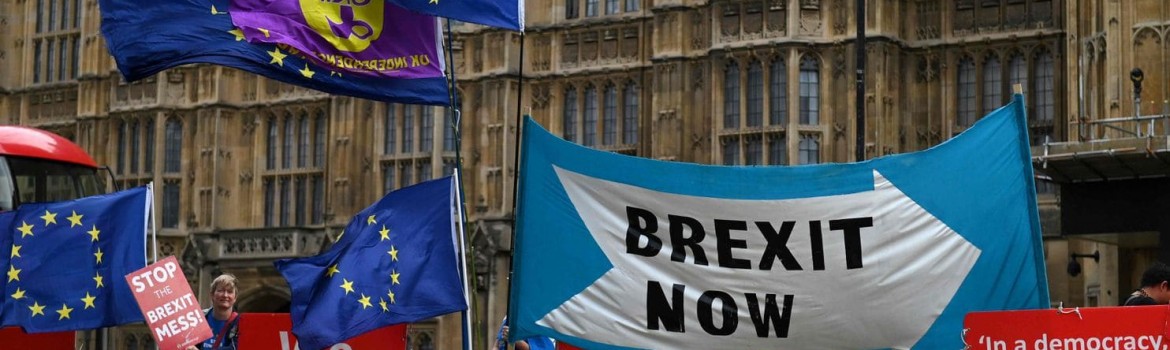
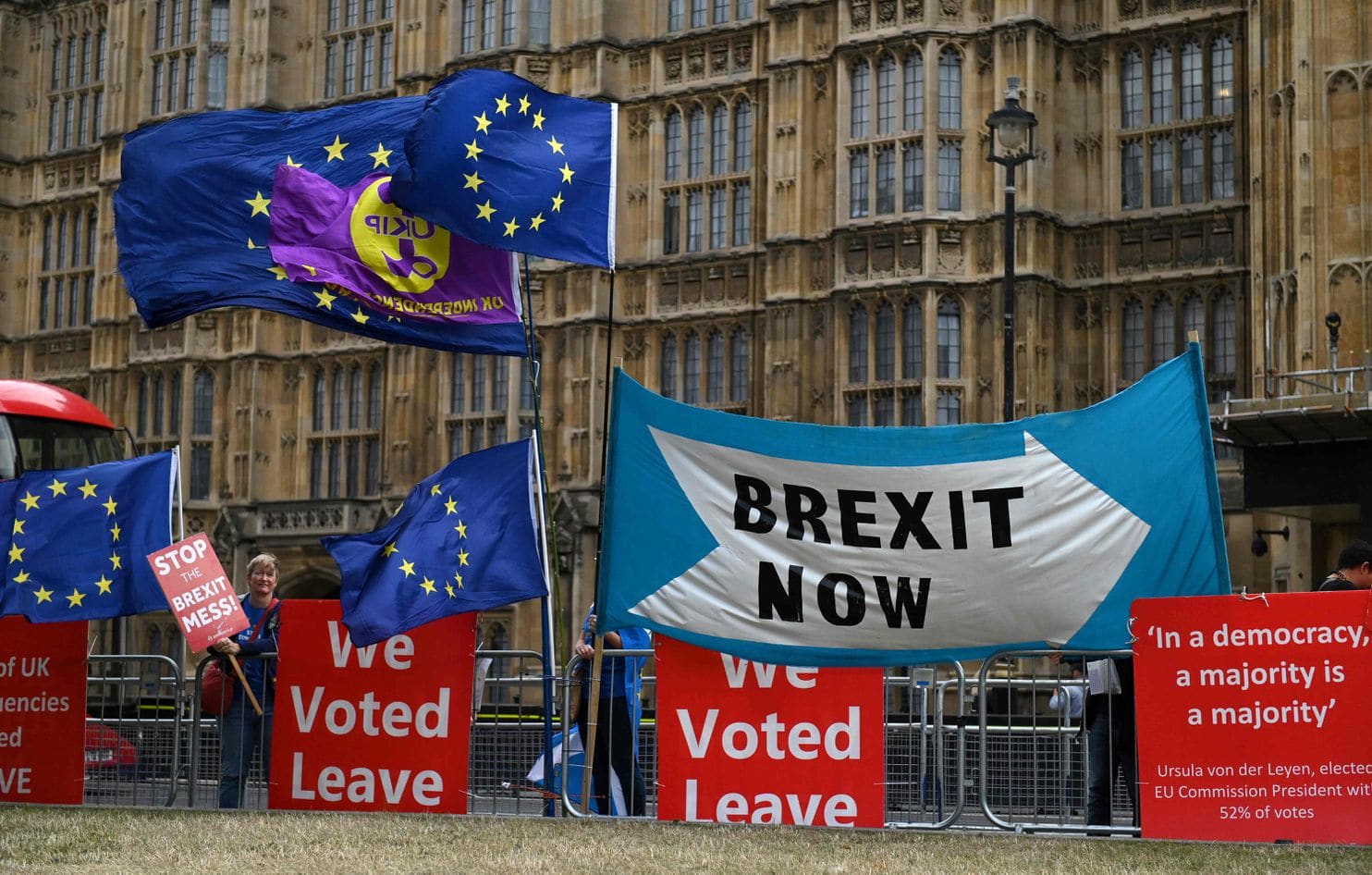
The E.U. flags of anti-Brexit activists fly as pro-Brexit activists stand with their placards and demonstrate near the Houses of Parliament in central London on Sept. 3, 2019. (Daniel Leal-Olivas/AFP/Getty Images)
Several legal challenges have been filed against Johnson’s move to suspend Parliament. A court in Scotland was scheduled to hear arguments Tuesday from lawyers representing 75 opposition lawmakers who want to prevent the suspension.
In a sign of the economic uncertainty caused by the political turmoil, the British pound dropped to its lowest level against the dollar in 35 years, apart from a brief plunge in 2016 likely for technical reasons.
Johnson’s threat of a snap election is aimed as much at his own party as at the opposition led by Labour Party leader Jeremy Corbyn. On Monday, Johnson said he would kick Conservative members of Parliament out of the party if they voted against his Brexit plans — meaning they would be unable to run as Conservatives in any upcoming election.
Unlike his predecessor Theresa May, who did everything she could to keep her party together, Johnson is pursuing tactics apparently aimed at uniting the Brexit vote and steering Britain out of the bloc, even if that means trimming his party by shedding dissenters.
That has already caused some remarkable splits in the party. On Tuesday, Philip Hammond, who was Britain’s finance minister only a few weeks ago, told the BBC that he would back legislation to delay Brexit and that there were “enough” Conservative rebels for it to pass.
He also questioned whether Johnson and his allies could kick him out of the party, saying they would have the “fight of a lifetime” if they tried.
A group of 14 rebel Conservative members of Parliament met with Johnson at 10 Downing Street Tuesday morning. Media reports suggested neither side changed its position.
David Gauke, a senior rebel, wrote in the Times that he would support the legislation to delay Brexit by three months, despite the threat to be kicked out of his party. “It is a simple and, in some respects, modest bill. But without it, the consequences for the country are likely to be calamitous. However painful, I must support it.”
Guto Harris, Johnson’s former communications director, told the BBC that Johnson risks “historical humiliation” in the Brexit maneuvering. “It looks as if he’s prepared to bet on himself being the shortest-serving prime minister in history,” Harris said.
A throng of noisy demonstrators gathered outside of Parliament, with those draped in E.U. blue chanting “Save our democracy! Stop the coup!”
Many wore yellow stickers that read “Bollocks to Brexit.” There were also pro-Brexit signs that read “Remain MPs are the only obstacle to a good deal” and “Traitor Parliament.”
“Brexit is a bad idea,” said Roger Horne, a retired accountant from London. Outside of the bloc, “Britain would have to go on bended knee to either President Trump or the remaining E.U. I think we have greater power, greater influence in the E.U.”
Referring to Johnson’s threat expel Tories who don’t back him, he said “maybe Johnson is trying to turn it [the party] into some kind of religious sect.”
Val Batesman, 77, a librarian, holding a large red “Vote Leave” placard, said that “Parliament has been fiddling about for three years and not implementing this even though they promised to do so.”
When a group of pro-E.U. protesters marched by chanting “This is what democracy looks like!” Batesman said muttered under her breath, “you didn’t get a majority, mate.”
A general election, which Johnson allies say could happen on Oct. 14, could either sink Johnson’s government or give him a popular mandate to push his promised “do or die” Oct. 31 Brexit. It could also propel Corbyn, a nationally unpopular leftist and vocal critic of President Trump, into the prime minister’s job, creating more uncertainty about Brexit and relations with Washington.
Taken together, all the threats and maneuvers have created an extremely volatile and emotional political drama in Westminster, London’s political center, as Parliament convenes on Tuesday.
Corbyn has said his priority for the day is to introduce emergency legislation to block Britain from leaving the E.U. without an agreement in place to regulate trade, border security and other critical issues — the so-called no-deal Brexit.
Source: US Government Class
Share:
Beijing’s Hong Kong Strategy: More Arrests, No Concessions
New York – HONG KONG — The arrests on Friday of prominent democracy lawmakers and activists in Hong Kong reflect a tactical escalation by China’s leaders, one that they hope will curb the escalating street violence of recent weeks, but which could run the risk of prolonging protests in the city for many more months.
Officials in Beijing, along with the Hong Kong government that answers to them, have decided on a policy of stepped-up arrests of demonstrators, who would be publicly labeled the most radical of the activists, according to Hong Kong cabinet members and leaders of the local pro-Beijing establishment.
In interviews over the past two weeks, these local political figures stressed that China wants the Hong Kong police to carry out the arrests — not Chinese soldiers, whose intervention in the city’s affairs would be unprecedented.
Beijing has also ruled out making concessions to the demonstrators, they said. With protest leaders also vowing not to back down, the officials acknowledged that the price of the strategy could be months of acrimony, possibly stretching into 2020.
“I hope we can start the process of reconciliation before the end of the year,” Ronny Tong, a member of Hong Kong’s Executive Council, or cabinet, said in an interview last week.
Beijing and Hong Kong officials are betting that the protests will gradually die down as the police detain the most hard-line demonstrators, and that public opinion will turn more decisively against the use of violence, said Lau Siu-kai, a longtime adviser to the Chinese government on Hong Kong policy.
The Hong Kong police said on Friday that they had arrested more than 900 people this summer in connection with the protests. Some of the local political figures estimated that as many as 4,000 protesters were seen by the authorities as radicals, but that it was unclear how many would eventually face legal action.
The police, who have been accused by demonstrators and international rights groups of using excessive force, have “not used their capacity to suppress the protests” until very recently, said Mr. Lau, who ran the city’s policy planning agency for a decade until 2012.
With broad public backing from mainland China, “the mood of the police was lifted up and they became even more ferocious in putting down the protests,” said Mr. Lau, who is now vice chairman of the Chinese Association of Hong Kong and Macau Studies, a semiofficial advisory body set up by Beijing.
With China’s hard-line leader, Xi Jinping, dealing with a trade war with the United States, a strategy of attrition in Hong Kong could be seen as preferable to a rash approach that might risk spiraling into a major crisis.
But it is far from clear how much success the authorities will have with their strategy of arresting protesters, resisting concessions and delaying negotiations. The arrests have begun to draw criticism from around the world.
The handful of democracy activists and lawmakers who were arrested on Friday have relatively moderate reputations. They include Joshua Wong, who rose to global prominence with the so-called Umbrella Movement protests in 2014, and who has publicly called this summer for protesters not to use violence. Mr. Wong and another activist, Agnes Chow, were later released on bail.
Demonstrators have contended that at least some of the violence attributed to them may have been instigated by undercover police agents. The police have acknowledged infiltrating the protests with officers dressed to look like demonstrators.
Protesters also suspect the authorities of involvement in a spate of attacks on democracy activists by men armed with sticks, baseball bats and even meat cleavers. Similar incidents in Hong Kong over the years have been linked to organized crime groups, which have a history of ties to Beijing.
The mutual distrust has become so great that not only are the authorities and pro-democracy activists not holding talks, but the informal contacts that once existed between the government and the older generation of activists — who, themselves, are mistrusted by many of the younger protesters — have essentially come to a halt.
Each side has worried that any effort to quietly negotiate a deal would be torpedoed by leaks, embarrassing anyone who might try to strike a compromise. From the government’s point of view, those fears were realized when Carrie Lam, the chief executive, met with local young people this week, only for a recording to be leaked to Apple Daily, a pro-democracy media outlet.
Democracy advocates consider Mrs. Lam a puppet of China’s leaders, but they have also ruled out talks with the Liaison Office, which represents Beijing’s interests in Hong Kong.
“This is the situation we are in: absolutely no back channel and total distrust between the two sides,” said Alan Leong, the leader of the Civic Party, one of Hong Kong’s largest pro-democracy parties.
“How would I in my right mind walk into the Liaison Office — that would upset the whole unity” of the democracy movement, he added.
The democracy advocates have agreed not to criticize the violent tactics of some of the younger protesters — a turnaround for many of the older activists, who have shunned violence since Britain returned Hong Kong to Chinese rule in 1997. Some pro-democracy lawmakers with decades-long track records of opposition to Beijing say they have been characterized as sellouts by hard-line protesters when they suggested compromising or refraining from violence.
“They will not listen to us, they think we are all outdated,” said Anson Chan, a longtime campaigner for democracy who was Hong Kong’s second-highest official in the years immediately before and after the 1997 handover.
On Tuesday, Mrs. Lam announced plans for a “platform for dialogue” to find a way out of the political quagmire. But she has sought to meet with neutral community leaders, not the opposition, and she has already ruled out accepting any of the protesters’ five demands, which include universal suffrage, amnesty for protesters and an investigation of the police’s conduct.
Given how polarized the city is now, it has been hard to find neutral figures with whom Mrs. Lam could meet, said Mr. Tong, the cabinet member, who is working on the matter for the chief executive.
Mr. Lau, the adviser to Beijing, said that democracy advocates were overestimating the extent to which Chinese leaders worried about being embarrassed internationally by the protests.
He said they paid more attention to how events in Hong Kong were seen within mainland China, adding that public perceptions there of disorder in Hong Kong had led to a nationalistic wave of support for Beijing.
The Chinese government has pushed those perceptions itself, through the state media’s misleading coverage of the protests.
The Chinese military’s police conducted large exercises just across the border from Hong Kong this month as a show of force. But those exercises were aimed at showing that China is prepared for any contingency, and were not a preamble to any plan for actual deployment in Hong Kong, Mr. Lau and others familiar with the exercises said.
The maneuvers followed plans, drafted years ago, for clearing hostile crowds who establish prolonged control of large urban areas — a tactic that Hong Kong protesters used for months in 2014, but have largely avoided this year.
Martin Lee, a veteran pro-democracy campaigner and founder of the Hong Kong Democratic Party, said that Beijing did not want anything to mar its Oct. 1 celebration of the 70th anniversary of the founding of the People’s Republic of China. Beijing “won’t allow bloodshed to happen in Hong Kong before then — after Oct. 1, beginning on the 2nd, I don’t know,” Mr. Lee said.
Source: US Government Class
Share:
Oil upswing boosts New Mexico revenue forecast
Santa Fe New Mexican – RED RIVER — New Mexico’s oil bonanza is set to continue.
State government will receive an estimated $907 million in “new” money next budget year, with revenue projected at just under $8 billion as oil and gas production continues to increase in the Permian Basin, according to forecasts released Wednesday at a Legislative Finance Committee meeting.
That’s a 12.8 percent increase from the current year’s recurring budget level. The projections are a remarkable turnaround from just three years ago, when the state had to cut spending to contend with a projected deficit.
“What a wild roller coaster ride it’s been,” Sen. Peter Wirth, D-Santa Fe, said at Wednesday’s hearing. “What a difference it makes to be on the up slope of the roller coaster, so that’s a good thing.”
As was true last year, record-high oil output is by far the main factor driving the windfall. Technological improvements and lower costs in the Permian are putting New Mexico on track to produce almost 400 million barrels annually by next budget year, according to the projections. Remarkably, that would more than quintuple the production the state averaged between 1980 and 2010.
The revenue projections, presented to lawmakers by economists from the LFC and two state departments, would allow the state to draft a budget in the next legislative session that exceeds the $7 billion threshold passed this year.
The state also is expected to receive more money than previously anticipated for the prior and current budget years. Revenue is estimated to be $7.9 billion for fiscal year 2019, $333 million above December’s forecasts, while the state is projected to receive $347 million more than previously expected for fiscal year 2020.
Revenue will be higher for last budget year even as oil prices dropped more than $30 per barrel in the fourth quarter of 2018. That’s because New Mexico oil production is estimated to have grown 46 percent from the prior year.
The state economists pointed out that a key driver of oil revenue is the fact that Permian producers’ current break-even level, the price at which oil must be sold to cover costs, has declined to an average of $38 per barrel.
“The forecast would suggest we’re at the start of a new plateau, that looking backward is not indicative of where we’ll go in the next five years,” said Stephanie Schardin Clarke, secretary of the Department of Taxation and Revenue. “The break-even point would have to be below $38 to disincentivize continuing drilling, and we’re not anywhere near that.”
Still, the economists are urging caution.
The new estimates are “heavily dependent” on oil price and production activity, which can change without warning. A precipitous decline in oil volumes could “create a fiscal challenge far more severe than a moderate recession,” the LFC’s report said.
“Obviously, that is the big risk we’re facing as a state,” said Olivia Padilla-Jackson, secretary for the Department of Finance and Administration. “We are really at the mercy of all of these factors and that’s why we have to plan accordingly.”
Next budget year’s energy revenue could decline $1.4 billion below the current projections if oil prices and the number of active rigs were to drop, according to the report.
“Revenues significantly above trend may not be sustainable over time, and the last time New Mexico saw state revenues this high above trend was just before the Great Recession,” LFC chief economist Dawn Iglesias and economic Ismael Torres wrote in their report.
A severe drop in prices can lead companies to reduce drilling in the Permian. That happened in 2016, when the number of rigs operating in New Mexico dropped to 15 from 90 in a matter of three months.
The risks are even greater given that some forecasting agencies now see the chance of a recession in 2020 as more likely than before.
The LFC report highlighted concerns related to the U.S.-China trade war, weakening global growth and the recent inversion of the spread between the 10-year and 2-year Treasury yields.
“A global economic slowdown, exacerbated by a U.S.-China trade war, could pull the U.S. into a recession,” the economists wrote.
Source: US Government Class
Share:
Biden campaign accuses Trump campaign of poaching donors
CBS News – Joe Biden’s presidential campaign is accusing President Trump’s campaign of poaching online donors. In a fundraising email sent to supporters Thursday, the Biden campaign pointed out that if someone types “donate Joe Biden” into a Google search, the first link to appear is one that directs them to donate to Donald J. Trump for President.
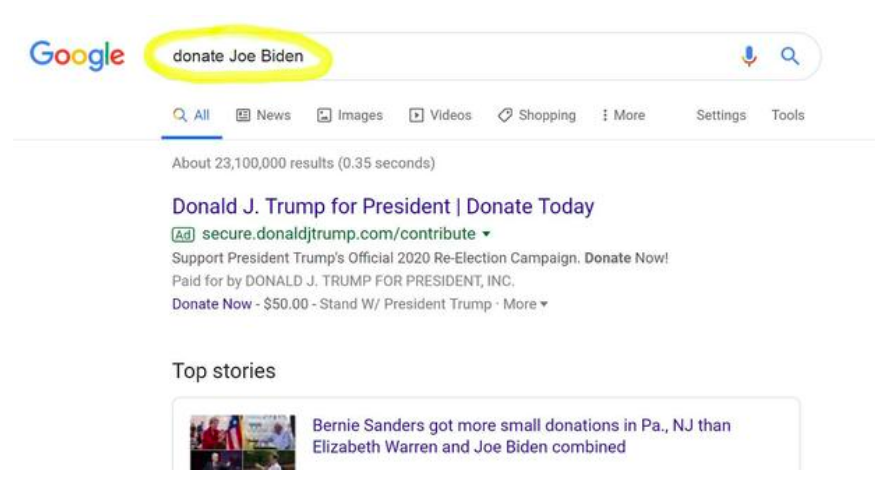 While the Biden campaign is calling out President Trump’s reelection campaign, it’s not immediately clear who exactly is behind the ad making the Trump campaign page appear above Biden’s in the search. The Trump campaign has not yet confirmed that it purchased the Google ad, which was purchased on Google’s pay-per-click keyword advertising platform.
The Trump campaign ad appears after a search of the specific words, “donate Joe Biden,” in that order. It doesn’t come up if users type “Joe Biden donate” or “donate Biden” in the search field. It’s also unclear whether these efforts have affected the attempts by Biden supporters to donate to the former vice president’s campaign.
Because there is a host of requirements for advertisers running Google ads that mention political candidates, it seems likely that the Trump campaign is responsible for the digital ad, according to Bully Pulpit Interactive, a digital marketing and strategy firm.
“The interesting part of the Trump ad strategy to me is that, even though the ads click through to a Trump campaign donation page, they are probably not driving many donations. People searching ‘donate to Biden’ are Democrats who have already made up their mind on who they are supporting and how,” J.D. Bryant, Bully Pulpit’s director of buying, told CBS News.
He went on to say, “They are really unlikely to suddenly change their minds and switch not only the candidate but also the party to which they are giving money. That means the people behind this ad aren’t doing it because it’s a smart digital tactic. They’re doing it because they’ll do anything to keep the attention on Trump.”
In the second quarter of the year, Biden raked in more than $22 million putting him just behind Pete Buttigieg in fundraising in that period. However, his fundraising efforts are not the same type of grassroots operations as those deployed by Bernie Sanders or Elizabeth Warren, who have both sworn off big-dollar fundraising events. The president and his campaign committees raised $54 million in the second quarter.
A Google search of other top polling Democratic presidential candidates in the race, including Sanders, Kamala Harris, Warren and Buttigieg, found no other candidate faced the same type of targeting when searched online.
This is not the first time the former vice president and current Democratic presidential frontrunner has been an online target. An search of “Joe Biden” lists a parody account just below his official website on Google. The website includes references to “Uncle Joe,” old videos and images of Biden awkwardly touching women, and a series of policy positions far outside the norms for progressive Democrats. The New York Times previously reported the website had been created by a Trump consultant.
Source: US Government Class
Share:
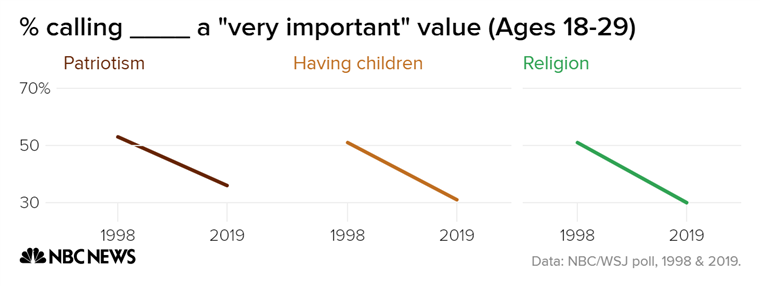
Younger Americans now less likely to prioritize patriotism, religion, children
NBC News – Younger Americans today are less likely to prioritize values that center around religion, “patriotism,” and having children than they were two decades ago, according to a new NBC News/Wall Street Journal Poll.
Just under a third of Millennials and Generation Z (ages 18-38) believe having children (32 percent) and religion or “belief in God” (30 percent) are “very important” values, followed by 42 percent who rank patriotism as a top value.
Those shares represent a sharp departure from their parents and grandparents. Among those 55 and over, majorities rank having children (54 percent), religion (67 percent) and patriotism (79 percent) as very important.
What’s more: Over the past 20 years, these values have seen a decline in importance among younger Americans.
According to data from a similarly designed 1998 NBC/WSJ poll, a majority of Americans who were between the ages 18-29 and 30-49 two decades ago prioritized religion, patriotism, and having children.
The decrease is particularly noteworthy when it comes to raising the next generation. Twenty years ago, 62 percent of Americans ages 30-49 and 51 percent of Americans 18-29 believed it was very important to have children. Today, according to the latest poll, that has decreased by 24 and 20 percent, respectively.


Similar reductions are seen among the values of religion and patriotism.
As younger generations shift their priorities away from more traditional values, the new poll finds that a significant number of Millennials and Generation Z rate “hard work” (83 percent) “tolerance for others” (83 percent) and “financial security” (78 percent) as very important.
One thing all Americans seem to agree on: Pessimism about the future they’re leaving for the next generation.
When asked if “life for our children’s generation will be better than it has been for us,” 68 percent of Americans ages 50-64 as well as 64 percent of Americans over 65 said they do not feel confident that will happen.
And this doubt extends past older generations. The poll shows a majority of Americans share this view regardless of their gender, ethnicity, economic class, region, or political party affiliation.
That includes the youngest Americans. Nearly seven-in-ten (68 percent) of Americans under 35 say they’re not confident that their children’s generation will be better off.
Source: US Government Class
Share:
Monmouth poll: Bernie Sanders, Joe Biden and Elizabeth Warren in three-way lead for Democratic bid
(CNN)Vermont Sen. Bernie Sanders, Massachusetts Sen. Elizabeth Warren and former Vice President Joe Biden top the Democratic field for president in 2020, with no clear leader, according to a Monmouth University poll released Monday.
The three candidates are bunched together, each receiving about the same amount of support (Sanders 20%, Warren 20% and Biden 19%) from registered Democrats and Democratic-leaning independent voters.
They’re followed by California Sen. Kamala Harris (8%), New Jersey Sen. Cory Booker (4%), South Bend, Indiana, Mayor Pete Buttigieg (4%), businessman Andrew Yang (3%), former Housing and Urban Development Secretary Julián Castro (2%), former Rep. Beto O’Rourke (2%) and author Marianne Williamson (2%). All other candidates received 1% or less in the poll.
Since Monmouth’s June poll, Sanders and Warren have gained slightly (up 6 and 5 percentage points), while Biden has lost significant support (down 13 points).
A CNN poll conducted by SSRS, out last week, found Biden with 29% support, while Sanders and Warren were lower (15% and 14%, respectively).
The results don’t impact who has qualified for the debates in September, with the Wednesday deadline fast approaching. This is Williamson’s first poll hitting 2%, giving her one debate qualifying poll. Williamson, who has said she has met the donor threshold, would need three more polls to qualify.
Biden’s decline comes mostly from registered Democrats and Democratic-leaning independent voters who consider themselves moderate or conservative, down 18 points since June. Meanwhile, Sanders and Warren have gained 10 percentage points each among those voters, an area that isn’t considered strong for either of the very liberal candidates.
Biden also lost support among those who don’t have a college degree (down 17 points) and those under the age of 50 (down 15 points).
Biden, Sanders and Warren all have similar favorable ratings — around two-thirds of registered Democrats and leaners have a positive opinion of the candidates, but Warren has a much lower unfavorable rating than the other two (13% find the Massachusetts senator unfavorable, compared to a 25% for Biden and 24% for Sanders).
Additionally, Warren’s favorability has gone up slightly since May, while Sanders has remained steady and Biden has slipped.
On the subject of health care, more than half (58%) of Democratic voters say it’s very important that they nominate someone who supports “Medicare for All,” and another half (53%) want to allow people to either opt in to Medicare or keep their private coverage over getting rid of all private insurance (22%).
The Monmouth University Poll of registered Democrats and Democratic-leaning independent voters was conducted by telephone August 16 through 20 among a random sample of 800 adults in the United States. Results in this release are based on 298 registered voters who identify as Democrats or lean toward the Democratic Party, which has a +/- 5.7 percentage point sampling margin of error.
Source: US Government Class
Share:
Factbox: Greenland for sale? Why Trump’s bid fell through
COPENHAGEN (Reuters) – President Donald Trump’s proposal for the United States to buy Greenland from Denmark has met with surprise and a sharp rebuff from Copenhagen, with Prime Minister Mette Frederiksen calling the idea “absurd”.
Stung by the rejection, Trump scrapped a Sept. 2-3 visit to Denmark, a NATO ally of Washington.
Following is an outline of Greenland’s attractions to the United States and big power rivals, and the obstacles to any sale of the vast Arctic territory, the world’s largest island.
STRATEGIC LOCATION, RESOURCE WEALTH
Greenland is strategically important for the U.S. military and its ballistic missile early-warning system since the shortest route from Europe to North America runs via the Arctic island. The United States maintains an air base in Thule in Greenland’s northwest under a 1951 treaty with Denmark.
The island, whose capital Nuuk is closer to New York than the Danish capital Copenhagen, boasts mineral, oil and natural gas wealth. But development has been slow, leaving its economy reliant on fishing and annual subsidies from Denmark.
“It’s hurting Denmark very badly because they’re losing almost $700 million a year, so they’re carrying (Greenland) at a great loss,” Trump said.
Greenland lacks basic infrastructure for its tiny population of 56,000. There are no roads between the country’s 17 towns and only one commercial international airport, forcing people to travel by sea or air.
Investors from the United States and Canada have been watching for signs Greenland will get a flagging mining program back on track to exploit vast mineral resources including uranium and rare earths.
However, due to a commodity price slump and a morass of red tape, Greenland – which is three times the size of the large U.S. state of Texas – has only has one small operating mine.
Greenland also has an estimated 50 billion barrels of offshore oil and gas reserves, as yet unexploited.
LEGAL OBSTACLES TO SALE
Greenland, once a colony of Denmark, became a formal territory of the Nordic kingdom in 1953 and was granted broad self-governing autonomy, excluding only foreign affairs and defense, under legislation passed a decade ago.
Any sale would require a change to Greenland’s legal status through an amendment to Denmark’s constitution. Since 2009 Greenland has held the right to declare independence from Denmark. If Greenland do so, it could choose to become associated with the United States.
But few Greenlanders see independence as viable given their economic dependence on Denmark, part of the affluent European Union.
“The only way Trump would be able to buy Greenland would be to give them an offer they couldn’t turn down,” said Aalborg University professor Ulrik Pram Gad, a former Greenland government official.
Greenland’s premier, Kim Kielsen, declared on Monday it is not for sale and that while the island was drawing worldwide interest, anyone wanting to do business would have to respect its autonomy.
When Greenland was still a colony and the Cold War with the Soviet Union was escalating, the United States under then-President Harry Truman sought to buy the island as a strategic asset, but Copenhagen declined to sell.
WHY THE TRUMP INTEREST NOW?
The Arctic region sits at a geopolitical intersection of renewed rivalry between world powers China, Russia and the United States, and – with its melting ice cap – is a major symbol of the growing impact of climate change.
Russia has been raising its profile in the Arctic, creating or reopening six military bases shut after the Cold War ended in 1990, modernizing its Northern Fleet, including 21 new vessels and two nuclear submarines, and staging frequent naval exercises in the Arctic.
Russia also hopes that as the polar ice cap retreats, a shipping lane north of Russia will develop as an alternative route for goods from Asia to Europe.
The Trump administration last year began re-establishing the U.S. Second Fleet, responsible for the northern Atlantic, to counter a more assertive Russia.
Washington wants a greater military presence in Greenland to better defend its Thule Air Base and enhance surveillance of the waters between the island and the European continent.
The Thule base mainly operates a missile warning system as well as space and satellite surveillance.
The U.S. military stationed personnel at some 50 bases in Greenland during the Cold War, but a renegotiation of their presence with Denmark in 2004 whittled it down to the Thule Air Base only. A few hundred U.S. personnel are stationed at Thule, compared with almost 10,000 during the Cold War.
In September last year, the U.S. Department of Defense said it wanted to invest in Greenland to enhance its “military operational flexibility and situational awareness”.
CHINESE FEELERS
China has also shown interest in Greenland after Beijing laid out its ambitions to form a “Polar Silk Road” by developing shipping lanes opened up by global warming and encouraging enterprises to build infrastructure in the Arctic.
Greenland, which plans to open a representative office in Beijing later this year to boost trade ties, has courted Chinese investors and construction firms to help expand three airports to allow direct flights from Europe and North America.
However, after U.S. and Danish officials voiced concern about Chinese involvement in such large-scale projects on security grounds, the Copenhagen government last year stepped in to finance the airports, effectively sidelining Beijing.
Source: US Government Class
Share:
Elizabeth Warren releases plan to reduce mass incarceration rates in U.S.
CBS News – Elizabeth Warren released a plan Tuesday aimed at reducing the inequities in the criminal justice system, ahead of a roundtable on the topic in Minneapolis.
“It’s not equal justice when a kid with an ounce of pot can get thrown in jail, while a bank executive who launders money for a drug cartel can get a bonus,” she wrote in a post on the site Medium. “It’s long past time for us to reform our system.”
The Massachusetts senator proposes reducing incarceration rates with a range of strategies, including increasing support for at-risk students in schools, tackling their academic readiness, providing them with health care access and giving schools resources to train school staff in more positive approaches to addressing students’ behavior problems.
Warren also has ideas to help the incarcerated as they exit the prison system, including a boost for rehabilitation services while prisoners are serving their time. And her plan includes several measures to revamp policing to use less violence and stem discrimination. She also promises to strengthen public defenders and rein in prosecutorial abuses.
According to Warren campaign press secretary Saloni Sharma, Warren’s pan will “reimagine how we talk and think about public safety in this country.”
“It is a false choice to suggest a tradeoff between safety and mass incarceration. We should spend our budgets on community services that lift people up, not imprisonment. That’s how we can de-carcerate and make our communities safer,” Sharma said in a statement.
Legislatively, Warren says she would push to repeal the 1994 crime bill, a jab at former Vice President Joe Biden, who authored it, and at progressive rival Sen. Bernie Sanders, who voted for it.
Warren’s plan comes just two days after Sanders’, and there’s a lot of overlap between the Senate colleagues.
Sanders and Warren both support safe injection sites. They’d both try to do away with solitary confinement, cash bail and the death penalty. There are some differences between the two, however. Sanders wants to legalize marijuana, while Warren favors decriminalizing it.
Sanders also first said months ago that incarcerated felons should be able to vote. Warren, however, has yet to match him there with her newest plan.
Source: US Government Class