

Share:
Democrats Move Toward Bringing Impeachment Inquiry Public
New York Times – WASHINGTON — House Democrats moved quickly on Monday to bring their impeachment case against President Trump into the open, saying they would forgo court battles with defiant witnesses and would vote this week on procedures to govern nationally televised hearings.
Representative Adam B. Schiff, the House Intelligence Committee chairman who is leading the inquiry, said that Democrats would not wait to fight the Trump administration in court as it moves to block key witness testimony. Instead, after Mr. Trump’s former deputy national security adviser defied a subpoena, he issued a warning: White House directives not to cooperate would only bolster the case that the president had abused his office and obstructed Congress.
By the afternoon, Speaker Nancy Pelosi added to that sense of urgency, announcing that after weeks of private fact-finding, the full House would vote on Thursday to initiate a public phase of the inquiry. That vote would establish rules for the public presentation of evidence and outline due process rights for Mr. Trump.
It will be the first time all House lawmakers will be asked to go on record on the investigation since it began in September, something Democrats had so far resisted.
“We are taking this step to eliminate any doubt as to whether the Trump administration may withhold documents, prevent witness testimony, disregard duly authorized subpoenas or continue obstructing the House of Representatives,” Ms. Pelosi said in a letter to colleagues. “Nobody is above the law.”
The announcements sent the clearest signals to date that Democrats believe their month-old inquiry is on track and will allow them to begin making an effective impeachment case before the nation by Thanksgiving. Party leaders are wary that their investigation, which focuses on Mr. Trump’s attempts to pressure a foreign nation to investigate his political rivals, will lose momentum and drag on into next year without a vote on articles of impeachment.
In earlier oversight disputes, House Democrats have turned to the courts with some frequency. But those lawsuits have eaten up valuable months without signs of resolution any time soon — time that impeachment investigators do not have.
“We are not willing to let the White House engage us in a lengthy game of rope-a-dope in the courts, so we press ahead,” Mr. Schiff told reporters outside his secure hearing rooms.
Democrats have resisted for weeks the idea of holding a vote on the impeachment inquiry, arguing that doing so was unnecessary to authorize their work, and privately worrying that a floor vote could put politically vulnerable Democrats in a difficult position.
But they have come under intense criticism from Republicans for failing to seek formal authorization for the inquiry, a step that is not required by the Constitution or House rules. In scheduling a vote now, Democrats were effectively challenging Mr. Trump and his congressional allies, who have called the inquiry the inquiry unfair and the process a sham, but avoided any substantive discussion of the president’s conduct.
Still, Republicans signaled that after weeks of calling for a vote on the inquiry, they would oppose the resolution en masse.
“We will not legitimize the Schiff/Pelosi sham impeachment,” Representative Kevin McCarthy, Republican of California and the minority leader, said in a tweet.
Stephanie Grisham, the White House press secretary, said Ms. Pelosi was “finally admitting what the rest of America already knew — that Democrats were conducting an unauthorized impeachment proceeding, refusing to give the president due process, and their secret, shady, closed door depositions are completely and irreversibly illegitimate.”
Democrats said their inquiry has been proper from the start. Ms. Pelosi reiterated what Democrats have argued for weeks and a Federal District Court judge ruled last week: that they did not need a formal vote of the full House to start a legitimate inquiry. (The Justice Department separately announced Monday it would appeal the ruling handed down Friday.)
So far, the work of the impeachment inquiry has mostly been done out of public view, with staff for Democrats and Republicans questioning a growing roster of diplomats and other administration officials in the closed chambers of the House Intelligence Committee. Democrats are pleased with the portrait they have assembled of a president who bypassed the normal channels of diplomacy to pressure Ukraine to investigate former Vice President Joseph R. Biden Jr. and unproven theories that could exonerate Russia from aiding his campaign in 2016 and implicate Democrats in interfering in the election instead.
That work was briefly interrupted on Monday, when Charles M. Kupperman, the former deputy national security adviser, defied a House subpoena for testimony, angering Mr. Schiff. The White House said on Friday that Mr. Kupperman, as one of the president’s “closest confidential” advisers, was immune from testifying, and directed him not to appear in defiance of a subpoena. That prompted him to file a lawsuit against Mr. Trump and congressional Democrats asking a federal judge whether he could testify, raising the prospect of a drawn-out legal battle over weighty questions about the separation of powers that could effectively stall the impeachment inquiry for months.
“If this witness had something to say that would be helpful to the White House, they would want him to come and testify,” Mr. Schiff said of Mr. Kupperman. “They plainly don’t.”
Mr. Schiff conceded that the White House would most likely try to invoke similar privilege to try to block other crucial witnesses, including John R. Bolton, the former national security adviser, who is said to be alarmed by Mr. Trump’s dealings with Ukraine. Doing so would only fuel another article of impeachment charging Mr. Trump with obstructing Congress’s fact-finding, he said.
As many as five more officials are expected to testify in closed session this week, including Lt. Col. Alexander S. Vindman, the top Ukraine expert on the National Security Council, who is scheduled to appear on Tuesday. He plans to detail his concerns about Mr. Trump’s attempts to pressure Ukraine to investigate his political rivals.
But if Democrats are going to convince the public — and potentially some Republicans — that Mr. Trump’s behavior warrants making him only the third president in American history to be impeached, they know they will have to secure clear and damning testimony out in the open.
Democrats described the vote as a necessary step.
“This resolution establishes the procedure for hearings that are open to the American people, authorizes the disclosure of deposition transcripts, outlines procedures to transfer evidence to the Judiciary Committee as it considers potential articles of impeachment, and sets forth due process rights for the president and his counsel,” Ms. Pelosi said in her letter.
Though aides for several committees were still drafting the resolution Monday evening, the rough outlines of the next phase of the inquiry began to come into view.
After it wraps up its closed witness depositions in the coming weeks, the House Intelligence Committee will begin to hold public hearings with key witnesses, such as Gordon D. Sondland, the American ambassador to the European Union; Fiona Hill, a former top White House adviser; and William B. Taylor Jr., the top American diplomat in Ukraine.
The rules will allow for the committee’s staff aides to question witnesses directly during public hearings, according to an official working on the inquiry who described the measure on condition of anonymity because it had yet to be made public.
When the panel concludes its fact-finding, Mr. Schiff will transmit raw evidence and, potentially, a written report on his findings to the House Judiciary Committee, the venue where presidential impeachment articles have traditionally been drafted and debated. In that sense, Mr. Schiff could play a role roughly akin to Ken Starr, the independent counsel who presented the results of his investigation into President Bill Clinton to the committee in 1998 as it weighed impeachment.
The Judiciary Committee would then be responsible for convening hearings to consider additional evidence, draft articles of impeachment and vote on whether to recommend them to the full House. It is at that stage when Democrats appear poised to give Mr. Trump and his legal team a chance to offer input on the case. It was not clear Monday evening how far they would go in granting them the right to call or cross-examine witnesses, as lawyers for Mr. Clinton and President Richard M. Nixon were allowed to do in earlier proceedings.
Source: US Government Class
Share:
Mark Zuckerberg grilled by Congress over Libra and political ads policy
New York (CNN Business)Mark Zuckerberg conceded on Wednesday that there is a scenario in which Facebook might have to rethink its involvement in its controversial cryptocurrency project, Libra, if the currency does not receive appropriate US regulatory approval.
In response to multiple questions on the matter during an hours-long grilling session on Capitol Hill, Zuckerberg said Facebook would be “forced to leave” the governance organization overseeing Libra if the group moves ahead with launching the digital currency without US policymaker approval.
“If at the end of the day we don’t receive the clearances,” Zuckerberg said, “we will not be a part of the association.”
The acknowledgment could have major implications for Zuckerberg and Facebook. The company is betting that introducing Libra can help Facebook users transact with businesses directly, which in turn could “lead to higher prices for ads” on the platform, Zuckerberg said Wednesday. “We may see a positive business impact,” he said.
Zuckerberg returned to Capitol Hill to testify before the House Financial Services Committee over Facebook’s plans for Libra. Within minutes, however, it became clear lawmakers would expand the focus of the hearing to include a wide range of concerns about Facebook.
Maxine Waters, the chair of the committee, kicked off the hearing by listing off the company’s history of running discriminatory housing ads, failing to protect consumer data and having its platform used for election interference. She also questioned
Zuckerberg over his company’s policy of not subjecting ads by political candidates to third-party fact-checking.
“You’re willing to step on anyone — your competitors, women and people of color, even our democracy,” Waters said in her opening remarks.
Zuckerberg attempted to defend Libra as necessary innovation for the financial services industry while acknowledging the concerns about Facebook in particular launching the effort.
“I believe that this is something that needs to get built, but I get that I’m not the ideal messenger for this right now,” Zuckerberg said. “We’ve faced a lot of issues over the past few years. I’m sure there are a lot of people who wish it was anyone but Facebook who proposed this.”
The stakes are high for Zuckerberg’s performance on Wednesday. Many lawmakers have not ruled out the possibility that they could try to block Libra altogether if they are not satisfied by Zuckerberg’s responses. David Marcus, the Facebook exec who headed up the Libra effort and now runs the company’s subsidiary developing services for users to save and spend Libra, testified before Congress in July, but many lawmakers weren’t entirely satisfied with what they heard.
It also comes as Facebook is under more scrutiny than ever. Facebook’s antitrust headache is only getting worse, as dozens more attorneys general join an investigation into the company. It has been embroiled in a feud with Democratic presidential candidate Elizabeth Warren over truthfulness in political ads.
On Wednesday, lawmakers pressed Zuckerberg on encryption, censorship, child sex abuse content and Facebook’s plan to integrate the data from its messaging apps. Rep. Gregory Meeks, a Democrat on the committee, slammed Facebook for not doing more to support the existing infrastructure to help the unbanked rather than embarking on a massively ambitious project that the CEO conceded was “risky.”
At other points, however, legislators echoed Zuckerberg’s arguments about the importance of fostering innovation in the US, applauded the Facebook CEO for declaring himself a “capitalist” and even compared him to President Donald Trump. “You’re both very successful businessmen, you’re both capitalists,” Rep. Barry Loudermilk, a Republican on the committee, said in the hearing. “You’ve done very well, but I think really what you share in common is you both challenge the status quo. He calls it ‘draining the swamp;’ you see it as innovation.”
Mark Zuckerberg returned to Capitol Hill on Wednesday to testify before the House Financial Services Committee over its plans for a cryptocurrency project called Libra.
The hearing represents yet another hurdle for the effort to bring Libra to life, which Facebook (FB) and its partners had hoped to do by mid-2020. That timeline now appears uncertain. Zuckerberg’s testimony comes days after several of the project’s early partners jumped ship, which some analysts warned could potentially make it harder for Libra to gain regulatory approval.
Still, the group has forged ahead with setting up the early governance structure and articles of association for the Libra Association, which will manage the digital currency. They say Libra could revolutionize the global payments system, making it easier to send money around the world and potentially benefiting the underbanked.
“People pay far too high a cost — and have to wait far too long — to send money home to their families abroad. The current system is failing them,” Zuckerberg said in his prepared remarks.
The digital currency will be managed by an organization comprised of 21 companies, including Facebook. The social networking firm has one seat of five on the board. But Facebook’s involvement — and Libra’s potential access to its more than 2 billion users — nonetheless helped make Libra a bigger concern for regulators.
In his prepared remarks, Zuckerberg also attempted to defuse fears about Libra’s potential impact on existing currencies. Zuckerberg said Libra “is not an attempt to create a sovereign currency.” He also noted that Libra will be backed “mostly by dollars,” referencing the Libra Reserve that will back the coin 1:1.
The anticipated makeup of the reserve, beyond Facebook’s statements that it will be comprised of government-backed currencies and debt instruments, has been unclear, leading lawmakers to fear Libra could undermine central banks’ ability to carry out monetary policy.
Zuckerberg’s lengthy testimony may still not have been enough to address the many questions lawmakers have about Libra. Near the end of the hearing, which lasted more than six hours, the committee’s ranking member Rep. Patrick McHenry said he is not sure the committee members had “learned anything new here.”
Source: US Government Class
Share:
Republicans ‘sit in’ during closed-door impeachment session, force Schiff to suspend hearing
FoxNews – House Republicans led by Rep. Matt Gaetz, R-Fla., on Wednesday essentially stormed a closed-door session connected to the impeachment investigation of President Trump, prompting House Intelligence Committee Chairman Adam Schiff to suspend the proceedings in a remarkable scene.
The stand-off happened after lawmakers held a press conference Wednesday morning where they accused House Democrats of a lack of transparency.
“We’re going to try and go in there, and we’re going to try to figure out what’s going on, on behalf of the millions of Americans that we represent that want to see this Congress working for them and not obsess with attacking a president who we believe has not done anything to deserve impeachment,” Gaetz said.
“What is Adam Schiff trying to hide?” asked House Minority Whip Steve Scalise, R-La. “I think that’s the question so many people have, so many of my colleagues have, so many people in the press should have.”
“Voting members of Congress are being denied access from being able to see what’s happening behind these closed doors where they’re trying to impeach the president of the United States with a one-sided set of rules,” Scalise continued. “They call the witnesses. They don’t let anybody else call the witnesses.”
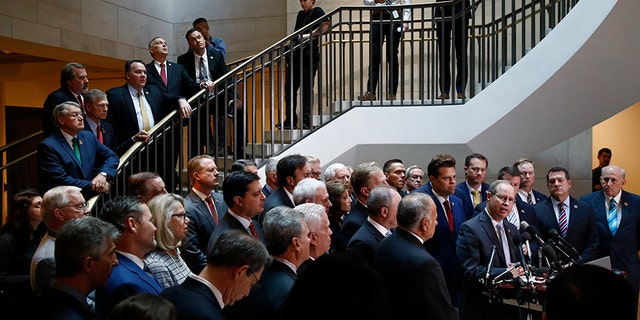
House Republicans hold a news conference before heading into a closed-door meeting where Deputy Assistant Secretary of Defense Laura Cooper was set to testify as part of the House impeachment inquiry into President Trump, on Oct. 23, 2019. (AP Photo/Patrick Semansky)
“We’re gonna go and see if we can get inside,” Gaetz said at the conclusion of the press conference.
From there, about 30 House Republicans flooded the room where Laura Cooper, who oversees Ukraine policy at the Department of Defense, was set to testify.
Because there was no agreement for non-committee members to be present, this ‘sit-in’ created an immediate standoff. Fox News is told that Schiff did not ask the U.S. Capitol Police to arrest or remove Republicans who charged in — but he did leave the room and apparently does not plan to start the interview until the situation is resolved.
Fox News is told about a dozen Republicans are still in the secure facility known as a SCIF. In another complication, some non-committee members brought in phones and other electronic devices in possible violation of House rules.
GOP lawmakers flooded Twitter with posts from the scene.
“Adam Schiff just SHUT DOWN his secret underground impeachment hearing after I led a group of Republicans into the room. Now he’s threatening me with an Ethics complaint! I’m on the Armed Services Cmte but being blocked from the Dept. Asst. SecDef’s testimony. This is a SHAM!” Rep. Bradley Byrne, R-Ala., tweeted.
Democrats slammed them in response. Rep. Ilhan Omar, D-Minn., tweeted: “This is what happens when people elect members more interested in media hits than the protection of our national security.”
Rep. Roger Marshall, R-Kan., told reporters that Schiff left the room without letting Marshall or other non-committee Republicans hear testimony.
“He doesn’t have the guts to come talk to us,” Marshall said. “He left. He just got up and left. He doesn’t have the guts to tell us why we can’t come in the room, why he doesn’t want this to be transparent. It’s the biggest facade, the biggest farce I’ve ever seen in my life.”
Gaetz, a member of the House Judiciary Committee, was kicked out of another session earlier this month where former deputy assistant to the president Fiona Hill faced questions behind closed doors. Gaetz was told he could not attend because he is not part of the House Intelligence Committee, which is conducting the investigation along with the House Oversight and Foreign Affairs Committees.
“Judiciary Chairman [Jerry Nadler] claimed to have begun the impeachment inquiry weeks ago,” Gaetz tweeted at the time. “Now, his own Judiciary members aren’t even allowed to participate in it. And yes – my constituents want me actively involved in stopping the #KangarooCourtCoup run by Shifty Schiff.”
Republicans are not the only ones criticizing the investigation for its lack of transparency. Democratic presidential candidate Rep. Tulsi Gabbard, D-Hawaii, said Tuesday she was “disappointed with the lack of transparency,” and warned that it could “undermine the integrity” of the investigation.
Democrats began calling witnesses for questioning behind closed doors after an anonymous whistleblower filed a complaint over a July 25 phone call between Trump and Ukrainian President Volodymyr Zelensky. Trump is accused of using military aid to Ukraine as leverage to pressure Zelensky into assisting investigations of alleged Democratic collusion with Ukraine in the 2016 election, as well as former vice president Joe Biden and his son Hunter’s business dealings with Ukrainian energy company Burisma Holdings.
Both Trump and Zelensky have stated that no pressure took place, though Acting U.S. Ambassador to Ukraine Bill Taylor testified Tuesday that the aid to Ukraine “was conditioned on the investigations.”
Fox News’ Griff Jenkins, Guerin Hays and Brooke Singman contributed to this report.
Source: US Government Class
Share:
Trump tweeted a photo attacking Nancy Pelosi. She made it her Twitter cover photo.
(CNN) – House Speaker Nancy Pelosi on Wednesday redirected an attack from President Donald Trump on Twitter, turning a photo he had tweeted of her during a contentious White House meeting with the caption “Nervous Nancy’s unhinged meltdown!” into her Twitter cover shot.
The image released by the White House shows the California Democrat standing with her finger pointed at a seated Trump during a meeting in which congressional Democratic leaders said the President had a “meltdown.”
Pelosi’s deputy chief of staff Drew Hammill noted the change on Twitter, writing, “Thanks for the new cover photo @realDonaldTrump!”
Democratic leaders were at the White House for a meeting on Syria, which came shortly after the House overwhelmingly in a bipartisan vote passed a resolution opposing the Trump administration’s troop withdrawal.
Speaking to reporters after the meeting, the top congressional Democrats said they had walked out. Senate Democratic leader Chuck Schumer of New York said they had done so when Trump “started calling Speaker Pelosi a third-rate politician.”
“He was insulting, particularly to the speaker. She kept her cool completely, but he called her a third-rate politician,” Schumer said. “This was not a dialogue, it was sort of a diatribe. A nasty diatribe, not focused on the facts.”
Pelosi later said Trump had actually referred to her as a “third-grade politician.”
White House press secretary Stephanie Grisham described the meeting differently, saying in a statement that Pelosi “had no intention of listening” and that Trump had been “measured” and “decisive.”
*
Later Wednesday, the President tweeted a series of photographs from the meeting along with insults. In one tweet, he called Pelosi “a very sick person!”
Tensions between congressional Democrats and the White House have escalated sharply in recent weeks as Democrats push forward in their impeachment investigation into Trump and his contacts with Ukraine. Lawmakers have conducted a steady stream of closed-door depositions this week as part of the inquiry.
CNN’s Clare Foran contributed to this report.
Source: US Government Class
Share:
Dems who praised Obama for troop withdrawal now highly critical of Trump
President Trump has met resistance from both parties after his decision to withdraw troops from northern Syria, but some of the rhetoric coming from Democrats is almost the opposite of what came from party members when President Barack Obama pulled forces out of Iraq.
California Democrats Rep. Maxine Waters and House Speaker Nancy Pelosi, for example, have been vocal opponents of Trump’s troop withdrawal, after supporting Obama’s efforts almost exactly eight years later.
“As the war in Iraq draws to a close, it is my hope that this conflict will serve as a solemn reminder of the costs of war,” Waters said in a statement issued Oct. 21, 2011. “We must carefully reexamine our approach to national security and how we view the United States’ role in promoting international peace and security. If we are to remain leaders in the world, we must always use our best judgment to determine when and how we engage other nations and other actors – particularly if we are considering the use of military force.”
Waters’ approach to the United States’ role in world affairs is similar to Trump’s recent warnings against “fighting other people’s wars.”
Cut to Oct. 7, 2019, and Waters blasted Trump for leaving Kurdish forces to fend for themselves against Turkish attacks.
“If the United States abandons the Kurds, these courageous allies will never trust us again,” Waters said in a statement, adding that “Trump’s betrayal of the Kurds is a gift to Russia, Iran and ISIS.”
That same day, Pelosi came out against Trump, warning that leaving northern Syria could lead to an ISIS resurgence.
“This reckless, misguided decision undermines the efforts by our brave servicemembers and our allies to end ISIS’s tyranny,” she said.
But while Republicans had similar concerns about withdrawing from Iraq in 2011, Pelosi praised Obama “for a promise made and a promise kept, honoring the U.S.-Iraq Security Agreement and the wishes of the American people to bring all our troops home by the end this year.”
Pelosi stormed out of a meeting with Trump Wednesday after what she said was a “meltdown” by the president.
One of the Democratic frontrunners for the 2020 presidential nomination, Sen. Bernie Sanders, I-Vt., was also critical of Trump, despite being historically anti-war.
“You don’t turn your back on an ally that lost 11,000 troops fighting against terrorism through a tweet and a discussion with Erdogan,” Sanders told ABC’s George Stephanopoulos. This criticism came despite Sanders acknowledgment that “I am a strong opponent of endless wars.”
That position was made evident in 2011 when Sanders backed Obama’s Iraq withdrawal.
“I applaud the president’s decision and have been advocating that position for quite a while,” adding, “Now is the time to bring our troops home, lower our military budget, and use those funds to create jobs by rebuilding our infrastructure and lowering our national debt.”
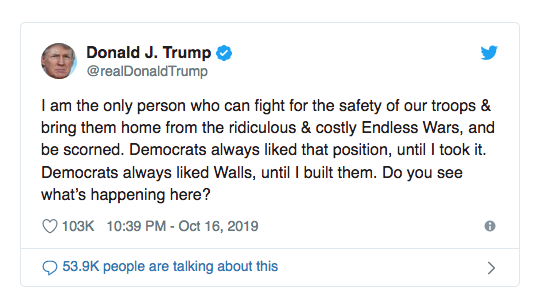
On Thursday, Trump vented about Democratic criticism. “I am the only person who can fight for the safety of our troops & bring them home from the ridiculous & costly Endless Wars, and be scorned. Democrats always liked that position, until I took it,” he said.
Republicans have been equally critical of Trump, with 129 GOP members voting for a resolution in opposition to the withdrawal, joining a unanimous Democratic contingent. Sen. Lindsey Graham has been particularly vocal, leading Trump to accuse the
Graham, however, was no supporter of Obama, and lumped Trump and his predecessor together in making what he believes to be critical foreign policy errors.
“President Trump is being told EXACTLY what President Obama was told before he withdrew from Iraq,” Graham tweeted Wednesday. “He appears to be hell-bent on making the same mistakes in Syria as President Obama made in Iraq.”
Source: US Government Class
Share:
Tonights Debate Online Discussion has been canceled
Tonights CNN debate online discussion has been canceled. If you would still like to get extra credit watch a least a 30 minute segment of the debate. Keep a log of what questions were asked, one of the candidates responses and your view of how they answered the question. You will need 5 -7 different question and responses to get credit.
Type your log and responses and turn them in by Friday.
Mr. Montano
Source: US Government Class
Share:
Egolf studying gross receipts tax reform for New Mexico
Santa Fe New Mexican – State House Speaker Brian Egolf is considering proposing legislation in the next session that would reduce the gross receipts tax rate in New Mexico while eliminating some deductions and exemptions related to the tax.
A potential bill would propose cutting the tax by a quarter of or half of a percentage point, Egolf said Thursday. A half-point reduction would lower the rate from 8.4 percent to 7.9 percent in the city of Santa Fe.
Egolf said such a proposal would not lower the total amount of revenue taken in by the state because getting rid of certain deductions and exemptions would make up for the money lost to the tax cut.
“The idea is to make it revenue neutral,” said Egolf, D-Santa Fe.
Egolf said he and his staff are just beginning to study which exemptions and reductions a bill might propose to eliminate, but he aims to focus on taxes on business-to-business purchases rather than taxes on retail goods so consumers would be minimally affected.
He added that the intent of such a bill would be to help lower-income New Mexicans because a substantial part of their income goes to gross receipt taxes.
“Lowering the gross receipts tax is the best way to give people a tax cut in New Mexico,” Egolf said. “It affects lower-income folks the most.”
On the Senate side, Majority Leader Peter Wirth said he would support discussing tax reform in the next legislative session. He would support lowering the gross receipts tax rate, he added, but only if oil and gas revenue were not used to pay for the tax cut.
“The reason it’s justified is we’ve basically spent the last 40 to 50 years narrowing the tax base and raising the rates,” said Wirth, also a Santa Fe Democrat. “The danger is thinking the good times are here so now we need to start cutting the tax base.”
A half-point cut could cost the state an estimated $350 million to $400 million, Egolf said.
Yet all the exemptions, deductions and credits related to the tax currently add up to around $1 billion, according to Wirth.
Egolf said a potential proposal would only affect the portion of the gross receipts tax that goes to state revenue and would not affect the portion distributed to local governments.
“We’re going to be talking with the Santa Fe delegation about a variety of issues related to taxes and revenues,” Santa Fe Mayor Alan Webber said when asked about a potential gross receipts tax proposal. “This is something that we would take up at that time as we look at all the options.”
The idea of reforming the gross receipts tax was “very lightly brushed upon” in a Wednesday meeting attended by Gov. Michelle Lujan Grisham and leadership from the House and Senate, the Governor’s Office said.
“Tax reform is a worthy subject of discussion and debate,” spokeswoman Nora Meyers Sackett said. “At this stage, it’s too early to say whether that’s something legislators are going to push for, and the governor would need to see a more fleshed-out proposal before weighing in one way or the other.”
Rep. Antonio Maestas , D-Albuquerque, said legislators should eliminate the deductions and exemptions that do not have an economic benefit.
“Some of the deductions have an economic incentive component. Others are just giveaways,” Maestas said. “To me, all the giveaways should be done away with.”
Proposals to lower the gross receipts tax have been debated before. House Bill 6, passed in the last session, originally aimed to lower the tax rate, but that measure was taken out of the bill.
Source: US Government Class
Share:
Turkey Launches Attacks on US Allies
CNN – Shortly after Erdogan announced the offensive, the spokesman for the Kurdish-led Syrian Democratic Forces (SDF) — a key US ally in northern Syria — claimed that warplanes had begun carrying out airstrikes on civilian areas. “There is huge panic among people in the region,” spokesman Mustafa Bali wrote.
The offensive comes days after US President Donald Trump provoked a storm of criticism, including from his own party, by announcing the pullback of US military forces from the region. Trump’s decision in effect gave Turkey a green light to attack US-backed Kurdish forces, though Trump threatened to punish Turkey economically if it does “anything outside of what we think is humane.”
Ankara regards the Kurdish People’s Protection Units, also known as the YPG, as a terrorist group affiliated with the Kurdistan Workers’ Party (PKK), which has fought the Turkish state for more than three decades. But the US backs the YPG and credits the Kurds for helping defeat ISIS in Syria.
Turkey has launched a planned military offensive into northeastern Syria, President Recep Tayyip Erdogan announced Wednesday, just days after the Trump administration announced it was pulling US troops back from the border area.
“Our aim is to destroy the terror corridor which is trying to be established on our southern border and to bring peace and peace to the region,” Erdogan tweeted.
He added that Turkey “will preserve Syria’s territorial integrity and liberate local communities from terrorists.”
In a tweet early Wednesday, the Turkish government communications director, Fahrettin Altun, said the YPG had two options: “They can defect or we will have stop them from disrupting our counter-ISIS efforts.”
Ahead of the offensive Wednesday, Syria condemned Turkey’s “aggressive behavior” and “hostile intentions,” according to
Syrian state news agency SANA. “The aggressive behavior of the Erdogan regime clearly shows the Turkish expansionist ambitions in the territory of the Syrian Arab Republic and cannot be justified under any pretext,” a source at the Foreign Ministry said, SANA reported.
A source at the Foreign Ministry said in a statement Wednesday that the Syrian government holds some Kurds responsible for what is happening “as a result of their dependence on the American project.”
Calls to avoid a ‘possible humanitarian catastrophe’
The Kurdish-led Syrian Democratic Forces (SDF) called on on the international community Tuesday to help avoid a possible humanitarian disaster.
In series of tweets from the verified Twitter account of the SDF, the General Command said the border areas of northeast Syria “are on the edge of a possible humanitarian catastrophe.” It went on to call on the international community and those countries fighting against ISIS “to carry out their responsibilities” to avoid a “possible impending humanitarian disaster.”
The SDF, which has vowed to defend itself against any perceived Turkish incursion, called on the US-led coalition and the international community to implement a no-fly zone over northern Syria similar to the one implemented in Iraq.
The Turkish Defense Ministry said Tuesday that the Turkish Armed Forces is “the only coalition and NATO army fighting the DAESH (ISIS) terrorist group in the Euphrates Shield Operation.”
“Turkey is one of the countries most affected by DAESH’s bloody activities and has fought against this terrorist organization both domestically and beyond its borders with increasing tempo and intensity,” the ministry said in a tweet posted on its official twitter page.
The Euphrates Shield Operation, launched in July 2014 inside Syrian territory, was not only aimed at fighting ISIS but also the YPG.
On Wednesday, the SDF said ISIS “sleeper cells” attacked Kurdish positions in Raqqa, Syria, in the early hours, as tweeted by Mustafa Bali, head of the SDF press office.
Manbij Military Council spokesman, Shervan Derwish, also tweeted about the attack citing security sources saying, “more than 50 armed Daesh group in Raqqa are launching a coordinated attack to control Al Basel base in center of the city.”
On Saturday, Erdogan announced that the country had “completed our preparations and action plan” and was ready to launch a “ground and air operation” east of the Euphrates river, with the goal of establishing “peace” by clearing the region of “terrorists.”
Reinforcements deployed by the Turkish army could be seen arriving at the border town of Akcakale on Tuesday, according to the state-owned Anadolu news agency.
The Kurds have long been considered as among Washington’s most reliable partners in Syria and in the broader campaign against ISIS in the region.
US-backed Kurdish forces have been responsible for holding all captured ISIS fighters in the area. However, according to the White House, this responsibility will now fall to Turkey.
Trump has defended his decision to remove US troops from the area, saying he was “not siding with anybody” — Kurdish forces or the Turkish government — and reiterated an earlier warning to Turkey about potential economic devastation.
“I told Turkey if they do anything outside of what we think is humane … they could suffer the wrath of an extremely decimated economy,” the President said.
Turkish Vice President Fuat Oktay said his country won’t “bow to threats” in an apparent response to Trump’s warning.
“Turkey will teach a lesson to terror organizations that threatens our southern border and we will give an opportunity for Syrian refugees who are currently in Turkey,” Oktay said. “Our message to international community is clear. Turkey is not a country that will bow to threats.”
CNN’s Hamdi Alkhshali, Samantha Beech, Sharif Paget, Isil Sariyuce, Jennifer Hansler, Alex Rogers and Ryan Browne contributed reporting.
Source: US Government Class
Share:
Trump tells Congress he won’t cooperate with impeachment probe
Washington Times – The White House on Tuesday called the House impeachment probe “partisan and unconstitutional” and said President Trump will not cooperate until Democrats come up with a fair process that respects his rights.
The move came hours after the administration blocked Gordon Sondland, the U.S. ambassador to the European Union, from testifying before a closed-door session of the impeachment probe.
Democrats said preventing Mr. Sondland from testifying was only adding fuel to their case for impeachment on the basis of obstructing an investigation, and they issued a subpoena to compel him to appear. But the White House said the House is operating without any rules and, until it writes guidelines that are fair to all sides, the president and his team won’t play ball.
“President Trump and his administration reject your baseless, unconstitutional efforts to overturn the democratic process. Your unprecedented actions have left the President with no choice,” White House Counsel Pat Cipollone wrote to House Speaker Nancy Pelosi and three Democratic committee chairmen. “In order to fulfill his duties to the American people, the Constitution, the executive branch, and all future occupants of the Office of the Presidency, President Trump and his administration cannot participate in your partisan and unconstitutional inquiry under these circumstances.”
He said the Democrats’ impeachment effort seems less an attempt to defend the Constitution and more an effort “to overturn the results of the 2016 election and deprive the American people of the President they have freely chosen.”
His eight-page letter is so far the administration’s most scathing and thorough rebuttal to the inquiry, all but daring House Democrats to advance articles of impeachment.
The letter capped a day of fast-moving developments on Capitol Hill. Mr. Trump on Twitter called the probe “a totally compromised kangaroo court,” and Mrs. Pelosi returned fire by accusing the president of “obstructing justice, abusing power and diminishing the office of the presidency” over the Sondland matter.
Mrs. Pelosi and Rep. Adam B. Schiff of California, who chairs the House Permanent Select Committee on Intelligence, were among those who received the eight-page letter.
The speaker posted a reply to the letter Tuesday evening on her site calling it “manifestly wrong” and “simply another unlawful attempt to hide the facts of the Trump Administration’s brazen efforts to pressure foreign powers to intervene in the 2020 elections.”
“The White House should be warned that continued efforts to hide the truth of the President’s abuse of power from the American people will be regarded as further evidence of obstruction. Mr. President, you are not above the law. You will be held accountable,” Mrs. Pelosi said.
“The White House should be warned that continued efforts to hide the truth of the President’s abuse of power from the American people will be regarded as further evidence of obstruction. Mr. President, you are not above the law. You will be held accountable,” Mrs. Pelosi said.
The White House said it has tried to cooperate — most notably by releasing the text of the president’s July 25 call with Ukrainian President Volodymyr Zelensky, which was the subject of a whistleblower complaint.
The transcript showed Mr. Trump asking for an investigation of corruption involving 2020 Democratic presidential front-runner Joseph R. Biden and his son Hunter, who had a high-paying job on the board of a Ukrainian gas company while his father was vice president. The transcript did not, however, show the president threaten to withhold U.S. military aid unless Mr. Zelensky complied, as the whistleblower alleged.
“Never before in our history has the House of Representatives — under the control of either political party — taken the American people down the dangerous path you seem determined to pursue,” Mr. Cipollone wrote.
“Your highly partisan and unconstitutional effort threatens grave and lasting damage to our democratic institutions, to our system of free elections, and to the American people,” he said in the letter, addressed to Mrs. Pelosi, Mr. Schiff, House Foreign Affairs Committee Chairman Eliot L. Engel of New York and House Oversight and Reform Committee Chairman Elijah E. Cummings of Maryland.
Democrats hoped Mr. Sondland would be a star witness and shed light on whether the president used a $391 million military aid package as leverage to get Ukraine to investigate the Bidens.
Mr. Sondland reported directly to the president on Ukrainian-U.S. relations.
Text messages turned over to Congress last week revealed that Mr. Sondland and another official wrote a statement for Mr. Zelensky expressing his commitment to investigate the Biden family.
Mr. Sondland was eager to testify, according to his attorney.
Republicans on Capitol Hill said they, too, were eager to hear from the ambassador, though they said they expected him to back up Mr. Trump’s claim that there was no quid pro quo.
The Republican lawmakers said that despite their disappointment, they agreed with the administration’s move to block the ambassador’s testimony at this point.
“It’s based on the unfair and partisan process that Mr. Schiff has been running,” said Rep. Jim Jordan, Ohio Republican.
Mr. Jordan said Kurt Volker, another State Department official who testified last week, was treated poorly by the Democrats and they did not want to subject Mr. Sondland to the same treatment.
House Republicans say if Democrats want to conduct an impeachment inquiry they should hold a vote in the full House and write rules to govern the proceedings, such as rules for sharing evidence, calling witnesses and granting access to the president’s team.
Those were all standard features of past impeachment inquiries, Republicans said, but Democrats have not embraced them this time.
Mrs. Pelosi, who unilaterally declared the impeachment probe last month, has brushed aside Republicans’ suggestions on how to achieve a fair probe. Yet she is also wary of her new majority being defined by the push for impeachment. In a letter to her Democratic troops on Tuesday, she urged them to continue to talk about legislation they hope to pass.
“We must legislate strongly, investigate fairly and litigate strategically,” she said.
Meanwhile, Senate Republicans, who have the majority in the upper chamber, vowed to use their platform to balance the House’s one-sided inquiry.
Senate Judiciary Committee Chairman Lindsey Graham, South Carolina Republican, said he would allow Mr. Trump’s personal attorney, former New York Mayor Rudolph W. Giuliani, to come before his committee to discuss the “disturbing allegations” of corruption in Ukraine.
“Given the House of Representatives’ behavior, it is time for the Senate to inquire about corruption and other improprieties involving Ukraine,” Mr. Graham tweeted.
• Gabriella Muñoz and Tom Howell Jr. contributed to this report.
Source: US Government Class