

Share:
Ruth Bader Ginsburg on ERA questions: Time to ‘start over’
FoxNews – Supreme Court Justice Ruth Bader Ginsburg questioned calls to add the Equal Rights Amendment to the Constitution amid renewed speculation, instead suggesting the U.S. start over with the ratification process.
Ginsburg said that one of her life’s goals — enshrining prohibition of gender-based discrimination in the Constitution — should be put on hold.
“I would like to see a new beginning,” Ginsburg, 86, told moderator Judge M. Margaret McKeown, of the 9th Circuit Court of Appeals, at an event at Georgetown University’s law school. “I’d like it to start over.”
The Equal Rights Amendment, which stipulates “equality of rights under the law shall not be denied or abridged by the United States or by any state on account of sex,” was introduced in the 1920s and passed by Congress in 1972. But the deadline to ratify the measure as a constitutional amendment expired in 1982.
Ginsburg’s comments formed an unlikely alliance between the Supreme Court justice who has been pivotal to the feminist movement and conservatives who believe the ERA is a threat to their stances on abortion and transgender rights. Still, Ginsburg assured that she would like to see equal rights spelled out in the Constitution.
“I would like to show my granddaughters that the equal citizenship stature of men and women is a fundamental human right,” she said.
However without Ginsburg’s vote, it’s unlikely that five members of the Supreme Court will ratify the ERA, without a complete do-over of the ratification process, sending it through Congress again.
Three-fourths of U.S. states, or 38 in total, are required to amend the Constitution. “There’s too much controversy about latecomers,” said Ginsburg. “Plus, a number of states have withdrawn their ratification. So, if you count a latecomer on the plus side, how can you disregard states that said, ‘We’ve changed our minds?’
Last month, Virginia became the 38th state to ratify the ERA. But Kentucky, Idaho, Nebraska, South Dakota and Tennessee passed the ERA and later rescinded the ratification.
Ginsburg’s comments seemed to back a statement the Justice Department released after Virginia ratified the ERA in January, pointing out that since the deadline to pass the amendment lapsed decades ago, it was too late for states to be added to the ratification list.
“Because three-fourths of the state legislatures did not ratify before the deadline that Congress imposed, the Equal Rights Amendment has failed of adoption and is no longer pending before the States,” Assistant Attorney General Steven Engel wrote.
As a result, multiple state attorneys general filed suit to force the U.S. to ratify the ERA.The attorneys general argue that the deadline passed by Congress is not binding; time limitation was not included in the text of the article that was sent to the states for consideration. They also said that the Constitution does not explicitly give Congress the power to set a timeline for amendment ratification. The added that the last amendment added in 1992 — the 27th Amendment limiting the ability of members of Congress to give themselves pay raises – took more than 200 years to be ratified by 38 states.
Source: US Government Class
Share:
CBS News Battleground Tracker poll: In New Hampshire, Sanders’ support v. Buttigieg bounce
CBS News – In New Hampshire, Bernie Sanders is trying to hold onto his lead against Pete Buttigieg, who has made gains coming off of the Iowa caucuses. Here, we present three of the possible scenarios that we might see Tuesday night — including different possible winners — that may illustrate the dynamics in this still-evolving race.
Only 39% of likely voters say they’ve definitely made up their minds, and only 59% are enthusiastic about their favored candidate. No matter which candidates draw the most attention, it does appear that Sanders and Buttigieg are both in position to get delegates.
Based on our latest CBS News Battleground Tracker poll, our baseline estimate of the contest has Sanders at 29% support among likely voters (up two points from January) while Buttigieg is at 25% — having gained 12 points since then. Many of Buttigieg’s recent gains come at the expense of Joe Biden, who is now at 12%. Elizabeth Warren is in front of Biden with 17%, and Amy Klobuchar just behind him at 10%.
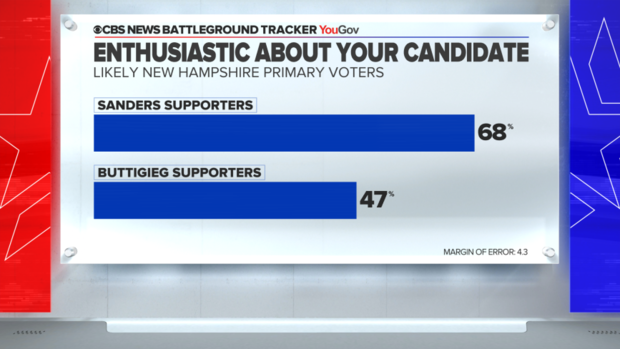
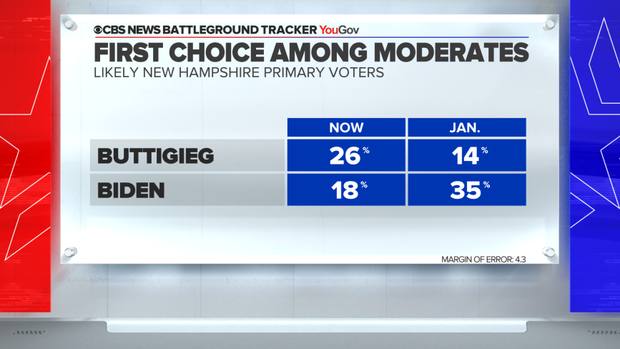
We also see a bit of what underlies a political “bounce”: Buttigieg is now leading among moderate Democrats — Biden did before — while both the number of voters supporting and even considering Biden has dropped. One thing keeping Sanders’ support steady is that his backers are more enthusiastic about him (68%) than the backers of other leading candidates are about them, and more than Buttigieg’s are about Buttigieg (47%). The polling was mostly completed before Friday night’s debate.
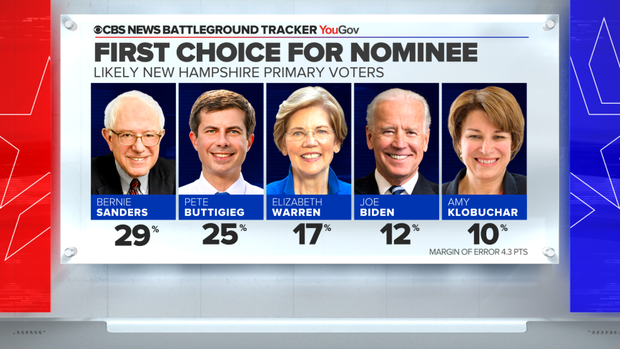
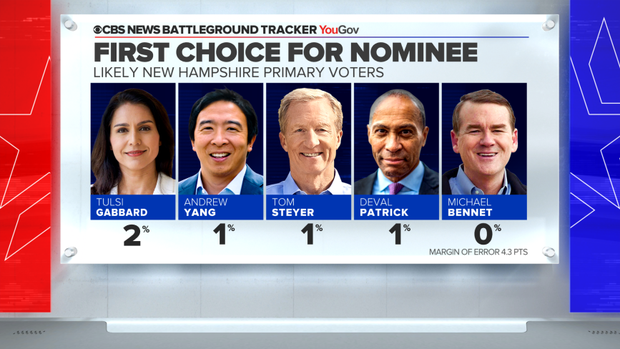
So how might Buttigieg win? Suppose he continues to persuade voters to back him — what observers might call “momentum” we pollsters would observe as voters giving a candidate renewed consideration. In one such scenario, let’s consider what would happen if the New Hampshire voters who have Buttigieg as their second choice, but are not fully committed to their first choice, were to switch. If that happened, it would put Buttigieg over Sanders, and is one way Buttigieg could win.
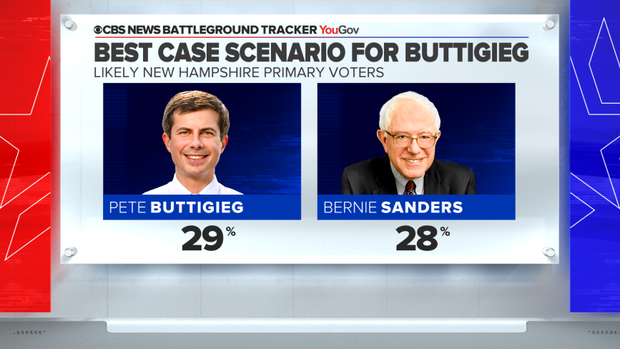
At the same time, things could go the other way for Buttigieg, too: his supporters are less likely to have definitely decided on him than are Sanders’.
Our next scenario revolves around turnout, and advantages Sanders.
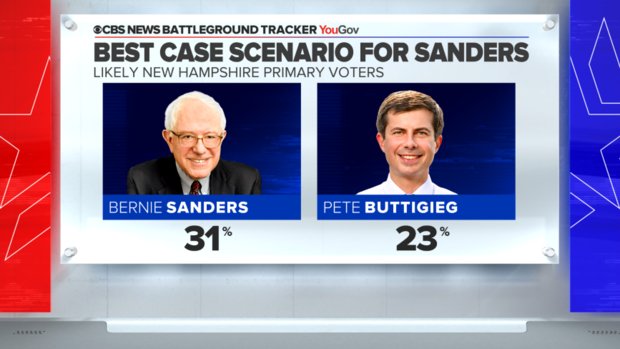
Sanders has the more enthusiastic backers. Suppose overall, voters who are enthusiastic about their candidates are much more likely to turn out than those who aren’t, all else being equal (and voters do tell us that enthusiasm is related to their likelihood of voting). This would greatly help Sanders. In that turnout scenario, Sanders would win by a substantial margin, 31% to 23%.
Warren does as well as Buttigieg here among liberals, but she trails among moderates. She does well among those with college- and post-graduate degrees, but not nearly as well with non-college voters; they are much more for Sanders. She is not being as widely considered as Sanders or Buttigieg overall, so her fortunes here probably hinge heavily on the composition of the electorate.
More from the survey
A third say the events of Iowa have made them less confident in the Democrats’ nominating process. And heading into New Hampshire, New Hampshire Democrats are no more confident today that their party will nominate someone who will beat President Trump than they were in November.
Michael Bloomberg is not on the ballot in New Hampshire but Democrats there have noticed him. Thirty-seven percent of Democratic likely voters say they would consider Bloomberg if he were on the ballot.
All told, in Iowa, turnout was close to 2016 levels but did not reach the records that some had expected. So we might reasonably expect that turnout — as well as persuasion and changing choice — are in play again here.
This CBS News survey is conducted by YouGov between February 5-8, 2020. A representative sample of 1,222 registered voters in New Hampshire was selected, including 848 self-identified Democrats, as well as independents who plan to vote in the Democratic primary this year. This sample was weighted according to gender, age, race, and education based upon voter registration lists and the U.S. Census Current Population Survey, as well as the 2016 presidential vote. The margin of error for the sample of likely voters is 4.3 points.
Source: US Government Class
Share:
Potential conflicts abound in New Mexico’s citizen legislature
Santa Fe New Mexican – Scott Scanland, one of the most influential lobbyists in the New Mexico Legislature, recently surveyed a Senate committee room during a hearing on a bill aimed at more stringently regulating electronic tobacco products.
Scanland represents Altria Client Services Inc., parent company of tobacco giant Philip Morris USA and a variety of other tobacco and cigar brands. Altria also has a 35 percent ownership stake in JUUL Labs Inc., a leading electronic cigarette company.
The lobbyist is married to state Rep. Doreen Gallegos, D-Las Cruces, the House majority whip. Some ethics watchdogs consider this a potential conflict of interest. But it’s only one example of many in a citizen Legislature where the potential for such conflicts is endemic, says former state Sen. Dede Feldman.
“Conflict of interest is built into the New Mexico Legislature by virtue of the fact that it’s a citizens’ legislature where legislators keep their day jobs,” said Feldman, an Albuquerque Democrat who served in the Legislature for 16 years.
In a small state where face-to-face connections are critical and political ties almost inescapable, potential conflicts abound. It’s no surprise to learn of state legislators who are married to lobbyists, have lobbyists within their own families, or regularly vote or even sponsor legislation that would support an industry in which the lawmaker has a personal business interest.
New Mexico lawmakers — who are unpaid for their service in the Legislature — work in the oil and gas industry, as cattle ranchers, as teachers, as Realtors, as lawyers, in nonprofits or for other businesses that could be impacted by the legislation they pass.
Gallegos, who is part of the top House Democratic leadership, originally had an interview scheduled with The New Mexican to talk about the potential conflict-of-interest issue. But a spokesman for House Democrats instead provided a statement signed by Gallegos that read: “A simple check of my voting record will show that I have voted on behalf of my constituency and my conscience.”
Feldman and other watchdogs say such ties give rise to potential conflicts, pointing to Rep. Moe Maestas’ marriage to another influential lobbyist, Vanessa Alarid. The nonpartisan group New Mexico Ethics Watch included the Gallegos-Scanland and Maestas-Alarid marriages and a handful of others in a report on lobbyists’ outsize influence on state lawmakers.
Alarid’s client list, like Scanland’s, is wide and varied, including the New Mexico Realtors Association, an e-nicotine industry group and Everytown for Gun Safety Action Fund. Both e-nicotine and the gun safety group have interest in legislation this session.
Maestas, D-Albuquerque, who chairs the House Commerce and Economic Development Committee, said he votes on legislation in which his wife is involved “all the time” but it is not a conflict of interest.
“It is a conflict of interest if a particular vote has an economic impact on my family,” he said. “But my wife represents her clients; I represent my constituents. And sometimes those interests are the same; sometimes those interests diverge.”
House Minority Leader Jim Townsend, R-Artesia, who works as a consultant for an oil and gas company, said the interwoven threads between personal connections, business and politics don’t present a conflict and are simply the nature of a citizen legislature. He noted that New Mexico’s unsalaried legislators work in a variety of fields and argued that this is a source of expertise.
“I have always been cognizant of the fact that I come from that industry,” Townsend said. “I think it does two things: I think it brings strength to the body, and I think it brings factual information.”
He added: “I have never recused myself because I can’t think of a time I was asked to vote on something that was solely good for Holly [Energy] and not anybody else. I voted for bills that supported the industry; I voted for bills that didn’t support the refining industry but were more supportive of the industry as a whole. Anybody can make a case one way or the other.”
There are other examples: State Sens. Liz Stefanics, D-Cerrillos, and Candace Gould, R-Albuquerque, also are married to lobbyists — in Gould’s case, one who represents the oil and gas industry. Meanwhile, House Speaker Brian Egolf, a Santa Fe Democrat who is a lawyer, has represented the state’s largest medical cannabis company, Ultra Health, in lawsuits against the state and is a supporter of Gov. Michelle Lujan Grisham’s push to legalize marijuana in the 2020 session for recreational use. Ultra Health CEO Duke Rodriguez has said the company wishes to expand into the full adult-use market.
Egolf declined to say whether Ultra Health remains a client as a vote to legalize marijuana nears, citing attorney privacy rules he said forbid him from doing so. In an interview with The New Mexican, Egolf said representing Ultra Health in the past was “absolutely not” a conflict of interest.
“The vote [that] was taken on medical cannabis resulted in no benefit, no personal benefit to me of any kind,” Egolf said. “So I truly don’t understand what the conflict of interest is.
“Should there be no lawyers in the Legislature?” Egolf added.
Egolf declined a second interview on the topic. In a prepared follow-up statement, he said: “Ethics are of paramount importance in the Legislature and for all elected officials. That is why I began fighting for a statewide independent ethics commission in my very first term in the Legislature.”
He praised the formation of the new State Ethics Commission as a “fair, independent” body and declined to comment on other lawmakers’ potential conflicts of interest.
Jeremy Farris, director of the recently created State Ethics Commission, said he could not offer an opinion on whether close family or personal ties constitute conflicts of interest because he does not want to prejudge matters the commission might look into. He said the commission will investigate issues when it receives complaints.
He added one of the commission’s major tasks is developing a model code of conduct for state agencies and the Legislature that could include a review of the state’s rules on conflicts of interest and situations in which lawmakers should recuse themselves from a vote.
The governor said she hopes the ethics commission will be an effective watchdog as conflicts arise.
“That’s exactly why there needs to be an ethics commission — so that you don’t get someone in my position opining about one legislator and one issue,” Lujan Grisham said in an interview. “You bet it needs to be completely independent. And my expectation is that they’re gonna pay complete attention to these issues and determine whether there are conflicts or not. And I feel really good about the work that they’ve done so far.
“I’m anxious for the ethics commission to get as much clarity about what we can and cannot do, and then I do expect during my term as governor that some legislators in one situation or another … will be recusing themselves on any number of issues, and I think that’s the whole intent,” she continued.
Currently, it is up to lawmakers themselves to decide when they should recuse themselves from a vote.
Sen. Gregg Fulfer, R-Jal, who owns Fulfer Oil & Cattle Co. and a small newspaper in far southeastern New Mexico, has not refrained from voting on bills affecting the oil and gas industry. The one time he recused himself from a vote was on a bill dealing with water waste from hydraulic fracturing operations while he was in the process of patenting a fracking water recycling plant.
“If it’s a direct relation, I can see maybe doing that, but if it broadly affects the industry that you’re working with and you’re knowledgeable … I feel like that’s not a conflict,” Fulfer said.
Sen. Jeff Steinborn, D-Las Cruces, who has in the past introduced legislation to force lobbyists to disclose how much their clients are paying, said it’s sometimes “a fine line” between a lawmaker offering their industry expertise and crossing into territory that would give the impression of a conflict.
“Are there lots of conflicts? Yes,” Steinborn said. “Does it get even more nuanced in the sense that some people represent an industry while others may actually be working for things that most people would view in the public good, like teachers?”
Most lawmakers interviewed for this story said industry expertise or knowledge of a certain field is valuable to other lawmakers trying to make sense of bills without paid staff to help them.
But Kathleen Sabo, former executive director of New Mexico Ethics Watch, said the Legislature needs to be far more transparent about potential conflicts.
“These are some of the issues that people who are pushing reform of the Legislature are going to have to figure out,” she said. “I think we get into dangerous territory when we start splitting hairs.”
For now, the Legislature will operate as it has, and most observers don’t see a change anytime soon.
“It is a citizen legislature,” said Paul Gessing, who operates the Rio Grande Foundation, a conservative think tank. “And it’s hard to come up with a conflict-free group of people.”
Source: US Government Class
Share:
House committee tables bills that would exempt Social Security tax
Santa Fe New Mexican – The House Taxation and Revenue Committee tabled two bills Friday that proposed to eliminate or reduce the state’s tax on Social Security income.
Key legislators had previously voiced support for House Bills 29 and 77, and the majority of public attendees who spoke favored it at Friday’s committee hearing. Yet Democratic and Republican legislators alike said they were worried about altering the tax without having a plan in place to replace the revenue that would be lost.
“You can’t have it both ways. Somewhere you have to pay the piper,” said Rep. Jim Trujillo, a Santa Fe Democrat and co-chair of the committee. “Let’s find a way to pay for it so we don’t create a hole in the general fund.”
House Bill 29, sponsored by five Republicans including Reps. Cathrynn Brown and Gail Armstrong, would have repealed New Mexico’s tax on Social Security income.
On the other hand, House Bill 77, co-sponsored by Democratic Rep. Daymon Ely of Corrales, would have allowed people to exempt up to $24,000 in Social Security income.
During the hearing, Brown and Armstrong told stories of their constituents who had asked them not to tax their Social Security income. Brown added that their bill would provide a form of economic development by attracting more retirees to New Mexico.
Fred Nathan, executive director of Santa Fe-based Think New Mexico, advocated for the legislation alongside the sponsors, saying it would help retirees who have little or no money saved for retirement. He also said the state’s current policy was a form of double taxation.
“So, why is the tax wrong? New Mexico is one of only 13 states to tax Social Security benefits,” said Nathan, whose think tank recently released a report on what it called “a looming retirement security crisis” in the state. “Of those states, we have the second harshest tax.”
But when it was time for committee members to speak, they expressed numerous concerns about the legislation.
Rep. Jason Harper, R-Rio Rancho, contested the notion that the current policy represented a double tax and also argued that repealing or reducing the tax wouldn’t help the poor.
Soon after, committee co-chair Rep. Javier Martinez, D-Albuquerque, said the savings that seniors would receive from the proposals were not worth the hole in revenue that they would create. He encouraged the sponsors to study the idea further.
“We have to have a backup plan for replacing the revenue,” he said.
House Speaker Brian Egolf said last week that the bills had “a lot of traction” and that he supported them “100 percent.” He also noted, however, that the proposed exemption could cost the state $75 million to $80 million and that it might be difficult to find replacement revenue this legislative session.
Source: US Government Class
Share:
Senate acquits President Trump of both impeachment charges
Washington Times – The Republican-controlled Senate on Wednesday ruled President Trump not guilty of abuse of power and obstruction of Congress, rejecting Democrats’ five-month impeachment crusade as weak and saying the president’s fate is better decided at the ballot box.
Though the outcome was never much in doubt, Sen. Mitt Romney, Utah Republican, did make history by becoming the first senator ever to vote to convict a president in his own party.
He joined Democrats in condemning Mr. Trump for abuse of power, but they were in the minority, and Mr. Trump was acquitted on a 52-48 vote. Mr. Romney did side with Mr. Trump and fellow Republicans for the obstruction vote, which was defeated by 53-47. Both were well shy of the two-thirds needed to convict and oust the president.
Mr. Trump went to Twitter to say he would make a public statement at noon Thursday to “discuss our Country’s VICTORY on the Impeachment Hoax!”
White House press secretary Stephanie Grisham said the vote was full vindication and exoneration of the president.
“As we have said all along, he is not guilty. The Senate voted to reject the baseless articles of impeachment, and only the president’s political opponents — all Democrats, and one failed Republican presidential candidate — voted for the manufactured impeachment articles,” she said, referencing Mr. Romney’s unsuccessful 2012 bid for president.
Mr. Trump was only the third president to be impeached. No president has been convicted and removed, though President Nixon resigned before he could be impeached.
Throughout Mr. Trump’s trial, some Democrats said his behavior was worse than Nixon’s.
They said Wednesday that the acquittal was meaningless because the Senate voted last week to reject proposals to call new witnesses or subpoena documents. Democrats said witnesses would have proved their case.
Republicans countered that House Democrats, who led the impeachment push, had a chance to pursue witnesses but rushed their process to meet a political deadline. Republican senators said they wouldn’t rescue the House from its own failings.
The vote, while clearing the president, did little to ease the deep divisions in Congress that have persisted since before Mr. Trump took office.
House Democrats said they will continue to investigate Mr. Trump. Judiciary Committee Chairman Jerrold Nadler, New York Democrat, said some committee is likely to subpoena former National Security Adviser John R. Bolton, who has written a book that reportedly backs much of the impeachment case against Mr. Trump.
Senate Republicans, meanwhile, say they too will investigate — though their focus is on former Vice President Joseph R. Biden and his son Hunter, whose position on the board of a Ukrainian energy company is at the crux of the impeachment saga.
After Mr. Biden expressed an interest in running for the Democratic nomination to battle Mr. Trump in the election this November, the president asked Ukraine to investigate the Bidens. He also wanted President Volodymyr Zelensky to turn over any documents that would back up a theory that Ukraine meddled in the 2016 elections. At the same time, the White House put a hold on almost $400 million in military assistance to Ukraine.
House Democrats said that was an abuse of power, and they voted Dec. 18 to impeach him. They added a second article accusing Mr. Trump of obstruction of Congress after he blocked documents and witnesses they had subpoenaed in their investigation. No Republicans joined the Democrats in impeaching the president.
Senate Democrats said the case was obvious and rose to the level of high crimes and misdemeanors — the standard the Constitution sets for impeachment. But the impeachment push was also freighted with years of frustration with Mr. Trump’s behavior, starting with the 2016 presidential campaign.
“You cannot be on the side of this president and be on the side of truth. And if we are to survive as a nation, we must choose the truth,” said Senate Minority Leader Charles E. Schumer, New York Democrat.
“If the truth doesn’t matter, if the news you don’t like is ‘fake,’ if cheating in an election is acceptable, if everyone is as wicked as the wickedest among us, then hope for the future is lost,” he said.
House Speaker Nancy Pelosi, a California Democrat who reversed herself to back impeachment last year, pointed to Mr. Romney’s defection and said Wednesday’s vote was still a victory of sorts.
“He is the first president in history to face a bipartisan vote to convict him in the Senate,” she said. “A full 75% of Americans and many members of the GOP Senate believe the president’s behavior is wrong. But the Senate chose instead to ignore the facts, the will of the American people and their duty to the Constitution.”
Some prominent Republican senators said Mr. Trump’s demand for investigations of political rivals was “inappropriate,” though none of them other than Mr. Romney thought his actions merited impeachment.
Mr. Romney called it “an appalling abuse of public trust.”
“What he did was not perfect. No, it was a flagrant assault on our electoral rights, our national security and our fundamental values,” he said.
Donald Trump Jr. said Senate Republicans should expel Mr. Romney from their ranks for his apostasy.
Mr. McConnell downplayed the idea, though he acknowledged he was “disappointed” with Mr. Romney’s defection.
Mr. Romney became the first senator ever to vote to convict a president in his own party. All 12 Democrats in the chamber voted to acquit President Andrew Johnson in 1868, and all Democrats voted to acquit President Clinton in 1999.
Democrats were unified again Wednesday.
Sens. Joe Manchin III of West Virginia, Kyrsten Sinema of Arizona and Doug Jones of Alabama, all of whom had been eyed as potential acquittal votes, backed conviction on both articles of impeachment.
Analysts said Mr. Jones likely sealed his doom in Alabama, a deep-red state where he is running for reelection this year.
Mr. Jones fired off a fundraising email Wednesday touting his vote.
“I didn’t consult my party or polling. I took my constitutional oaths seriously,” he told supporters. “That isn’t going to make Mitch McConnell or the extremists he supports in Washington happy, but it was the right thing to do.”
The politics of impeachment appear to be tilting against Democrats.
Mr. Trump’s job approval rating has soared 9 percentage points in Gallup’s polling since late September, when Mrs. Pelosi announced the impeachment inquiry.
Meanwhile, Mr. Biden’s political fortunes have sunk as his son’s dealings in Ukraine have drawn scrutiny.
Mr. McConnell said impeachment also has dented Democrats in the most contested Senate races this year.
“This was a political loser for them. They initiated it. They thought this was a great idea, and at least for the short term it has been a colossal political mistake,” the Kentucky Republican said.
• Stephen Dinan contributed to this report.
Source: US Government Class
Share:
State of the Union: Trump hails ‘American comeback’
BBC – At his annual State of the Union address, Mr Trump set out his case for another four years in office.
He was speaking on the eve of his expected acquittal on corruption charges in his impeachment trial.
At one point the Democratic House Speaker Nancy Pelosi ripped up a copy of his speech behind him.
The Republican president delivered Tuesday night’s nationally televised speech in the Democratic-controlled House of Representatives, where he was impeached in December.
His trial in the upper chamber, the Senate, culminates on Wednesday but with Republicans in charge there he is all but certain to be cleared and escape being thrown out of office.
Mr Trump did not mention impeachment at all in his speech although he did jab at Democrats.
Republican lawmakers chanted “four more years” as Mr Trump prepared to speak, urging him on for November’s White House election.
The State of the Union address is a speech delivered by the president to Congress towards the beginning of each calendar year in office.
It is usually used as a chance to report on the condition of the nation, but also allows the president to outline a legislative agenda and national priorities.
Why did Trump and Pelosi clash?
Mrs Pelosi has been one of the president’s fiercest critics – she was the one who first launched formal impeachment efforts last year. Mr Trump has frequently taunted her as “Crazy Nancy”.
It was the first time the two had come face-to-face since she stormed out of a White House meeting four months ago.
Before Mr Trump began speaking at the podium in the well of the House, he appeared to snub the outstretched hand of Mrs Pelosi, America’s most powerful elected Democrat.
The House speaker, critics noticed, skipped the traditional introduction welcoming the president as a “distinct honour”.
When the president accused Democrats of planning to force American taxpayers to provide unlimited free healthcare to undocumented immigrants, Mrs Pelosi was observed twice mouthing: “Not true.”
She stunned onlookers by shredding a copy of the president’s remarks as he concluded.
Mrs Pelosi told reporters afterwards her gesture was “the courteous thing to do, considering the alternatives”.
She did rise to applaud the president more than once, including when he promoted his pet project of infrastructure investment, a possible area of bipartisan co-operation.
What else did the president say?
Mr Trump struck an upbeat note in a speech lasting one hour and 18 minutes that contrasted sharply with his lament of “American carnage” in his 2017 inaugural presidential address.
In an implicit rebuke to his predecessor Barack Obama, the president told his audience: “In just three short years, we have shattered the mentality of American decline and we have rejected the downsizing of America’s destiny.
“We are moving forward at a pace that was unimaginable just a short time ago, and we are never going back!”
Mr Trump repeatedly swiped at Democrats, including left-wing candidates such as Bernie Sanders, who are vying to challenge him for the presidency.
“We will never let socialism destroy American healthcare!” said the president, whose critics point out that he has not put forward a healthcare plan of his own.
Who else was there?
As is tradition, the president invited several special guests, including Venezuelan opposition leader Juan Guaidó, military veterans and the brother of a man killed by an undocumented immigrant.
In a move certain to infuriate liberal critics, Mr Trump announced he would award the Presidential Medal of Freedom, America’s highest civilian honour, to firebrand conservative radio host Rush Limbaugh, who revealed this week he has lung cancer.
First Lady Melania Trump bestowed the honour on an emotional Mr Limbaugh as the president spoke.
A protester was escorted from the chamber while Mr Trump defended gun rights. It was Fred Guttenberg, the father of Jaime Guttenberg, a student killed in a mass school shooting at Parkland, Florida, in February 2018.
Mr Guttenberg was a guest of Mrs Pelosi.
How did Democrats respond?
Each year after the State of the Union speech, a member of the main opposition party is tasked with responding and this year it fell to Michigan Governor Gretchen Whitmer.
She accused the president of failing to fix America’s problems. “Bullying people on Twitter doesn’t fix bridges – it burns them,” she said.
As they did last year, many female Democrats – including Mrs Pelosi – wore white as tribute to the suffragettes who won the vote for US women a century ago.
Several liberal Democratic lawmakers, including Alexandria Ocasio-Cortez of New York and Maxine Waters of California, boycotted Mr Trump’s address.
Ms Ocasio-Cortez tweeted that she would “not use my presence at a state ceremony to normalize Trump’s lawless conduct & subversion of the Constitution”.
Other left-wing Democrats, including Rashida Tlaib of Michigan, walked out during Mr Trump’s speech.
Who was the designated survivor?
As is traditional during the State of the Union, one member of the president’s cabinet did not attend the address.
He or she remains at a secret location to make sure the government can continue should calamity befall the nation’s president, vice-president and other top leaders.
That person, who is known as the designated survivor, was Interior Secretary David Bernhardt on Tuesday night.
Source: US Government Class
Share:
Ruth Bader Ginsburg decries Washington ‘dysfunction’ amid impeachment trial
FoxNews – As the highly polarized impeachment trial of President Trump rages on in the Senate, Supreme Court Justice Ruth Bader Ginsburg panned the “dysfunction” and “polarization” at an award ceremony in Washingon.
Though she did not mention impeachment specifically, Ginsburg spoke about the lack of cooperation between the two parties in recent years and reflected on how the collaboration between Republicans and Democrats was much more common when she was confirmed onto the Supreme Court.
“Now we’ve seen the high degree of polarization in recent years,” Ginsburg said at a LBJ Foundation event Thursday. “Yes, that’s true… My hope is that someday there will be patriots on both sides of the aisle who are determined to stop the dysfunction we are now experiencing and will decide that their institutional government should work for the benefit of all of the people.”
When asked what her fears for the U.S. over the next decade were, she continued: “That is the fear that this polarization will continue, and my greatest hope is that it will end. So you think back to how it was in ’93, the person who was my biggest supporter on the Senate Judiciary Committee was not the then-chairman, although the chairman was certainly in my corner; it was then-Senator Biden. But my greatest supporter was Orrin Hatch of Utah. And, Strom Thurmond gave me a supply of Strom Thurmond key chains, which has lasted until last year.”
Ginsburg’s comments came on the same day that Sen. Elizabeth Warren, D-Mass. seemingly undermined her colleague Chief Justice John Roberts in a question she submitted for him to read during the impeachment trial.
“At a time when large majorities of Americans have lost faith in government, does the fact that the chief justice is presiding over an impeachment trial in which Republican senators have thus far refused to allow witnesses or evidence contribute to the loss of legitimacy of the chief justice, the Supreme Court, and the Constitution?” Roberts read from the card handed to him by the clerk before shooting a visibly irritated look in what appeared to be Warren’s direction.
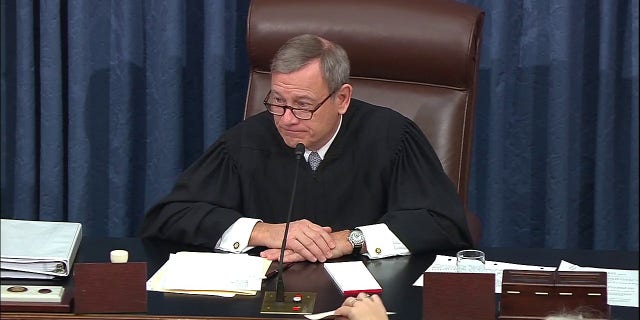
In contrast to the partisan votes and charged rhetoric from both sides in the impeachment trial, Ginsburg described the “civility” on the Supreme Court.
“It is the most collegial place I have ever worked. One symbol of it is every day before we sit to hear cases, and every day before we confer on cases, we go around the conference room, each justice shakes hands with every other,” she said. “And that’s the way of saying ‘Yes, you circulated a pretty spicy dissent yesterday’ … but we’re all in this together and we know that the institution we serve is ever so much more important than our individual egos. So to make it work, we have to not just tolerate but genuinely appreciate each other.”
Ginsburg has made similar comments in the past. Last year, for example, she defended the two most junior justices of the Supreme Court, Trump-appointees Brett Kavanaugh and Neil Gorsuch, at a forum hosted by Duke Law School.
At an hourlong question-and-answer session, Duke Law professor Neil Siegel lamented that “nominees for the Supreme Court are not chosen primarily anymore for independence, legal ability, personal decency, and I wonder if that’s a loss for all of us.”
Ginsburg shot back, “My two newest colleagues are very decent, very smart individuals.” The exchange was first reported by The National Review.
Source: US Government Class
Share:
Education Dept. Unveils Fix For Student Loan Program’s ‘Bureaucratic Nightmare’
NPR – Public servants with student loans were furious, and the U.S. Department of Education heard them. The department revealed Thursday that it will simplify the process for borrowers to apply for an expansion of the troubled Public Service Loan Forgiveness (PSLF) Program.
The move comes after a damning Government Accountability Office review, first reported by NPR. In that 2019 review, the federal watchdog found that during the expansion program’s first year, the department turned away 99% of applicants.
The change — which the department posted to the Federal Register without a news release or other public announcement — will address one of the most alarming revelations in the GAO’s review: 71% of denials were essentially due to a paperwork technicality. According to the GAO, more than 38,000 applicants were denied relief under the expansion — known as Temporary Expanded Public Service Loan Forgiveness (TEPSLF) — simply because they hadn’t first applied for and been denied PSLF.
The department’s fix is to consolidate the two programs into one application form so that borrowers applying for TEPSLF will no longer have to first file a separate application for PSLF.
In a statement, the department said of the fix: “We believe borrowers will be better served by using a single form for both programs. So the point is to further reduce confusion and to eliminate the need for a borrower who completed the wrong form to complete a new form.”
“Sometime in the near future, we’ll be able to go one step further and actually text the student that information,” added Mark Brown, head of the department’s student loan office, Federal Student Aid.
The fix was widely praised.
“We think it’s a great move. It responds to our recommendation,” said Melissa Emrey-Arras, who led the GAO investigation. “It is just so much simpler from a borrower perspective to have a single application. That way, you know, if you’re eligible for the regular Public Service Loan Forgiveness, you can receive it. And if you’re not, you can be considered for the Temporary Expanded process. It’s like one-stop shopping.”
In a statement to NPR, the Education Department said: “This is just another action we are taking as part of our commitment to simplifying the program. While we cannot change the fundamental problem of having to administer a program designed to serve only a small fraction of the borrowers, we are doing our best to at least remove unnecessary administrative burden.”
Congress created the PSLF program in 2007 to encourage promising college graduates to take up public service careers. In return for 10 years of government or not-for-profit work and 120 eligible student loan payments, borrowers were told that the Department of Education would forgive whatever remained of their federal student loans. But the program’s requirements are so rigid and were so poorly communicated in those early days that the overwhelming majority of borrowers have, so far, been rejected.
In response to an outcry from borrowers and lawmakers, in 2018 Congress set aside $700 million for TEPSLF — to help borrowers who had fulfilled their public service but who were, unbeknownst to them, in the wrong repayment plan. While the program was meant to help thousands of public servants who felt unfairly excluded from PSLF, its burdensome requirement that they first be denied PSLF created what Emrey-Arras calls a “bureaucratic nightmare.”
“This can be confusing to borrowers,” Emrey-Arras told NPR in September. “It doesn’t make a lot of sense, from a borrower perspective, as to why you would need to apply for a program that you know you’re ineligible for. Yet that’s the way the process works.”
“What sort of Kafkaesque thing are we in here?” Matthew Austin told NPR in September. His wife, Heather, a teacher, had been denied TEPSLF for her federal student loans. The explanation given, Austin said: “because we had not been denied for PSLF.”
Austin said that the rejection was demoralizing and pushed him and Heather to abandon their hope of loan forgiveness. But after being contacted by NPR, they reapplied one last time. In October, their application for TEPSLF was approved. The Education Department forgave more than $40,000 in outstanding federal student loans and issued the Austins a refund for the extra payments they’d made.
It’s unclear how many of the original 38,000-plus denied TEPSLF applicants still technically qualify for loan forgiveness, like the Austins, and simply need to reapply.
On Thursday, lawmakers welcomed the consolidation of application forms but also warned Education Secretary Betsy DeVos that the department’s efforts to improve the PSLF and TEPSLF programs should not stop here.
The department’s lack of urgency in helping borrowers navigate the Public Service Loan Forgiveness Program has left applicants confused, panicked and rightfully frustrated,” said Rep. Bobby Scott, a Virginia Democrat and chairman of the House education committee. “I am relieved that — in response to intense public pressure — the department is finally taking a step toward fixing the PSLF application process. However, this change alone does not satisfy the department’s responsibility to faithfully implement the law.”
When asked how it feels to have more than $40,000 in student loans forgiven, Austin laughed and said it has allowed him and his wife to “turn our eyes forward, because we can stop making payments on colleges from 12 years ago and we can start saving for college 10 years in our kids’ future.”
Source: US Government Class
Share:
Executive branch, legislators negotiating budget
Santa Fe New Mexican – One-third of the way through the 2020 legislative session, the House and Senate have yet to hear the state’s main budget bill. But as that moment draws nearer, a flurry of negotiations over how to spend more than $7 billion are heating up in committee meetings and behind closed doors.
Key talks involve bridging the gaps between the executive and legislative branches’ competing spending plans on education. A series of interviews Thursday showed some of those discrepancies are being resolved, while others … well, not yet.
“The House dubbed investments in education — not just K through 12, but cradle to career — as a moonshot,” Gov. Michelle Lujan Grisham told The New Mexican in an interview Thursday. “Well, they need to demonstrate that they’re serious about that moonshot. I believe that they will. But I think it’s early.”
While Lujan Grisham didn’t elaborate on specific budget items, a key House lawmaker did. Rep. Patricia Lundstrom, chair of the House Appropriations and Finance committee, said one area of likely common ground is funding for the state’s new Early Childhood Education and Care Department.
“We’ve come together much closer on that,” the Gallup Democrat said. “You’ll see that when we roll out the budget on Monday.”
There had been a significant disparity between the governor’s recommendation for the department’s budget ($440.5 million) and the Legislative Finance Committee’s ($390 million).
Lundstrom herself had voiced concern over the governor’s plan just two weeks ago.
“On early childhood, I think there’s going to be compromise,” said Sen. John Arthur Smith, chair of the Senate Finance Committee.
Another area of apparent agreement is higher education funding. Lundstrom said her committee will adopt the governor’s recommendation on “instruction and general” funding, which is the main appropriation colleges and universities use for their operations.
The House committee plans to finalize an updated version of House Bill 2, the General Appropriations Act sponsored by Lundstrom, on Saturday and file it Monday.
Once the committee approves the legislation, it will go to the House floor and then to the Senate.
One place where legislators and the governor still don’t see eye to eye is Lujan Grisham’s proposed Opportunity Scholarship, which Lundstrom said may not be approved.
“I think it’s an idea a little before it’s time and probably needs some more work in the interim,” she said. “I would imagine it would come back next summer if it doesn’t make it through the process.”
The reason, she said, is that lawmakers believe the scholarship —which would provide free college tuition for all New Mexicans — would be “disproportionately harder for poorer kids to get.”
“People feel like it needs to be needs-based,” Lundstrom said.
Senate President Pro Tem Mary Kay Papen also wasn’t sure if the proposal will be approved.
“I think there are still moving pieces,” said Papen, D-Las Cruces. “People are trying to figure out what this is going to do to the colleges. Can they really do this? Is this money really going to the most disadvantaged?”
And Smith, D-Deming, said legislators and the governor could reach a compromise, but some concerns remain for Senate Democrats.
“The exchange I’ve had, it’s not falling on party lines,” said Smith, whose committee will have a crucial role in shaping the budget. “There’s pushback from both Republicans and Democrats. At least that’s what they’ve communicated to me.”
The initiative would require $35 million in recurring funds to pay for students’ tuition and fees not already covered by the lottery scholarship and federal Pell grants.
Colleges have said the scholarship could help wealthy students more than poor ones given that it doesn’t specifically target low-income people.
They’ve also said lower-income students may have trouble getting help to cover living expenses such as books, transportation, housing and food.
The House Appropriation and Finance Committee has yet to settle on its proposal on pay increases for teachers and state employees.
Lundstrom said she was aiming to include a 3 percent raise for state employees in House Bill 2, the same level Lujan Grisham recommended in her spending plan.
“It’s just tragic — some of those salary levels are way too low,” Lundstrom said.
She added the committee was unlikely to adopt a proposal by House Speaker Brian Egolf to increase teachers’ salaries by 10 percent, especially since that number is so much higher than the proposed state employee hike.
“It would be disingenuous to have one at 10 [percent] and all the rest of state employees at 3 [percent],” she said. “Teachers are hard to fill, and I understand why he’d like to do that, but we’re just not going to do that high.”
The governor is proposing a 4 percent pay increase for all teachers and education personnel, while the Legislative Finance Committee has called for 3 percent.
Of course, these different areas of the budget can still be modified multiple times on their long path to the governor’s desk. Lujan Grisham said she is in constant talks with lawmakers during that journey and is willing to find consensus.
“I’m always willing to compromise,” she said. “And I meet with them all the time.
“I am enthusiastically optimistic about where we’ll end up,” she added. “And let’s see if I’m right.”
Source: US Government Class