LONDON — Boris Johnson, set to speak Tuesday before the British Parliament for only the second time since becoming prime minister, is facing a rebellion of lawmakers who are livid about his plan to shut them down and who are desperately trying to stop Britain from leaving the European Union without a withdrawal deal on Oct. 31.
Washington Post – LONDON — Boris Johnson, set to speak Tuesday before the British Parliament for only the second time since becoming prime minister, is facing a rebellion of lawmakers who are livid about his plan to shut them down and who are desperately trying to stop Britain from leaving the European Union without a withdrawal deal on Oct. 31.
The opposition, which includes members of Johnson’s Consevative Party, are seeking to take control of the agenda and pass legislation to delay Brexit by an additional three months.
Johnson has warned that if they succeed, he will trigger a snap general election — and bar those who vote against him this week from running as Conservatives.
The showdown is happening as Parliament returns from its summer recess, after days of legislators accusing each other of attacking British democracy and raucous street protests calling Johnson’s moves a “coup.”
Johnson enraged opponents by getting the queen’s approval to suspend Parliament for five more weeks starting as early as Monday, as the country is trying to resolve its most serious political crisis in decades.

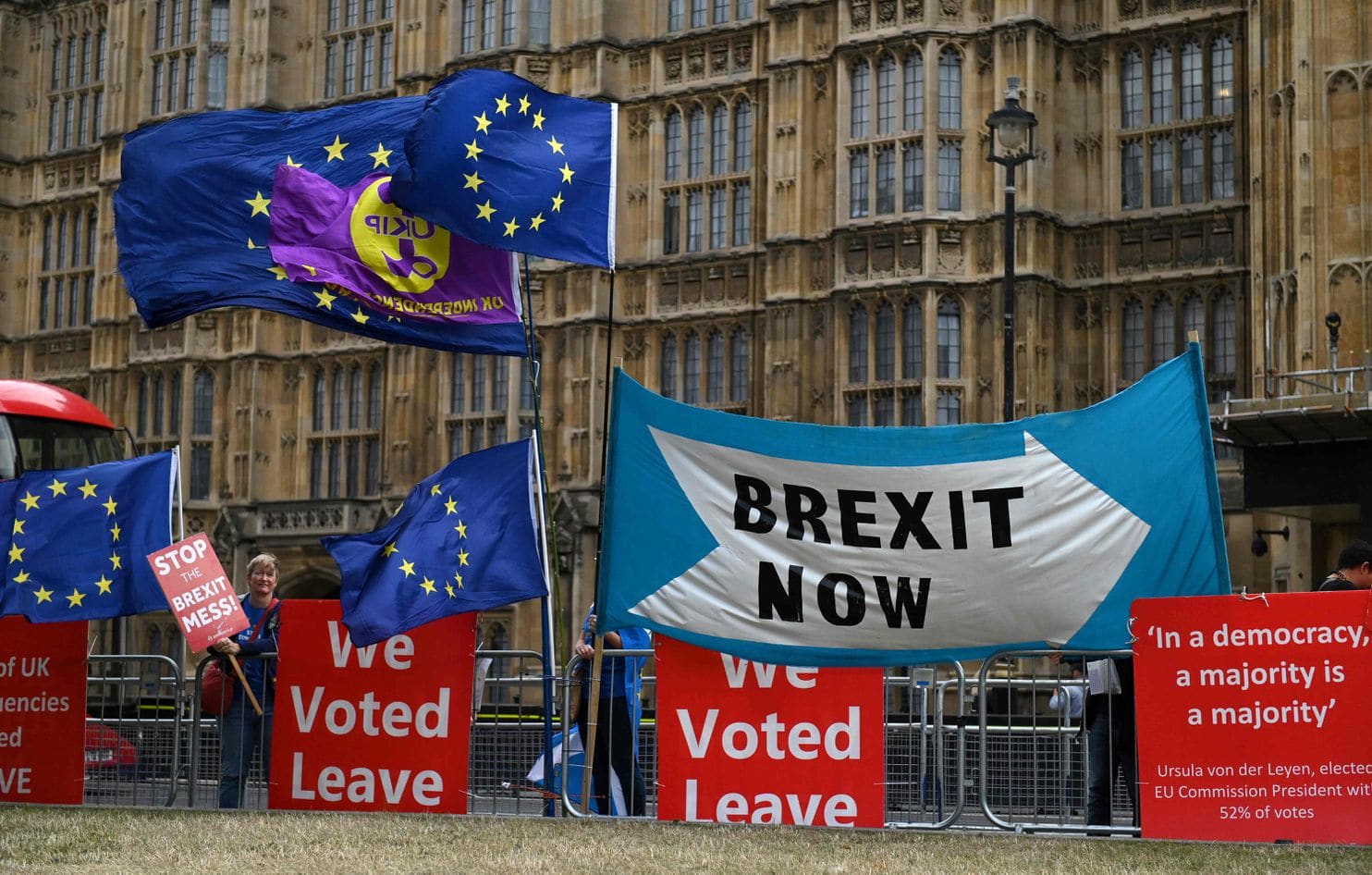
The E.U. flags of anti-Brexit activists fly as pro-Brexit activists stand with their placards and demonstrate near the Houses of Parliament in central London on Sept. 3, 2019. (Daniel Leal-Olivas/AFP/Getty Images)
Several legal challenges have been filed against Johnson’s move to suspend Parliament. A court in Scotland was scheduled to hear arguments Tuesday from lawyers representing 75 opposition lawmakers who want to prevent the suspension.
In a sign of the economic uncertainty caused by the political turmoil, the British pound dropped to its lowest level against the dollar in 35 years, apart from a brief plunge in 2016 likely for technical reasons.
Johnson’s threat of a snap election is aimed as much at his own party as at the opposition led by Labour Party leader Jeremy Corbyn. On Monday, Johnson said he would kick Conservative members of Parliament out of the party if they voted against his Brexit plans — meaning they would be unable to run as Conservatives in any upcoming election.
Unlike his predecessor Theresa May, who did everything she could to keep her party together, Johnson is pursuing tactics apparently aimed at uniting the Brexit vote and steering Britain out of the bloc, even if that means trimming his party by shedding dissenters.
That has already caused some remarkable splits in the party. On Tuesday, Philip Hammond, who was Britain’s finance minister only a few weeks ago, told the BBC that he would back legislation to delay Brexit and that there were “enough” Conservative rebels for it to pass.
He also questioned whether Johnson and his allies could kick him out of the party, saying they would have the “fight of a lifetime” if they tried.
A group of 14 rebel Conservative members of Parliament met with Johnson at 10 Downing Street Tuesday morning. Media reports suggested neither side changed its position.
David Gauke, a senior rebel, wrote in the Times that he would support the legislation to delay Brexit by three months, despite the threat to be kicked out of his party. “It is a simple and, in some respects, modest bill. But without it, the consequences for the country are likely to be calamitous. However painful, I must support it.”
Guto Harris, Johnson’s former communications director, told the BBC that Johnson risks “historical humiliation” in the Brexit maneuvering. “It looks as if he’s prepared to bet on himself being the shortest-serving prime minister in history,” Harris said.
A throng of noisy demonstrators gathered outside of Parliament, with those draped in E.U. blue chanting “Save our democracy! Stop the coup!”
Many wore yellow stickers that read “Bollocks to Brexit.” There were also pro-Brexit signs that read “Remain MPs are the only obstacle to a good deal” and “Traitor Parliament.”
“Brexit is a bad idea,” said Roger Horne, a retired accountant from London. Outside of the bloc, “Britain would have to go on bended knee to either President Trump or the remaining E.U. I think we have greater power, greater influence in the E.U.”
Referring to Johnson’s threat expel Tories who don’t back him, he said “maybe Johnson is trying to turn it [the party] into some kind of religious sect.”
Val Batesman, 77, a librarian, holding a large red “Vote Leave” placard, said that “Parliament has been fiddling about for three years and not implementing this even though they promised to do so.”
When a group of pro-E.U. protesters marched by chanting “This is what democracy looks like!” Batesman said muttered under her breath, “you didn’t get a majority, mate.”
A general election, which Johnson allies say could happen on Oct. 14, could either sink Johnson’s government or give him a popular mandate to push his promised “do or die” Oct. 31 Brexit. It could also propel Corbyn, a nationally unpopular leftist and vocal critic of President Trump, into the prime minister’s job, creating more uncertainty about Brexit and relations with Washington.
Taken together, all the threats and maneuvers have created an extremely volatile and emotional political drama in Westminster, London’s political center, as Parliament convenes on Tuesday.
Corbyn has said his priority for the day is to introduce emergency legislation to block Britain from leaving the E.U. without an agreement in place to regulate trade, border security and other critical issues — the so-called no-deal Brexit.
Source: US Government Class